
Quick Answer
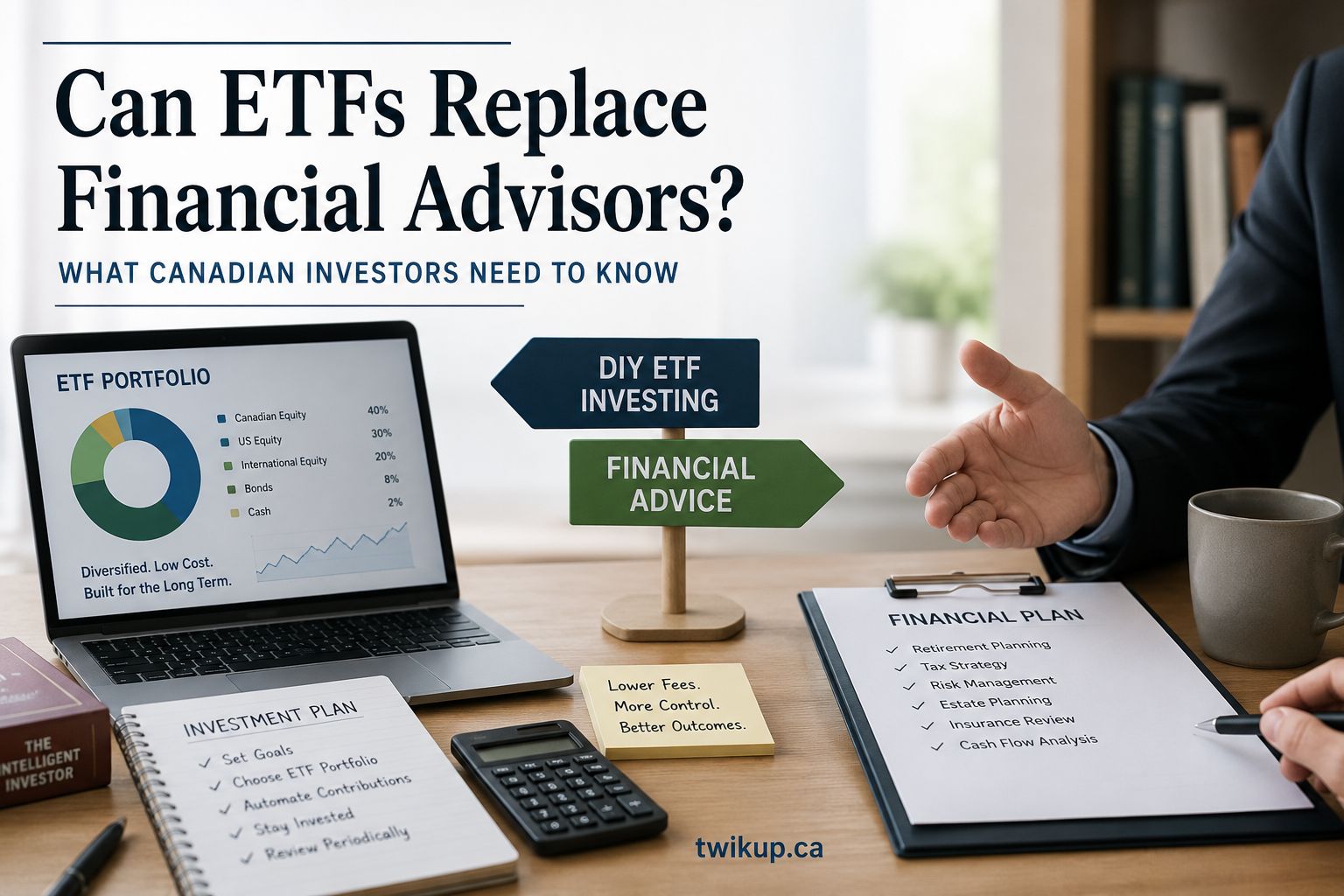
ETFs can replace much of the investment-management work traditionally performed by a financial advisor—but they cannot automatically replace comprehensive financial advice.
A Canadian investor with straightforward finances, a long-term horizon and enough discipline may be able to build a diversified portfolio using one or a few low-cost ETFs without paying an ongoing advisory fee.
However, ETFs do not create a retirement plan, calculate how much insurance you need, coordinate your TFSA and RRSP strategy, plan withdrawals, minimize estate complications or stop you from panic-selling during a market crash.
For many Canadians, the most cost-effective solution may be a hybrid approach:
- Use diversified ETFs for portfolio management.
- Handle routine contributions independently.
- Pay a qualified financial planner for specific planning needs.
- Seek tax, legal or estate specialists when the situation requires specialized advice.
The real question is not whether ETFs can replace advisors entirely. It is whether you are currently paying an advisor for services that a simple ETF portfolio could perform at a much lower cost.
Important: This article is educational and does not provide personalized investment, tax, legal or financial advice. Investment products involve risk, and past performance does not guarantee future results.
TwikUp Insight
ETFs have made investing cheaper and more accessible, but they have not eliminated the need for good financial decisions.
A diversified ETF can automate asset allocation. It cannot automate judgment.
The investor who understands account selection, risk capacity, tax consequences, contribution limits and withdrawal planning may need very little ongoing portfolio management. The investor who repeatedly changes strategies, chases performance or sells during downturns may benefit significantly from professional guidance—even when the underlying portfolio consists entirely of ETFs.
In other words:
ETFs can replace expensive product selection. They cannot always replace planning, discipline and accountability.
Before paying an ongoing percentage of your investments for advice, determine exactly what services you are receiving and whether those services remain valuable as your portfolio grows.
Why More Canadians Are Asking Whether They Still Need an Advisor
Traditional investing often required Canadians to visit a bank branch, brokerage or financial advisory firm. An advisor might recommend mutual funds, create an asset allocation and arrange recurring contributions.
ETFs have changed that model.
Today, an investor can open a self-directed account, purchase a broadly diversified ETF and hold exposure to hundreds or thousands of companies through a single investment.
Some all-in-one ETFs may include:
- Canadian stocks
- U.S. stocks
- International developed-market stocks
- Emerging-market stocks
- Government bonds
- Corporate bonds
- Automatic portfolio rebalancing
This creates an important question: if one ETF can perform much of the portfolio construction and rebalancing, what is the investor paying an advisor to do?
The answer depends on whether the advisor is providing only investment products or delivering broader financial planning.
What an ETF Can Do for You
An ETF is an investment fund whose units generally trade on a stock exchange. Different ETFs may track market indexes, sectors, commodities, bonds, investment strategies or combinations of multiple asset classes.
A properly selected ETF can perform several jobs that were once handled manually.
1. Diversify Your Portfolio
Instead of selecting individual companies, an investor can use an ETF to spread money across many securities.
Diversification does not prevent losses, but it can reduce the damage caused by depending too heavily on one company, sector or market.
A globally diversified portfolio may be especially useful for Canadians because the Canadian stock market represents only part of the global investment opportunity set and is relatively concentrated in certain industries.
However, owning several ETFs does not automatically mean that a portfolio is properly diversified. Multiple funds may hold many of the same companies.
For example, an investor holding a broad U.S. index ETF, a technology ETF and an artificial-intelligence ETF may have substantial overlapping exposure to the same large technology companies.
Investors concerned about this risk can review whether they are overinvested in artificial intelligence and the Magnificent Seven.
2. Maintain an Asset Allocation
Asset allocation refers to how a portfolio is divided among investments such as equities, bonds and cash.
An all-equity ETF may be suitable for an investor with:
- A long time horizon
- High tolerance for market volatility
- Stable finances
- No need to withdraw the money soon
- The emotional ability to remain invested during major declines
A balanced ETF containing stocks and bonds may be more appropriate for someone seeking lower volatility.
Some asset-allocation ETFs automatically rebalance their holdings. This means the fund periodically adjusts its investments to maintain its intended mix.
That removes one of the recurring responsibilities traditionally handled by an advisor.
3. Reduce Investment Costs
ETFs often have lower management costs than many traditional actively managed investment products. However, they are not free.
Depending on the product and brokerage, an ETF investor may face:
- Management fees
- Fund operating expenses
- Trading commissions
- Currency-conversion costs
- Bid-ask spreads
- Foreign withholding taxes
- Account administration charges
Canadian securities regulators require an ETF Facts document containing important information about a fund, including its risks and costs. Investors should review this document before buying an ETF.
Lower costs can make a meaningful difference over several decades because every dollar paid in fees is a dollar that is no longer invested and compounding.
4. Automate Long-Term Investing
Many brokerages now support recurring deposits or recurring ETF purchases.
An investor can establish a simple process:
- Receive income.
- Transfer a fixed amount to an investment account.
- Purchase the chosen ETF.
- Reinvest distributions when appropriate.
- Repeat for decades.
This process is similar to dollar-cost averaging, where investments are purchased at regular intervals rather than trying to predict the ideal market entry point.
The potential long-term effect is explored in how quickly a Canadian could build $1 million using ETFs.
5. Remove the Need to Select Individual Stocks
Many investors do not have the time, expertise or desire to analyze individual businesses.
A broad-market ETF eliminates the need to predict:
- Which company will become the next market leader
- Which stock is currently undervalued
- Which sector will outperform
- When to sell a particular company
- Which earnings report will disappoint investors
This does not eliminate market risk. It changes the investor’s task from selecting winning companies to maintaining an appropriate, diversified portfolio.
What ETFs Cannot Do
An ETF is an investment product. It is not a financial plan.
That distinction becomes increasingly important as an investor’s life and finances become more complicated.
1. ETFs Cannot Determine Your Financial Goals
An ETF does not know whether you are investing for:
- Retirement
- A home purchase
- A child’s education
- Early retirement
- Long-term wealth
- Income generation
- A business purchase
- A major expense five years from now
Different goals may require different accounts, timelines, contribution amounts and levels of risk.
A portfolio that may be reasonable for retirement 30 years away could be inappropriate for a down payment needed in two years.
2. ETFs Cannot Measure Your True Risk Capacity
Risk tolerance describes how comfortable you feel with market fluctuations.
Risk capacity describes how much investment loss your financial situation can actually withstand.
These are not always the same.
An investor might feel comfortable owning an all-equity portfolio during a rising market. But that same portfolio may become unsuitable if the investor:
- Has unstable employment
- Carries high-interest debt
- Lacks an emergency fund
- Needs the money soon
- Is approaching retirement
- Depends on portfolio withdrawals
- Has significant family obligations
Choosing an ETF based only on age or recent returns may overlook these factors.
3. ETFs Cannot Choose Between a TFSA, RRSP, FHSA or Non-Registered Account
The investment and the account holding it are separate decisions.
Canadian investors may use accounts such as:
- Tax-Free Savings Account
- Registered Retirement Savings Plan
- First Home Savings Account
- Registered Education Savings Plan
- Registered Retirement Income Fund
- Non-registered investment account
Each has different contribution rules, withdrawal consequences and tax characteristics.
An ETF cannot determine which account should receive your next dollar.
It also cannot prevent you from recontributing a TFSA withdrawal too early or exceeding your available contribution room. This is one reason investors should understand the biggest TFSA investing mistake Canadians make.
4. ETFs Cannot Build a Retirement Withdrawal Strategy
Accumulating investments is only one part of retirement planning.
Retirees may need to decide:
- When to begin CPP benefits
- When to begin Old Age Security
- How quickly to withdraw from RRSPs or RRIFs
- Whether to spend from a TFSA or taxable account first
- How to manage taxable income
- How much cash to hold
- How to reduce the risk of selling investments during a downturn
- How to provide income for a surviving spouse
- How to account for inflation and longevity
A portfolio may be simple while the withdrawal strategy remains complex.
5. ETFs Cannot Provide Tax, Insurance or Estate Planning
An advisor or planner may help coordinate financial decisions involving:
- Life insurance
- Disability insurance
- Critical illness coverage
- Beneficiary designations
- Wills and powers of attorney
- Business succession
- Capital gains
- Charitable giving
- Estate taxes and probate considerations
- Family trusts
- Cross-border assets
- Incorporated business income
Not every investment advisor is qualified to provide every one of these services. Complex situations may also require a tax professional, accountant or lawyer.
6. ETFs Cannot Control Investor Behaviour
This may be the most important limitation.
An ETF portfolio works only when the investor follows the strategy.
Investors can damage their returns by:
- Selling after markets fall
- Waiting indefinitely for the “perfect” entry point
- Buying sectors after they become popular
- Switching funds based on recent performance
- Keeping too much money in cash
- Trading too frequently
- Abandoning a long-term plan during temporary volatility
- Taking more risk than they can emotionally tolerate
A diversified portfolio can perform well while the person holding it earns a much lower return because of poor timing decisions.
This behaviour gap is examined in why many ETF investors underperform their own ETFs.
A good advisor may add value by preventing destructive decisions. A poor advisor may instead encourage unnecessary products, transactions or fees. The quality and scope of advice matter.
ETF Investing vs Financial Advisor: What Is the Difference?
| Area | Self-Directed ETF Investor | Financial Advisor or Planner |
|---|---|---|
| Portfolio selection | Investor selects ETFs | Advisor may recommend or manage investments |
| Diversification | Available through broad ETFs | Advisor may design a diversified portfolio |
| Rebalancing | Automatic with some all-in-one ETFs or completed manually | Often handled by advisor or firm |
| Contributions | Investor manages deposits | Advisor may establish and review a contribution plan |
| Financial planning | Investor must create it | May be included, depending on the advisor |
| Tax planning | Investor researches independently | May provide general guidance or coordinate with tax specialists |
| Retirement withdrawals | Investor designs strategy | May model and manage withdrawals |
| Behavioural coaching | Limited | A good advisor may provide accountability |
| Cost | ETF costs, trading and platform charges | Product costs plus possible advisory fees |
| Control | High | Depends on the relationship and account type |
| Time commitment | Higher | Potentially lower |
| Personalization | Created by investor | May be personalized to the client |
The key word is may.
Hiring an advisor does not guarantee that you will receive comprehensive planning. Some relationships focus primarily on selling or managing investments.
Before hiring or retaining an advisor, ask for a written explanation of the services included.
How Much Could Advisor Fees Cost?
Advisor compensation can take several forms, including:
- Hourly planning fees
- Flat project fees
- Annual retainers
- Trading commissions
- Embedded product compensation
- A percentage of assets under management
Suppose an advisor charges 1% annually on managed assets.
That equals approximately:
| Portfolio Value | 1% Annual Fee |
|---|---|
| $100,000 | $1,000 |
| $250,000 | $2,500 |
| $500,000 | $5,000 |
| $1,000,000 | $10,000 |
| $2,000,000 | $20,000 |
These amounts exclude any additional costs charged inside the investment products.
A percentage-based fee may appear reasonable when the portfolio is small. But the dollar cost rises automatically as the account grows, even when the services provided remain largely unchanged.
This does not automatically make the fee unreasonable. Comprehensive tax, retirement, estate and behavioural planning may be highly valuable.
The right question is:
Would I willingly pay this annual dollar amount for the planning and support I am receiving?
An investor with $1 million paying approximately $10,000 annually should understand whether the relationship includes more than selecting funds and scheduling an annual review.
A Simple Illustration of Long-Term Fee Impact
Assume two investors each begin with $100,000 and add $1,000 monthly for 30 years.
For illustration only, suppose:
- The investments earn 7% annually before fees.
- Investor A pays total portfolio costs of 0.25%.
- Investor B pays total portfolio and advisory costs of 1.25%.
- Returns occur smoothly, which does not happen in real markets.
- Taxes and trading costs are ignored.
The difference is one percentage point per year.
Under these simplified assumptions:
- Investor A earns approximately 6.75% after costs.
- Investor B earns approximately 5.75% after costs.
After 30 years, the difference could amount to hundreds of thousands of dollars.
This is not a forecast. Actual markets fluctuate, fees differ, taxes matter and advisor guidance may improve behaviour or financial decisions.
The illustration simply demonstrates why recurring percentage fees deserve close attention. Small annual differences can become substantial over long periods.
For another long-term scenario, see what could happen after investing $100,000 in XEQT over 10, 20 and 30 years.
When ETFs May Be Able to Replace an Advisor
Self-directed ETF investing may be reasonable when most of the following apply:
Your Financial Situation Is Straightforward
You are an employee with predictable income, manageable debt and uncomplicated tax filings.
You do not have a corporation, trust, major cross-border assets or complex estate-planning requirements.
You Have Clear Long-Term Goals
You know what you are investing for, when the money may be needed and how much you need to contribute.
You Understand Account Rules
You understand the basic differences among TFSAs, RRSPs, FHSAs and taxable accounts and monitor your available contribution room.
You Can Select an Appropriate Asset Allocation
You understand the difference between an all-equity portfolio and one containing bonds.
You are choosing risk based on your goals and capacity—not simply because equities recently performed well.
You Can Stay Invested During Market Declines
You recognize that major declines are a normal possibility when investing in equities.
You are unlikely to sell simply because headlines become negative or your portfolio falls temporarily.
You Are Willing to Learn
You can review ETF Facts documents, understand costs and keep basic financial records.
You Do Not Constantly Change Strategies
A simple plan requires consistency.
Someone who cannot resist chasing themes, dividends or recent winners may not benefit from having unlimited control.
When a Financial Advisor or Planner May Still Be Worth the Cost
Professional advice may be valuable when your decisions involve more than selecting investments.
You Are Approaching Retirement
The final years before retirement can involve important decisions about risk, income, government benefits, taxes and withdrawal sequencing.
Mistakes made during this period may be difficult to reverse.
You Own a Business
Business owners may need to coordinate corporate assets, personal investments, salary, dividends, insurance, succession planning and eventual sale proceeds.
You Recently Received a Large Amount of Money
An inheritance, business sale, severance package, insurance payment or property sale can create tax and investment decisions that should not be rushed.
Your Family Situation Is Complex
Blended families, dependants with disabilities, multiple properties or family members in different countries may require specialized planning.
You Have Significant Taxable Investments
Tax-loss selling, capital gains, adjusted cost base tracking and asset location may become more important as non-registered assets grow.
You Need Accountability
Some investors understand exactly what they should do but struggle to follow through.
A professional who keeps the investor contributing and prevents panic-selling may provide real value.
You Do Not Want to Manage Your Finances
DIY investing requires time, interest and responsibility.
Paying for delegation can be reasonable when the cost is transparent and the service is valuable.
The Hybrid Model: ETFs Plus Advice When Needed
Investors do not have to choose between managing everything alone and paying an ongoing percentage of their entire portfolio.
A hybrid model may involve:
- Holding a simple diversified ETF portfolio independently.
- Automating regular contributions.
- Paying a planner a flat or hourly fee for a financial plan.
- Updating the plan after major life changes.
- Hiring an accountant for tax-specific questions.
- Hiring a lawyer for wills, powers of attorney or estate structures.
- Using an advice-based or managed platform when additional support is needed.
This model separates investment management from financial planning.
The investor pays for advice when advice is needed rather than automatically paying a percentage of the portfolio every year.
A hybrid approach may be particularly attractive for investors who understand ETFs but want professional help with retirement projections, taxes, insurance or estate planning.
What About Robo-Advisors?
A robo-advisor sits between fully self-directed investing and a traditional advisor.
Despite the name, robo-advisors are generally not simply trading robots. They commonly collect information about an investor’s goals, finances, time horizon and risk profile, then place the client in a managed portfolio—often built with ETFs.
Potential advantages include:
- Automatic portfolio management
- Rebalancing
- Recurring contributions
- Lower minimum balances
- Lower costs than some traditional advisory arrangements
- Some access to human support
Potential limitations include:
- Less customization
- Limited tax or estate planning
- Standardized portfolios
- Additional fees compared with buying ETFs directly
- Different service levels among providers
A robo-advisor may suit someone who wants ETF-based investing without personally managing every trade or rebalance.
Does a Dividend ETF Replace Retirement Advice?
Dividend ETFs are sometimes marketed or perceived as a complete retirement-income solution.
However, a high distribution yield does not automatically mean:
- The portfolio is safer
- The return will be higher
- The income will keep pace with inflation
- The distribution is guaranteed
- The fund is sufficiently diversified
- The investment is tax-efficient in every account
- The investor can safely spend the entire distribution
Focusing only on income may lead investors to overlook total return, concentration, taxes and capital sustainability.
Before choosing an income-focused strategy, compare dividend ETFs with growth ETFs and the risks of chasing high yields.
Younger investors may also benefit from examining whether dividend investing before age 30 is a smart strategy or an unnecessary limitation.
An ETF can distribute income. It cannot determine how much of that income you can sustainably spend.
Can One ETF Really Be Enough?
In some cases, one broadly diversified asset-allocation ETF may provide a complete investment portfolio.
But “one ETF” does not necessarily mean “one complete financial strategy.”
Before relying on a single fund, examine:
- Its investment objective
- Equity and bond allocation
- Geographic exposure
- Currency exposure
- Management costs
- Distribution policy
- Risk rating
- Rebalancing methodology
- Underlying holdings
- Tax considerations
- Whether its risk level matches your timeline
A one-fund portfolio can be simple and diversified. It can still be inappropriate for someone who selected the wrong risk level or is holding money that will be needed soon.
ETFs, Real Estate and the Role of Advice
Some investors are not deciding between an ETF and an advisor. They are deciding among ETFs, rental properties, mortgage repayment, business investment and other uses of capital.
Those choices cannot be answered by comparing historical returns alone.
The decision may depend on:
- Interest rates
- Debt levels
- Available cash flow
- Tax implications
- Liquidity needs
- Concentration risk
- Real-estate experience
- Time commitment
- Personal goals
A diversified ETF may be easier to manage than a rental property, but it does not offer leverage, control or the same cash-flow structure.
The trade-offs are explored in $1,000 per month into VEQT versus buying a rental property.
A capable financial planner should evaluate how these decisions interact rather than looking at each investment in isolation.
Questions to Ask Before Leaving Your Financial Advisor
Do not leave an advisory relationship simply because ETFs have lower fees.
First, understand what you currently receive and what responsibilities you would be taking over.
Ask:
- What is my total annual cost in dollars and as a percentage?
- Which costs go to the advisor, firm and investment funds?
- What planning services are included?
- How was my current asset allocation selected?
- What benchmark should I use to evaluate the portfolio?
- How often is my financial plan updated?
- Do I receive retirement-income projections?
- Does the advisor coordinate tax, insurance or estate planning?
- What happens during a major market decline?
- Are there transfer, redemption or deferred charges?
- Is the advisor appropriately registered?
- Would a flat-fee arrangement be available?
- Can the advisor use lower-cost ETFs?
- What services would I lose by moving to a self-directed account?
Request clear answers in writing where possible.
Questions to Ask Before Becoming a DIY ETF Investor
Before managing your investments independently, ask yourself:
- What is the purpose of this money?
- When will I need it?
- Do I have an emergency fund?
- Have I repaid high-interest debt?
- Which account should I use?
- How much can I contribute regularly?
- What level of loss could I tolerate financially?
- What level of decline could I tolerate emotionally?
- Which ETF matches that level of risk?
- How will I rebalance?
- What will I do during a market crash?
- How will my strategy change before retirement?
- Who will manage the portfolio if I become unable to do so?
- When will I seek professional advice?
If several of these questions cannot be answered, the investor may need planning assistance before moving entirely to self-directed investing.
A Practical Decision Framework
Consider DIY ETFs When:
- Your situation is uncomplicated.
- Your goals are clearly defined.
- You understand investment-account rules.
- You can select an appropriate asset allocation.
- You can remain disciplined through market declines.
- You value lower costs and greater control.
- You are willing to manage the process.
Consider a Robo-Advisor When:
- You want an ETF-based portfolio.
- You prefer automatic management.
- You do not want to rebalance manually.
- You want some support without a traditional full-service relationship.
- You accept an additional management fee for convenience.
Consider a Financial Planner or Advisor When:
- Your finances are complex.
- You are approaching or entering retirement.
- Tax and estate decisions are becoming important.
- You own a business.
- You recently received a large windfall.
- You need behavioural coaching.
- You do not have the time or interest to manage investments.
- The professional delivers services worth the cost.
Consider a Hybrid Approach When:
- You are comfortable managing ETFs.
- You still need periodic financial planning.
- You prefer hourly or project-based advice.
- You want to reduce recurring portfolio fees.
- You recognize when specialist advice is required.
Frequently Asked Questions
Can I invest without a financial advisor in Canada?
Yes. Canadians can use a self-directed brokerage to buy ETFs and other eligible investments without hiring an advisor.
However, self-directed investors are responsible for selecting suitable investments, monitoring contribution limits, understanding costs and managing their own behaviour.
Are ETFs safer than using a financial advisor?
These are not directly comparable.
An ETF is an investment product, while a financial advisor is a person or service provider.
The risk of an ETF depends on what it owns. An all-equity ETF can experience substantial declines even when it is diversified. An advisor cannot eliminate market risk, although a good advisor may help select an appropriate portfolio and prevent emotional decisions.
Do financial advisors use ETFs?
Yes. Advisors may use ETFs as part of client portfolios.
Hiring an advisor does not require investing in high-cost mutual funds. Investors should ask what products the advisor uses, why they were selected and what the total costs are.
Are all-in-one ETFs good for beginners?
They may provide a convenient, diversified portfolio with automatic rebalancing. However, investors must still select an asset allocation that matches their goals, timeline and ability to accept losses.
A simple product is not automatically a suitable product.
Is paying 1% for a financial advisor worth it?
It depends on the services received.
Paying 1% only for basic fund selection may become difficult to justify as a portfolio grows. Paying for comprehensive retirement, tax, estate, insurance and behavioural planning may provide greater value.
Evaluate the fee in annual dollars—not only as a percentage.
Can I use an ETF for my entire retirement?
A diversified ETF may serve as the investment component of a retirement portfolio.
It does not create a complete retirement-income plan. Retirees must still address withdrawal rates, taxes, government benefits, cash reserves, inflation, longevity and estate needs.
Should I fire my advisor and buy ETFs?
That decision should not be made solely because ETFs are less expensive.
Compare your current costs, services, financial complexity, investment knowledge and ability to remain disciplined. Review possible transfer fees, tax consequences and account restrictions before moving investments.
What is the biggest risk of DIY ETF investing?
The biggest risk may not be the ETF itself. It may be investor behaviour.
A suitable long-term portfolio can still produce poor personal results when the investor panic-sells, performance-chases or repeatedly changes strategies.
Final Verdict: Can ETFs Replace Financial Advisors?
ETFs can replace many of the investment products and portfolio-management tasks that investors once paid advisors to provide.
A disciplined Canadian with straightforward finances may be able to build and maintain a diversified, low-cost portfolio without paying an ongoing advisory percentage.
But ETFs cannot independently:
- Define your financial goals
- Determine your appropriate savings rate
- Choose the best account for every contribution
- Create a retirement withdrawal plan
- Coordinate taxes, insurance and estate planning
- Evaluate complex family or business finances
- Prevent emotional investing decisions
For many investors, the strongest solution is not “ETF or advisor.”
It is:
Use low-cost ETFs for investing and purchase high-quality professional advice only where it adds measurable value.
The best financial structure is one you understand, can afford and are capable of following through both strong and weak markets.
Sources
Government and Canadian regulatory investor-education resources:
-
Financial Consumer Agency of Canada — Choosing a financial advisor
-
Financial and Consumer Services Commission of New Brunswick — Investment funds and ETFs
-
Financial and Consumer Services Commission of New Brunswick — Self-directed investing
-
Financial and Consumer Services Commission of New Brunswick — Robo-advisors
-
Financial and Consumer Services Commission of New Brunswick — Working with an advisor
-
Canadian Investment Regulatory Organization — DIY vs advised investing
-
Canadian Investment Regulatory Organization — Selecting an advisor
-
Canadian Investment Regulatory Organization — Investment fees and costs
-
Canadian Investment Regulatory Organization — Dollar-cost averaging
-
Canada Revenue Agency — Qualified investments for registered accounts
Financial Disclaimer
This article is provided for general educational and informational purposes only. It does not constitute investment, financial, tax, accounting, insurance or legal advice, and it does not recommend any specific security, ETF, advisor, brokerage, strategy or account.
Investment values can rise or fall, and investors may lose some or all of their invested capital. Fees, taxes, account rules and investment suitability vary by investor and may change over time. Consider consulting an appropriately qualified and registered professional before making significant financial decisions.