
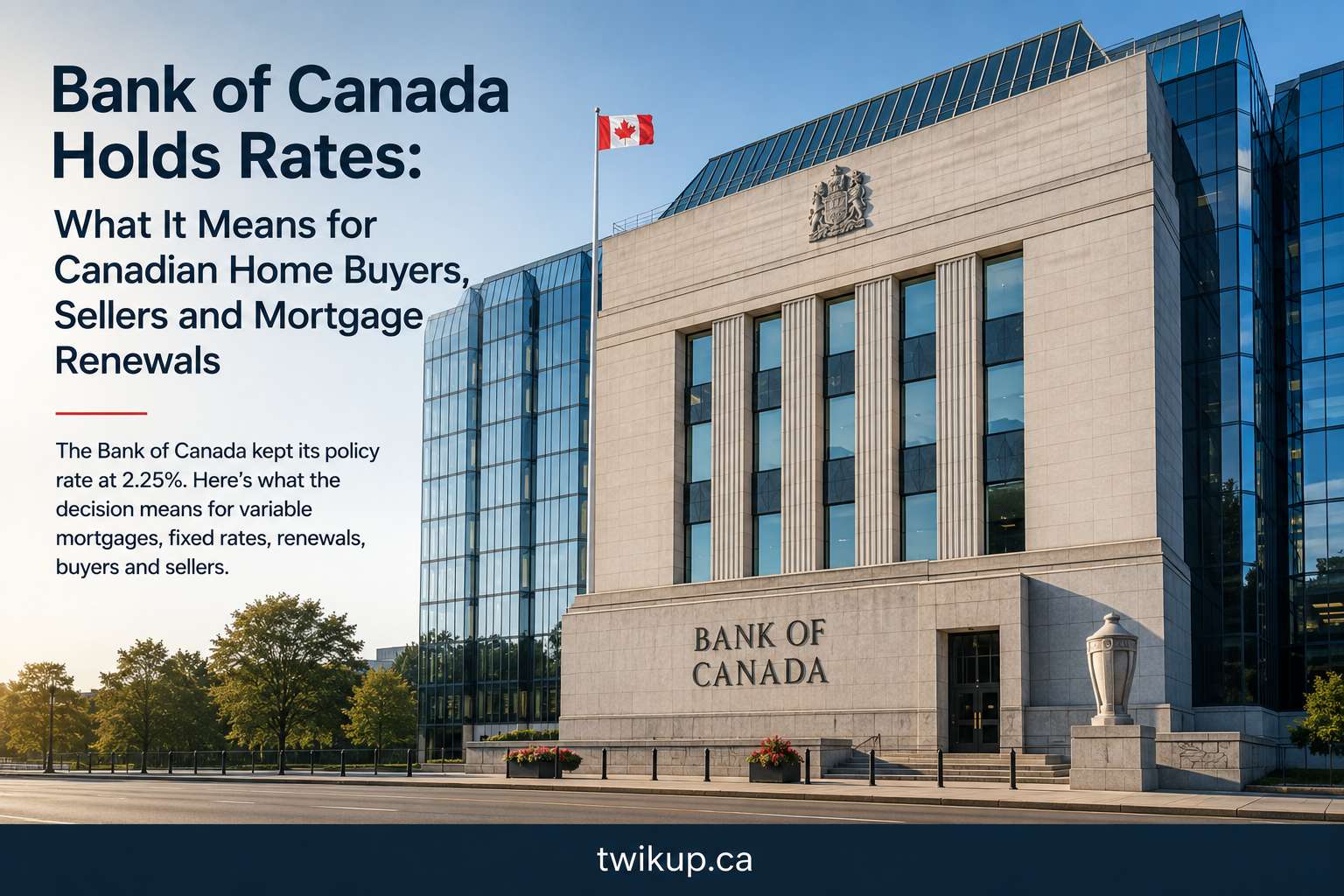
The Bank of Canada has kept its policy interest rate unchanged at 2.25%, extending the period of rate stability for Canadian borrowers.
The July 15, 2026 decision means Canadians with variable-rate mortgages are unlikely to see an immediate change in their borrowing costs. However, fixed mortgage rates may still move because they are influenced more directly by Government of Canada bond yields, lender funding costs and financial-market expectations.
For home buyers, sellers and homeowners approaching renewal, the rate hold offers greater short-term certainty—but it does not guarantee cheaper mortgages or an immediate housing-market rebound.
Quick Answer
The Bank of Canada held its overnight policy rate at 2.25% on July 15, 2026. The Bank Rate remains at 2.50%, while the deposit rate remains at 2.20%.
Here is what the decision means:
- Variable-rate mortgage borrowers: Payments or interest costs should generally remain unchanged for now.
- Fixed-rate mortgage borrowers: Rates could still rise or fall because fixed mortgages are not determined solely by the Bank of Canada rate.
- Home buyers: Affordability has not suddenly improved, but borrowing costs have become more predictable.
- Home sellers: Stable rates may support buyer confidence, although affordability and local housing supply remain major constraints.
- Mortgage renewals: Many Canadians may still renew at a higher rate than the one they secured during the pandemic-era low-rate period.
- Future rate cuts: Additional relief is possible, but the Bank has not committed to a specific path.
The next scheduled Bank of Canada interest-rate announcement is September 2, 2026.
TwikUp Insight: A rate hold is neither clearly good nor bad for Canadian real estate. It reduces the risk of an immediate payment increase for variable-rate borrowers, but it also signals that the Bank is not yet ready to provide additional borrowing-cost relief. For most households, the decisive numbers remain the mortgage rate offered by their lender, the purchase price and the size of their down payment—not simply the overnight rate.
Why Did the Bank of Canada Hold Rates?
The Bank of Canada said economic growth appears to have resumed after stalling, although Canada continues to face uncertainty from global trade conditions, oil prices and geopolitical developments.
The Bank’s July outlook suggested that:
- Canada’s economy has been weak but is showing signs of improvement.
- Economic growth is expected to strengthen.
- Inflation is projected to move toward approximately 2%.
- Trade policy and global geopolitical developments remain important risks.
- Higher oil prices could create renewed inflation pressure.
- Consumer spending has shown some resilience despite economic uncertainty.
This leaves the Bank in a difficult position.
Cutting rates too quickly could increase inflation pressure, weaken the Canadian dollar or encourage excessive borrowing. Keeping rates high for too long could further restrict consumer spending, business investment and housing activity.
Holding the rate at 2.25% allows the Bank to assess incoming inflation, employment and economic-growth data before deciding whether further cuts are appropriate.
What the Rate Hold Means for Variable-Rate Mortgages
Variable mortgage rates are usually connected to a lender’s prime rate, which generally responds to changes in the Bank of Canada’s overnight rate.
Because the policy rate was left unchanged, lenders are unlikely to make an immediate Bank of Canada-driven change to their prime rates.
The effect depends on the structure of the mortgage.
Adjustable-rate mortgage
With an adjustable-rate mortgage, the required payment typically changes when the lender’s prime rate changes.
Since the Bank held its rate:
- The required payment will generally remain unchanged.
- The portion going toward principal and interest should remain similar.
- Borrowers will not receive an immediate payment reduction from this announcement.
Variable-rate mortgage with fixed payments
Some variable mortgages maintain the same payment even when interest rates change. Instead, the amount allocated toward interest and principal changes.
With no rate change:
- The scheduled payment will normally stay the same.
- The amortization should not be affected by a new rate adjustment.
- Borrowers already dealing with extended amortizations may still need to review their position before renewal.
A rate hold prevents an immediate new shock, but it does not reverse the financial effects of previous rate increases.
What the Decision Means for Fixed Mortgage Rates
One of the most common misconceptions in Canadian real estate is that fixed mortgage rates automatically decline when the Bank of Canada cuts rates—or remain unchanged when it holds.
That is not necessarily true.
Fixed mortgage rates, particularly five-year terms, are influenced by factors including:
- Government of Canada bond yields
- Inflation expectations
- Expectations for future Bank of Canada decisions
- Global financial-market conditions
- Competition among banks and mortgage lenders
- The lender’s funding and risk-management costs
This means five-year fixed mortgage offers could move even while the policy rate remains at 2.25%.
For example, bond yields may rise if investors become concerned about inflation, government borrowing or global energy prices. That could put upward pressure on fixed rates without any Bank of Canada increase.
Alternatively, fixed rates could decline if markets expect weaker economic growth or future policy-rate cuts.
The rate hold creates stability for short-term borrowing costs, but it does not freeze the entire mortgage market.
What It Means for Canadians Renewing a Mortgage
Mortgage renewals remain one of the most important financial issues facing Canadian homeowners in 2026.
The Bank of Canada previously estimated that approximately 60% of mortgage holders renewing in 2025 and 2026 could experience a payment increase compared with their December 2024 payments. Most borrowers expected to face increases held five-year fixed-rate mortgages.
The Bank estimated that, on average, monthly payments for those renewing in 2026 could be approximately 6% higher than their December 2024 payments.[3]
However, the effect will vary substantially by borrower.
Someone renewing from a mortgage rate near 2% could still face a meaningful payment increase, even though the Bank of Canada has reduced its policy rate from previous highs.
Illustrative mortgage-renewal example
Consider a homeowner with:
- A remaining mortgage balance of $500,000
- A remaining amortization of 20 years
- An expiring mortgage rate of 2.25%
- A new mortgage rate of 4.25%
The approximate monthly payment could move from around $2,585 to $3,090.
That represents an increase of roughly:
- $505 per month
- $6,060 per year
These calculations are illustrative. Actual payments depend on the mortgage balance, amortization, payment frequency, compounding method and lender terms.
What to do before renewal
The Financial Consumer Agency of Canada recommends beginning the mortgage-shopping process several months before the term expires rather than automatically accepting the existing lender’s first offer.[4]
Homeowners approaching renewal should:
- Confirm the remaining mortgage balance and amortization.
- Request offers for multiple terms—not only a five-year fixed mortgage.
- Compare fixed and variable options.
- Ask the existing lender for a better rate.
- Obtain quotes from other lenders or a licensed mortgage broker.
- Review prepayment privileges and penalties.
- Stress-test the household budget at a higher payment.
- Check whether extending the amortization would reduce payments but increase total interest.
- Avoid adding unsecured debts to the mortgage without understanding the long-term cost.
Federally regulated lenders must generally provide a renewal statement at least 21 days before the end of the mortgage term. The statement must include information such as the remaining balance, interest rate, term, payment frequency and applicable charges.[4]
However, waiting until that letter arrives may leave too little time to negotiate properly.
Should Renewing Borrowers Choose Fixed or Variable?
There is no universally superior mortgage type.
The right choice depends on cash-flow tolerance, financial flexibility, future plans and comfort with uncertainty.
A fixed mortgage may be more suitable when:
- The household needs predictable payments.
- A payment increase would create financial stress.
- The borrower expects to remain in the property for the full term.
- The borrower is comfortable paying a possible certainty premium.
- The mortgage contract includes acceptable prepayment and penalty terms.
A variable mortgage may be more suitable when:
- The borrower can absorb payment or interest-cost fluctuations.
- The borrower expects future rate cuts.
- Flexibility and potentially lower penalties are important.
- The borrower has sufficient emergency savings.
- The household is not already operating near its maximum affordable payment.
Borrowers should not choose a variable rate merely because they believe the Bank “must” cut soon. Rate forecasts are uncertain, and geopolitical or inflation developments can change the outlook quickly.
What the Rate Hold Means for First-Time Home Buyers
For first-time home buyers, the decision provides stability but not a major affordability breakthrough.
A 2.25% policy rate does not mean a buyer can obtain a mortgage at 2.25%. Consumer mortgage rates include lender funding costs, credit risk, operational costs and profit margins.
Potential advantages for buyers
The hold may provide:
- More predictable variable mortgage pricing
- Less fear of an immediate rate increase
- Additional time to compare mortgage products
- Greater confidence when preparing a monthly budget
- A more stable environment for obtaining a preapproval
Remaining affordability challenges
Buyers still need to manage:
- High home prices in several Canadian markets
- Down-payment requirements
- Mortgage stress-test qualification
- Property taxes
- Home insurance
- Condo fees where applicable
- Maintenance and repair costs
- Closing costs
- Income and employment uncertainty
Stable interest rates do not make an unaffordable property affordable.
A buyer should determine affordability using the full monthly ownership cost—not only the advertised mortgage payment.
Should Canadians Buy a Home After the Rate Hold?
The decision should not be interpreted as a universal signal to buy.
A purchase may make sense when:
- The buyer expects to remain in the home for several years.
- Income is stable.
- Emergency savings will remain after closing.
- The buyer can afford payments at the contract rate and at a moderately higher rate.
- The property meets long-term household needs.
- The buyer is not depending on rapid price appreciation.
- The purchase price is reasonable compared with local alternatives.
Waiting may be more appropriate when:
- The down payment would consume nearly all available savings.
- Employment is uncertain.
- The buyer expects to move soon.
- Monthly ownership costs substantially exceed the household budget.
- The property requires expensive repairs.
- The buyer is purchasing mainly from fear of missing out.
For a detailed decision framework, read TwikUp’s analysis: Should You Buy a Home Now or Wait Until 2027? Canada Housing Market Outlook for Buyers.
Could the Rate Hold Increase Home Prices?
It could support buyer confidence, but it does not guarantee rising home prices.
Housing prices are influenced by more than interest rates. Other important factors include:
- Local housing supply
- Population and household formation
- Employment conditions
- Buyer income
- Investor activity
- New construction
- Rental-market conditions
- Property taxes and maintenance costs
- Consumer confidence
- Regional economic growth
A stable rate environment may encourage some buyers who were waiting for greater clarity. However, if mortgage qualification remains difficult or households remain concerned about employment and living costs, demand may stay restrained.
The effect will also vary by market.
A rate hold may affect Toronto, Vancouver, Calgary, Edmonton, Montreal, Ottawa, Halifax and smaller Canadian markets differently because each has distinct supply, employment and affordability conditions.
What the Rate Hold Means for Home Sellers
For sellers, stable rates may be mildly supportive because buyers can make decisions without facing an immediate new increase in variable borrowing costs.
However, the hold does not automatically create a seller’s market.
Sellers should consider:
- The number of comparable homes available
- Average days on market
- Recent neighbourhood sales
- Price reductions among competing listings
- Local employment conditions
- The type and price range of the property
- Whether buyers in that segment rely heavily on financing
Sellers may benefit when:
- Inventory is limited.
- The home is priced competitively.
- The property is move-in ready.
- The local market has strong employment and population growth.
- Comparable properties are receiving multiple offers.
Sellers may face difficulty when:
- Inventory is increasing.
- The listing price is based on previous market peaks.
- Buyers have many similar options.
- The property requires major repairs.
- The monthly carrying cost is high.
- The target buyer faces significant mortgage-qualification constraints.
The best pricing strategy should be based on recent local transactions, not national headlines about the Bank of Canada.
Does a Rate Hold Mean Mortgage Rates Have Bottomed?
No.
Mortgage rates could still move in either direction.
Rates may decline if:
- Inflation continues moving toward 2%.
- Economic growth weakens.
- Unemployment rises.
- Global trade uncertainty reduces demand.
- The Bank of Canada signals future policy easing.
- Government bond yields decline.
Rates may rise if:
- Oil or other commodity prices push inflation higher.
- Global conflict disrupts energy markets.
- Inflation expectations increase.
- Economic growth strengthens faster than expected.
- Government bond yields rise.
- Financial-market volatility increases lenders’ funding costs.
Borrowers should therefore avoid building a home-buying or renewal plan around a single rate forecast.
How Much Difference Would a Future Rate Cut Make?
A future reduction could lower borrowing costs for some variable-rate borrowers, but the monthly savings may be smaller than buyers expect.
Consider an illustrative $500,000 mortgage with a 25-year amortization:
| Mortgage rate | Approximate monthly payment |
|---|---|
| 4.50% | $2,768 |
| 4.25% | $2,708 |
| 4.00% | $2,646 |
| 3.75% | $2,571 |
A 0.25-percentage-point difference may save roughly $60 per month in this example.
That is meaningful, but it could easily be offset if the home’s purchase price increases while the buyer waits.
For example, saving $60 per month on financing may not compensate for paying $20,000 more for the property.
This is why buyers should evaluate the combination of:
- Purchase price
- Mortgage rate
- Down payment
- Property condition
- Expected ownership period
- Monthly carrying costs
The lowest mortgage rate does not necessarily produce the lowest total cost.
A Practical Plan for Home Buyers
Following the July rate hold, prospective buyers should focus on preparation rather than trying to predict the Bank’s next move.
Before making an offer:
- Obtain a mortgage preapproval.
- Confirm how long the offered rate is protected.
- Calculate payments at multiple interest rates.
- Include property tax, insurance and maintenance costs.
- Keep closing costs separate from the down payment.
- Preserve an emergency fund after closing.
- Review comparable local sales.
- Include appropriate financing and inspection conditions where needed.
- Avoid borrowing the lender’s maximum solely because it is available.
- Confirm whether the home will remain affordable after renewal.
A preapproval is not a guarantee that the final mortgage will be approved. Changes to income, debt, credit, interest rates or the property itself can affect the lender’s decision.
A Practical Plan for Mortgage Renewals
Homeowners renewing within the next six months should consider:
Six months before renewal
- Review the mortgage contract.
- Check prepayment privileges.
- Estimate the balance at maturity.
- Review household debts and credit.
- Calculate payments under several renewal-rate scenarios.
Four months before renewal
- Ask the current lender about early-renewal options.
- Compare offers from other lenders.
- Consider consulting a licensed mortgage broker.
- Review fixed, variable and shorter-term options.
One to two months before renewal
- Negotiate the final rate.
- Confirm all fees and conditions.
- Decide whether to make a lump-sum payment.
- Review the new amortization and total interest cost.
- Complete any required documentation for switching lenders.
The lowest advertised rate may not be the best overall mortgage. Penalties, portability, prepayment rights and refinancing restrictions can materially affect the total cost.
What Home Buyers and Owners Should Watch Next
The next Bank of Canada rate announcement is scheduled for September 2, 2026.[1]
Before that decision, the housing market will be watching:
- Consumer Price Index inflation
- Measures of underlying inflation
- Employment and unemployment
- Wage growth
- Canadian economic growth
- Household spending
- Business investment
- Oil prices
- Government bond yields
- Changes in global trade policy
One monthly report is unlikely to determine the entire rate path. The Bank will assess how multiple indicators are evolving together.
TwikUp Insight
The biggest mistake Canadians can make after a rate announcement is to treat it as a direct instruction to buy, sell or choose a particular mortgage term.
A Bank of Canada hold provides useful stability, especially for variable-rate borrowers. But a household’s decision should be based on its own renewal date, income security, mortgage balance, down payment and local real-estate conditions.
For buyers, negotiating the purchase price can be more valuable than waiting for a small rate reduction.
For renewing homeowners, shopping among lenders can be more valuable than trying to predict the next Bank of Canada meeting.
And for sellers, realistic pricing based on recent neighbourhood transactions matters more than national rate headlines.
The rate hold may calm the market, but affordability—not monetary-policy speculation—will continue to determine who can buy and how much they can safely borrow.
Frequently Asked Questions
What is the Bank of Canada interest rate in July 2026?
The Bank of Canada’s target for the overnight rate is 2.25% following its July 15, 2026 decision. The Bank Rate is 2.50%, and the deposit rate is 2.20%.[1]
Did the Bank of Canada cut rates today?
No. The Bank of Canada held its policy interest rate unchanged at 2.25% on July 15, 2026.
Will variable mortgage payments decrease?
Not because of this announcement. A rate hold generally means no immediate Bank of Canada-driven change to lender prime rates. Future changes will depend on subsequent policy decisions and lender actions.
Will fixed mortgage rates stay unchanged?
Not necessarily. Fixed rates can move based on Government of Canada bond yields, market expectations and lender funding costs.
Is now a good time to buy a house in Canada?
It depends on the buyer’s finances, location, time horizon and the specific property. The rate hold improves predictability but does not guarantee that prices or mortgage rates have reached their lowest point.
Should I automatically renew with my current bank?
Not without comparing alternatives. The Financial Consumer Agency of Canada advises borrowers to shop around several months before renewal because they are not required to remain with the same lender.[4]
When is the next Bank of Canada rate announcement?
The next scheduled interest-rate announcement is September 2, 2026.[1]
Financial Disclaimer
This article is for general information and educational purposes only. It does not constitute financial, mortgage, legal, tax or real-estate advice. Mortgage availability, rates, qualification requirements and housing-market conditions vary by borrower, lender and location. Consider consulting a qualified mortgage professional, financial adviser, lawyer or real-estate professional before making a major financial decision.
Sources
- Bank of Canada — Bank of Canada maintains the policy rate at 2¼%, July 15, 2026
- Bank of Canada — Monetary Policy Report, July 2026
- Bank of Canada — How will mortgage payments change at renewal?
- Financial Consumer Agency of Canada — Renewing your mortgage
- Financial Consumer Agency of Canada — Mortgage calculator
- Statistics Canada — New Housing Price Index
- Statistics Canada — Conventional five-year mortgage lending rate