
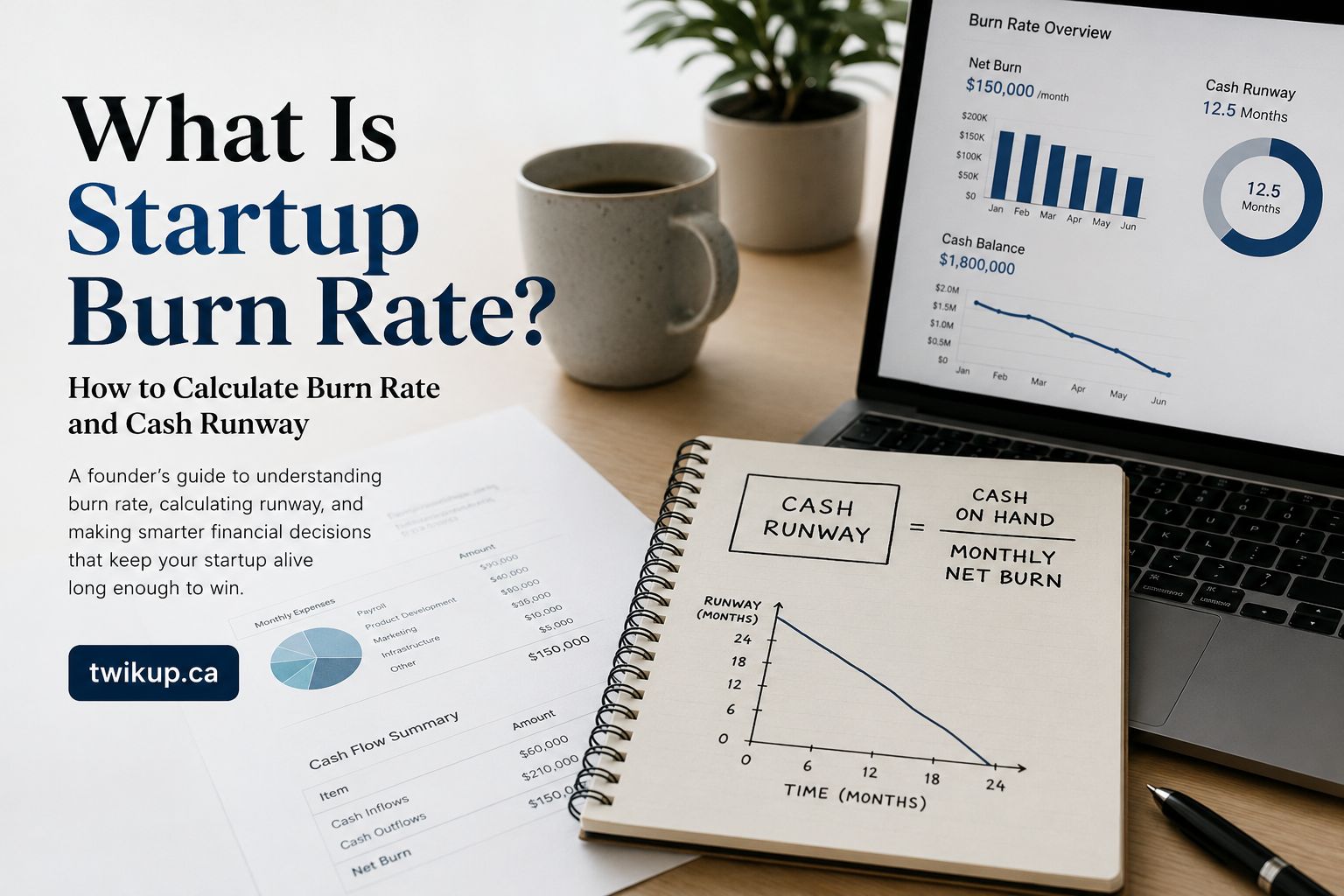
Startup burn rate is the amount of cash a company spends—or loses—during a specific period, usually one month. It helps founders understand how quickly their available cash is disappearing and how long the business can continue operating before it must become cash-flow positive, reduce expenses, or raise additional funding.
For an early-stage startup, revenue growth may attract attention. But burn rate and cash runway determine whether the company survives long enough to achieve that growth.
Quick Answer
Startup burn rate measures how quickly a company is using its available cash.
There are two main types:
- Gross burn rate: The startup’s total monthly cash expenses.
- Net burn rate: Total monthly cash expenses minus monthly cash inflows.
The basic formulas are:
Gross Burn Rate = Total Monthly Cash Expenses
Net Burn Rate = Monthly Cash Outflows − Monthly Cash Inflows
Cash Runway = Available Cash ÷ Monthly Net Burn Rate
For example, if a startup has $1.2 million in cash and loses $100,000 per month, it has approximately:
$1,200,000 ÷ $100,000 = 12 months of runway
That means the company could theoretically operate for another 12 months if its cash inflows and expenses remained unchanged.
TwikUp Insight
A high burn rate is not automatically a sign of a bad startup.
The more important question is:
What measurable progress is the startup purchasing with every dollar it burns?
A startup may deliberately increase spending to hire engineers, launch a product, acquire customers or expand into a new market. That spending can be rational when it creates faster revenue growth, stronger retention, valuable technology or a defensible market position.
Burn becomes dangerous when expenses grow faster than evidence that the business is working.
Founders should therefore monitor burn rate alongside:
- Revenue growth
- Gross margin
- Customer acquisition cost
- Customer retention
- Product milestones
- Fundraising requirements
- Cash runway
Burn rate tells you how quickly cash is leaving. These supporting metrics tell you whether that cash is producing enough value.
What Does Burn Rate Mean for a Startup?
Burn rate represents the speed at which a startup consumes cash before it reaches sustainable positive cash flow.
Most startups spend money before they generate enough revenue to cover their costs. They may need to pay for:
- Employee salaries and benefits
- Software development
- Cloud infrastructure
- Marketing
- Office expenses
- Professional services
- Insurance
- Legal and accounting work
- Equipment
- Customer support
- Research and development
If the company spends more cash than it brings in, its cash balance declines. The rate of that decline is its net burn rate.
Burn rate is generally measured monthly because monthly reporting makes it easier to identify trends, adjust forecasts and estimate how many months of operating life remain.
Gross Burn Rate vs Net Burn Rate
Founders should understand both gross burn and net burn because they answer different questions.
What Is Gross Burn Rate?
Gross burn rate is the company’s total cash spending during a month.
It does not subtract revenue or other operating cash inflows.
Gross Burn Rate = Total Monthly Cash Outflows
Suppose a startup spends:
| Expense | Monthly Amount |
|---|---|
| Salaries and benefits | $160,000 |
| Marketing | $35,000 |
| Cloud infrastructure | $20,000 |
| Office and administration | $15,000 |
| Legal, accounting and software | $20,000 |
| Total monthly expenses | $250,000 |
The startup’s gross burn rate is:
$250,000 per month
Gross burn helps founders understand the full cost of running the business. It is also useful for considering what could happen if revenue suddenly declined.
What Is Net Burn Rate?
Net burn rate measures how much the company’s cash balance is actually shrinking after cash inflows are considered.
Net Burn Rate = Monthly Cash Outflows − Monthly Cash Inflows
Using the previous example, assume the company spends $250,000 per month and collects $90,000 from customers.
Net Burn Rate = $250,000 − $90,000
Net Burn Rate = $160,000 per month
The business is spending $250,000 to operate, but its cash balance is declining by approximately $160,000 each month.
For runway calculations, net burn is usually more useful because it reflects the company’s actual monthly cash loss.
How to Calculate Startup Burn Rate
There are two practical ways to calculate net burn rate.
Method 1: Expenses Minus Cash Inflows
This method works well for monthly management reporting.
Net Burn Rate = Cash Expenses − Operating Cash Inflows
Example:
Monthly cash expenses: $300,000
Monthly cash inflows: $125,000

Net Burn Rate = $300,000 − $125,000
Net Burn Rate = $175,000
The company is burning $175,000 per month.
Method 2: Change in Cash Balance
Founders can also calculate burn by comparing the company’s starting and ending cash balances.
Average Monthly Burn =
Starting Cash Balance − Ending Cash Balance
÷ Number of Months
Suppose a startup began a three-month period with $2 million and ended with $1.55 million.
Total cash reduction = $2,000,000 − $1,550,000
Total cash reduction = $450,000
Average Monthly Burn = $450,000 ÷ 3
Average Monthly Burn = $150,000
Its average net burn was $150,000 per month.
This method can reveal the company’s real cash movement, but founders must review unusual transactions. Equipment purchases, annual insurance payments, financing proceeds, tax refunds or one-time legal bills may distort a single month.
What Is Cash Runway?
Cash runway is the estimated amount of time a startup can continue operating before it runs out of available cash.
It is typically expressed in months.
Cash Runway = Available Cash ÷ Average Monthly Net Burn
Suppose a startup has:
- $1.8 million in available cash
- $150,000 in average monthly net burn
Its estimated runway is:
$1,800,000 ÷ $150,000 = 12 months
The company has approximately 12 months before its cash is exhausted, assuming no meaningful change in revenue, expenses or financing.
That final assumption matters. Runway is a forecast, not a guaranteed expiry date.
Burn Rate and Runway Calculation Example
Consider a software startup with the following monthly cash activity:
| Cash-flow item | Monthly Amount |
|---|---|
| Payroll and benefits | $220,000 |
| Marketing and sales | $70,000 |
| Cloud and software | $35,000 |
| Professional services | $25,000 |
| Office and administration | $20,000 |
| Total cash expenses | $370,000 |
| Customer cash collections | $145,000 |
| Net burn rate | $225,000 |
The company has $3.15 million in available cash.
Step 1: Calculate Gross Burn
Gross Burn = $370,000 per month
Step 2: Calculate Net Burn
Net Burn = $370,000 − $145,000
Net Burn = $225,000 per month
Step 3: Calculate Cash Runway
Cash Runway = $3,150,000 ÷ $225,000
Cash Runway = 14 months
The startup has approximately 14 months of runway under its current operating assumptions.
However, that does not necessarily mean the founders can wait 13 months before thinking about funding. They may need several months to prepare investor materials, build relationships, complete due diligence, negotiate documents and close the transaction.
Founders should understand the entire process through TwikUp’s complete startup fundraising roadmap.
Why Burn Rate Matters to Founders
Burn rate affects almost every major startup decision.
1. It Shows How Long the Company Can Survive
Revenue forecasts can be optimistic. Cash balances are harder to ignore.
Monitoring burn rate forces founders to answer a direct question:
How many months can the company continue operating without new capital?
A startup may have a strong product, rapidly growing users and promising investor conversations. But without enough cash to reach the next milestone, those advantages may not protect it from failure.
2. It Determines When Fundraising Must Begin
Fundraising can take longer than founders expect.
The company may need time to:
- Prepare financial forecasts
- Update the pitch deck
- Build investor relationships
- Complete partner meetings
- Negotiate valuation
- Conduct due diligence
- Finalize legal agreements
- Receive funds
A founder who starts fundraising only when the company is close to running out of cash may lose negotiating power.
Investors can recognize when a company has limited alternatives. That pressure may lead to a lower valuation, more dilution, investor-friendly control provisions or restrictive terms.
Before negotiating a financing round, founders should understand how startup term sheets can affect economics, governance and control.
3. It Influences Startup Valuation
Burn rate does not determine valuation by itself. However, it affects how investors interpret the company’s financial discipline and future funding needs.
Two startups may have similar revenue growth, but the startup requiring substantially more cash to produce that growth may be viewed differently.
Investors may examine:
- How much capital has already been raised
- How much cash remains
- Monthly burn
- Revenue growth
- Gross margin
- Capital efficiency
- Future financing requirements
- Milestones expected before the next round
A high burn rate can be justified when it supports exceptional growth or creates a durable competitive advantage. It becomes more difficult to defend when the startup lacks customer adoption or repeatable economics.
Learn more about how investors actually value startups.
4. It Shapes Hiring Decisions
Employees are often one of a startup’s largest recurring expenses.
Hiring ten people may accelerate product development or sales, but it also creates ongoing obligations through:
- Salaries
- Benefits
- Payroll taxes
- Equipment
- Software
- Recruitment costs
- Management requirements
Founders should calculate how each hiring plan changes monthly burn and runway before approving it.
A company should not hire solely because money was recently raised. Every role should connect to a business objective, product milestone, revenue opportunity or operational requirement.
5. It Reveals Problems Earlier
A burn-rate forecast allows management to identify trouble before the bank balance becomes critical.
For example:
- Revenue may be growing slower than planned.
- Customer acquisition costs may be rising.
- A product launch may be delayed.
- Hiring may be occurring faster than expected.
- Gross margins may be deteriorating.
- Customers may be paying later.
- Infrastructure costs may be scaling inefficiently.
Monthly burn monitoring turns these issues into visible financial consequences.
What Is a Good Burn Rate for a Startup?
There is no universal burn-rate number that every startup should target.
A good burn rate depends on:
- Available cash
- Business model
- Startup stage
- Revenue growth
- Gross margin
- Industry
- Funding environment
- Hiring plan
- Product-development requirements
- Time required to reach the next milestone
A bootstrapped software startup and a biotechnology company should not be judged using the same spending expectations.
The better question is:
Is the startup’s burn rate appropriate for the progress it is producing and the runway it preserves?
A startup burning $500,000 per month may be financially disciplined if it has substantial reserves, strong unit economics and rapid growth.
Another startup burning $80,000 per month may be in danger if it has only $200,000 left and no credible financing or revenue plan.
Burn should therefore be evaluated relative to cash, growth and milestones—not as an isolated number.
What Is Burn Multiple?
Burn multiple measures how much net cash a startup burns to generate each unit of new recurring revenue.
It is commonly discussed for subscription businesses.
Burn Multiple =
Net Cash Burn During the Period
÷
Net New Annual Recurring Revenue During the Period
Suppose a startup burns $1 million during a quarter and adds $500,000 in net new annual recurring revenue.
Burn Multiple = $1,000,000 ÷ $500,000
Burn Multiple = 2
The business burned $2 for every $1 of net new annual recurring revenue added.
Burn multiple can help founders assess capital efficiency, but it should not be used without context. New product investment, market-entry spending, annual customer contracts and timing differences can influence the result.
It also does not replace cash-flow forecasting. A startup can improve its burn multiple and still face a cash shortage if its runway is already limited.
High Burn Rate vs Low Burn Rate
Neither high burn nor low burn is automatically good.
A High Burn Rate May Be Rational When:
- Demand has been validated.
- Customer acquisition is predictable.
- The company has strong gross margins.
- Spending accelerates valuable product development.
- The startup is entering a time-sensitive market.
- The company has sufficient runway.
- The spending supports measurable growth.
A High Burn Rate Becomes Dangerous When:
- Revenue growth is weak.
- Customers are leaving.
- Hiring is disconnected from business priorities.
- Spending is based on unrealistic forecasts.
- The startup repeatedly misses milestones.
- Fundraising is assumed to be guaranteed.
- Runway is shrinking without corrective action.
A Low Burn Rate May Be Positive When:
- The company is operating efficiently.
- Founders are preserving ownership.
- Revenue funds most operating expenses.
- The business can grow without large capital requirements.
- The company retains strategic flexibility.
A Low Burn Rate Can Also Be a Warning When:
- The startup is underinvesting in a proven opportunity.
- Product development is too slow.
- The company cannot attract necessary talent.
- Competitors are gaining market share.
- The founders are avoiding calculated risks.
The goal is not to minimize burn at any cost. The goal is to spend deliberately.
Why Startups Run Out of Cash After Raising Millions
A successful funding announcement can create the illusion that financial risk has disappeared.
In reality, raising capital often increases the number and size of decisions founders must make.
After a round, startups may quickly:
- Expand headcount
- Increase marketing
- Sign larger office agreements
- Add management layers
- Launch new products
- Enter additional markets
- Purchase expensive software
- Increase founder and executive compensation
Many of these investments may be reasonable. The danger comes when the startup commits to a cost structure based on growth that has not yet materialized.
Capital raised is not revenue earned. It is temporary financial capacity that should help the company reach a more valuable and sustainable position.
Founders can explore this transition in You Raised Millions—Here’s What Happens Next.
How Investors Evaluate Startup Burn Rate
Investors generally do not look at burn rate in isolation.
They may compare burn against:
- Revenue growth
- Annual recurring revenue
- Gross margin
- Customer retention
- Pipeline quality
- Product development
- Market expansion
- Headcount growth
- Capital already invested
- Milestones achieved
- Time until the next financing round
They may also ask:
- What is the current gross burn?
- What is the current net burn?
- How has burn changed during the past six months?
- What caused the changes?
- How many months of runway remain?
- What assumptions are built into the forecast?
- What milestone will the company achieve before the next round?
- What happens if revenue is 20% below plan?
- Which costs can be reduced quickly?
- How much capital will the startup need next?
VCs understand that many portfolio companies will fail. That is built into the venture-capital model. However, they still want each company to use its capital intelligently and create a credible opportunity for an outsized result.
Read more about why venture capitalists expect many startups to fail before investing.
Founders may also benefit from understanding who funds venture capital firms and how VCs make money.
How to Reduce Startup Burn Rate Without Destroying Growth
Reducing burn should begin with prioritization, not random cost-cutting.
1. Freeze Non-Essential Hiring
Review every open position.
Ask:
- Is this role required now?
- What measurable outcome will it create?
- Could the work be delayed?
- Could an existing employee temporarily own it?
- Does the role move the company toward its next funding or revenue milestone?
2. Separate Essential Costs From Optional Costs
Classify expenses into categories:
- Essential for current operations
- Required for committed growth
- Useful but deferrable
- Low-value or unnecessary
This makes cost reductions more strategic.
3. Renegotiate Recurring Contracts
Review:
- Software subscriptions
- Cloud commitments
- Agency retainers
- Professional services
- Insurance
- Office agreements
- Recruitment tools
- Data providers
Small recurring expenses can create a meaningful cumulative effect.
4. Improve Customer Collections
Reported revenue does not pay salaries until the cash is collected.
Startups can examine:
- Payment terms
- Invoice timing
- Overdue accounts
- Upfront payment incentives
- Annual prepayment options
- Customer credit risk
Better collections may extend runway without reducing growth investment.
5. Focus on High-Value Customers
Not every customer generates equal value.
A customer may create revenue but still consume excessive sales, onboarding, customization and support resources.
Founders should examine contribution margin and retention—not just top-line sales.
6. Sequence Expansion
Launching multiple products or entering several markets at once can increase complexity and burn.
A staged approach can allow the company to validate one expansion before funding the next.
7. Build Multiple Scenarios
Management should maintain at least three forecasts:
- Base case
- Downside case
- Upside case
The downside case should show what happens if revenue arrives later, fundraising takes longer or expenses exceed expectations.
Can Venture Debt Extend Startup Runway?
Venture debt can provide additional capital without immediately issuing the same amount of new equity.
It may be used to:
- Extend runway after an equity round
- Finance equipment
- Support working capital
- Reach a milestone before the next equity financing
- Reduce immediate dilution
However, debt is not free runway.
The company must consider:
- Interest
- Fees
- Repayment obligations
- Financial covenants
- Security interests
- Warrants
- Default provisions
Debt can create additional risk when the startup does not have sufficient cash flow or a credible financing plan.
Founders considering this option should read What Is Venture Debt? The Complete Guide to Startup Debt Financing Without Equity Dilution.
How Often Should a Startup Calculate Burn Rate?
Early-stage startups should normally review cash and burn at least monthly.
Companies with limited runway or rapidly changing expenses may need weekly cash monitoring.
A useful finance dashboard can include:
| Metric | Review Frequency |
|---|---|
| Cash balance | Weekly |
| Accounts receivable | Weekly |
| Accounts payable | Weekly |
| Gross burn | Monthly |
| Net burn | Monthly |
| Cash runway | Monthly |
| Revenue forecast | Monthly |
| Hiring plan | Monthly |
| Downside scenario | Monthly or quarterly |
| Fundraising timeline | Monthly |
The purpose is not to produce complicated reporting. It is to ensure founders can make decisions before financial pressure removes their options.
Common Burn-Rate Mistakes Founders Make
Confusing Profit With Cash
A startup may report accounting revenue while still waiting for customers to pay.
Runway should be calculated using actual or realistically forecast cash movement—not revenue recognition alone.
Using Only One Month
A single month may include annual payments, equipment purchases, legal fees or delayed customer collections.
Using a three- or six-month average can provide a more stable baseline, provided founders also account for planned changes.
Treating Investment Proceeds as Revenue
Capital raised from investors increases cash, but it is not operating revenue.
It should not be used to make the business appear closer to operating sustainability.
Assuming Burn Will Remain Constant
Hiring, marketing campaigns, product launches and contract renewals can change spending significantly.
A forward-looking cash model is more valuable than simply dividing today’s balance by last month’s burn.
Waiting Too Long to Cut Costs
Emergency reductions are often more disruptive than early, targeted changes.
Founders who monitor runway continuously have more time to protect important teams, customer relationships and product priorities.
Assuming Another Funding Round Is Guaranteed
Market conditions, investor priorities and company performance can change.
A responsible forecast should include a scenario in which new equity is delayed or unavailable.
Burn Rate vs Revenue Run Rate
Burn rate and revenue run rate sound similar but measure different things.
Burn Rate
Burn rate measures how quickly cash is being consumed.
Example: The startup is burning $100,000 per month.
Revenue Run Rate
Revenue run rate annualizes current revenue performance.
Monthly Revenue × 12 = Annual Revenue Run Rate
If a startup generates $200,000 in revenue during one month:
$200,000 × 12 = $2.4 million annual revenue run rate
Revenue run rate assumes the current performance continues. It does not automatically account for seasonality, churn or future changes.
A startup can have a growing revenue run rate while still burning substantial cash.
Burn Rate vs Operating Expenses
Operating expenses are the costs incurred while running the business.
Burn rate focuses on the effect of cash outflows and inflows on the company’s available cash.
A business may record an expense that is not paid immediately. It may also pay cash for something that is recognized as an expense over time.
That is why founders should use cash-flow data—not only the income statement—when calculating runway.
What Happens When Startup Runway Becomes Too Short?
As runway declines, founders generally have five broad choices:
- Increase revenue.
- Reduce spending.
- Raise equity capital.
- Obtain debt or another financing facility.
- Sell, merge or wind down the company.
The earlier management recognizes the problem, the more options it may retain.
A company with significant runway can make deliberate strategic decisions. A company with only a few weeks of cash may be forced to accept whatever option is available.
Fundraising under pressure may also affect governance. After raising institutional capital, founders may no longer control every important decision. In some circumstances, a startup’s board may even remove its founder-CEO.
Read Your Board Can Fire You: What Every Founder Should Know After Raising Capital.
Startup Burn Rate Checklist
Founders should be able to answer the following questions without waiting for an accountant or board meeting:
- How much cash is available today?
- What was gross burn last month?
- What was net burn last month?
- What was average net burn over the last three months?
- What is the expected burn for the next six months?
- How many months of runway remain?
- What happens if revenue is below plan?
- Which costs could be reduced quickly?
- When should fundraising begin?
- What milestone will the startup reach before the next round?
- How much capital will the company need?
- What happens if the next round does not close?
If these answers are unclear, management may not have enough visibility into the company’s financial risk.
Frequently Asked Questions
What is startup burn rate in simple terms?
Startup burn rate is the amount of cash a company spends or loses each month while operating. It shows how quickly the startup’s cash reserves are declining.
How do you calculate net burn rate?
Subtract monthly cash inflows from monthly cash outflows.
Net Burn Rate = Monthly Cash Outflows − Monthly Cash Inflows
If a startup spends $200,000 and collects $75,000, its net burn is $125,000.
How do you calculate startup runway?
Divide available cash by average monthly net burn.
Cash Runway = Available Cash ÷ Monthly Net Burn
A startup with $900,000 in cash and a $100,000 monthly net burn has approximately nine months of runway.
Is a high burn rate always bad?
No. A high burn rate may be reasonable when it produces strong growth, valuable technology, customer retention or an important market advantage. It becomes dangerous when spending rises without measurable progress.
Should runway be calculated using gross burn or net burn?
Net burn is commonly used because it reflects the amount by which the company’s cash balance is actually declining. Gross burn remains useful for understanding total operating costs and downside exposure.
Can a profitable startup have a burn rate?
A company can report accounting profit while still experiencing negative cash flow because of delayed customer payments, inventory purchases, debt repayments or capital expenditures. Founders should monitor actual cash movement.
When should a startup start raising its next funding round?
There is no universal date. Founders should work backward from their cash-out date and allow sufficient time for preparation, investor outreach, diligence, negotiations and closing. Waiting until runway is nearly exhausted can weaken the company’s negotiating position.
What is the biggest mistake founders make with burn rate?
One of the biggest mistakes is assuming current spending can continue because another funding round will arrive. Financing should be treated as uncertain until the money has closed and reached the company’s bank account.
Final Takeaway
Startup burn rate measures how quickly a company is consuming cash, while cash runway estimates how long that cash will last.
The essential formulas are:
Gross Burn = Total Monthly Cash Expenses
Net Burn = Monthly Cash Outflows − Monthly Cash Inflows
Cash Runway = Available Cash ÷ Monthly Net Burn
But the formula is only the beginning.
Founders must understand whether spending is producing meaningful product progress, revenue, customer retention or strategic advantage. They must also model what happens when sales are delayed, expenses rise or fundraising becomes more difficult.
The strongest startups do not simply spend less. They understand exactly what their capital is purchasing, how long their cash will last and which milestones must be reached before the next financing decision.
Sources
- Y Combinator — How to Calculate Burn Rate, Runway and Growth Rate
- Carta — What Is a Burn Rate? How to Calculate Your Cash Runway
- JPMorgan — Does Your Startup Have Enough Runway to Survive?
- HSBC Innovation Banking — Understanding and Managing Burn Rate
- Mercury — How to Calculate Your Startup’s Cash Burn Rate
This article is provided for general educational purposes and does not constitute financial, accounting, investment or legal advice. Startup finances and funding agreements should be reviewed with qualified professional advisers.