
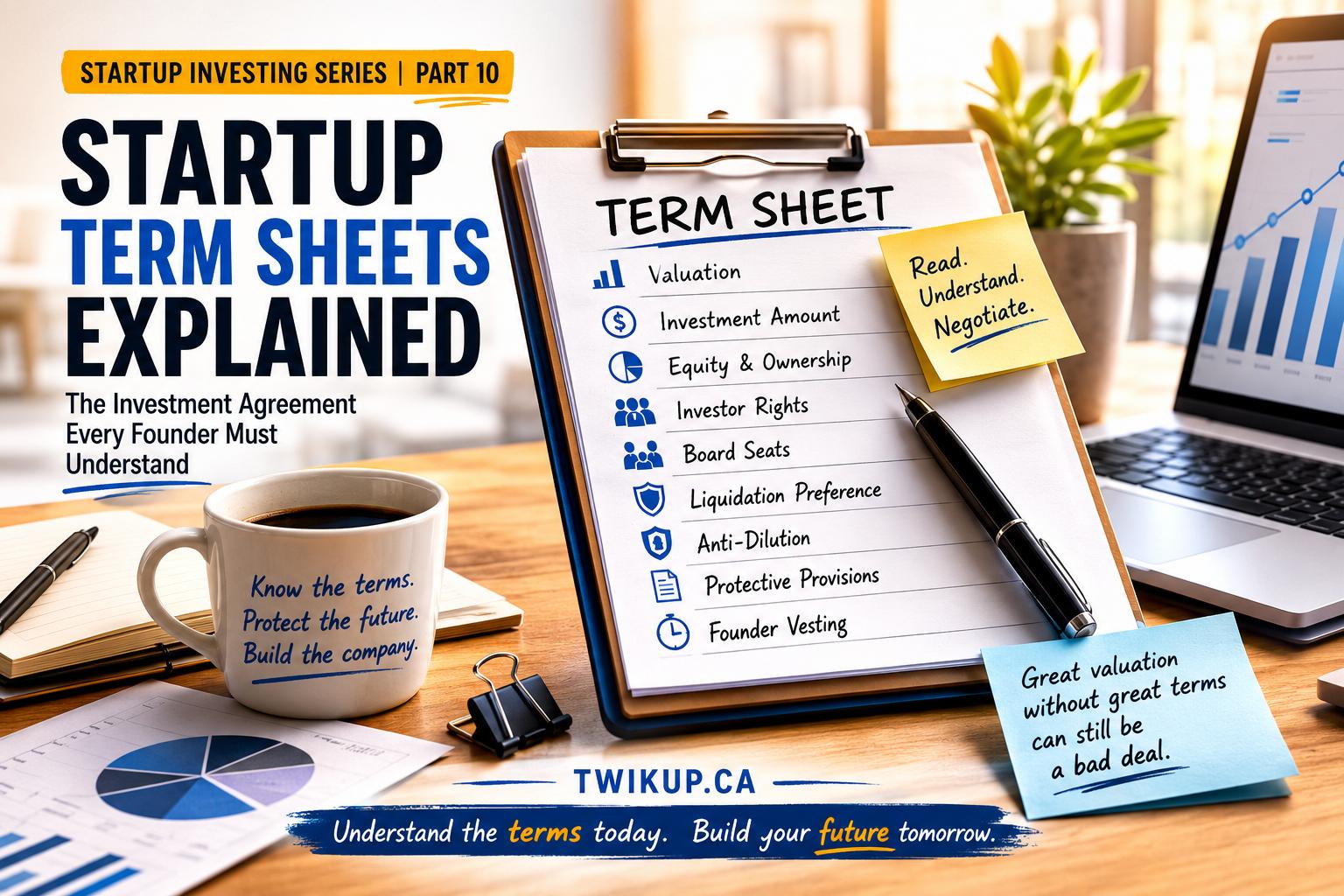
Startup Term Sheets Explained: The Investment Agreement Every Founder Must Understand
Part 10 of Twikup’s Startup Investing Series
Quick Answer
A startup term sheet is the document that outlines the key terms of an investment deal before the final legal agreements are signed.
It usually covers:
- How much money the investor will put in
- The startup’s valuation
- How much ownership the investor gets
- Investor rights
- Board control
- Liquidation preferences
- Anti-dilution protection
- Founder responsibilities
For founders, the term sheet is not just paperwork. It can decide how much control you keep, how much money you receive in a future exit, and whether the investment helps or quietly weakens your company.
Continue Reading the Series
If you're joining the series for the first time, start here:
Part 1: How First-Time Founders Can Raise Their First Investment
Part 2: What Investors Look For Before Funding a Startup
Part 3: Why Most Startup Pitches Fail Even When the Idea Is Good
Part 4: How to Build a Pitch Deck That Investors Actually Read
Part 5: How Startup Valuations Actually Work Before Revenue
Part 6: How Startup Dilution Works: What Happens When Investors Buy Equity
Part 7: How Startup Cap Tables Work And Why Founders Must Understand Them
Part 8: SAFE Notes Explained: How Startups Raise Money Before a Valuation
Part 9: Convertible Notes vs SAFE Notes: Which Fundraising Method Is Better for Startups in 2026?
Why Term Sheets Matter More Than Founders Think
Many first-time founders celebrate when an investor says:
“We want to invest.”
That moment feels like victory.
But the real negotiation begins after that.
The investor may like your idea. They may like your team. They may even agree with your valuation. But the term sheet decides what the deal actually means.
Two founders can raise the same amount of money at the same valuation, but end up in very different positions because of the terms attached to the deal.
One founder may keep control and build long-term value.
Another may accept terms that make future fundraising harder, reduce founder upside, or give investors too much control too early.
That is why founders must understand term sheets before signing anything.
What Is a Startup Term Sheet?
A startup term sheet is a document that summarizes the main business and legal terms of an investment.
It is usually signed before the final investment documents are prepared.
A term sheet may include:
- Investment amount
- Pre-money valuation
- Post-money valuation
- Share class
- Ownership percentage
- Board rights
- Voting rights
- Liquidation preference
- Anti-dilution protection
- Founder vesting
- Information rights
- Pro-rata rights
- Closing conditions
In simple words:
A term sheet tells everyone what the investment deal will look like before lawyers turn it into full legal documents.
For early-stage startups, SAFEs and convertible notes may be simpler than a priced equity round. Y Combinator’s SAFE documents, for example, are widely used for early-stage financing and include Canada-specific SAFE forms, though founders are advised to consult a lawyer licensed in their jurisdiction before using them.
But once a startup raises a priced round, especially a seed round or Series A, the term sheet becomes much more important.
Term Sheet vs SAFE vs Convertible Note
Founders often confuse these documents.
Here is the simple difference:
| Document | What It Does | Common Stage |
|---|---|---|
| SAFE | Lets investors invest now and receive equity later | Very early stage |
| Convertible Note | Debt that can convert into equity later | Early stage |
| Term Sheet | Outlines terms of a priced equity investment | Seed, Series A, later rounds |
| Share Purchase Agreement | Final legal document for the investment | Closing stage |
A SAFE or convertible note may delay valuation until later.
A priced equity term sheet usually sets the valuation now.
That is why understanding valuation, dilution, and cap tables from earlier parts of this series is critical before reading a term sheet.
The Most Important Terms Founders Must Understand
1. Investment Amount
This is the amount the investor is putting into the startup.
Example:
An investor agrees to invest $1 million.
That sounds simple.
But the real question is:
What does the investor receive in exchange?
That depends on valuation, share type, and deal terms.
2. Pre-Money Valuation
Pre-money valuation is the value of the company before the new investment comes in.
Example:
- Pre-money valuation: $5 million
- New investment: $1 million
The company is valued at $5 million before receiving the investor’s money.
3. Post-Money Valuation
Post-money valuation is the company’s value after the investment.
Formula:
Pre-money valuation + investment amount = post-money valuation
Example:
- Pre-money valuation: $5 million
- Investment: $1 million
- Post-money valuation: $6 million
Investor ownership:
$1 million ÷ $6 million = 16.67%
So the investor owns around 16.67% of the company after the round.
Real Example: How a Term Sheet Changes Ownership
Imagine a startup raises money on these terms:
- Pre-money valuation: $5 million
- Investment amount: $1 million
- Post-money valuation: $6 million
Ownership after investment:
| Person / Group | Ownership |
|---|---|
| Founders | 83.33% |
| Investor | 16.67% |
| Total | 100% |
At first, this looks simple.
But now imagine the term sheet also requires a 15% employee option pool before investment.
That changes the founder’s dilution.
The Option Pool Trap
An employee option pool is a percentage of shares reserved for future employees.
This is normal.
Startups need stock options to hire talent.
But founders must understand whether the option pool is created before or after the investment.
If the option pool is created before investment
The founders are diluted more.
If the option pool is created after investment
The dilution is shared between founders and investors.
This one detail can change the real economics of the deal.
Example
Investor says:
“We will invest $1 million at a $5 million pre-money valuation, but we need a 15% option pool included before closing.”
That means the founders may not really own 83.33% after the round.
A portion of their ownership is set aside for future employees before the investor calculates their ownership.
This is why founders should never look only at the headline valuation.
Twikup Insight
Most founders negotiate the valuation because it feels like the biggest number.
But experienced investors know the real deal is often hidden in the terms.
A high valuation with harsh terms can be worse than a lower valuation with clean terms.
The question is not only:
“What is my startup worth?”
The better question is:
“After this deal, how much control, flexibility, and future upside do I still have?”
4. Share Class: Common Shares vs Preferred Shares
Founders usually own common shares.
Investors usually receive preferred shares.
Preferred shares often come with extra rights, such as:
- Liquidation preference
- Voting rights
- Protective provisions
- Anti-dilution rights
- Board rights
- Information rights
This does not automatically mean preferred shares are bad.
They are standard in venture capital.
But founders must understand what rights are attached to those shares.
5. Liquidation Preference
Liquidation preference decides who gets paid first if the company is sold, shut down, or liquidated.
This is one of the most important terms in venture investing.
Simple Example
Investor puts in $1 million with a 1x liquidation preference.
Later, the startup sells for $4 million.
Before common shareholders receive money, the investor has the right to get their $1 million back first.
Then the remaining money is distributed based on ownership.
A 1x non-participating liquidation preference is common.
But some terms can be much harsher.
6. Participating Preferred Shares
Participating preferred shares can be dangerous for founders.
With participating preferred shares, investors may get:
- Their money back first
- Then also participate in the remaining proceeds based on ownership
This can reduce founder payout significantly.
Example
Startup sells for $10 million.
Investor invested $2 million and owns 20%.
With participating preferred shares, the investor may receive:
- $2 million back first
- Plus 20% of the remaining $8 million
- Total investor payout: $3.6 million
Founder payout is reduced.
This is why founders must ask:
“Is this liquidation preference participating or non-participating?”
7. Anti-Dilution Protection
Anti-dilution protection protects investors if the startup raises money later at a lower valuation.
This lower valuation is called a down round.
There are different types of anti-dilution protection:
| Type | Founder Impact |
|---|---|
| Broad-based weighted average | More founder-friendly |
| Narrow-based weighted average | Less founder-friendly |
| Full ratchet | Very investor-friendly and risky for founders |
Full ratchet anti-dilution can heavily dilute founders in a down round.
Founders should be very careful before accepting it.
8. Board Seats
A board of directors helps oversee the company.
A term sheet may say who gets board seats.
Example:
- 2 founder seats
- 1 investor seat
- 1 independent seat
This may seem harmless, but board control matters.
The board may influence:
- CEO decisions
- Hiring and firing executives
- Future fundraising
- Company sale
- Major spending
- Strategic direction
Founders should avoid giving too much board control too early.
9. Voting Rights and Protective Provisions
Protective provisions give investors approval rights over major decisions.
Investors may require approval before the company can:
- Sell the company
- Raise more money
- Issue new shares
- Take on large debt
- Change the company’s business
- Increase executive compensation
- Create a new share class
Some protective provisions are normal.
But too many can slow down the company.
A founder should ask:
“Does this protect the investor, or does it give them control over everyday business decisions?”
10. Founder Vesting
Founder vesting means founders earn their shares over time.
This may sound strange because founders started the company.
But investors often want founder vesting to make sure founders stay committed.
Example:
- 4-year vesting schedule
- 1-year cliff
- Monthly vesting after the first year
If a founder leaves early, they may lose some unvested shares.
This can protect the company, especially if there are multiple co-founders.
But founders must understand what happens if:
- They are fired
- They resign
- The company is acquired
- A co-founder leaves
- There is a disagreement
11. Pro-Rata Rights
Pro-rata rights allow investors to maintain their ownership percentage in future rounds.
Example:
An investor owns 10% today.
In the next round, they may have the right to invest more money to keep owning 10%.
This is common.
It can be good if the investor is helpful and wants to continue supporting the company.
But founders should understand how pro-rata rights affect future rounds and new investors.
YC’s own financing structure, for example, includes participation rights related to future financing rounds.
12. Information Rights
Information rights require the startup to share updates with investors.
These may include:
- Monthly updates
- Quarterly financial statements
- Annual budgets
- Major company updates
- Cap table updates
This is normal for serious investors.
But founders should avoid overly burdensome reporting requirements too early.
A two-person startup should not be spending more time preparing investor reports than building the product.
13. No-Shop Clause
A no-shop clause prevents the founder from actively seeking other investment offers for a period of time after signing the term sheet.
Example:
The term sheet may say the founder cannot negotiate with other investors for 30 to 60 days.
This protects the investor while they do due diligence.
But founders should be careful.
If the no-shop period is too long and the investor walks away, the startup may lose momentum with other investors.
14. Due Diligence Conditions
A term sheet may say the investment is subject to due diligence.
This means the investor can review:
- Financial records
- Incorporation documents
- Customer contracts
- Employee agreements
- Intellectual property ownership
- Cap table
- Tax records
- Legal risks
- Product and technology
Founders should prepare these documents before fundraising.
A messy data room can delay or kill a deal.
Founder Red Flags in a Term Sheet
Not every bad term is obvious.
Here are red flags founders should watch for:
- Very high liquidation preference
- Participating preferred shares
- Full ratchet anti-dilution
- Too many investor veto rights
- Investor control of the board too early
- Large option pool created only from founder ownership
- Long no-shop period
- Unclear founder vesting terms
- Investor rights that scare future investors
- Terms you do not understand but feel pressured to sign
If you feel rushed, slow down.
A serious investor should expect you to review the term sheet carefully.
Good Term Sheet vs Bad Term Sheet
| Area | Founder-Friendly | Risky for Founders |
|---|---|---|
| Liquidation preference | 1x non-participating | 2x or 3x participating |
| Anti-dilution | Broad-based weighted average | Full ratchet |
| Board control | Balanced board | Investor-controlled board |
| Option pool | Fairly negotiated | Fully pushed onto founders |
| Voting rights | Major decisions only | Too many veto rights |
| No-shop | Short and reasonable | Long and restrictive |
| Legal clarity | Simple and understandable | Vague or complex |
Why the Highest Valuation Is Not Always the Best Deal
Imagine two investors offer you money.
Offer A
- $8 million valuation
- 1x non-participating liquidation preference
- Balanced board
- Reasonable pro-rata rights
Offer B
- $10 million valuation
- 2x participating liquidation preference
- Strong investor veto rights
- Large option pool before investment
- Investor board control
Offer B has the higher valuation.
But Offer A may be the better deal.
Why?
Because Offer B may reduce founder control and future exit payout.
This is one of the biggest mistakes first-time founders make.
They compare valuation but ignore structure.
Simple Founder Checklist Before Signing a Term Sheet
Before signing, ask these questions:
Valuation
- What is the pre-money valuation?
- What is the post-money valuation?
- Is the option pool included before or after investment?
Ownership
- How much equity is the investor getting?
- How much dilution will founders face?
- How does this affect the cap table?
Control
- Who gets board seats?
- What decisions require investor approval?
- Can the founder still operate the company effectively?
Exit Economics
- What is the liquidation preference?
- Is it participating or non-participating?
- What happens if the company sells for less than expected?
Future Fundraising
- Will these terms scare future investors?
- Are the investor rights standard?
- Will this make a Series A easier or harder?
Legal Review
- Has a startup lawyer reviewed it?
- Do you understand every clause?
- Have you modelled different exit scenarios?
Example: How a Bad Term Sheet Can Hurt Founders
A startup raises $2 million.
The headline looks great:
- Valuation: $10 million
- Investor ownership: around 16.67%
But the terms include:
- 2x liquidation preference
- Participating preferred shares
- Full ratchet anti-dilution
- Investor board control
Later, the company sells for $8 million.
The founders expect a strong payout.
But the investor gets paid first and participates again.
The founders receive much less than expected.
This is why founders should model outcomes before signing.
Do not only model the best-case unicorn scenario.
Model:
- What happens if the company sells for $5 million?
- What happens if it sells for $10 million?
- What happens if it raises a down round?
- What happens if the next round is delayed?
- What happens if the investor blocks a sale?
A term sheet should be tested under stress, not just optimism.
Canadian Founder Perspective
Canadian founders often raise from a mix of:
- Angel investors
- Local startup funds
- U.S. investors
- Canadian venture capital firms
- Accelerators
- Strategic investors
- Government-backed or institutional capital sources
Canada also has organizations focused on entrepreneurship and venture financing. BDC, for example, describes itself as the bank for Canadian entrepreneurs and offers financing, advisory services, and capital solutions through BDC Capital.
But regardless of where the investor is based, founders should not assume every term is standard.
Canadian startups raising from U.S. investors may see U.S.-style venture terms.
Founders should use legal counsel familiar with startup financing in their jurisdiction.
Twikup Insight: The Term Sheet Is a Founder Stress Test
A term sheet does more than define an investment.
It reveals how the investor thinks.
A good investor will explain terms clearly, answer questions, and want the founder to understand the deal.
A risky investor may pressure the founder to sign quickly, avoid explaining downside scenarios, or make complex terms sound harmless.
The way an investor behaves during term sheet negotiation can tell you how they may behave when the startup faces pressure later.
Money is not the only thing you are accepting.
You are accepting a long-term relationship.
Common Mistakes First-Time Founders Make
Mistake 1: Only Negotiating Valuation
Valuation matters, but it is not everything.
A clean $6 million valuation may be better than a messy $10 million valuation.
Mistake 2: Ignoring Liquidation Preference
This can decide who gets paid first in an exit.
Founders should understand it before signing.
Mistake 3: Not Understanding the Option Pool
A large option pool can quietly dilute founders more than expected.
Mistake 4: Giving Up Too Much Control
Investor rights are normal.
Investor control over everyday operations is not.
Mistake 5: Not Hiring the Right Lawyer
A general business lawyer may not be enough.
Startup financing has specific terms and market practices.
Mistake 6: Assuming “Standard Terms” Means Safe Terms
Investors may say:
“This is standard.”
Founders should still ask:
“Standard for whom?”
What Founders Should Negotiate
Founders may not be able to negotiate every term, especially if they have limited investor interest.
But these areas are worth reviewing carefully:
- Valuation
- Option pool size
- Liquidation preference
- Board composition
- Protective provisions
- Founder vesting
- Anti-dilution terms
- Pro-rata rights
- No-shop period
- Legal fees
- Closing conditions
Negotiation does not mean being difficult.
It means understanding the deal and protecting the company’s future.
What Investors Usually Care About
Good investors are not only trying to take ownership.
They want protection.
They care about:
- Downside protection
- Future fundraising ability
- Founder commitment
- Governance
- Reporting
- Exit rights
- Fair ownership for risk taken
Founders should understand investor logic.
When both sides understand each other, the deal becomes cleaner.
The Founder-Friendly Way to Read a Term Sheet
When reviewing a term sheet, read it in this order:
- How much money is being invested?
- What is the valuation?
- What ownership does the investor receive?
- What happens to the option pool?
- Who controls the board?
- What rights does the investor get?
- What happens if the company sells?
- What happens if the next round is lower?
- What happens if a founder leaves?
- Will future investors accept these terms?
This order helps founders move from simple numbers to deeper consequences.
Final Thoughts
A startup term sheet is not just a funding document.
It is a map of power, ownership, risk, and future upside.
For first-time founders, the biggest danger is not raising money on a low valuation.
The bigger danger is raising money on terms they do not understand.
A founder who understands term sheets can negotiate better, protect the company, and avoid painful surprises later.
A founder who does not understand term sheets may celebrate the investment today and regret the deal later.
Before signing, remember this:
The investor’s cheque may help you build the company, but the term sheet decides how much of the company you still control after the cheque arrives.
Helpful References
-
Y Combinator SAFE Financing Documents
https://www.ycombinator.com/documents -
Y Combinator Standard Investment Deal (The YC Deal)
https://www.ycombinator.com/deal -
National Venture Capital Association (NVCA) Model Legal Documents for Venture Financings
https://nvca.org/model-legal-documents/ -
Canadian Venture Capital & Private Equity Association (CVCA) Model Legal Documents
https://www.cvca.ca/resources/model-legal-documents/ -
Business Development Bank of Canada (BDC) – Resources and Financing for Canadian Entrepreneurs
https://www.bdc.ca -
Osler – Startup & Emerging Companies Resources
https://www.osler.com -
Blake, Cassels & Graydon LLP – Emerging Companies and Venture Capital
https://www.blakes.com -
McCarthy Tétrault – Startups and Venture Capital Resources
https://www.mccarthy.ca -
Goodmans LLP – Technology and Venture Capital Resources
https://www.goodmans.ca
Important: This article is for educational purposes only and should not be considered legal, tax, or investment advice. Before signing any term sheet, SAFE, convertible note, or venture financing agreement, founders should consult qualified legal counsel familiar with Canadian and cross-border startup financings.