
Part 8 of the Twikup.ca Exclusive Startup Investing & Fundraising Series
Continue Reading the Series
If you're joining the series for the first time, start here:
Part 1: How First-Time Founders Can Raise Their First Investment https://twikup.ca/money/investing/how-first-time-founders-can-raise-their-first-investment
Part 2: What Investors Look For Before Funding a Startup https://twikup.ca/money/investing/what-investors-look-for-before-funding-a-startup
Part 3: Why Most Startup Pitches Fail Even When the Idea Is Good https://twikup.ca/money/investing/why-most-startup-pitches-fail-even-when-the-idea-is-good
Part 4: How to Build a Pitch Deck That Investors Actually Read https://twikup.ca/money/investing/how-to-build-a-pitch-deck-that-investors-actually-read
Part 5: How Startup Valuations Actually Work Before Revenue https://twikup.ca/money/investing/how-startup-valuations-actually-work-before-revenue
Part 6: How Startup Dilution Works: What Happens When Investors Buy Equity https://twikup.ca/money/investing/how-startup-dilution-works-what-happens-when-investors-buy-equity
Part 7: How Startup Cap Tables Work (And Why Founders Must Understand Them) https://twikup.ca/money/investing/how-startup-cap-tables-work-and-why-founders-must-understand-them
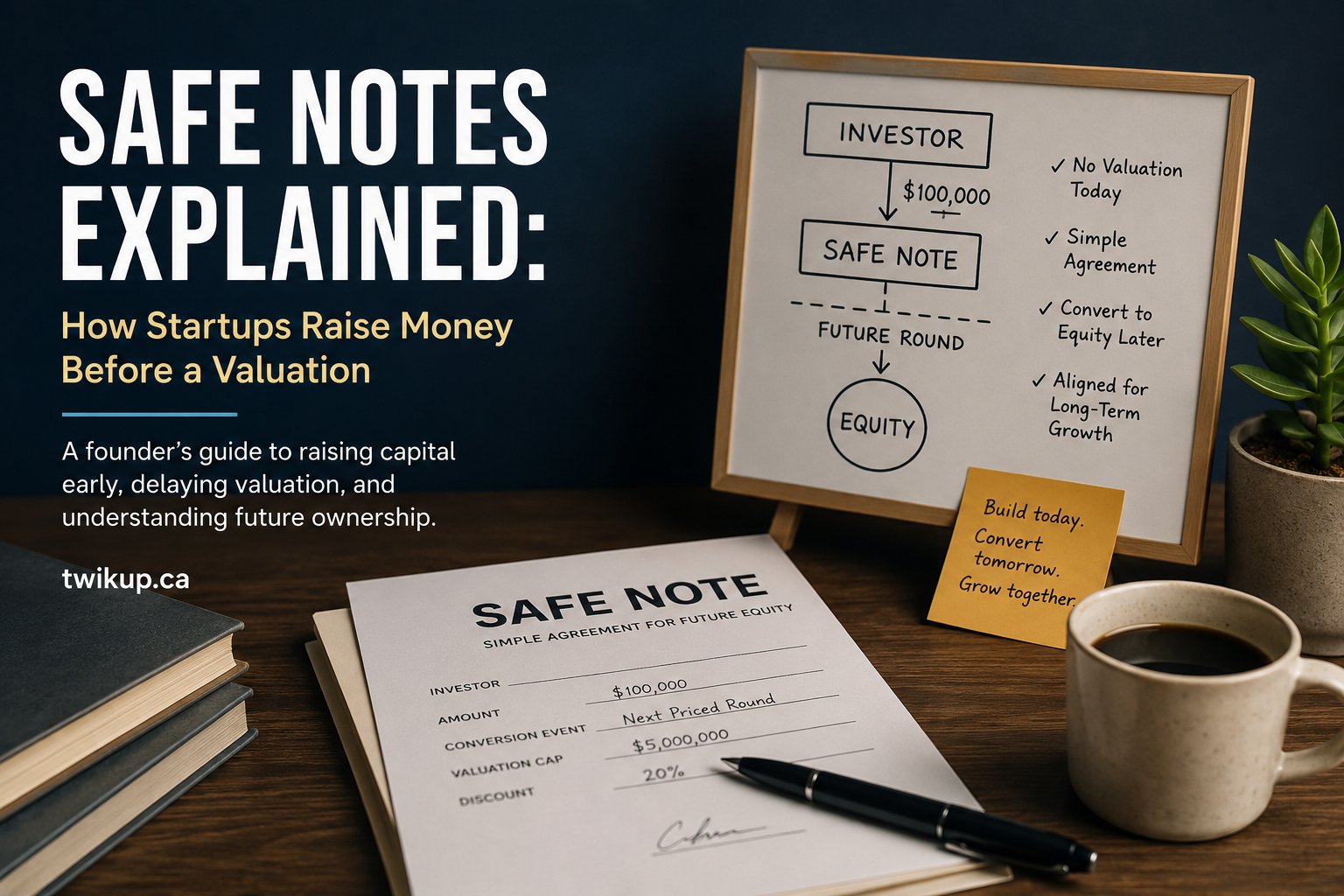
SAFE Notes Explained: How Startups Raise Money Before a Valuation
Most first-time founders believe they must determine their startup's valuation before raising investment.
In reality, many early-stage startups raise capital before anyone knows what the company is truly worth.
That's where SAFE Notes come in.
SAFE Notes have become one of the most common fundraising tools in startup ecosystems across North America, allowing founders to raise capital quickly while delaying valuation negotiations until a future funding round.
If you've ever heard investors mention terms like:
- SAFE
- Valuation Cap
- Discount Rate
- Conversion Event
- Priced Round
This guide will explain exactly what they mean and why understanding SAFE Notes can save founders from expensive mistakes later.
Quick Answer
A SAFE (Simple Agreement for Future Equity) allows investors to provide funding today in exchange for future shares in the company.
Instead of determining the company's valuation immediately, the valuation is usually decided during a future investment round when more information is available.
SAFE Notes help startups raise money faster while postponing complex valuation discussions.
What Is a SAFE Note?
SAFE stands for:
Simple Agreement for Future Equity
It was introduced by the startup accelerator Y Combinator to simplify early-stage fundraising.
Unlike traditional equity investments:
- Investors do not immediately receive shares.
- No company valuation is required today.
- No loan repayment is expected.
- No interest accumulates.
Instead:
The investor receives the right to convert their investment into shares later when a predefined event occurs.
Why Do Startups Use SAFE Notes?
Early-stage startups face a common challenge:
Investors want ownership.
Founders don't know how much the company is worth.
Imagine:
- Product still being built
- No revenue yet
- No customers yet
- No historical financial data
Trying to assign a precise valuation at this stage often becomes guesswork.
SAFE Notes solve this problem by delaying valuation discussions until the company becomes more mature.
Benefits include:
For Founders
- Faster fundraising
- Lower legal costs
- Simpler negotiations
- No immediate dilution calculation
For Investors
- Early access to promising startups
- Potentially better future share pricing
- Less paperwork
- Participation before institutional investors arrive
How Does a SAFE Note Actually Work?
Let's use a simple example.
Step 1
A founder raises:
$100,000
through a SAFE Note.
No valuation is determined.
No shares are issued.
Step 2
The company grows.
- Gains customers
- Generates revenue
- Builds traction
Step 3
One year later, the startup raises a Seed Round.
New investors invest at a valuation of:
$5 million
Now the SAFE converts into equity.
The original investor receives shares according to the SAFE agreement.
This conversion usually happens automatically.
What Triggers a SAFE Conversion?
Most SAFE Notes convert when a startup completes a future priced funding round.
Common trigger events include:
| Event | Conversion Occurs? |
|---|---|
| Seed Round | Yes |
| Series A | Yes |
| Series B | Yes |
| Acquisition | Usually |
| IPO | Usually |
| Company Shutdown | No |
The exact trigger depends on the SAFE agreement.
Understanding the Valuation Cap
One of the most important SAFE terms is the Valuation Cap.
A valuation cap protects early investors.
Example:
Investor invests:
$100,000 SAFE
Valuation Cap:
$4 million
Later the company raises at:
$10 million valuation
The SAFE investor converts as if the company were worth only $4 million.
This means they receive more shares than the new investors.
Why?
Because they took the early risk.
Understanding the Discount Rate
Some SAFE Notes use a discount instead of a valuation cap.
Example:
Future funding round valuation:
$10 million
SAFE discount:
20%
The SAFE investor converts as if shares were priced at:
$8 million valuation equivalent.
Again, this rewards investors for investing early.
Valuation Cap vs Discount
| Feature | Valuation Cap | Discount |
|---|---|---|
| Protects Investor | Yes | Yes |
| Easier to Understand | Yes | Moderate |
| More Common Today | Yes | Less Common |
| Founder Friendly | Depends | Depends |
Many SAFE agreements include both.
Investors receive whichever option gives them the better outcome.
Example: How a SAFE Can Affect Founder Ownership
Let's assume:
Founder owns:
100%
Investor provides:
$250,000 SAFE
Valuation Cap:
$5 million
Later Seed Round:
$8 million valuation
Because the SAFE converts at the lower capped valuation, the investor receives more shares than if they invested at the Seed Round valuation.
The result:
- Founder ownership decreases
- Investor ownership increases
- Cap table changes
This is why founders must understand SAFE Notes before signing them.
Common SAFE Note Mistakes Founders Make
1. Raising Too Many SAFEs
Many founders believe SAFE money is "free money."
It isn't.
Every SAFE eventually converts into ownership.
Too many SAFEs can create massive dilution later.
2. Ignoring the Cap Table Impact
Some founders sign multiple SAFE agreements without updating their cap table.
Later they discover they own much less of the company than expected.
3. Accepting Extremely Low Valuation Caps
A low cap may help close funding faster.
However, it can dramatically increase future dilution.
4. Not Understanding Investor Rights
Different SAFE agreements may include:
- Pro-rata rights
- Information rights
- Conversion preferences
Always review legal documents carefully.
5. Using Online Templates Without Legal Review
Every startup situation is unique.
A lawyer experienced in startup financing can prevent costly mistakes.
SAFE Notes vs Equity Funding
| Feature | SAFE Note | Equity Round |
|---|---|---|
| Valuation Required | No | Yes |
| Legal Complexity | Lower | Higher |
| Fundraising Speed | Faster | Slower |
| Immediate Shares Issued | No | Yes |
| Typical Stage | Pre-Seed | Seed and Later |
Most startups use SAFE Notes during:
- Pre-Seed
- Friends & Family
- Angel Investor Rounds
Why Investors Like SAFE Notes
Investors understand that early-stage startups are difficult to value.
Rather than spending months negotiating valuation, SAFE Notes allow both parties to focus on:
- Building the product
- Finding customers
- Growing the business
If the startup succeeds, investors participate in future upside.
If the startup fails, investors understand the risk.
Twikup Insight
One of the biggest misconceptions among new founders is believing that SAFE funding avoids dilution.
It does not.
SAFE Notes simply delay dilution.
The dilution appears later when the SAFE converts into shares.
Many founders celebrate raising multiple SAFE rounds because their ownership still appears unchanged on paper.
The reality often becomes visible during a Seed or Series A round when several SAFE agreements convert simultaneously.
Before signing any SAFE agreement, founders should update their cap table and model different conversion scenarios.
Understanding future ownership today can prevent unpleasant surprises tomorrow.
Key Takeaways
- SAFE stands for Simple Agreement for Future Equity.
- SAFE Notes allow startups to raise money before determining a valuation.
- Investors receive future shares instead of immediate equity.
- Valuation caps and discounts reward investors for taking early risk.
- SAFE Notes do not eliminate dilution; they postpone it.
- Founders should model future cap table impacts before accepting SAFE investments.
- SAFE Notes are among the most popular fundraising tools used in modern startup ecosystems.
Coming Next in the Twikup Startup Investing Series
Part 9: Convertible Notes vs SAFE Notes — Which Fundraising Method Is Better for Startups?
Many founders use these terms interchangeably.
They're not the same.
In Part 9, we'll break down the critical differences, hidden risks, investor preferences, and when founders should choose one over the other.