
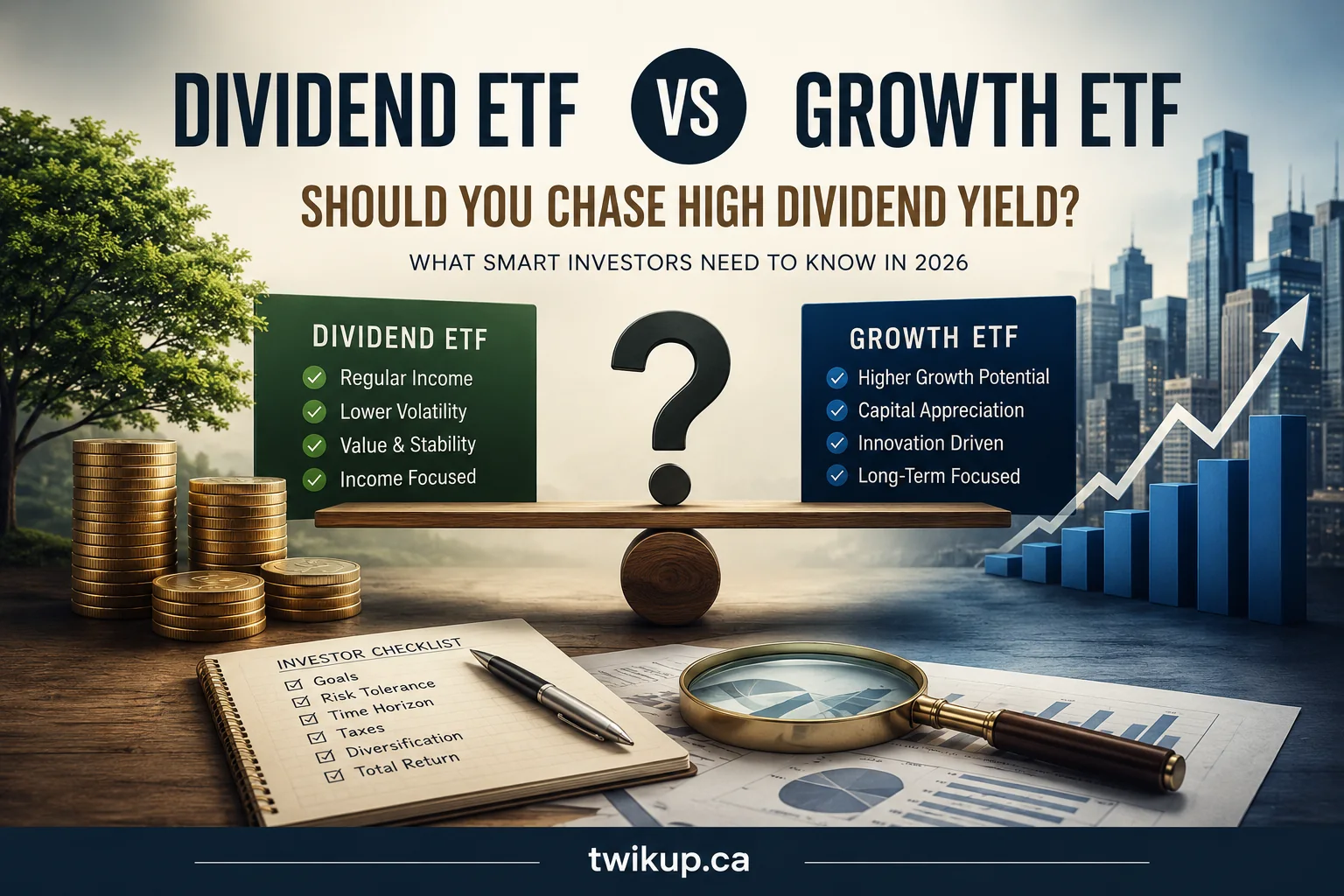
Quick Answer: Dividend ETFs and growth ETFs serve different investment objectives, and neither is automatically better in 2026. Growth ETFs offer greater exposure to companies expected to expand earnings rapidly, while dividend ETFs prioritize businesses returning cash to shareholders. However, chasing the highest dividend yield can expose investors to weaker companies, dividend cuts, and poor total returns. For long-term investors, the more important questions are diversification, valuation, risk tolerance, taxes, fees, and total return—not dividend yield alone.
Key Takeaways
- Dividend ETFs focus on companies that distribute part of their profits to shareholders.
- Growth ETFs invest primarily in companies expected to grow revenue and earnings faster than the broader market.
- A high dividend yield does not automatically mean a better investment.
- Dividend yields can rise because a company’s share price has fallen significantly.
- Growth ETFs may offer greater capital appreciation potential but can also experience larger valuation swings.
- Dividend-growth ETFs provide a third approach by focusing on companies with histories of increasing their dividends.
- Investors should compare total return, not just dividend income.
- Taxes can materially affect the after-tax returns of dividend strategies, particularly for Canadian investors holding U.S. investments.
- The best ETF strategy depends on an investor’s goals, time horizon, risk tolerance, tax situation, and need for income.
Twikup Insight: The dividend-versus-growth debate is often framed incorrectly. The real choice is not between “getting paid” and “waiting for growth.” Investors in both strategies are trying to generate returns. The difference is primarily how companies use their profits and how investors receive their share of potential value creation.
Why the Dividend vs Growth Debate Matters in 2026
The investment environment has made the debate between dividend ETFs and growth ETFs increasingly relevant.
Growth-oriented companies—particularly large technology businesses—have played a significant role in U.S. stock market performance in recent years. Artificial intelligence investment, semiconductor demand, cloud computing, and expectations for future earnings growth have helped attract enormous amounts of investor capital.
But strong performance creates new questions.
Are growth stocks becoming too expensive?
Are major indexes becoming too concentrated in a relatively small number of companies?
Should investors look toward dividend-paying businesses for greater diversification and income?
Or could abandoning growth stocks mean missing future innovation and earnings expansion?
At the same time, investors seeking alternatives to expensive growth stocks may encounter another problem: the temptation to chase unusually high dividend yields.
The result is one of the most important questions facing ETF investors in 2026:
Should you prioritize growth, dividend income, or a combination of both?
The answer begins with understanding what investors are actually buying.
What Is a Dividend ETF?
A dividend ETF is an exchange-traded fund that invests primarily in companies paying dividends to shareholders.
Instead of buying dozens or hundreds of individual dividend stocks, investors can purchase one ETF that provides exposure to a diversified portfolio.
Popular U.S.-listed dividend ETFs include:
- Schwab U.S. Dividend Equity ETF (SCHD)
- Vanguard High Dividend Yield ETF (VYM)
- Vanguard Dividend Appreciation ETF (VIG)
However, these ETFs do not follow identical strategies.
SCHD focuses on U.S. companies selected using dividend quality and fundamental criteria.
VYM emphasizes companies with above-average dividend yields.
VIG focuses on companies with records of growing their dividends over time.
This distinction is extremely important.
A high-dividend ETF and a dividend-growth ETF are not necessarily pursuing the same investment strategy.
What Is a Growth ETF?
A growth ETF invests primarily in companies expected to grow revenue, earnings, cash flow, or business value faster than the broader market.
Popular examples include:
- Vanguard Growth ETF (VUG)
- Schwab U.S. Large-Cap Growth ETF (SCHG)
- Invesco NASDAQ 100 ETF (QQQM)
Growth ETFs frequently have significant exposure to sectors such as:
- Technology
- Communication services
- Consumer discretionary businesses
Many growth companies pay relatively small dividends—or no dividends at all—because they reinvest capital into areas such as:
- Research and development
- Artificial intelligence
- New products
- International expansion
- Infrastructure
- Acquisitions
The investment thesis is straightforward.
Instead of distributing profits today, the company attempts to reinvest that capital to create greater business value in the future.
Dividend ETFs vs Growth ETFs: Quick Comparison
| Factor | Dividend ETFs | Growth ETFs |
|---|---|---|
| Primary objective | Income and potential capital appreciation | Long-term capital appreciation |
| Dividend yield | Generally higher | Generally lower |
| Company profile | Often mature, profitable businesses | Companies expected to grow rapidly |
| Sector exposure | Often financials, consumer staples, healthcare, industrials and energy | Often technology, communications and consumer discretionary |
| Volatility | Can be lower, but not guaranteed | Can experience larger valuation swings |
| Income generation | Generally stronger | Generally limited |
| Growth potential | Moderate to strong depending on strategy | Potentially higher |
| Valuation risk | Still possible | Can be significant during expensive markets |
| Best suited for | Income-focused and total-return investors | Investors seeking long-term capital appreciation |
The biggest mistake investors can make is assuming one category is universally superior.
Neither strategy guarantees higher returns.
Why Are Investors Attracted to Dividend ETFs?
Dividends are psychologically appealing.
When investors receive regular cash distributions, they can physically see part of their investment return entering their accounts.
The money can be:
- Reinvested
- Used for living expenses
- Allocated to other investments
- Held as cash
This can make dividend investing feel more predictable than relying entirely on rising share prices.
Dividend ETFs may be particularly attractive to retirees and other investors who want regular portfolio income.
But dividend income creates an important misconception.
Receiving a dividend does not automatically make an investor wealthier.
Do Dividends Actually Create Free Money?
No.
When a company distributes cash to shareholders, that money leaves the company.
Consider a simplified example.
Imagine a company worth $100 per share pays a $5 dividend.
The investor receives $5 in cash, but the company now has $5 less cash available.
In an efficient market, the share price generally adjusts to reflect the distribution.
This means investors should not evaluate an investment based only on the amount of dividends received.
The more meaningful measurement is total return.
Total return considers both capital appreciation and investment income.
For example:
| Investment | Capital Appreciation | Dividend Income | Total Return |
|---|---|---|---|
| Investment A | 12% | 1% | 13% |
| Investment B | 5% | 6% | 11% |
Investment B produced significantly more dividend income.
But Investment A generated the higher total return.
This same principle becomes even more important when evaluating options-based income strategies. Investors attracted to large monthly distributions may also want to understand how covered call ETFs generate income and why high distributions can sometimes come at the cost of long-term growth.
Twikup Insight: A dividend payment can feel like an additional return, but economically, investors should focus on the combined result of income and price appreciation. A 7% dividend yield cannot compensate for permanently weak business performance if the investment consistently loses value.
Should You Chase High Dividend Yields?
This is where dividend investing becomes potentially dangerous.
Many investors search for investments offering:
- 6% yields
- 8% yields
- 10% yields
- Or even higher distributions
The assumption is simple:
Higher dividend yield = more investment income = better investment.
But dividend yields can rise for two very different reasons.
A company can increase its dividend.
Or its stock price can fall.
Consider this simplified example.
A company pays an annual dividend of $5 while its shares trade at $100.
Its dividend yield is 5%.
Now imagine the company experiences serious financial problems and its share price falls to $50.
If the dividend has not yet been reduced, the yield becomes 10%.
The company suddenly appears to offer twice as much yield.
But nothing has necessarily improved.
In fact, the business may be significantly weaker.
This is one of the most important concepts for dividend investors to understand.
An unusually high dividend yield can sometimes be a warning sign rather than an opportunity.
What Is a Dividend Yield Trap?
A dividend yield trap occurs when investors are attracted to a high yield without adequately considering the financial health of the underlying company.
The pattern can look like this:
- A company experiences financial difficulties.
- Investors sell the stock.
- The share price falls.
- The dividend yield mathematically increases.
- Income-focused investors become attracted to the high yield.
- The company eventually reduces or eliminates the dividend.
- Investors potentially suffer both capital losses and reduced income.
This does not mean every high-yield investment is dangerous.
It means investors need to investigate why the yield is high.
The same warning applies beyond traditional dividend ETFs. Some investors move toward covered call ETFs because of their much larger headline distributions, but high ETF income should always be evaluated alongside total return, NAV performance, fees, taxes, and the potential upside being sacrificed.
High Dividend Yield vs Dividend Growth
One of the most overlooked distinctions in ETF investing is the difference between high dividend yield and dividend growth.
A high-yield strategy prioritizes companies currently paying relatively large dividends.
A dividend-growth strategy focuses on companies capable of increasing their dividends over time.
Consider two hypothetical companies.
| Company | Current Yield | Annual Dividend Growth |
|---|---|---|
| Company A | 7% | 0% |
| Company B | 2% | 10% |
An income-focused investor may immediately prefer Company A.
But Company B may have:
- Faster earnings growth
- Stronger cash flow
- Lower payout ratios
- Greater potential for future dividend increases
Over long investment periods, dividend growth can become extremely powerful.
This is why ETFs such as VIG follow a fundamentally different philosophy from ETFs designed primarily to maximize current yield.
VUG vs SCHD vs VIG: Three Different Investment Philosophies
One way to understand the dividend-versus-growth debate is to compare three different strategies.
VUG: Growth Investing
VUG provides exposure to large U.S. growth companies.
The strategy emphasizes businesses expected to generate above-average growth.
Investors may benefit from:
- Earnings expansion
- Innovation
- Technological development
- Capital appreciation
The primary risks include:
- High valuations
- Market concentration
- Greater sensitivity to interest rates
- Larger declines when growth expectations weaken
SCHD: Dividend and Fundamental Quality
SCHD combines dividend investing with fundamental screening criteria.
Rather than simply selecting the highest-yielding stocks, the ETF considers factors related to company quality and dividend sustainability.
Investors may benefit from:
- Dividend income
- Exposure to established businesses
- Diversification away from some mega-cap growth stocks
Potential disadvantages include:
- Underperformance during growth-driven markets
- Sector concentration
- Slower exposure to emerging technologies
VIG: Dividend Growth
VIG focuses on companies with records of increasing dividends.
The strategy sits somewhere between traditional high-yield investing and broader quality investing.
Potential advantages include:
- Exposure to established companies
- Growing dividend income
- Emphasis on financially durable businesses
Potential disadvantages include:
- Lower current yield than some high-dividend ETFs
- No guarantee of superior total returns
- Potential underperformance relative to aggressive growth strategies
Twikup Insight: The most interesting investment debate in 2026 may not be “dividends versus growth.” It may be growth versus high yield versus dividend growth. These three strategies solve different investor problems and carry different risks.
If You Invested $10,000 Today, Which Strategy Could Make More Sense?
Imagine three investors each have $10,000.
Investor A purchases a growth ETF.
Investor B purchases a high-dividend ETF.
Investor C purchases a dividend-growth ETF.
What happens next?
Nobody knows.
And that is precisely the point.
Future investment returns cannot be predicted reliably from past performance.
The growth ETF could outperform if:
- Corporate earnings continue expanding rapidly
- Artificial intelligence investment creates significant economic value
- Interest rates become supportive of growth valuations
- Technology companies maintain strong profitability
The dividend ETF could outperform if:
- Investors rotate toward value-oriented companies
- Growth valuations decline
- Income becomes increasingly attractive
- Dividend-paying sectors perform strongly
The dividend-growth ETF could outperform if:
- High-quality companies continue increasing profits
- Investors favor financial strength and durable cash flows
- Markets reward consistent earnings rather than speculative growth
The correct decision cannot be determined solely by asking:
Which ETF performed best last year?
Historical comparisons can still help investors understand how different ETF structures behave over long periods. For example, Canadian investors comparing two funds tracking the same major U.S. index can examine how a hypothetical $10,000 investment in VFV versus ZSP would have performed over the previous decade.
Past performance cannot predict future returns, but historical analysis can reveal how fees, tracking differences, distributions, and fund structure may influence investor outcomes.
Why Total Return Matters More Than Dividend Yield
Consider two hypothetical $10,000 investments held for one year.
Investment A: High Dividend ETF
- Starting investment: $10,000
- Dividend income: $700
- Capital loss: $1,000
- Ending economic value: $9,700
Investment B: Growth ETF
- Starting investment: $10,000
- Dividend income: $100
- Capital appreciation: $1,200
- Ending economic value: $11,300
The high-dividend investment generated seven times more income.
But the growth investment produced the better overall result.
The opposite scenario could also occur.
Growth stocks could decline significantly while dividend-paying companies remain more resilient.
This is why investors should evaluate:
- Capital appreciation
- Dividends
- Fees
- Taxes
- Inflation
- Risk
Together.
Not separately.
Are Growth ETFs Too Expensive in 2026?
This is one of the most important questions facing investors.
Strong enthusiasm surrounding artificial intelligence and large technology companies has contributed to significant investor interest in growth-oriented businesses.
But strong performance can create valuation risk.
When investors pay increasingly high prices for expected future earnings, companies may need to deliver exceptional results simply to justify those valuations.
A great company can still be a disappointing investment if purchased at an excessively high price.
Growth investors should consider:
- Price-to-earnings ratios
- Expected earnings growth
- Market concentration
- Sector exposure
- Interest-rate sensitivity
However, expensive valuations do not automatically mean growth stocks are about to collapse.
Markets can remain expensive for extended periods.
Trying to perfectly time the transition between growth and value strategies is extremely difficult.
Are Dividend ETFs Safer During Market Crashes?
Not necessarily.
Dividend-paying companies can still experience significant losses.
During recessions and financial crises:
- Corporate earnings can decline
- Dividends can be reduced
- Companies can suspend distributions
- Share prices can fall
Dividend ETFs may have different sector exposures than growth ETFs, which can affect performance during different market environments.
But investors should not assume that receiving dividends eliminates market risk.
Dividend ETFs are still equity investments.
Their value can decline.
Are Growth ETFs Better for Young Investors?
Young investors often have longer investment horizons.
This can potentially give them more time to recover from market declines and benefit from long-term economic growth.
As a result, growth-oriented investments may appear attractive.
However, age alone should not determine investment strategy.
A young investor may still have:
- Low risk tolerance
- Short-term financial goals
- High-interest debt
- Limited emergency savings
- A need for greater diversification
Similarly, a retired investor may still want growth exposure to help protect purchasing power over a potentially long retirement.
Investment decisions should consider the investor’s complete financial situation.
Are Dividend ETFs Better for Retirees?
Dividend ETFs can potentially provide regular income.
This may make them attractive to retirees.
However, relying exclusively on dividends can create several problems.
A portfolio may become:
- Overexposed to certain sectors
- Insufficiently diversified
- Too focused on current income
- Vulnerable to dividend cuts
Retirement planning should generally consider the entire portfolio rather than dividend yield alone.
Potential sources of retirement cash flow can include:
- Dividends
- Interest
- Capital gains
- Cash reserves
- Pension income
- Government benefits
The objective is typically sustainable income—not simply maximizing dividend yield.
Should You Own Both Dividend and Growth ETFs?
Some investors may decide they do not need to choose exclusively between the two strategies.
A portfolio could potentially contain:
- Growth investments
- Dividend-paying companies
- Dividend-growth companies
- Bonds
- International investments
- Cash
However, investors should be careful about unnecessary ETF overlap.
Owning several ETFs does not automatically create better diversification.
Two different ETFs may own many of the same companies.
Before combining funds, investors should examine:
- Top holdings
- Sector allocations
- Geographic exposure
- Investment objectives
- Fees
The number of ETFs in a portfolio matters less than the underlying investments they actually contain.
What About Broad-Market Index ETFs?
There is another option frequently overlooked in the dividend-versus-growth debate.
Investors do not necessarily have to choose either strategy.
Broad-market ETFs can provide exposure to:
- Growth companies
- Dividend companies
- Value companies
- Multiple economic sectors
For many long-term investors, the more relevant question may be:
Do I need to deliberately tilt my portfolio toward dividends or growth at all?
A broad-market strategy can allow market capitalization and company performance to determine portfolio exposure over time.
For Canadian investors, this raises another important decision: whether to buy a Canadian-listed S&P 500 ETF or invest through a U.S.-listed fund. Twikup explores the differences in Should Canadians Buy VFV or Invest Directly in the S&P 500?, including considerations around currency, taxes, account type, and investment structure.
Twikup Insight: Sometimes the most important investment decision is recognizing when you do not need to make an additional decision. Investors choosing between multiple specialized ETFs should first ask whether a diversified broad-market fund already provides the exposure they need.
U.S. vs Canadian Investors: Taxes Can Change the Calculation
Tax considerations can materially affect investment returns.
For U.S. investors, dividend taxation can vary depending on factors including:
- Whether dividends are qualified
- The type of investment account
- The investor’s income and tax situation
Canadian investors purchasing U.S.-listed dividend ETFs face additional considerations.
These can include:
- U.S. withholding taxes
- RRSP treatment
- TFSA treatment
- Non-registered account taxation
- Currency conversion costs
The tax efficiency of an ETF can depend significantly on where it is held.
This is particularly important for dividend strategies because a larger portion of potential returns may be distributed regularly.
Canadian investors deciding between Canadian-listed and U.S.-listed S&P 500 exposure may want to examine the differences between buying VFV and investing directly through a U.S.-listed S&P 500 ETF.
Canadian investors should understand the tax implications before selecting a U.S.-listed ETF based solely on its yield.
How to Evaluate a Dividend ETF Before Investing
Before buying a dividend ETF, investors may want to examine several factors.
1. Understand the Index Methodology
How does the ETF select companies?
Does it prioritize:
- Maximum yield?
- Dividend growth?
- Financial quality?
- Low volatility?
2. Look Beyond the Headline Yield
Ask why the yield is high.
A large distribution is not automatically sustainable.
3. Examine Sector Concentration
Dividend strategies can become heavily exposed to specific industries.
4. Review Dividend Sustainability
Consider the financial strength of the underlying businesses.
5. Compare Total Returns
Do not evaluate the investment solely on distributions.
6. Understand the Fees
Higher costs reduce investment returns over time.
7. Consider Taxes
The same ETF can produce different after-tax outcomes depending on the investor and account type.
8. Check Portfolio Overlap
Investors holding multiple ETFs should determine whether they are repeatedly buying the same companies.
Which Makes More Sense in Today’s Market?
There is no universal answer.
Growth ETFs may appeal to investors seeking long-term capital appreciation and willing to accept potentially significant valuation swings.
Dividend ETFs may appeal to investors seeking regular income and exposure to established dividend-paying businesses.
Dividend-growth ETFs may appeal to investors who want exposure to companies with histories of increasing shareholder distributions.
Broad-market ETFs may appeal to investors who prefer not to deliberately favor one investment style.
Covered call ETFs represent another alternative for income-focused investors, but they introduce a different trade-off by potentially exchanging part of the market’s future upside for current distributions. Investors considering that strategy can read Twikup’s complete guide to whether covered call ETFs are a passive income strategy or a potential performance trap.
The critical point is this:
Investors should not choose an ETF simply because its recent performance was strong or its dividend yield looks attractive.
The decision should consider:
- Investment objectives
- Time horizon
- Risk tolerance
- Diversification
- Valuation
- Fees
- Taxes
- Total return
Final Verdict
Dividend ETFs and growth ETFs can both play legitimate roles in an investment portfolio.
The biggest mistake is assuming that one strategy always wins.
Growth companies can generate exceptional long-term returns—but paying excessive valuations can increase risk.
Dividend-paying companies can provide valuable income—but chasing unusually high yields can expose investors to dividend cuts, weak businesses, and capital losses.
Dividend-growth strategies offer another alternative, while broad-market ETFs allow investors to own multiple investment styles simultaneously.
For investors navigating the 2026 market, the most useful question may not be:
“Which ETF pays the biggest dividend?”
Or:
“Which growth ETF increased the most?”
A better question is:
“Which investment strategy best matches my financial goals, time horizon, risk tolerance, tax situation, and need for diversification?”
That question is less exciting than chasing the market’s hottest investment trend.
But over the long term, it may be far more important.
Twikup Insight: Income feels tangible. Growth feels exciting. Neither feeling should determine an investment decision. A sustainable investment strategy begins with understanding what you own, why you own it, what risks you are taking, and how the investment contributes to your overall financial plan.
Frequently Asked Questions
Are dividend ETFs better than growth ETFs?
Neither strategy is universally better. Dividend ETFs generally emphasize income-producing companies, while growth ETFs prioritize businesses expected to expand earnings more rapidly. The better fit depends on an investor’s objectives, risk tolerance, time horizon, tax situation, and overall portfolio.
Is a high dividend yield good?
A high dividend yield can provide significant income, but it can also indicate increased risk. Yields may rise because share prices have fallen, and financially stressed companies may eventually reduce their dividends.
Can you lose money with dividend ETFs?
Yes. Dividend ETFs are equity investments, and their market value can decline. Companies held by the ETF may also reduce or eliminate dividends.
Are growth ETFs risky?
Growth ETFs can experience significant volatility, particularly when valuations are high, interest rates change, or expected corporate earnings fail to materialize.
Is SCHD a growth ETF?
No. SCHD is generally categorized as a dividend-focused ETF that selects companies using dividend and fundamental criteria.
Is VIG a high-dividend ETF?
VIG primarily focuses on companies with records of dividend growth rather than maximizing current dividend yield.
Should young investors choose growth ETFs?
Some young investors may prefer greater growth exposure because of their longer investment horizons, but age alone should not determine an investment strategy.
Should retirees only invest in dividend ETFs?
Not necessarily. Retirees may require diversification, capital growth, fixed-income exposure, and other sources of cash flow in addition to dividends.
Can I own dividend ETFs and growth ETFs together?
Yes, but investors should examine portfolio overlap and ensure that combining multiple ETFs actually improves diversification.
What matters more: dividend yield or total return?
For evaluating overall investment performance, total return provides a more complete picture because it considers both investment income and capital appreciation.
Twikup is not registered as an investment dealer, adviser, or portfolio manager, and nothing in this article should be interpreted as a recommendation to buy, sell, or hold any security or investment product.
Financial Disclaimer
This article is provided for general educational and informational purposes only and does not constitute financial, investment, tax, legal, or accounting advice. It does not consider any individual investor’s objectives, financial situation, risk tolerance, tax circumstances, or investment needs.
References to specific securities, ETFs, companies, or investment strategies are for illustrative and educational purposes only and should not be interpreted as recommendations, endorsements, solicitations, or offers to buy or sell any security.
Investment values can rise or fall, dividends are not guaranteed, and investors may lose some or all of their invested capital. Past performance does not guarantee future results. Tax rules and investment regulations may change over time and can vary by jurisdiction and individual circumstances.
Before making financial or investment decisions, consider conducting independent research and consulting appropriately qualified financial, tax, or legal professionals where necessary.