
Raising Capital? Here's What Investors Really Look For Before Funding a Startup
Raising capital is often seen as the biggest challenge in building a startup. Yet, for most founders, the investment decision begins long before financial due diligence or legal reviews ever take place.
Experienced investors can often determine within the first few meetings whether a startup is worth pursuing. They are not simply evaluating an idea—they are assessing the team behind it, the size of the opportunity, the evidence that customers care, and whether the business has the potential to generate meaningful returns.
Understanding how investors think is one of the most valuable advantages a founder can have. The better you understand their decision-making process, the better you can prepare your startup before asking for capital.
Whether you're raising your first seed round or preparing to approach angel investors, knowing what investors expect can dramatically improve your chances of progressing beyond that first meeting.
Missed Part 1?
Before diving into what investors evaluate, start with the first article in this series:
How First-Time Founders Can Raise Their First Investment
https://twikup.ca/money/investing/how-first-time-founders-can-raise-their-first-investment
This guide explains where founders typically raise their first capital, how to prepare for fundraising, and the essential documents investors expect before the first pitch.
Why Most Startups Never Reach Due Diligence
Many first-time founders imagine investors carefully reviewing every startup that lands in their inbox.
The reality is far different.
Angel investors, venture capital firms and institutional funds collectively review hundreds—or even thousands—of investment opportunities each year. Only a small percentage move beyond the initial screening stage, and an even smaller number receive funding.
Research from CB Insights consistently shows that the leading reason startups fail is the absence of market demand, followed by challenges such as running out of cash, pricing issues, team problems and strong competition.
That same risk-focused thinking shapes investment decisions.
During an initial meeting, investors aren't trying to prove your startup will succeed.
They're trying to determine whether the risks are manageable enough to justify investing more time.
Some of the most common reasons startups are rejected before due diligence include:
- The problem being solved isn't clearly defined.
- The market opportunity appears too small.
- The founders lack relevant experience.
- Customer demand hasn't been validated.
- Financial projections appear unrealistic.
- Competitive positioning is weak.
- The business model lacks clarity.
- Founders cannot explain why now is the right time to build the company.
Rather than asking, "Is this a great idea?", investors are often asking:
- Can this team execute?
- Does the market exist?
- Is there evidence customers care?
- Can this business scale?
- Does the potential return justify the risk?
This subtle difference explains why many promising ideas never receive funding.
💡 TwikUp Insight
Most founders believe fundraising is about convincing investors.
In reality, successful fundraising is about systematically reducing uncertainty.
Every customer interview, pilot project, retained user, recurring customer and measurable milestone lowers investment risk. Great founders don't eliminate uncertainty—they continuously replace assumptions with evidence.
How Professional Investors Evaluate Startup Opportunities
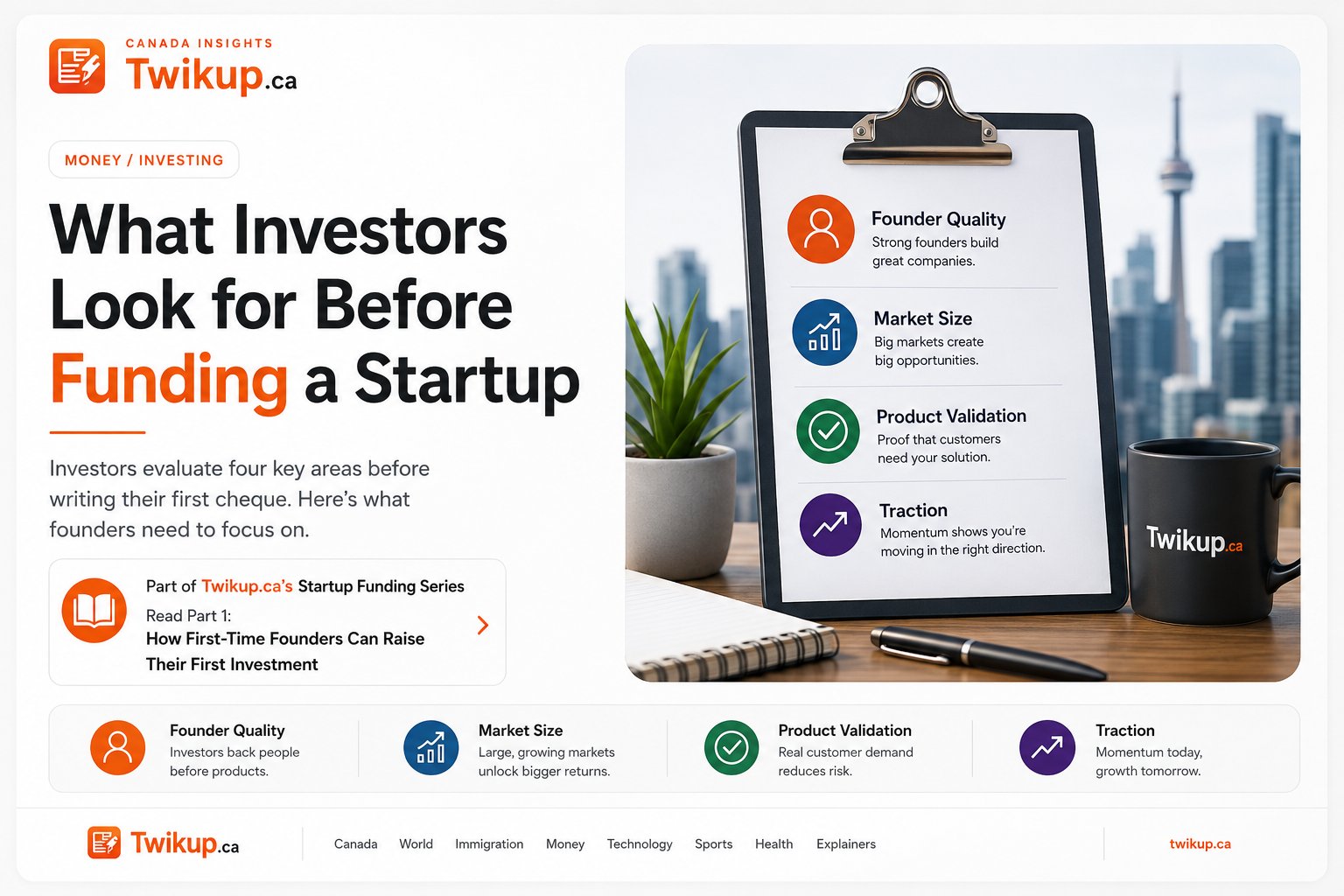
Although every investor has their own investment philosophy, most evaluate startups using four fundamental questions:
| Investor Question | What They're Really Trying to Understand |
|---|---|
| Can this team execute? | Founder quality and leadership |
| Is the opportunity large enough? | Market size and scalability |
| Do customers actually want this? | Product validation |
| Is the business gaining momentum? | Traction and measurable progress |
These four areas form the foundation of most investment decisions—from angel investors writing their first cheque to institutional venture capital firms managing hundreds of millions of dollars.
Let's examine each one in detail.
1. Founder Quality Often Matters More Than the Product
One of the most repeated sayings in venture capital is:
"We'd rather invest in an A-team with a B-product than a B-team with an A-product."
Products evolve.
Markets change.
Technology advances.
Founders, however, make thousands of decisions that determine whether a company survives those changes.
That's why experienced investors frequently evaluate founders before they evaluate features.
Paul Graham, co-founder of Y Combinator, summarizes startup success with one of the most widely quoted pieces of startup advice:
"Make something people want."
Although simple, that statement reflects a deeper truth.
Founders who remain obsessed with solving customer problems usually outperform founders obsessed with perfecting products.
What Investors Look for in Founders
Industry Knowledge
Investors prefer founders who deeply understand the industry they're entering.
That doesn't necessarily mean decades of experience.
It means understanding:
- customer frustrations
- existing alternatives
- purchasing behaviour
- industry regulations
- emerging trends
For example, a fintech founder who previously worked in banking often begins with greater credibility than someone entering the industry with no domain knowledge.
Execution Ability
Ideas rarely impress investors on their own.
Execution does.
Investors ask questions like:
- What have you already built?
- What assumptions have you tested?
- What customer feedback have you collected?
- What milestones have you achieved without outside funding?
Founders who demonstrate consistent execution reduce perceived investment risk significantly.
Coachability
One characteristic consistently mentioned by experienced investors is coachability.
Investors don't expect founders to know everything.
They do expect them to:
- listen carefully
- absorb feedback
- challenge ideas thoughtfully
- adapt when new evidence appears
A founder who refuses feedback today may ignore customers tomorrow.
That becomes a major investment concern.
Resilience During Uncertainty
Every startup encounters setbacks.
Customers leave.
Competitors launch.
Hiring becomes difficult.
Funding takes longer than expected.
Rather than asking whether challenges will occur, investors ask whether founders can continue executing despite them.
Marc Andreessen, co-founder of Andreessen Horowitz, has frequently emphasized that startups succeed by finding product-market fit—the point where the market actively pulls the product forward.
Reaching that stage almost always requires multiple iterations, making resilience one of the most valuable founder qualities.
A Practical Example
Imagine two founders pitching similar software products.
Founder A
- MBA graduate
- Beautiful pitch deck
- No customers
- No product
- Limited industry experience
Founder B
- Five years working in the industry
- Functional MVP
- Twelve pilot customers
- Monthly customer interviews
- Product improvements based on feedback
Even if Founder A delivers the stronger presentation, many investors would likely spend more time evaluating Founder B because execution has already begun reducing uncertainty.
Evidence consistently outweighs ambition.
Founder Signals That Increase Investor Confidence
Investors often gain confidence when founders can demonstrate:
| Strong Signal | Why It Matters |
|---|---|
| Domain expertise | Shows understanding of customer problems |
| Full-time commitment | Demonstrates long-term focus |
| Product already built | Reduces execution risk |
| Customer conversations | Confirms problem validation |
| Fast iteration cycles | Shows learning ability |
| Transparent communication | Builds investor trust |
| Clear decision-making | Indicates leadership maturity |
Notice that none of these signals require millions in revenue.
Most can be achieved before raising institutional investment.
Internal Resource
If you're still preparing for your first fundraising process, revisit Part 1: How First-Time Founders Can Raise Their First Investment to ensure you've built the essential fundraising foundation before approaching investors.
In the next section, we'll examine another factor that can determine whether investors continue the conversation—or walk away after the first meeting: market size and opportunity.
2. Market Size Determines the Opportunity
Even the most talented founders can struggle to raise capital if investors believe the market opportunity is too small.
From an investor's perspective, startup investing is a game of probabilities. Most venture-backed companies will never become billion-dollar businesses, so investors rely on a handful of exceptional performers to generate returns across their entire portfolio.
That means a great product serving a tiny market may never deliver the scale venture investors require.
Simply put:
A great business is not always a venture-scale business.
Understanding this distinction helps founders target the right investors and set realistic fundraising expectations.
Investors Want More Than a Big Number
One of the biggest mistakes founders make is presenting an enormous market size without explaining how they plan to capture it.
Statements like:
- "The global market is worth $500 billion."
- "If we capture just 1% of the market..."
rarely impress experienced investors.
Instead, investors want founders to demonstrate a structured understanding of the market using three key concepts:
| Metric | Meaning | Why Investors Care |
|---|---|---|
| TAM (Total Addressable Market) | Total revenue opportunity if every potential customer used your solution | Shows long-term potential |
| SAM (Serviceable Available Market) | Portion of the market your product can realistically serve | Demonstrates focus |
| SOM (Serviceable Obtainable Market) | Market share you can realistically capture over the next few years | Reflects execution capability |
Investors generally place the greatest emphasis on SOM, because it reflects realistic growth rather than optimistic assumptions.
Example: Understanding TAM, SAM and SOM
Imagine you're building HR software for small businesses in Canada.
- TAM: Every business worldwide that could use HR software.
- SAM: Canadian businesses with fewer than 500 employees.
- SOM: The number of Canadian companies you realistically expect to acquire within your first three to five years.
This approach demonstrates disciplined thinking and gives investors confidence that your projections are grounded in reality.
💡 TwikUp Insight
Investors are rarely impressed by billion-dollar market claims.
They're impressed when founders can clearly explain who their first 100 customers are, why they'll buy, and how they'll reach them efficiently.
A realistic growth strategy builds far more credibility than an oversized market estimate.
Investors Also Look for Market Timing
Even strong products can fail if the market isn't ready.
Professional investors often ask:
- Why is this problem becoming more important now?
- What has changed in technology, regulation or consumer behaviour?
- Why couldn't this company have been built five years ago?
These questions help investors understand whether your startup is riding a long-term trend or chasing a short-lived opportunity.
For example:
- The rise of artificial intelligence has created entirely new software categories.
- Remote work accelerated demand for collaboration platforms.
- Digital banking regulations opened opportunities for fintech startups.
- Climate policies continue driving investment into clean technology.
Founders who can explain why now often create a more compelling investment narrative.
Large Markets Alone Don't Guarantee Funding
A massive market is only attractive if customers are willing to pay for your solution.
Investors also evaluate:
- Customer purchasing power
- Competitive intensity
- Switching costs
- Customer acquisition difficulty
- Pricing potential
- Long-term retention
A startup entering a smaller but underserved niche may be more attractive than one competing against dozens of well-funded incumbents.
Market quality often matters just as much as market size.
Canadian Investors Often Evaluate Local Market Potential First
For founders raising capital in Canada, investors frequently expect evidence that you've validated your business locally before expanding internationally.
Many Canadian startups successfully begin by proving traction in one province or region before entering the United States or global markets.
Organizations such as:
- Business Development Bank of Canada (BDC)
- MaRS Discovery District
- Communitech
- National Angel Capital Organization (NACO)
often encourage founders to demonstrate product-market fit before pursuing rapid expansion.
Showing strong execution in your initial market typically carries more weight than presenting ambitious international growth projections without evidence.
Real-World Example
Consider two startups entering the same industry.
Startup A
- Claims a $200 billion global market
- No defined customer segment
- No pricing strategy
- No acquisition plan
Startup B
- Targets independent dental clinics in Ontario
- Has interviewed 150 clinic owners
- Five clinics already paying for the software
- Expansion roadmap across Canada over the next three years
Although Startup A presents the larger opportunity, Startup B often appears less risky because its growth strategy is based on validated customer behaviour rather than assumptions.
3. Product Validation Reduces Investment Risk
One of the fastest ways to lose investor confidence is to confuse an idea with evidence.
Founders naturally believe in their products.
Investors believe in customer behaviour.
That's why product validation sits at the centre of almost every early-stage investment decision.
According to CB Insights, the number one reason startups fail is that there is no market need for their product.
Experienced investors know this.
As a result, one of their first questions is rarely:
"How good is your product?"
Instead, they ask:
"How do you know customers actually want it?"
That single question separates assumptions from evidence.
What Counts as Validation?
Validation is any measurable proof that real people experience the problem you're solving and are willing to invest time, money or attention in your solution.
Depending on your stage, validation may include:
- Customer discovery interviews
- Pilot projects
- Waiting lists
- Beta users
- Letters of Intent (LOIs)
- Signed partnerships
- Paying customers
- Subscription renewals
- Referral growth
- Positive customer testimonials
The stronger the evidence, the lower the perceived investment risk.
Validation Is Different at Every Stage
Investors don't expect a pre-seed startup to have millions in annual revenue.
Instead, they evaluate validation relative to the company's maturity.
| Startup Stage | Strong Validation Signals |
|---|---|
| Idea Stage | 100+ customer interviews, problem validation, surveys, waiting list |
| MVP Stage | Active beta users, pilot customers, product feedback, repeat usage |
| Early Revenue | Paying customers, recurring revenue, customer retention |
| Growth Stage | Expansion, enterprise contracts, referral growth, strong unit economics |
This is why founders shouldn't compare themselves with companies that are years ahead in their journey.
The question isn't:
"How big are you?"
It's:
"Are you making measurable progress for your current stage?"
Validation Without Revenue Still Matters
Many founders assume they must generate significant revenue before investors take them seriously.
That's not always true.
A startup with:
- 250 customer interviews,
- 40 businesses on a waiting list,
- 12 successful pilot customers,
- and weekly product improvements based on feedback,
may attract more investor interest than another startup earning modest revenue but showing little customer engagement or retention.
Investors recognise that engaged customers often predict future revenue more reliably than early sales alone.
Continue Reading
As customer validation strengthens, investors begin looking for one final piece of evidence:
Momentum.
In the next section, we'll explore how investors measure traction, the metrics that matter at different startup stages, and why consistent progress often matters more than company size.
4. Traction Demonstrates Momentum
If product validation proves that customers want your solution, traction proves they're continuing to use it.
This is one of the biggest differences between startups that receive polite investor feedback and startups that receive follow-up meetings.
Investors understand that every startup begins small.
They are not expecting millions in annual revenue from a pre-seed company.
Instead, they're asking a much simpler question:
"Is this business moving in the right direction?"
Consistent progress—even if it's modest—is often more valuable than one impressive but isolated milestone.
Why Investors Care About Momentum
Most venture-backed startups raise multiple funding rounds over several years.
That means investors aren't only evaluating where your company is today.
They're evaluating how quickly it's improving.
Imagine two startups after six months.
Startup A
- 1,000 users
- Flat growth
- No repeat customers
- No product improvements
Startup B
- 350 users
- 20% month-over-month growth
- Customers returning every week
- Product improving after every customer interview
Many investors would spend more time with Startup B because it demonstrates momentum rather than stagnation.
Momentum suggests that the founders are learning, adapting and steadily reducing risk.
What Traction Looks Like at Different Startup Stages
One of the biggest misconceptions among founders is that traction only means revenue.
In reality, traction evolves as the company grows.
| Startup Stage | Meaningful Traction |
|---|---|
| Idea Stage | Customer interviews completed, newsletter sign-ups, waitlist growth |
| MVP Stage | Active users, weekly engagement, pilot customers, feature adoption |
| Early Revenue | Paying customers, monthly recurring revenue (MRR), renewals, referrals |
| Growth Stage | Revenue growth, profitability, enterprise contracts, expansion into new markets |
Investors evaluate traction relative to your stage—not against companies that have already raised millions.
Metrics Investors Commonly Review
Different startups require different performance indicators.
SaaS Startups
Investors often review:
- Monthly Recurring Revenue (MRR)
- Customer Retention
- Churn Rate
- Customer Acquisition Cost (CAC)
- Lifetime Value (LTV)
- Net Revenue Retention (NRR)
Example:
A SaaS company growing MRR by 15–20% month-over-month during the early stages often attracts stronger investor interest than one showing inconsistent growth.
Marketplace Businesses
Typical metrics include:
- Gross Merchandise Value (GMV)
- Buyer growth
- Seller growth
- Repeat transactions
- Marketplace liquidity
- Average order value
Consumer Apps
Investors usually focus on:
- Daily Active Users (DAU)
- Monthly Active Users (MAU)
- User retention
- Session length
- Referral rate
- Organic growth
For example, an app with 10,000 downloads but only 300 monthly active users is generally less attractive than one with 3,000 downloads and 2,200 active monthly users.
Engagement matters more than downloads.
D2C & E-commerce Startups
Important metrics include:
- Repeat purchase rate
- Average Order Value (AOV)
- Customer Lifetime Value
- Gross Margin
- Customer reviews
- Return rate
Strong customer loyalty often signals long-term business sustainability.
Investors Prefer Trends Over Snapshots
A common mistake is presenting a single impressive metric.
Instead, investors look for consistent improvement over time.
For example:
| Weak Presentation | Strong Presentation |
|---|---|
| "We have 5,000 users." | "We've grown users by 18% every month for the last eight months." |
| "Revenue reached $20,000." | "Revenue has doubled every quarter while maintaining 92% customer retention." |
| "We launched six months ago." | "Customer acquisition cost has fallen 35% while referrals continue increasing." |
Patterns build confidence.
One-time achievements rarely do.
Strong Startup vs Weak Startup Signals
The following comparison reflects how many professional investors evaluate early-stage businesses.
| Area | Weak Signal | Strong Signal |
|---|---|---|
| Founder | Vision only | Proven execution |
| Market | Huge but undefined | Clearly defined TAM, SAM and SOM |
| Validation | Assumptions | Customer interviews and pilot users |
| Product | Prototype only | Customers actively using product |
| Traction | Flat growth | Consistent month-over-month growth |
| Competition | "We have no competitors." | Deep understanding of alternatives |
| Financials | Unrealistic projections | Assumption-based forecasting |
| Pitch | Feature-focused | Problem, customer and execution-focused |
Founders don't need perfection across every category.
However, the more strong signals you can demonstrate, the easier it becomes for investors to justify continuing the conversation.
💡 TwikUp Insight
Investors rarely expect perfection.
They expect progress.
A founder who consistently ships improvements, speaks with customers every week and measures key business metrics often becomes far more investable than someone waiting until everything feels "ready."
Progress compounds.
So does investor confidence.
How the Fundraising Journey Actually Works
Many founders think fundraising begins with a pitch deck.
In reality, investors gradually build conviction as they collect evidence.
A simplified version of that journey looks like this:
Startup Idea
      │
      ▼
Problem Validation
      │
      ▼
Customer Discovery
      │
      ▼
MVP Development
      │
      ▼
Pilot Customers
      │
      ▼
Early Traction
      │
      ▼
Investor Meetings
      │
      ▼
Due Diligence
      │
      ▼
Term Sheet
      │
      ▼
Investment
Every stage reduces uncertainty.
The stronger your evidence before approaching investors, the smoother the fundraising process becomes.
Canadian Startup Funding: What Local Investors Often Expect
Although fundraising principles remain similar worldwide, Canadian investors frequently place additional emphasis on disciplined growth and capital efficiency.
Many early-stage founders begin their journey by working with organizations such as:
- Business Development Bank of Canada (BDC) — Canada's development bank supporting entrepreneurs with financing and advisory services.
- MaRS Discovery District — One of North America's largest innovation hubs, helping startups scale through mentorship and investor connections.
- Communitech — Supporting technology companies across Ontario through growth programs and networking opportunities.
- National Angel Capital Organization (NACO) — Connecting founders with angel investors across Canada.
- NRC IRAP (Industrial Research Assistance Program) — Providing funding and advisory support for innovative Canadian businesses.
Many Canadian investors appreciate founders who demonstrate:
- Responsible capital allocation.
- Strong unit economics.
- Customer validation before aggressive scaling.
- Realistic financial forecasting.
- Sustainable long-term growth.
For founders building in Canada, proving success in one province or customer segment before expanding internationally often creates a stronger fundraising story.
Continue Reading
By this point, investors have evaluated:
- Your ability to execute.
- The size of your opportunity.
- Whether customers genuinely want the product.
- Whether your business is building momentum.
The next step is equally important.
In Part 2, we'll explore:
- The biggest red flags that immediately concern investors.
- How to prepare for due diligence.
- A practical fundraising readiness checklist.
- Expanded FAQs covering the questions founders ask most often.
- Trusted resources and references every entrepreneur should bookmark.
If you're enjoying this series, don't forget to revisit Part 1: How First-Time Founders Can Raise Their First Investment, and continue to Part 3: Why Most Startup Pitches Fail Even When the Idea Is Good https://twikup.ca/money/investing/why-most-startup-pitches-fail-even-when-the-idea-is-good , where we break down the most common mistakes that cause founders to lose investor interest—even when the underlying business has real potential.
Red Flags That Immediately Raise Investor Concerns
Every investor is searching for reasons to invest, but they're also actively looking for reasons not to.
During early meetings, investors often identify warning signs long before financial due diligence begins. A single red flag rarely ends a fundraising conversation, but multiple concerns can quickly erode confidence.
Understanding these warning signs allows founders to address them before approaching investors.
The Most Common Startup Red Flags
1. The Problem Isn't Clearly Defined
If founders struggle to explain the problem they're solving in one or two sentences, investors often assume customers will struggle to understand it too.
Ask yourself:
- What problem exists today?
- Who experiences it?
- How painful is it?
- Why does it matter now?
If those questions cannot be answered clearly, your pitch needs refinement.
2. "We Have No Competitors"
This is one of the fastest ways to lose credibility.
Every business has competition.
Even if no direct competitor exists, customers are already solving the problem somehow.
Competition may include:
- Existing software
- Manual spreadsheets
- Consultants
- Internal teams
- Legacy systems
- Doing nothing
Professional investors expect founders to understand both direct and indirect competitors.
3. Unrealistic Financial Projections
Financial forecasts should demonstrate thoughtful assumptions—not wishful thinking.
For example, projections like:
- $10 million revenue in Year 2
- 80% market share
- Zero customer churn
- Near-perfect profit margins
without supporting assumptions often reduce investor confidence.
Instead, explain:
- Customer acquisition assumptions
- Pricing model
- Conversion rates
- Hiring plans
- Growth drivers
Transparent assumptions build trust.
4. Lack of Customer Validation
Nothing increases investor risk more than building a product nobody has asked for.
If founders have:
- never interviewed customers,
- never tested pricing,
- never launched an MVP,
- never gathered feedback,
investors often encourage them to validate demand before raising capital.
Evidence always carries more weight than enthusiasm.
5. Founder Misalignment
For startups with multiple founders, investors frequently assess team dynamics.
Common concerns include:
- unclear ownership
- unequal commitment
- conflicting long-term goals
- unresolved equity discussions
- internal disagreements
Strong founding teams present a united vision and clearly defined responsibilities.
6. Excessive Focus on Valuation
Many first-time founders spend more time discussing valuation than building the business.
Ironically, experienced investors usually care far more about:
- execution
- traction
- market opportunity
- customer demand
Valuation is important—but it should be the outcome of building a valuable company, not the starting point of every fundraising conversation.
💡 TwikUp Insight
Most funding conversations don't fail because investors dislike the startup.
They fail because investors don't yet have enough confidence.
Every customer interview, successful pilot, revenue milestone and product improvement reduces uncertainty—and increases confidence.
How Founders Can Improve Their Fundraising Readiness
Successful fundraising rarely begins with sending emails to investors.
It begins months earlier through disciplined preparation.
The strongest founders often complete much of this work before scheduling their first investor meeting.
Build Founder Credibility
Investors back founders they believe can execute.
Ways to build credibility include:
- Developing deep industry expertise
- Publishing thought leadership
- Building relationships with early customers
- Demonstrating consistent execution
- Maintaining transparency during fundraising
Credibility compounds over time.
Validate Customer Demand
Continue gathering evidence that customers genuinely want your solution.
Strong validation includes:
- Customer interviews
- Pilot projects
- Product usage
- Referrals
- Testimonials
- Repeat purchases
- Letters of Intent (LOIs)
Validation should never stop after launch.
Measure What Matters
Rather than tracking dozens of vanity metrics, focus on indicators aligned with your business model.
Examples include:
- Monthly Recurring Revenue (MRR)
- Customer Retention
- Weekly Active Users
- Customer Acquisition Cost (CAC)
- Lifetime Value (LTV)
- Gross Margin
- Referral Rate
Good investors care more about meaningful metrics than impressive-looking dashboards.
Understand Your Competitive Landscape
Founders should know:
- Who competitors are
- How competitors price
- Why customers choose alternatives
- Where competitors are weak
- What unique advantage the startup possesses
Competitive awareness demonstrates strategic maturity.
Prepare Investor Materials Before Outreach
Professional fundraising usually requires:
- Pitch deck
- Executive summary
- Financial model
- Cap table
- Product demonstration
- Customer references
- Data room
Preparing these materials in advance makes fundraising significantly more efficient.
A Practical Fundraising Readiness Checklist
Before scheduling investor meetings, ask yourself:
| Question | Ready? |
|---|---|
| Can I explain the problem in under one minute? | ☐ |
| Have I validated demand with real customers? | ☐ |
| Do I understand my competitors? | ☐ |
| Can I explain my market using TAM, SAM and SOM? | ☐ |
| Do I have measurable traction? | ☐ |
| Is my pitch deck investor-ready? | ☐ |
| Do I have realistic financial projections? | ☐ |
| Can I clearly explain how investment accelerates growth? | ☐ |
The more boxes you can confidently check, the stronger your fundraising position becomes.
Why Understanding Investor Psychology Matters
Many founders believe fundraising is about persuading investors.
In reality, it is about helping investors become comfortable with uncertainty.
Every investment involves risk.
The investor's job is not to eliminate risk—it is to determine whether the remaining risk is worth taking.
Founders who consistently answer questions with evidence rather than assumptions naturally build stronger investor confidence.
This is why experienced founders spend less time trying to "sell" and more time demonstrating progress.
The Bottom Line
Investors rarely fund startups simply because the idea sounds exciting.
They invest when founders demonstrate:
- Strong leadership
- A meaningful market opportunity
- Real customer validation
- Consistent traction
- Thoughtful execution
Every conversation, experiment, customer interview and product improvement reduces uncertainty and strengthens your investment story.
Fundraising is rarely about finding the perfect investor.
More often, it's about becoming the type of company that investors actively want to fund.
As Paul Graham famously advises:
"Make something people want."
Everything else—from traction to fundraising—becomes much easier when that foundation is in place.
Continue Reading the Startup Funding Series
If you're following the complete TwikUp Startup Funding Series, continue with:
Part 1: How First-Time Founders Can Raise Their First Investment
https://twikup.ca/money/investing/how-first-time-founders-can-raise-their-first-investment
Part 3: Why Most Startup Pitches Fail Even When the Idea Is Good
https://twikup.ca/money/investing/why-most-startup-pitches-fail-even-when-the-idea-is-good
Frequently Asked Questions
What do investors look for before funding a startup?
Most investors evaluate four primary areas:
- Founder quality
- Market opportunity
- Product validation
- Business traction
These factors help investors assess both risk and growth potential.
Can a startup raise funding without revenue?
Yes.
Many pre-seed and seed-stage startups raise capital using strong customer validation, pilot programs, waitlists, product engagement and experienced founding teams instead of significant revenue.
How much traction do investors expect?
There is no universal benchmark.
Investors evaluate traction relative to your stage. Early-stage companies may demonstrate traction through customer interviews and pilot users, while later-stage startups are expected to show recurring revenue and sustainable growth.
What is product validation?
Product validation is measurable evidence that customers genuinely need your solution.
Examples include:
- Customer interviews
- Beta users
- Paying customers
- Letters of Intent
- Waitlists
- Product usage data
Why do startups fail to raise funding?
Common reasons include:
- Weak founder credibility
- Small market opportunity
- Poor customer validation
- Limited traction
- Unrealistic financial projections
- Inability to clearly communicate the business opportunity
Should founders raise capital before building an MVP?
In most cases, investors prefer founders who have validated the problem and built at least a basic MVP before seeking external funding.
Even modest progress demonstrates execution capability.
Sources & Helpful References
-
CB Insights – Startup Failure Analysis and Industry Research https://www.cbinsights.com/research/report/startup-failure-reasons-top/
-
Y Combinator – Startup Library and Founder Resources https://www.ycombinator.com/library
-
Paul Graham Essays – Startup Fundraising, Growth, and Product-Market Fit https://paulgraham.com/articles.html
-
Business Development Bank of Canada (BDC) – Financing and Growth Resources for Canadian Entrepreneurs https://www.bdc.ca/
-
National Angel Capital Organization (NACO) – Canada's Angel Investment Ecosystem https://www.nacocanada.com/
-
MaRS Discovery District – Startup Programs, Mentorship, and Innovation Resources https://www.marsdd.com/
-
Startup Genome – Global Startup Ecosystem Reports https://startupgenome.com/reports
-
PitchBook – Venture Capital Market Reports and Investment Trends https://pitchbook.com/news/reports
Related Perspectives
- How First-Time Founders Can Raise Their First Investment
- Why Most Startup Pitches Fail Even When the Idea Is Good
- How to Build a Pitch Deck That Investors Actually Read
- Angel Investors vs Venture Capitalists: Which Is Right for Your Startup?
- Seed Round vs Series A: What Changes for Founders?