
Quick Answer
Meta can challenge OpenAI and Google, but it is competing with a fundamentally different strategy.
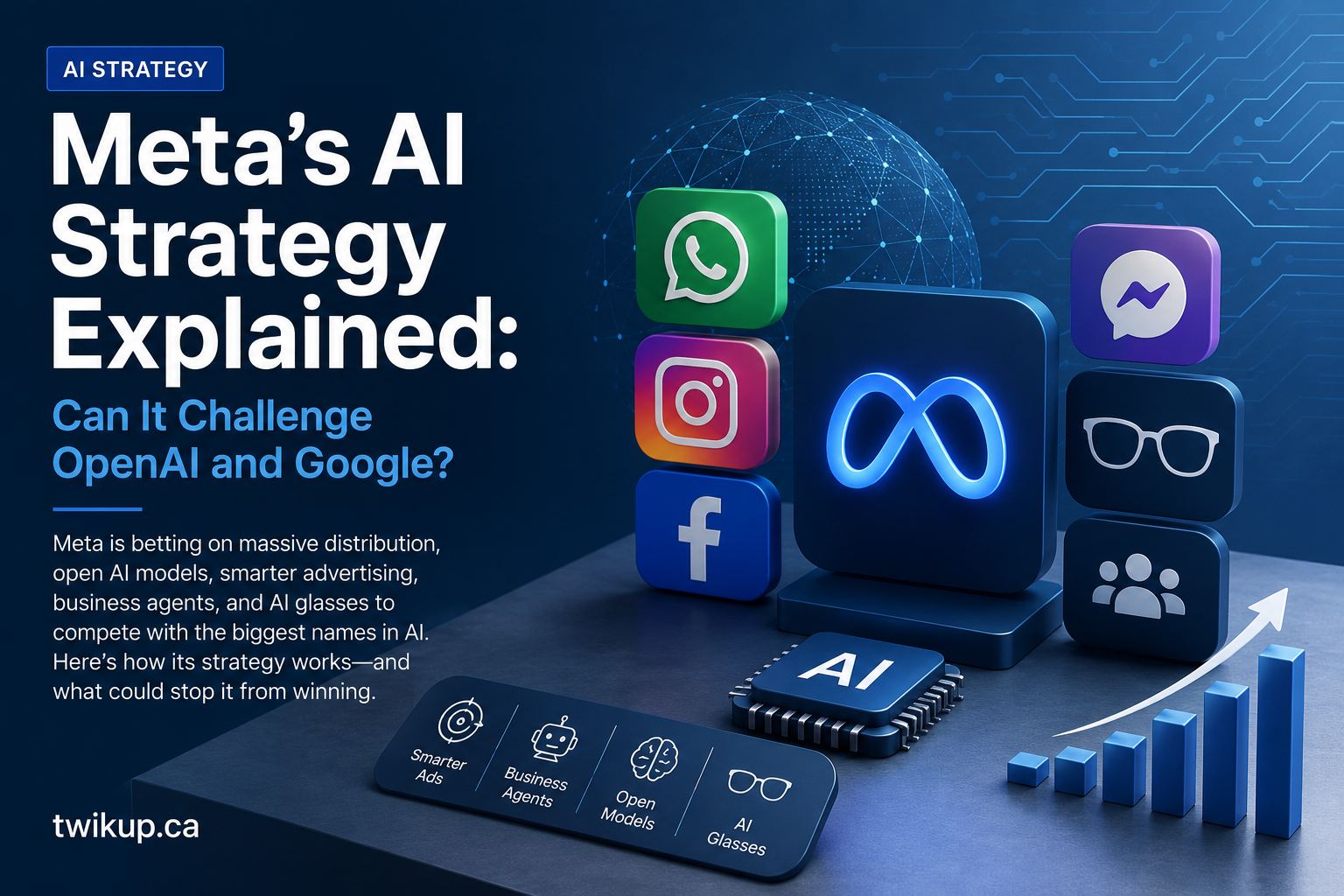
OpenAI is building ChatGPT into a powerful general-purpose assistant and work platform. Google is embedding Gemini across Search, Android, Workspace, YouTube, Cloud, and its broader technology ecosystem. Meta’s biggest advantage is distribution: it can place artificial intelligence directly inside WhatsApp, Instagram, Facebook, Messenger, Threads, and AI-powered glasses used by billions of people.
Meta does not necessarily need to convince users to download a separate AI product. It can introduce Meta AI inside apps people already open every day.
The company is also investing aggressively in AI infrastructure, models, advertising systems, business agents, content creation tools, recommendation algorithms, and wearable devices. However, Meta still faces major challenges, including intense competition, enormous infrastructure costs, model reliability, privacy concerns, regulatory risk, and uncertainty over whether users will choose Meta AI for serious work.
TwikUp Insight
Meta’s most important AI advantage may not be having the highest-scoring model.
It may be owning the places where billions of conversations, purchases, recommendations, advertisements, creator interactions, and social connections already happen.
OpenAI is trying to make ChatGPT the place where people complete complex tasks. Google is trying to make Gemini the intelligence layer across Search, Android, Workspace, Cloud, and the web. Meta is trying to make AI an invisible but constant layer across social communication.
That difference matters.
Meta could lose individual benchmark comparisons while still building one of the world’s most widely used AI ecosystems. If AI becomes deeply integrated into messaging, content discovery, advertising, customer service, creator tools, and smart glasses, Meta may not need to replace ChatGPT or Google Search. It could instead control a separate and extremely valuable part of the AI economy.
Why Meta Is Investing So Aggressively in Artificial Intelligence
Artificial intelligence is becoming central to nearly every major part of Meta’s business.
Meta uses AI to:
- Recommend posts, Reels, videos, and advertisements
- Match advertisements with potentially interested customers
- Generate images, text, video, and creative variations
- Power Meta AI across its apps and devices
- Help creators understand and grow their audiences
- Detect scams, harmful material, and policy violations
- Build automated business-customer conversations
- Improve translation across languages
- Develop AI-enabled glasses and future wearable devices
- Train advanced multimodal and agentic models
This makes Meta’s AI strategy broader than simply launching a chatbot.
The company is attempting to build a connected system in which AI improves engagement, advertising performance, creator productivity, business communication, personal assistance, and hardware.
That system could strengthen Meta’s existing business while creating entirely new revenue opportunities.
The Five Main Parts of Meta’s AI Strategy
1. Put Meta AI Inside Apps People Already Use
Meta owns one of the strongest consumer-distribution networks in the technology industry.
Its apps include:
- Messenger
- Threads
Instead of relying only on a standalone AI website or application, Meta can place its assistant in search bars, group chats, direct messages, posts, creator dashboards, business conversations, and content feeds.
This reduces one of the biggest obstacles facing new technology products: convincing people to develop a new habit.
A user may not intentionally open an AI chatbot every day. However, that same user may interact with AI while searching Instagram, asking a question in WhatsApp, creating a Facebook post, messaging a business, or using smart glasses.
Meta’s strategy is therefore based on embedded distribution.
The company wants AI to appear wherever the user already is.
2. Build Models Designed Around Meta’s Own Products
Meta previously made the Llama model family a central part of its AI identity. The company promoted broad developer access and positioned openness as a way to encourage adoption, experimentation, and ecosystem growth.
Its newer strategy increasingly emphasizes models developed by Meta Superintelligence Labs and optimized for Meta’s products.
Meta introduced Muse Spark in April 2026 as the first model in a new series from Meta Superintelligence Labs. The company said it was designed to improve agentic tasks, coding, multimodal perception, and Meta AI experiences.
Meta subsequently introduced Muse Spark 1.1, along with media-generation systems such as Muse Image and Muse Video.
This suggests that Meta is moving toward a more layered model strategy.
It can continue supporting external developers through model releases and APIs while reserving some of its most strategically valuable capabilities for Meta AI, advertising, recommendations, wearables, and internal products.
That approach may give Meta greater control over how its models are commercialized.
3. Use AI to Strengthen the Advertising Business
Advertising remains the economic engine supporting Meta’s enormous AI investments.
AI can improve Meta’s advertising business in several ways:
-
Better audience matching: Machine-learning systems can identify which users may be more likely to respond to an advertisement.
-
Automated creative production: Businesses can generate or modify images, text, videos, backgrounds, and advertising variations.
-
Campaign optimization: AI can adjust delivery, placement, targeting, and budgets based on performance signals.
-
Personalized recommendations: Better recommendations can increase engagement, providing Meta with more opportunities to display advertisements.
-
Business agents: AI assistants can answer customer questions and potentially help people move from product discovery to purchase.
This gives Meta an advantage that many AI companies do not have: an established, highly profitable advertising system that can finance model development and potentially monetize AI improvements immediately.
Meta does not need to rely exclusively on AI subscriptions.
If its AI systems improve advertising efficiency, creator activity, user engagement, or business messaging, those improvements may already generate financial value.
4. Turn Messaging Into an AI Commerce and Customer-Service Platform
WhatsApp and Messenger could become critical parts of Meta’s long-term AI strategy.
Businesses already use messaging platforms to:
- Answer customer questions
- Confirm appointments
- Provide delivery updates
- Recommend products
- Manage support requests
- Share payment or ordering information
Meta Business Agent is designed to help companies automate more of these interactions.
An AI agent could eventually answer questions based on a company’s products, policies, inventory, services, and customer history. It could guide shoppers through product discovery, explain differences between options, and help complete transactions.
This creates a potentially valuable combination:
social discovery + personalized advertising + business messaging + AI assistance + commerce
A person might discover a product through Instagram, ask questions through WhatsApp, receive an AI-generated recommendation, and complete a purchase without leaving Meta’s ecosystem.
That would move Meta beyond selling advertising exposure. It could become part of the complete customer journey.
5. Make AI Glasses a New Computing Platform
Meta’s work with Ray-Ban and Oakley shows that its AI ambitions extend beyond phones and computers.
AI glasses could allow users to:
- Ask questions about what they are seeing
- Take photos or videos hands-free
- Translate conversations
- Identify objects and locations
- Receive navigation or contextual information
- Listen to audio
- Communicate through voice
- Create and share content instantly
This is strategically important because the next major AI platform may not look like a traditional chatbot.
AI could become more useful when it can see what users see, hear what they hear, and respond without requiring them to open a laptop or type on a phone.
Meta has spent years investing in virtual reality, augmented reality, wearable devices, and Reality Labs. Those investments have been expensive, but they could become more valuable if AI creates a compelling reason for consumers to use smart glasses.
OpenAI and Google are also exploring new devices and AI interfaces. However, Meta already has consumer eyewear products in the market and can connect them directly with its social platforms.
Meta’s Biggest Advantage: Distribution
In consumer technology, the best product does not always become the most widely used product.
Distribution can be equally important.
Meta can expose AI features to users through some of the world’s largest communication and social platforms. Its assistant can appear in conversations, searches, feeds, creator tools, advertisements, and wearables.
This gives Meta several advantages:
- Low customer-acquisition friction
- Immediate access to a massive potential user base
- Frequent opportunities for repeat interaction
- Integration with social and communication behaviour
- Existing relationships with creators and businesses
- Multiple channels for monetization
OpenAI built enormous consumer recognition with ChatGPT. Google controls major access points including Search, Chrome, Android, YouTube, Workspace, and Cloud.
Meta’s comparable asset is its social graph and messaging network.
The central question is whether Meta can convert that reach into meaningful AI engagement rather than simply placing an AI button inside popular apps.
Meta vs OpenAI: Two Different AI Strategies
Meta and OpenAI overlap, but their priorities are not identical.
OpenAI’s Core Position
OpenAI has built ChatGPT into a recognizable destination for:
- Research
- Writing
- Coding
- Analysis
- Voice conversations
- File-based work
- Image generation
- Professional workflows
- Agentic task completion
OpenAI’s advantage is that many users actively think of ChatGPT when they need help completing a complex intellectual or professional task.
Its brand has become closely connected with generative AI itself.
OpenAI is also expanding beyond question-and-answer interactions. Its tools increasingly aim to complete multi-step work across documents, applications, data, and connected services.
Meta’s Core Position
Meta is prioritizing:
- Social integration
- Messaging
- Personalized recommendations
- Advertising
- Creator tools
- Business communication
- AI-generated media
- Wearable devices
- Mass consumer distribution
Meta AI may become extremely widespread even if it is not the first tool professionals choose for advanced research, coding, or workplace analysis.
Where Meta May Beat OpenAI
Meta may have an advantage in:
- Social discovery
- Creator-focused AI
- Messaging-based customer service
- Consumer distribution
- Personalized content recommendations
- Advertising monetization
- AI glasses
- Integration with personal relationships and communities
Where OpenAI May Remain Stronger
OpenAI may remain stronger in:
- Dedicated AI usage
- Complex knowledge work
- Enterprise productivity
- Advanced coding workflows
- Independent developer mindshare
- Premium AI subscriptions
- Users seeking a neutral general-purpose assistant
Meta does not necessarily have to replace ChatGPT. It can win by making Meta AI the default assistant for social, communication, creator, and commerce-related tasks.
Meta vs Google: The Battle of Distribution Giants
Google may be Meta’s most structurally comparable AI competitor.
Both companies already operate enormous consumer platforms and profitable advertising businesses.
Google’s AI Advantages
Google can distribute Gemini through:
- Google Search
- Android
- Chrome
- Gmail
- Docs
- Sheets
- Slides
- Drive
- Maps
- YouTube
- Google Cloud
- Pixel devices
- AI-powered eyewear and other hardware
Google also controls a full AI technology stack that includes models, cloud infrastructure, custom chips, consumer software, enterprise services, and developer platforms.
Gemini is increasingly being embedded directly into Search and productivity tools. This gives Google strong access to both consumer information-seeking and workplace activity.
Meta’s AI Advantages
Meta has deeper access to:
- Social relationships
- Private and group messaging
- Creator communities
- Short-form content
- Influencer-driven product discovery
- Consumer-to-business conversations
- Social advertising signals
- Wearable content creation
Google understands what people search for.
Meta has the potential to understand what people share, watch, discuss, recommend, follow, and purchase after social discovery.
Who Has the Better Position?
Google currently appears to have the more complete AI stack.
It has strong models, cloud infrastructure, enterprise relationships, productivity software, search distribution, mobile operating-system access, and developer tools.
Meta’s opportunity is narrower but still enormous. It can become the AI layer for social interaction, creator activity, messaging, advertisements, and wearable experiences.
The winner may not be determined by a single model benchmark. It may depend on which company makes AI most useful within its existing ecosystem.
Meta’s Massive AI Spending Shows the Scale of Its Ambition
Meta’s AI strategy requires extraordinary infrastructure spending.
In April 2026, Meta increased its forecast for full-year capital expenditures to between $125 billion and $145 billion. The company connected this investment to higher component costs, data-centre capacity, Meta Superintelligence Labs, and future AI requirements.
For comparison, Meta had reported 2025 capital expenditures of approximately $70 billion to $72 billion.
The expected increase illustrates how quickly the AI infrastructure race is accelerating.
Training and operating advanced models require:
- High-performance chips
- Networking equipment
- Data centres
- Electricity
- Cooling systems
- Storage
- Engineering talent
- Model-training data
- Security and safety systems
These investments may strengthen Meta’s products and advertising business. However, they also create financial risk.
The company must prove that AI-driven revenue and operational improvements can eventually justify the spending.
How Meta Can Make Money From AI
Meta has several potential AI monetization paths.
Better Advertising Performance
This is the most immediate opportunity.
AI can make advertisements more relevant, automate creative production, and improve campaign performance. Even relatively small improvements can be financially significant because of the scale of Meta’s advertising business.
Paid Business Agents
Companies may eventually pay for AI agents that manage customer service, product discovery, lead qualification, appointment scheduling, and sales conversations.
Developer APIs
Meta can charge selected developers and enterprise partners for access to advanced models, tools, or infrastructure.
Premium Consumer Features
Meta could introduce subscriptions for advanced AI capabilities, greater generation limits, enhanced creative tools, or premium assistant features.
However, subscriptions may be less central to Meta than they are to companies whose primary product is an AI assistant.
Creator Tools
Meta could offer advanced AI editing, analytics, content planning, translation, or production capabilities to professional creators and businesses.
AI Glasses and Hardware
AI may increase demand for smart glasses and future wearable devices. Hardware sales could become more meaningful if Meta develops products consumers use throughout the day.
Commerce and Messaging
Meta could monetize AI-assisted business conversations, transactions, product recommendations, and customer engagement through WhatsApp, Messenger, and Instagram.
Why Meta’s Open-Model Strategy Matters
Meta’s previous Llama strategy helped establish the company as an important provider of broadly accessible AI models.
Providing model weights allowed developers, researchers, startups, governments, and enterprises to customize and deploy Llama-based systems.
This helped Meta in several ways:
- Expanded its developer ecosystem
- Encouraged external experimentation
- Reduced dependence on closed-model providers
- Strengthened Meta’s influence over AI standards
- Created alternatives to OpenAI and Google
- Increased demand for tools compatible with Meta’s models
However, “open” does not always mean unrestricted.
Model licences can contain use conditions, and training data, development methods, and infrastructure may remain proprietary.
Meta’s challenge is balancing ecosystem openness with the commercial need to protect its most advanced technology and monetize its investments.
The introduction of private API previews for newer models suggests that its future strategy may combine open releases with more controlled access to frontier capabilities.
The Shift Toward Personal Superintelligence
Meta has increasingly described its long-term goal as building personal superintelligence.
In practical terms, this means creating AI that understands individual preferences, relationships, interests, communication patterns, goals, and surroundings well enough to provide highly personalized assistance.
Potential applications include:
- Recommending content based on deeper context
- Helping users communicate and create
- Remembering preferences across conversations
- Offering suggestions based on a person’s social world
- Assisting through glasses while users move through daily life
- Connecting people with communities, businesses, and information
- Acting on a user’s behalf across Meta’s services
This could create more useful experiences than a generic chatbot.
But it also raises important privacy questions.
The more personal context an AI system uses, the more carefully the company must manage consent, transparency, data protection, security, and user control.
Meta’s history of privacy controversies may make some users cautious about allowing its AI systems deeper access to personal information.
Can Meta AI Become the World’s Default Consumer Assistant?
Meta has many of the ingredients required:
- Billions of potential users
- Large-scale infrastructure
- A profitable core business
- Strong AI research teams
- Messaging and social platforms
- Advertising relationships
- Creator ecosystems
- Consumer hardware
- Advanced recommendation technology
But availability does not guarantee preference.
Users may ignore Meta AI if it feels intrusive, unreliable, unnecessary, or inferior to alternatives.
To become a default assistant, Meta must make its AI:
- Noticeably useful
- Fast and dependable
- Easy to access
- Trustworthy
- Contextually aware
- Less disruptive to existing app experiences
- Strong enough for more than casual entertainment
The company must also determine which tasks users genuinely want to complete inside social applications.
Someone may happily use Meta AI to create a birthday image, translate a message, discover a restaurant, or ask about an Instagram post. That does not automatically mean the same person will trust it with financial research, workplace analysis, sensitive documents, or complex coding.
Meta’s likely success will therefore vary by use case.
Where Meta Has the Best Chance of Winning
Meta appears particularly well positioned in five areas.
1. AI-Powered Social Discovery
People already use social platforms to discover products, destinations, restaurants, entertainment, trends, and opinions.
Meta AI can organize and explain recommendations based on publicly shared content across its platforms.
This could create a different experience from traditional web search because the answers may draw more heavily from communities, creators, and social activity.
2. Creator Assistance
Meta can help creators generate ideas, edit media, analyze performance, translate content, interact with audiences, and identify growth opportunities.
Because creators already publish on Instagram and Facebook, Meta can embed these tools directly into their existing workflow.
3. Business Messaging
WhatsApp and Messenger provide a natural environment for customer-service and sales agents.
Businesses may value AI that can immediately handle high volumes of customer conversations.
4. Personalized Advertising
Meta already operates one of the most sophisticated digital advertising systems. AI can make that system more automated, measurable, and accessible to smaller companies.
5. AI Wearables
Smart glasses may become Meta’s most distinctive AI product.
If consumers become comfortable using visual and voice assistants throughout the day, Meta could control an important new computing interface.
The Biggest Risks Facing Meta’s AI Strategy
Enormous Capital Requirements
The cost of building data centres and acquiring AI hardware is rising rapidly.
Meta must generate substantial long-term returns from its infrastructure investments.
Competition for Talent
Frontier AI researchers and engineers are highly sought after. Meta must compete with OpenAI, Google DeepMind, Anthropic, Microsoft, xAI, and well-funded startups.
Model Reliability
Incorrect, misleading, or unsafe answers can reduce user trust. This becomes especially important when AI is integrated into widely used social and communication platforms.
Privacy Concerns
Personalized AI could require access to sensitive contextual information. Users and regulators may scrutinize how Meta collects, combines, and uses that data.
Regulatory Pressure
Governments are developing rules governing AI transparency, privacy, competition, intellectual property, child safety, and algorithmic accountability.
Meta’s size and history make it likely to face intense regulatory attention.
Weak User Intent
People open ChatGPT specifically because they want AI assistance. People open Instagram or WhatsApp for other reasons.
Meta must integrate AI without making its apps feel cluttered or forcing features users did not request.
Brand Trust
Some consumers may be less willing to share personal information with Meta than with competing AI providers.
Open vs Closed Strategy Tension
Broad model access can encourage adoption, but Meta may need tighter control to protect safety, competitive advantages, and monetization opportunities.
Does Meta Need the Best AI Model to Win?
Probably not.
Model quality matters, particularly for coding, reasoning, multimodal tasks, reliability, and agentic work. However, consumer technology markets are rarely determined by technical performance alone.
The winning platform may combine:
- Strong-enough models
- Massive distribution
- Low cost
- Familiar interfaces
- Personalization
- Useful integrations
- Developer support
- Business monetization
- Trusted user experiences
Meta can compete even when another company temporarily leads a benchmark.
For example, a user may choose Meta AI because it is already available inside a WhatsApp conversation or through a pair of glasses. Convenience can outweigh a moderate difference in model performance.
At the same time, Meta cannot allow the quality gap to become too large. Distribution may encourage people to try a product, but usefulness determines whether they return.
How Meta’s AI Strategy Connects With Nvidia
Meta’s AI ambitions depend heavily on enormous computing capacity.
Advanced AI models require powerful accelerators, high-speed networking, data-centre infrastructure, and energy. Nvidia has become one of the most important suppliers supporting this global expansion.
Readers interested in the infrastructure behind the AI race can explore TwikUp’s analysis of how Nvidia built its AI empire and became one of the world’s most valuable companies.
The relationship highlights an important reality: the competition between Meta, OpenAI, Google, and other AI companies also creates enormous demand for the businesses supplying chips, cloud capacity, networking systems, electricity, and data centres.
Meta, OpenAI and Google: Competitive Comparison
| Competitive area | Meta | OpenAI | |
|---|---|---|---|
| Primary consumer advantage | Social and messaging distribution | Dedicated AI brand and assistant usage | Search, Android and productivity ecosystem |
| Core assistant | Meta AI | ChatGPT | Gemini |
| Major distribution channels | WhatsApp, Instagram, Facebook, Messenger, Threads and glasses | ChatGPT app, web, desktop and partner integrations | Search, Android, Chrome, Workspace, YouTube and Pixel |
| Main business engine | Advertising | AI subscriptions, enterprise services and API access | Advertising, Cloud, subscriptions and enterprise software |
| Developer strategy | Mix of accessible models, APIs and controlled frontier systems | Primarily hosted proprietary models and APIs | Gemini APIs, Cloud and developer platforms |
| Strongest potential use cases | Social discovery, creators, messaging, advertisements and wearables | Knowledge work, coding, research and agents | Search, productivity, mobile, cloud and multimodal services |
| Key strategic risk | Spending, privacy and uncertain user intent | Infrastructure costs and intense platform competition | Protecting Search economics while transforming products with AI |
Can Meta Challenge OpenAI?
Yes, particularly in consumer reach.
Meta may be able to place AI in front of more people through messaging and social applications than a standalone assistant can reach on its own.
But challenging OpenAI in advanced knowledge work may be harder.
ChatGPT has developed strong user intent: people deliberately open it to solve problems, create documents, conduct research, write code, and complete complex tasks. Meta must demonstrate that its assistant can become similarly valuable rather than remaining a lightweight feature inside social apps.
Meta’s best route may not be copying ChatGPT.
It may be creating an AI experience that OpenAI cannot easily replicate: one deeply connected to social relationships, creators, businesses, messaging, recommendations, and wearable devices.
Can Meta Challenge Google?
Yes, but Google has formidable structural advantages.
Google can combine Gemini with Search, YouTube, Android, Chrome, Workspace, Maps, Cloud, custom chips, and decades of information infrastructure.
Google also has strong relationships with businesses, schools, developers, advertisers, and enterprise customers.
Meta’s opportunity is to dominate a different layer of daily life.
Google may become the AI people use to search, work, navigate, and manage information. Meta may become the AI people use to communicate, discover, create, shop socially, and interact with businesses.
There will be significant overlap, but both companies could remain powerful if they control different AI behaviours.
What Investors Should Watch
Investors evaluating Meta’s AI strategy should look beyond model announcements.
Important indicators include:
Capital Expenditure Growth
Is infrastructure spending continuing to rise, and is Meta providing evidence that those investments are improving revenue or efficiency?
Advertising Performance
Are AI-powered advertising tools producing better conversions, higher advertiser returns, and greater spending?
Meta AI Engagement
Are people voluntarily and repeatedly using Meta AI, or are usage numbers driven mainly by automatic placement inside popular apps?
Business-Agent Adoption
Are companies paying for AI-driven customer service, lead generation, commerce, or messaging tools?
Developer Adoption
Do developers continue building with Meta’s models, APIs, and ecosystem?
Smart-Glasses Demand
Are AI glasses becoming a mainstream product category or remaining a niche accessory?
Operating Margins
Can Meta maintain financial discipline while spending heavily on AI infrastructure and Reality Labs?
Privacy and Regulation
Do new rules limit how Meta can use personal, advertising, messaging, or behavioural data to power AI?
Model Competitiveness
Can Meta’s models remain close enough to the frontier to support reliable products and developer adoption?
The Most Likely Outcome
The AI market is unlikely to produce only one winner.
OpenAI, Google, Meta, Microsoft, Anthropic, Amazon, Apple, Nvidia, and other companies control different combinations of models, infrastructure, software, data, distribution, devices, and customer relationships.
Meta is unlikely to eliminate ChatGPT or replace Google Search completely.
A more realistic outcome is that Meta becomes one of several major AI platforms.
Its strongest position could include:
- AI-powered social discovery
- Creator tools
- Personalized recommendations
- Advertising automation
- Business messaging
- Consumer image and video creation
- AI-enabled eyewear
- Assistants embedded across communication platforms
Success would still make Meta one of the most influential companies in the AI economy—even without winning every model benchmark or becoming the leading workplace assistant.
Final Verdict: Can Meta Challenge OpenAI and Google?
Yes, Meta can challenge both companies, but it will not win by following exactly the same strategy.
OpenAI’s strength is the direct relationship users have with ChatGPT as a general-purpose intelligence and work platform.
Google’s strength is its full-stack ecosystem spanning Search, Android, Workspace, YouTube, Cloud, models, infrastructure, and devices.
Meta’s strength is its ability to integrate AI into social communication, content discovery, advertising, creators, business messaging, and wearable technology.
Its distribution advantage is real. Its advertising business can fund massive infrastructure investment. Its apps provide frequent consumer touchpoints. Its smart-glasses strategy gives it an opportunity to shape how people interact with AI beyond the smartphone.
However, Meta must prove that people want more than convenient access. It must deliver high-quality, trusted, useful AI experiences while controlling costs and managing privacy concerns.
Meta does not need to defeat OpenAI and Google everywhere.
It needs to make AI indispensable inside the digital environments it already controls.
If it succeeds, Meta could become one of the three most important consumer AI ecosystems—even if ChatGPT remains stronger for complex work and Google remains stronger in search and productivity.
Frequently Asked Questions
What is Meta’s main AI strategy?
Meta’s strategy is to integrate artificial intelligence throughout Facebook, Instagram, WhatsApp, Messenger, Threads, advertising products, creator tools, business messaging, and smart glasses. It is also developing advanced models and investing heavily in data-centre infrastructure.
Is Meta AI better than ChatGPT?
The answer depends on the task. ChatGPT is strongly positioned for research, writing, coding, analysis, and professional workflows. Meta AI may be more convenient for social discovery, messaging, content creation, and tasks performed inside Meta’s apps.
Can Meta compete with Google Gemini?
Meta can compete through its massive social and messaging distribution. However, Google has advantages in Search, Android, Workspace, YouTube, Cloud, developer tools, and its broader AI infrastructure.
What happened to Meta’s Llama strategy?
Llama remains an important part of Meta’s AI ecosystem, particularly for developer adoption and accessible model deployment. However, Meta is also introducing newer systems through Meta Superintelligence Labs and using more controlled distribution for certain advanced models.
How does Meta make money from artificial intelligence?
AI can improve Meta’s advertising performance, automate creative production, power paid business agents, strengthen commerce and messaging, support developer APIs, offer creator tools, and increase demand for AI glasses.
Why is Meta spending so much on AI?
Training and operating advanced AI systems requires chips, data centres, networking, energy, storage, engineers, and safety infrastructure. Meta also needs enough computing capacity to serve AI features across products used by billions of people.
What is Meta’s biggest AI advantage?
Its biggest advantage is distribution. Meta can integrate AI directly into applications and devices that consumers already use frequently.
What is Meta’s biggest AI risk?
Its largest risks include infrastructure costs, privacy concerns, regulatory scrutiny, intense competition, model reliability, and uncertainty over whether users will adopt Meta AI for valuable recurring tasks.
Will Meta AI replace Google Search?
A complete replacement is unlikely in the near term. Meta AI may compete more directly in social discovery, recommendations, creators, and commerce, while Google remains deeply established in web search and information retrieval.
Is Meta an AI company now?
Meta remains primarily a social-platform and advertising company, but artificial intelligence has become central to its recommendations, advertising systems, content tools, assistants, safety systems, infrastructure, and future hardware strategy.
Disclaimer
This article is provided for general informational and educational purposes only. It does not constitute financial, investment, legal, or professional advice. Technology strategies, financial forecasts, model capabilities, product availability, and competitive conditions can change rapidly. Investors should review current company filings and consult a qualified financial professional before making investment decisions.
Sources
-
Meta Reports First Quarter 2026 Results — Meta Investor Relations — Meta reported first-quarter revenue of $56.31 billion and increased expected 2026 capital expenditures to $125 billion–$145 billion.
-
Meta Reports Fourth Quarter and Full Year 2025 Results — Meta Investor Relations — Provides Meta’s full-year results and discussion of investment in Meta Superintelligence Labs and core AI infrastructure.
-
Introducing Muse Spark — Meta — Explains Meta’s model strategy, product integration, Meta AI rollout, glasses support, and selected API access.
-
Introducing Muse Spark 1.1 — AI at Meta — Details improvements to Meta’s latest model for agentic tasks, coding, multimodal understanding, and tool use.
-
The Llama 4 Herd — AI at Meta — Explains the Llama 4 architecture, multimodal capabilities, mixture-of-experts design, and model-access strategy.
-
Introducing the Meta AI App — Meta — Describes Meta’s standalone AI app, personalization, contextual memory, Discover feed, website connection, and integration with AI glasses.
-
2026: AI Drives Performance — Meta — Outlines how Meta uses AI to improve consumer experiences, advertisements, business outcomes, and product performance.
-
Meta Business Agent — Meta — Introduces Meta’s AI agent for helping businesses communicate with and support customers.
-
New AI Tools on Facebook — Meta — Describes AI Mode, socially grounded recommendations, content-generation features, and Facebook’s evolving AI-search experience.
-
Introducing Muse Image — Meta — Covers Meta’s image-generation strategy and integration of creative AI into Meta AI and social sharing.
-
Google I/O 2026 AI Announcements — Google — Summarizes Gemini 3.5, Gemini Omni, developer tools, agentic capabilities, and AI integration across Google products.
-
Alphabet 2025 Fourth-Quarter Earnings Call — Alphabet Investor Relations — Reports more than 750 million monthly active Gemini App users and projected 2026 capital expenditures of $175 billion–$185 billion.
-
How People Are Using ChatGPT — OpenAI — Reports 700 million weekly active ChatGPT users at the time of the study and examines consumer AI-use patterns.
-
ChatGPT for Ambitious Work — OpenAI — Describes OpenAI’s expansion toward agentic work across applications, files, documents, spreadsheets, and longer-running projects.