
Quick Answer
A term sheet is the document that defines the key business terms of a startup investment before the final legal agreements are drafted.
Although most term sheets are described as "non-binding," they determine how much ownership founders give up, who controls major decisions, who gets paid first if the company is sold, and how future fundraising rounds will work.
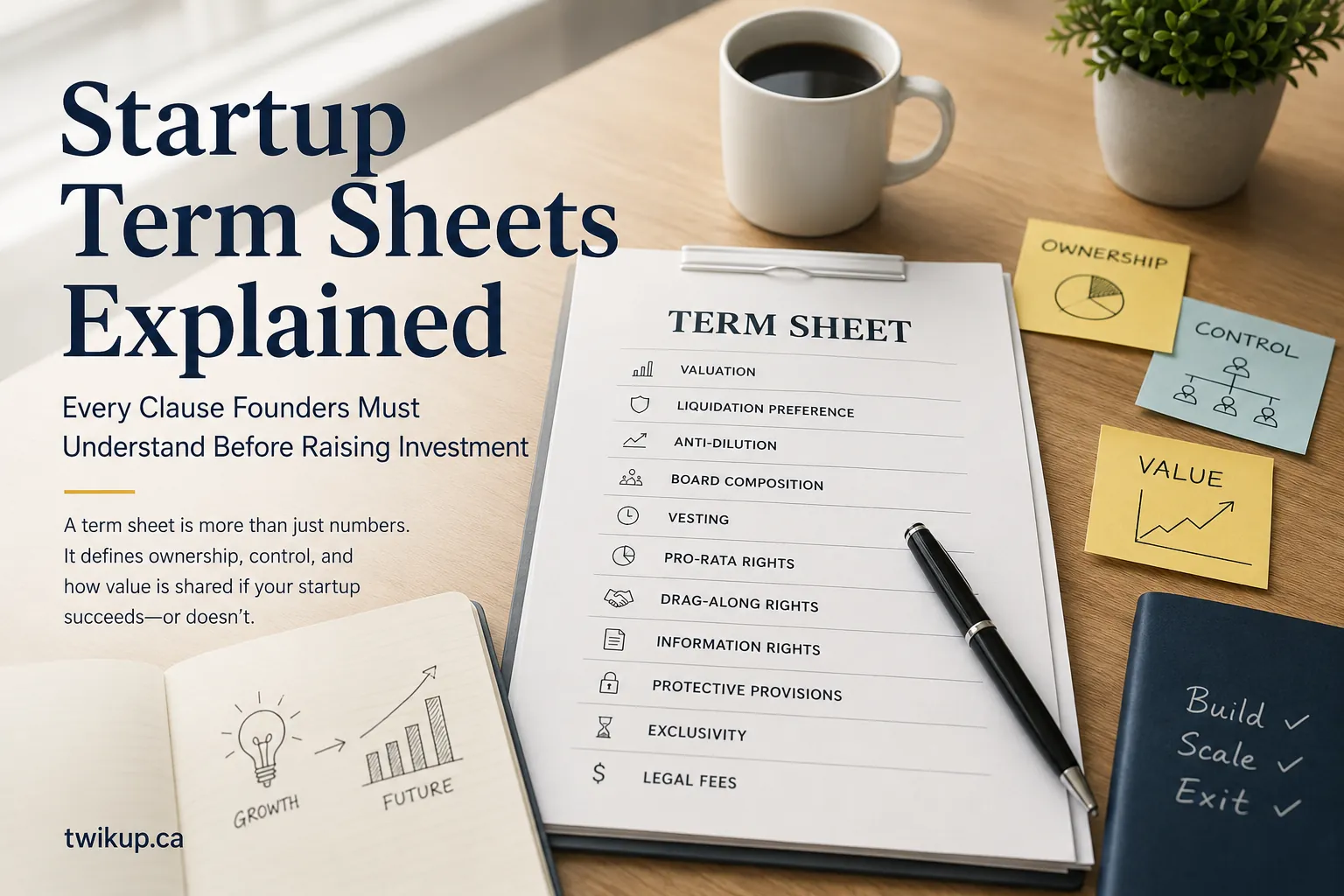
The clauses that usually matter most are valuation, option pool expansion, liquidation preference, participation rights, anti-dilution protection, board composition, protective provisions, founder vesting, pro-rata rights, drag-along rights, and investor information rights.
Understanding these terms before signing can save founders from giving away far more control or value than they expected.
Twikup Insight
Many founders celebrate the valuation.
Experienced founders study the terms.
A startup that raises at a $10 million valuation with aggressive investor protections can leave founders in a much worse position than one raising at an $8 million valuation with founder-friendly terms.
The real question isn't:
"How much money are we raising?"
It's:
"Who owns the company after this round, who controls the important decisions, and who gets paid first if things don't go according to plan?"
If you're just beginning your fundraising journey, start with our guide on How First-Time Founders Can Raise Their First Investment, which explains how founders typically secure their first external capital:
https://twikup.ca/money/investing/how-first-time-founders-can-raise-their-first-investment
What Is a Startup Term Sheet?
A term sheet is a preliminary agreement that outlines the commercial terms of an investment before lawyers prepare the definitive legal documents.
Think of it as the blueprint for the investment.
It explains what both sides have agreed to before spending significant time and money on legal paperwork.
A typical startup term sheet covers:
- Investment amount
- Company valuation
- Investor ownership
- Type of security being issued
- Liquidation preference
- Board composition
- Voting rights
- Founder vesting
- Option pool size
- Anti-dilution protection
- Information rights
- Pro-rata rights
- Drag-along rights
- Closing conditions
In simple terms, a term sheet answers one question:
What exactly are the founders and investors agreeing to?
Most startup term sheets are only partially binding.
The commercial terms generally remain non-binding until the final financing documents are signed. However, provisions such as confidentiality, exclusivity (no-shop), governing law, and expense reimbursement are often legally binding immediately.
Why Term Sheets Matter More Than Most Founders Realize
Many founders focus almost entirely on one number:
"We raised $2 million at a $10 million valuation."
While that sounds impressive, it tells only a small part of the story.
Two startups can raise the exact same amount at the exact same valuation yet produce completely different outcomes for founders.
One founder may retain strong ownership, balanced governance, and clean economics.
Another founder may unknowingly accept:
- A large pre-money option pool
- Participating liquidation preferences
- Broad investor veto rights
- Founder vesting resets
- Aggressive anti-dilution protection
- Investor-controlled board seats
- Drag-along rights that can force a company sale
That's why a term sheet isn't simply a fundraising document.
It's an ownership document.
It's a governance document.
Most importantly, it's a control document.
Before negotiating investment terms, it's also worth understanding what professional investors actually evaluate before writing a cheque:
https://twikup.ca/money/investing/what-investors-look-for-before-funding-a-startup
The Most Important Clauses Every Founder Should Understand
1. Valuation
Valuation is usually the first number founders notice.
But it's only one piece of the overall deal.
Two terms appear in nearly every financing:
Pre-money valuation
The company's value immediately before the investment.
Post-money valuation
The company's value after the investment has been added.
Example
If a startup raises $2 million at an $8 million pre-money valuation, the post-money valuation becomes $10 million.
$2M ÷ $10M = 20% investor ownership
In this simplified example, investors own 20% of the company after closing.
However, this ownership percentage can change significantly if an option pool is expanded before the financing closes.
Many first-time founders mistakenly believe valuation alone determines ownership.
In reality, dilution mechanics often matter just as much.
If you want to understand why two startups with identical revenue can receive very different valuations, read:
How Startup Valuations Actually Work Before Revenue
https://twikup.ca/money/investing/how-startup-valuations-actually-work-before-revenue
2. Option Pool Expansion
An option pool reserves equity for future employees, advisors, and executives.
Professional investors frequently require founders to increase the option pool before completing the investment.
This sounds harmless.
In practice, it often creates additional founder dilution.
The key question is:
Is the option pool being created before or after the investment?
If the option pool is created before the financing closes, existing shareholders—primarily the founders—usually absorb almost all of the dilution.
Example
A founder believes they're selling 20% of the business.
The investor then requests a new 15% option pool before closing.
Instead of giving away only 20%, the founder's ownership drops significantly further because the option pool is created first.
Many founders don't notice this until the final cap table arrives.
Understanding dilution before signing a term sheet is essential.
Our guide below walks through the mathematics using practical examples:
How Startup Dilution Works
https://twikup.ca/money/investing/how-startup-dilution-works-what-happens-when-investors-buy-equity
Understanding the company's ownership structure also becomes much easier when you know how capitalization tables work.
Read:
How Startup Cap Tables Work
https://twikup.ca/money/investing/how-startup-cap-tables-work-and-why-founders-must-understand-them
3. Liquidation Preference
Liquidation preference determines who gets paid first if the company is sold, merged, or liquidated.
It has one of the biggest impacts on founder returns during an acquisition.
A common venture capital structure is a 1× non-participating liquidation preference.
Under this structure, investors have the right to recover their original investment before common shareholders receive proceeds.
Example
An investor invests $5 million.
Years later, the company is acquired for $20 million.
With a 1× liquidation preference, the investor can first recover their original $5 million, with the remaining proceeds then distributed according to ownership percentages.
This type of protection is common and generally considered market standard.
However, founders should pay close attention to whether the liquidation preference is participating or non-participating, because the financial outcomes can be dramatically different.
4. Participating Preferred Shares
Participating preferred is one of the most misunderstood clauses in venture financing.
With non-participating preferred shares, investors generally choose one of two outcomes:
- Recover their liquidation preference.
- Convert into common shares and receive their ownership percentage.
With participating preferred shares, investors may receive both.
They first recover their original investment.
Then they also participate in the remaining proceeds as shareholders.
Example
An investor invests $5 million for 25% ownership.
Later, the company sells for $25 million.
Under ordinary common equity:
- Investor receives 25% = $6.25 million
Under 1× participating preferred:
- Investor first receives $5 million
- Remaining proceeds = $20 million
- Investor also receives 25% of $20 million = $5 million
Total investor proceeds:
$5M preference
+$5M participation
-----------------
$10M total payout
Although both deals may have started with the same valuation, founder proceeds become substantially lower under participating preferred terms.
5. Anti-Dilution Protection
Anti-dilution protection protects investors if a future financing occurs at a lower valuation than the current round.
This situation is commonly called a down round.
Several forms of anti-dilution exist.
Broad-Based Weighted Average
The most common and generally considered the most founder-friendly approach.
Narrow-Based Weighted Average
Provides investors with stronger protection while creating additional founder dilution.
Full Ratchet
The most aggressive form of anti-dilution.
Under a full-ratchet provision, earlier investor shares may effectively be repriced as though they had originally invested at the new lower valuation.
This can create severe dilution for founders and employee shareholders.
Whenever founders negotiate anti-dilution protection, they should ask one important question:
What happens if our next fundraising round is completed at a lower valuation?
The answer can dramatically change long-term founder ownership.
6. Board Composition
Board composition is where a term sheet shifts from economics to control.
While valuation determines ownership, the board often determines who ultimately makes the most important decisions.
A startup board may approve or influence:
- CEO hiring or removal
- Future fundraising
- Annual budgets
- Major acquisitions
- Taking on debt
- Executive compensation
- Strategic direction
- Selling the company
A typical early-stage board might look like:
- 2 Founder seats
- 1 Investor seat
As additional funding rounds occur, investors may negotiate additional board representation.
Founders should think carefully about how board composition will evolve over time—not just immediately after the current financing.
A company can remain founder-led while founders retain board influence. But over multiple financing rounds, board control can gradually shift away from the founding team.
If you'd like to understand how founders can eventually lose control of the companies they created, read:
Your Board Can Fire You: What Every Founder Should Know After Raising Capital
7. Protective Provisions
Protective provisions give investors veto rights over specific company actions.
These provisions exist to protect investors from major decisions that could materially affect their investment.
Common protective provisions include approval rights over:
- Selling the company
- Issuing new shares
- Raising additional capital
- Taking on significant debt
- Changing the company's charter
- Expanding the option pool
- Declaring dividends
- Changing board composition
- Liquidating the company
These clauses are not inherently bad.
Professional investors should have protections against decisions that fundamentally change their investment.
Problems arise when protective provisions become so broad that founders require investor approval for routine business decisions.
Healthy governance protects both founders and investors.
8. Pro-Rata Rights
Pro-rata rights allow existing investors to maintain their ownership percentage in future financing rounds.
For investors, these rights are extremely valuable.
Most venture capital returns come from a small number of exceptional companies.
If one portfolio company becomes the next billion-dollar business, investors want the opportunity to continue investing rather than watching their ownership shrink.
For founders, pro-rata rights are generally reasonable.
However, granting extensive pro-rata rights to many investors can create challenges later because new investors may have less room to participate.
Founders should understand exactly:
- Which investors receive pro-rata rights
- Whether those rights are optional or guaranteed
- Whether "super pro-rata" rights exist
9. Information Rights
Information rights require the company to provide investors with regular business updates.
Typical requirements include:
- Monthly financial statements
- Quarterly operating reports
- Annual budgets
- Updated capitalization tables
- Management updates
- Inspection rights
These obligations are normal in venture-backed companies.
However, founders should avoid granting extensive reporting obligations to every small shareholder.
Doing so can create unnecessary administrative work while increasing confidentiality risks.
A practical approach is providing comprehensive reporting to major institutional investors while offering lighter communication to smaller shareholders.
10. Drag-Along Rights
Drag-along rights prevent minority shareholders from blocking an acquisition.
If the required parties approve a sale, remaining shareholders may be required to participate.
The clause exists because buyers generally want to acquire the entire company—not negotiate separately with dozens of shareholders.
Founders should carefully examine who has the authority to trigger the drag-along.
A balanced structure usually requires approval from:
- The board
- Preferred shareholders
- Common shareholders (or founder majority)
A more investor-friendly version may allow investors to approve a sale even if founders disagree.
Although drag-along rights simplify acquisitions, founders should ensure they cannot be used unfairly.
11. Founder Vesting
Investors frequently ask founders to place part—or all—of their shares onto a new vesting schedule.
This is commonly called reverse vesting.
The purpose is straightforward.
If a founder leaves shortly after the investment closes, investors want to ensure that a significant portion of the company's equity remains available for someone who continues building the business.
From the founder's perspective, this can feel like earning the same equity twice.
Key questions include:
- How much equity will vest?
- Is previous time building the company recognized?
- What happens if the founder is terminated without cause?
- Is there acceleration if the company is acquired?
- Is there acceleration if the founder is removed after an acquisition?
These details can dramatically affect founder ownership.
12. Exclusivity (No-Shop Clause)
A no-shop clause prevents founders from negotiating with other investors for a specified period after signing the term sheet.
Investors request exclusivity because they invest significant time and legal costs into due diligence.
Reasonable exclusivity periods are common.
However, founders should be cautious when:
- The exclusivity period is unusually long
- Due diligence has barely started
- The investor has limited commitment
- Alternative financing opportunities disappear during exclusivity
A long no-shop period can weaken the founder's negotiating position if the investor later changes the proposed terms.
13. Legal Fees and Expenses
Most venture term sheets require the startup to reimburse the investor's legal expenses once the transaction closes.
This practice is standard.
However, founders should negotiate a reasonable cap.
Example:
Company agrees to reimburse investor legal expenses
up to $35,000, payable only upon successful closing.
Without a cap, founders may face unexpected legal costs.
14. SAFE Notes vs. Priced Equity Rounds
Not every startup raises money through a traditional priced equity round.
Many early-stage companies instead raise capital using SAFE Notes (Simple Agreements for Future Equity).
SAFE Notes postpone valuation discussions until a later financing round while allowing founders to raise capital more quickly and with lower legal costs.
If you're unfamiliar with SAFE financing, read:
SAFE Notes Explained: How Startups Raise Money Before a Valuation
https://twikup.ca/money/investing/safe-notes-explained-how-startups-raise-money-before-a-valuation
Founders should understand concepts such as:
- Valuation caps
- Discounts
- Most Favoured Nation (MFN) clauses
- Pro-rata side letters
- Pre-money vs. post-money SAFEs
- Multiple SAFE conversions
Some founders instead choose Convertible Notes, which function differently because they are debt instruments before converting into equity.
Learn how the two compare:
Convertible Notes vs SAFE Notes
Example: Why the Highest Valuation Isn't Always the Best Deal
Imagine a founder receives two investment offers.
Offer A
- $2 million investment
- $8 million pre-money valuation
- 20% investor ownership
- 1× non-participating liquidation preference
- 10% option pool created after financing
- Balanced board
- Standard investor protections
Offer B
- $2 million investment
- $10 million pre-money valuation
- Participating preferred shares
- 15% option pool created before financing
- Investor-heavy board
- Broad veto rights
- Aggressive anti-dilution protection
At first glance, Offer B appears significantly better because the valuation is higher.
But after accounting for dilution, liquidation preferences, governance rights, and future financing consequences, many founders would actually be better off accepting Offer A.
This illustrates one of the most important lessons in startup fundraising:
A higher valuation does not automatically mean a better investment deal.
Founder-Friendly vs. Investor-Friendly Term Sheet Terms
| Clause | Founder-Friendly | Investor-Friendly |
|---|---|---|
| Valuation | Higher valuation with clean terms | High valuation with aggressive protections |
| Option Pool | Created after financing | Created before financing |
| Liquidation Preference | 1× non-participating | Participating preferred or multiple preference |
| Anti-Dilution | Broad-based weighted average | Full ratchet |
| Board Composition | Founder-balanced | Investor-controlled |
| Protective Provisions | Limited to major corporate actions | Broad investor veto rights |
| Pro-Rata Rights | Major investors only | Extensive investor participation rights |
| Founder Vesting | Credit for time already served | Significant vesting reset |
| Drag-Along | Requires founder/common approval | Can be triggered primarily by investors |
| Legal Fees | Capped and payable only at closing | Uncapped reimbursement |
What Founders Should Negotiate First
Every clause matters.
But not every clause carries the same long-term impact.
If founders have limited negotiating leverage, these are usually the areas worth prioritizing:
- Valuation
- Option pool size and timing
- Liquidation preference
- Participation rights
- Board composition
- Protective provisions
- Anti-dilution protection
- Founder vesting
- Drag-along rights
- Legal fee caps
Instead of asking only:
"How much are you investing?"
Ask questions like:
- What percentage will founders own after closing?
- Is the option pool calculated before or after the investment?
- Who controls the board after this round?
- Who gets paid first if the company sells?
- What happens if our next financing is a down round?
- Can investors block future fundraising?
- What happens if a founder leaves?
- Under what circumstances can the company be sold?
The answers to these questions usually matter far more than the headline valuation.
Red Flags Every Founder Should Watch For
A term sheet deserves careful legal review if it contains any of the following:
- Participating preferred shares with no participation cap
- Multiple liquidation preferences (2× or higher)
- Full-ratchet anti-dilution provisions
- Large pre-money option pool expansions
- Investor-controlled boards at an early stage
- Broad veto rights over routine business decisions
- Long exclusivity periods with limited investor commitment
- Unlimited legal expense reimbursement
- Founder vesting resets without credit for previous years
- Drag-along rights that exclude founder approval
- Hidden side letters granting special investor rights
- Unclear SAFE conversion mechanics
- Pressure to sign quickly without legal review
Many founders never reach the term sheet stage because investors decline to invest in the first place.
If you're wondering why, our guide explains the most common reasons investors walk away—even when they like the business idea:
Why Most Startup Pitches Fail Even When the Idea Is Good
https://twikup.ca/money/investing/why-most-startup-pitches-fail-even-when-the-idea-is-good
A Term Sheet Is the Beginning—Not the Finish Line
Receiving a signed term sheet is a significant milestone.
It is not the same as having money in the company's bank account.
After signing, founders usually move through several additional stages:
- Financial due diligence
- Legal due diligence
- Cap table verification
- Intellectual property review
- Employment agreement review
- Customer contract review
- Board approvals
- Preparation of definitive legal documents
- Closing
- Funds transferred
Until the transaction officially closes, the investment can still fall apart.
This is why experienced founders continue running the business normally instead of assuming the financing is guaranteed.
Practical Checklist Before Signing Any Term Sheet
Ownership
- How much will founders own after the round?
- What percentage will investors own?
- What size is the option pool?
- Is the option pool pre-money or post-money?
Economics
- What liquidation preference applies?
- Is it participating or non-participating?
- Is participation capped?
- What happens if the company sells for less than expected?
Governance
- Who appoints board members?
- Can founders be removed?
- Which decisions require investor approval?
- Can investors block future financing?
Future Fundraising
- Which anti-dilution provisions apply?
- Who receives pro-rata rights?
- Will future investors have enough allocation available?
- What happens during a down round?
Founder Protection
- Are founder shares subject to new vesting?
- Is previous service recognized?
- Is there acceleration following an acquisition?
- What happens if a founder is terminated without cause?
Closing Process
- How long does exclusivity last?
- What due diligence remains?
- Are legal expenses capped?
- When are funds actually transferred?
Founders who understand these questions are far less likely to be surprised after closing.
Bottom Line
A startup term sheet is much more than a summary of an investment.
It determines:
- How ownership changes
- How future dilution works
- Who controls the board
- Which decisions require investor approval
- Who gets paid first during an acquisition
- How future fundraising rounds will unfold
The biggest mistake founders make is focusing almost entirely on valuation.
Valuation is only one number.
The real economics are hidden inside the clauses.
A fair term sheet should protect investors while still giving founders enough ownership, incentives, and control to build a successful company.
Before signing any investment agreement, founders should understand every major clause—or seek experienced legal advice from professionals who regularly work with venture-backed startups.
If you'd like to see how every financing stage connects together—from raising your first investment all the way to an IPO—read our complete guide:
The Complete Startup Fundraising Roadmap: From Idea to IPO (2026 Complete Founder Guide)
Following the roadmap will help you understand not only how to negotiate a single term sheet, but how each funding round affects ownership, control, and long-term founder outcomes throughout the life of your startup.