
Quick Answer
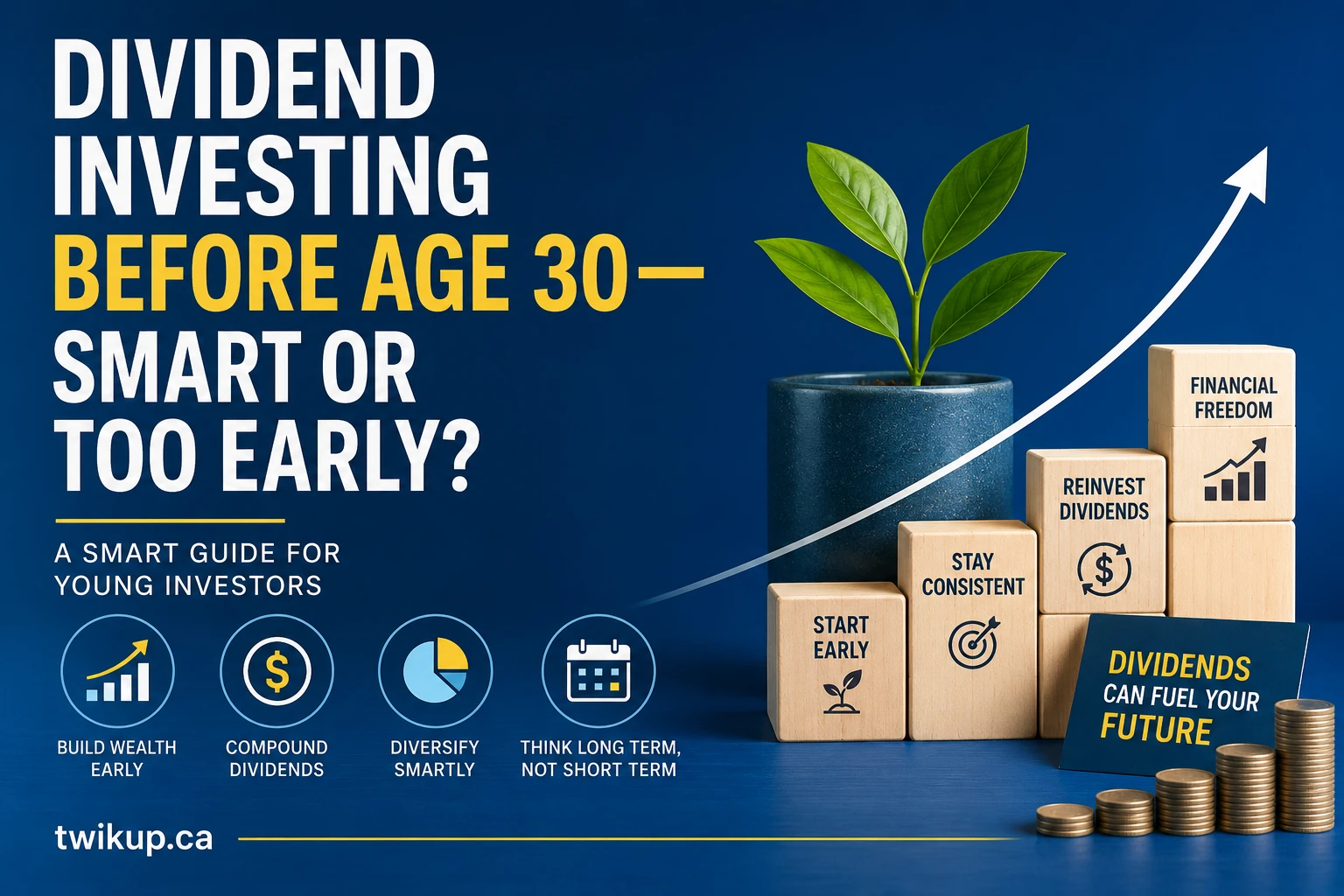
Dividend investing before age 30 can be smart, but only if you treat dividends as one part of total return, not the whole strategy. At a young age, your biggest advantage is time, compounding, diversification, and consistent investing — not chasing the highest yield.
Twikup Insight
For investors under 30, the best question is not “dividends or growth?”
It is: will this portfolio still make sense 20–30 years from now?
A dividend stock or dividend ETF can be useful if it owns strong companies, grows payouts sustainably, and fits your risk level. But a high dividend yield alone can be misleading. Some companies pay high dividends because their stock price has fallen, their growth has slowed, or the payout may not be sustainable.
That is why young investors should focus on:
- total return
- diversification
- low fees
- tax efficiency
- dividend growth, not just dividend yield
- reinvesting income instead of spending it too early
For a deeper comparison, read Twikup’s guide on Dividend ETFs vs Growth ETFs.
Why Dividend Investing Feels Attractive Before Age 30
Dividend investing is popular because it feels simple: buy shares, collect income, repeat.
For young investors, that can feel powerful. Instead of waiting decades to see results, dividends create visible cash flow early. Even small monthly or quarterly payouts can make investing feel more real.
But there is a catch.
A dividend is not free money. When a company pays a dividend, that cash leaves the company. The investor receives income, but the business has less cash available for reinvestment, expansion, debt reduction, or buybacks.
That does not make dividends bad. It simply means the investor should judge the full picture.
A good dividend investment should answer three questions:
- Is the business financially strong?
- Can the dividend grow over time?
- Is the total return competitive after taxes and fees?
If the answer is yes, dividends can be useful. If the answer is only “the yield looks high,” that is not enough.
The Biggest Advantage Under 30 Is Time
Before age 30, time is your biggest investment advantage.
A 25-year-old has something a 50-year-old cannot buy: decades for compounding to work. Compounding happens when returns generate more returns over time. Dividends can support that process if they are reinvested instead of spent.
For example, if dividends are automatically reinvested, they can buy more shares. Those shares may later generate more dividends. Over decades, this can create a snowball effect.
This is why dividend investing can be smart for young investors — but only when the income is reinvested and the underlying investments remain strong.
The mistake is using dividends too early as lifestyle income. At age 25 or 30, the goal is usually wealth building, not portfolio income replacement.
Dividend Yield vs Dividend Growth
A common beginner mistake is chasing the highest dividend yield.
A 7%, 9%, or 12% yield may look better than a 2% or 3% yield. But high yield can sometimes be a warning sign.
A dividend yield rises when:
- the dividend increases, or
- the stock price falls
That second point matters. A company may look “cheap” and “high income” because investors are worried about its future.
A lower-yielding company that grows earnings and dividends steadily may be healthier than a high-yield company with weak growth.
Young investors should usually pay more attention to:
- dividend growth history
- payout ratio
- earnings growth
- debt level
- cash flow stability
- sector concentration
- long-term total return
Dividend growth can matter more than starting yield because the investor has decades ahead.
Should Young Investors Prefer Growth Instead?
Not always.
Growth investing can make sense before age 30 because younger investors usually have more time to recover from volatility. Growth companies may reinvest profits instead of paying dividends, which can support faster expansion.
But growth investing also comes with risk. Some growth stocks become overpriced. Some never become profitable. Some rise quickly and fall just as fast.
This is why the better approach for many young investors is not “all dividend” or “all growth.”
A balanced portfolio may include:
- broad-market ETFs
- dividend-growth ETFs
- global equity exposure
- some Canadian dividend exposure
- U.S. or global growth exposure
- cash or fixed income depending on risk tolerance and timeline
If you are comparing broad ETFs, Twikup’s guide on XEQT vs VEQT vs VFV vs VOO can help explain how different equity ETF structures work.
The Tax Angle: Dividends Are Not Always Equal
Taxes matter, especially in Canada.
Canadian eligible dividends may receive dividend tax credit treatment in taxable accounts. However, foreign dividends do not qualify for the Canadian dividend tax credit, according to CRA guidance. Foreign dividends inside a TFSA may also be subject to foreign withholding tax.
That means the same dividend strategy can have different results depending on:
- whether the account is TFSA, RRSP, FHSA, or taxable
- whether dividends are Canadian or foreign
- whether the ETF holds U.S. stocks directly or through a Canadian wrapper
- your income level
- your province or territory
- whether income is reinvested
This is why dividend investing should not be judged only by yield. After-tax return matters.
For Canadian investors comparing U.S. exposure, Twikup’s guide on whether Canadians should buy VFV or invest directly in the S&P 500 may be useful.
Covered Call ETFs: Be Careful Before Age 30
Covered call ETFs often attract young investors because the yield looks high.
But higher income does not automatically mean higher wealth creation.
Covered call strategies may generate more cash flow, but they can also limit upside when markets rise. For a young investor with decades ahead, giving up long-term upside for short-term income may not always be ideal.
That does not mean covered call ETFs are bad. They may fit some income-focused investors. But before age 30, investors should understand the trade-off clearly.
If the goal is long-term wealth building, a high-yield covered call ETF should be compared against broad-market or growth-oriented ETFs on total return, not monthly income alone.
Read Twikup’s full breakdown here: Covered Call ETFs Explained.
A Simple Way to Think About It
Before age 30, dividend investing can fit into a portfolio, but it should not dominate the portfolio just because the income feels good.
A simple framework:
| Investor Goal | Better Focus |
|---|---|
| Build long-term wealth | Total return and diversification |
| Create motivation to invest | Dividend growth ETFs can help |
| Avoid risky stock picking | Broad-market ETFs |
| Generate monthly income | Be careful; income may reduce growth |
| Learn investing discipline | Reinvest dividends consistently |
| Reduce concentration risk | Avoid owning only banks, utilities, telecoms, or REITs |
Young investors should avoid building a portfolio that is too concentrated in high-yield sectors.
In Canada, dividend portfolios often lean heavily toward banks, pipelines, telecoms, utilities, and REITs. These sectors can be useful, but overconcentration can reduce diversification.
Dividend ETFs vs Individual Dividend Stocks
Dividend ETFs may be easier for beginners because they provide diversification in one fund.
Individual dividend stocks require more research. You need to understand the business, balance sheet, payout ratio, industry risks, valuation, and dividend sustainability.
A dividend ETF can reduce company-specific risk, but it still has risks:
- sector concentration
- management fee
- index methodology
- lower growth exposure
- tax treatment
- yield traps inside the ETF
For most beginners under 30, a dividend ETF is usually easier to manage than trying to pick 10–20 individual dividend stocks.
But even then, it should be compared with broad-market ETFs. For example, someone deciding between Canadian S&P 500 ETFs may want to review Twikup’s comparison of VFV vs ZSP over 10 years.
When Dividend Investing Before 30 Makes Sense
Dividend investing can make sense before age 30 if:
- you reinvest dividends
- you focus on dividend growth, not just high yield
- you stay diversified
- you avoid chasing monthly income products blindly
- you understand taxes
- you keep fees low
- you use dividends as part of total return
- you have a long-term plan
It can also help investors stay disciplined. Some people enjoy seeing income arrive in their account. That motivation can keep them investing regularly.
Behaviour matters. The best portfolio is not always the one that looks perfect on paper. It is the one an investor can actually stick with.
When Dividend Investing May Be Too Early
Dividend investing may be too early if the investor is choosing dividends for the wrong reason.
It may not be ideal if:
- you are chasing high yield
- you need short-term cash
- you ignore growth opportunities
- you only buy stocks because they pay dividends
- you think dividends are guaranteed
- you are not diversified
- you are choosing income over long-term compounding
- you do not understand tax treatment
A 25-year-old does not necessarily need a retirement-income-style portfolio. They usually need a wealth-building portfolio.
That may include dividends, but it should not be built only around dividends.
A Practical Portfolio Mindset Before Age 30
A young investor could think in layers:
Layer 1: Core long-term growth
This may include broad-market ETFs that give exposure to Canada, the U.S., and global markets.
Layer 2: Dividend growth
This may include dividend-growth ETFs or strong dividend companies that have a history of sustainable payouts.
Layer 3: Learning allocation
This could be a small portion for individual stocks, sector ETFs, or income strategies — but only if the investor understands the risks.
The key is not to let the “interesting” part of the portfolio take over the core.
Key Takeaways
- Dividend investing before age 30 is not too early, but chasing high yield can be risky.
- Young investors should focus on total return, not just dividend income.
- Reinvested dividends can support long-term compounding.
- Dividend growth is usually more important than starting yield.
- Covered call ETFs may offer income but can limit upside.
- Taxes matter, especially for Canadian vs foreign dividends.
- A diversified ETF portfolio may be better than a concentrated dividend-stock portfolio.
- Dividends can be part of the plan, but they should not replace a long-term growth strategy.
Compliance Disclaimer
This article is for general educational and informational purposes only. It is not financial, investment, tax, legal, or retirement advice. Twikup does not recommend buying, selling, or holding any specific stock, ETF, or investment product. Investment decisions should be based on your personal financial situation, risk tolerance, time horizon, tax position, and professional advice where appropriate. Past performance does not guarantee future results. All investing involves risk, including possible loss of principal.
Sources
-
CRA — Federal dividend tax credit: https://www.canada.ca/en/revenue-agency/services/tax/individuals/topics/about-your-tax-return/tax-return/completing-a-tax-return/deductions-credits-expenses/line-40425-federal-dividend-tax-credit.html
-
CRA — TFSA guide for individuals: https://www.canada.ca/en/revenue-agency/services/forms-publications/publications/rc4466/tax-free-savings-account-tfsa-guide-individuals.html
-
CRA — Investment income reporting: https://www.canada.ca/en/revenue-agency/services/tax/individuals/topics/about-your-tax-return/tax-return/completing-a-tax-return/personal-income/investment-income.html
-
Investor.gov — Compound interest calculator: https://www.investor.gov/financial-tools-calculators/calculators/compound-interest-calculator
-
Investor.gov — What is compound interest?: https://www.investor.gov/additional-resources/information/youth/teachers-classroom-resources/what-compound-interest
-
Vanguard Canada — Dividend investing: https://www.vanguard.ca/en/product/investment-capabilities/dividend-investing
-
Vanguard — Principles for investing success: https://corporate.vanguard.com/content/dam/corp/research/pdf/vanguards_principles_for_investing_success.pdf