
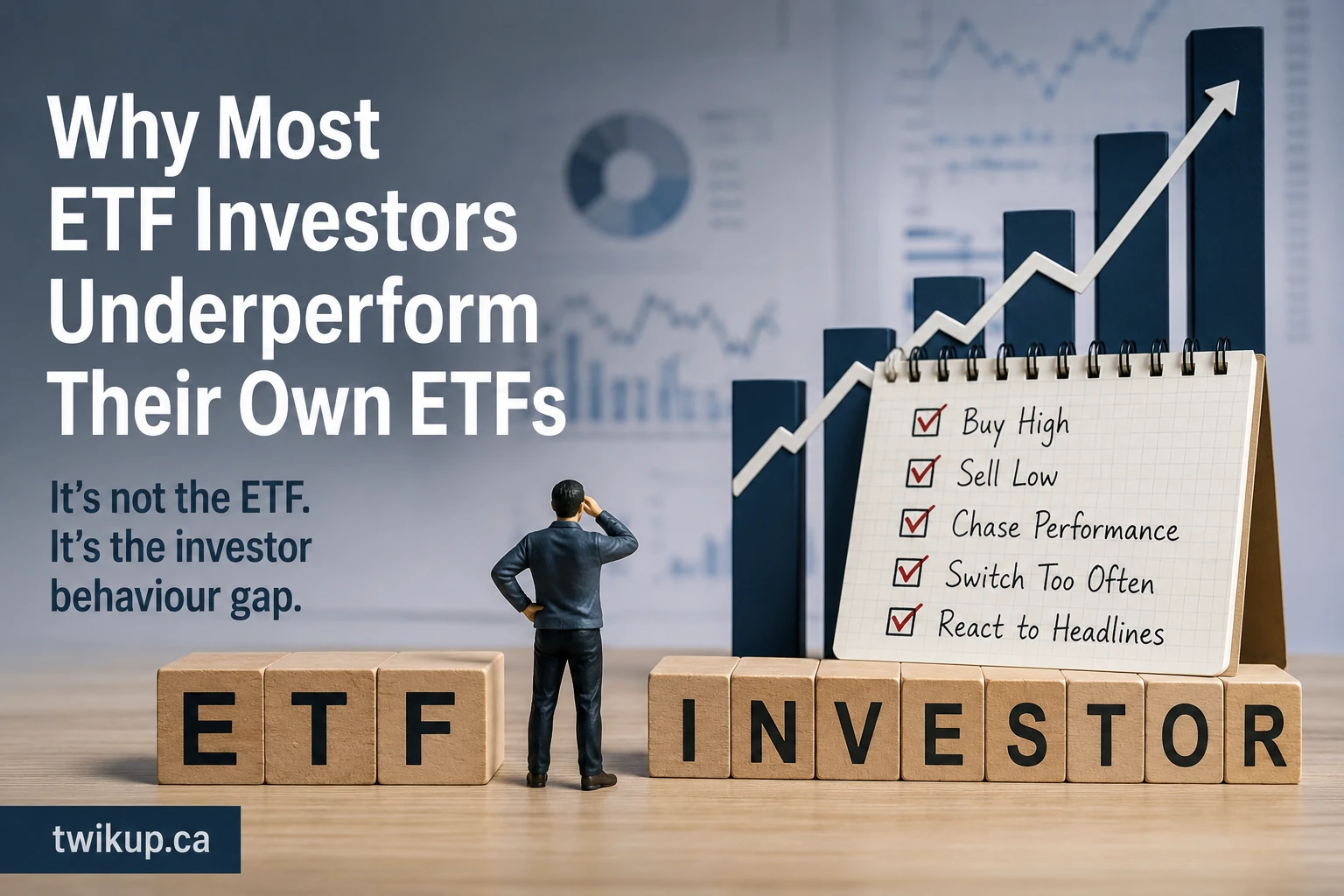
Why Most ETF Investors Underperform Their Own ETFs
Quick Answer
Most ETF investors do not underperform because the ETF is bad. They underperform because they buy late, sell early, chase recent winners, switch strategies too often, overreact to headlines, ignore fees and taxes, and treat long-term ETFs like short-term trades.
The ETF may deliver one return. The investor may earn a lower return because of behaviour.
That gap is the real problem.
TwikUp Insight
ETFs are simple products, but simple does not mean easy.
A broad-market ETF can quietly do its job for years, but investors often interrupt the process. They move from Canadian ETFs to U.S. ETFs, from dividend ETFs to growth ETFs, from AI-heavy funds to “safer” funds, and then back again after prices already move.
The mistake is not always picking the wrong ETF.
The mistake is not giving the ETF enough time to work.
The ETF Return and the Investor Return Are Not Always the Same
An ETF has a published performance number. That number usually assumes the investment was held for the full period.
But many investors do not hold for the full period.
They may:
- Buy after a strong run
- Sell during a correction
- Switch after one bad year
- Add more only when confidence is high
- Stop contributing when markets look scary
- Chase whatever performed best recently
That means the ETF may perform well, while the investor’s actual result is lower.
This is why two people can buy the same ETF and end up with very different outcomes.
Why This Happens So Often
Most underperformance comes from behaviour, not product design.
ETFs are transparent, low-cost, and easy to buy. That is good.
But that ease also makes it easier to make emotional decisions.
When an ETF is up, investors feel safe buying more.
When it drops, they feel smart selling.
When another ETF performs better, they feel behind.
When social media promotes a theme, they feel pressure to switch.
The problem is that long-term investing often rewards patience, while investor behaviour often rewards action.
Those two forces fight each other.
1. Investors Chase the Best-Performing ETF Too Late
Many ETF investors look at a 1-year or 3-year chart and assume the winner will keep winning.
That can lead to buying after a major run.
For example, an investor may move heavily into U.S. growth, AI, technology, or a specific high-performing sector after reading headlines. But by the time the trend becomes obvious, valuations may already be stretched.
That does not mean the ETF is bad. It means the entry point may be emotional.
This connects directly with the risk explained in Are You Overinvested in AI? The Truth About Tech Stocks and the Magnificent Seven.
A strong theme can still become a risky portfolio if investors pile in too late.
2. Investors Sell Good ETFs During Bad Markets
A broad-market ETF can fall sharply during corrections, recessions, inflation shocks, rate scares, or global uncertainty.
That is normal.
But many investors treat normal volatility as a sign that the ETF has failed.
They sell to “wait for things to calm down.”
The problem is that markets often recover before confidence returns. By the time the investor feels safe again, prices may already be higher.
This is one of the most common ways investors underperform their own ETFs.
They miss the recovery because they were waiting for emotional comfort.
3. Investors Keep Switching Strategies
One year dividend ETFs look smart.
Another year growth ETFs lead.
Another year S&P 500 ETFs dominate.
Another year all-in-one ETFs look better.
Another year covered-call ETFs attract attention because of income.
Every strategy has a season where it looks brilliant and a season where it looks disappointing.
The investor who keeps switching may never capture the full benefit of any strategy.
That is why comparing ETFs is useful, but constantly changing based on short-term results can be harmful.
For deeper context, see:
- Dividend ETFs vs Growth ETFs: Should You Chase High Dividend Yields?
- Covered-Call ETFs Explained: Passive Income Strategy or Performance Trap?
- XEQT vs VEQT vs VFV vs VOO: Which ETF Is Best for Long-Term Investing?
The best ETF is not always the one with the best recent chart.
It is often the one the investor can actually hold.
4. Investors Confuse “Simple” With “Risk-Free”
ETFs can reduce company-specific risk, but they do not remove market risk.
An S&P 500 ETF can fall.
A Canadian equity ETF can fall.
A global all-equity ETF can fall.
A dividend ETF can fall.
A covered-call ETF can lag in strong markets.
A bond ETF can also decline when interest rates move sharply.
Diversification helps, but it does not guarantee smooth returns.
When investors expect ETFs to rise steadily every year, they panic when reality looks different.
That panic often causes the underperformance.
5. Investors Ignore Their Own Time Horizon
A 25-year-old investing for retirement and a 62-year-old investing for near-term income should not always think the same way.
But many investors choose ETFs based on popularity instead of time horizon.
A long-term investor may be able to handle more volatility.
A short-term investor may need more stability.
A new investor may need simplicity more than optimization.
This is why investing before age 30 can be powerful, but only if the strategy matches the investor’s behaviour and timeline.
Read more: Dividend Investing Before Age 30: Smart Strategy or Too Early?
The longer the time horizon, the more important consistency becomes.
6. Investors Overcomplicate Their Portfolio
Some investors start with one or two ETFs.
Then they add:
- A Canadian ETF
- A U.S. ETF
- A global ETF
- A dividend ETF
- A tech ETF
- A covered-call ETF
- A bond ETF
- A sector ETF
- A few individual stocks
Soon, the portfolio becomes harder to understand.
The investor may think they are diversified, but they may actually own the same companies across multiple ETFs.
This can create overlap, confusion, and unnecessary decision-making.
A complicated portfolio is not automatically a better portfolio.
Sometimes it simply gives the investor more reasons to interfere.
7. Investors Use Their TFSA Like a Trading Account
The TFSA is one of the most powerful accounts available to Canadians because investment income and capital gains are generally tax-free when rules are followed.
But many investors hurt themselves by using the TFSA for short-term trades, panic selling, frequent switching, or speculative bets.
The TFSA should not be treated casually just because withdrawals are flexible.
A poor strategy inside a TFSA is still a poor strategy.
Read more: The Biggest TFSA Investing Mistake Canadians Make
The account is powerful, but the behaviour still matters.
8. Investors Compare Too Often
ETF investors often compare their ETF against whatever did best recently.
A Canadian ETF holder compares against the S&P 500.
A global ETF holder compares against U.S. tech.
A dividend investor compares against growth stocks.
A VFV investor compares against VOO.
A ZSP investor compares against VFV.
Comparison can be useful during research. But constant comparison after investing can create doubt.
For Canadians choosing between similar S&P 500 exposure, these guides may help:
- VFV vs ZSP: Which S&P 500 ETF Makes More Sense for Canadians?
- Should Canadians Buy VFV or Invest Directly in the S&P 500?
The goal is not to own the ETF that wins every month.
The goal is to own a strategy that fits your life long enough to work.
A Simple Example
Imagine two investors buy the same ETF.
Investor A invests regularly, ignores short-term noise, and holds for years.
Investor B buys after strong performance, sells during declines, waits in cash, then buys back after recovery.
Both used the same ETF.
But Investor A may earn much closer to the ETF’s actual return.
Investor B may underperform because the timing decisions damaged the result.
That is the investor behaviour gap.
How ETF Investors Can Reduce Underperformance
The goal is not to be perfect.
The goal is to reduce mistakes.
A stronger ETF plan usually includes:
- A clear reason for owning each ETF
- A realistic time horizon
- An asset mix the investor can tolerate
- Fewer unnecessary switches
- Regular contributions when possible
- Less reaction to headlines
- Awareness of fees, taxes, and account rules
- A written plan before markets become emotional
The best ETF strategy is not the one that looks smartest in a spreadsheet.
It is the one the investor can follow during both good and bad markets.
Bottom Line
Most ETF investors underperform their own ETFs because they interfere too much.
They chase performance, sell during fear, switch strategies, overreact to headlines, and confuse activity with progress.
ETFs can be excellent long-term tools, but they do not remove the hardest part of investing: behaviour.
The ETF can only do its job if the investor lets it.
Disclaimer: This article is for educational and informational purposes only and should not be considered financial, investment, tax, or legal advice. ETFs, stocks, mutual funds, and other investments can rise or fall in value, and past performance does not guarantee future results. Every investor's financial situation, goals, time horizon, and risk tolerance are different. Before making investment decisions, consider consulting a qualified financial advisor and review the official fund documents and disclosures. Tax rules, including those related to TFSAs and other registered accounts, may change over time and depend on your individual circumstances.
Sources
- Financial Consumer Agency of Canada — Investing basics
- Canada Revenue Agency — Tax-Free Savings Account guide
- Canada Revenue Agency — What is a TFSA
- Canada Revenue Agency — Owing tax on a TFSA
- Ontario Securities Commission — ETFs: Exchange-traded funds
- Ontario Securities Commission — How ETFs work
- Competition Bureau Canada — Investment scams