
Quick Answer
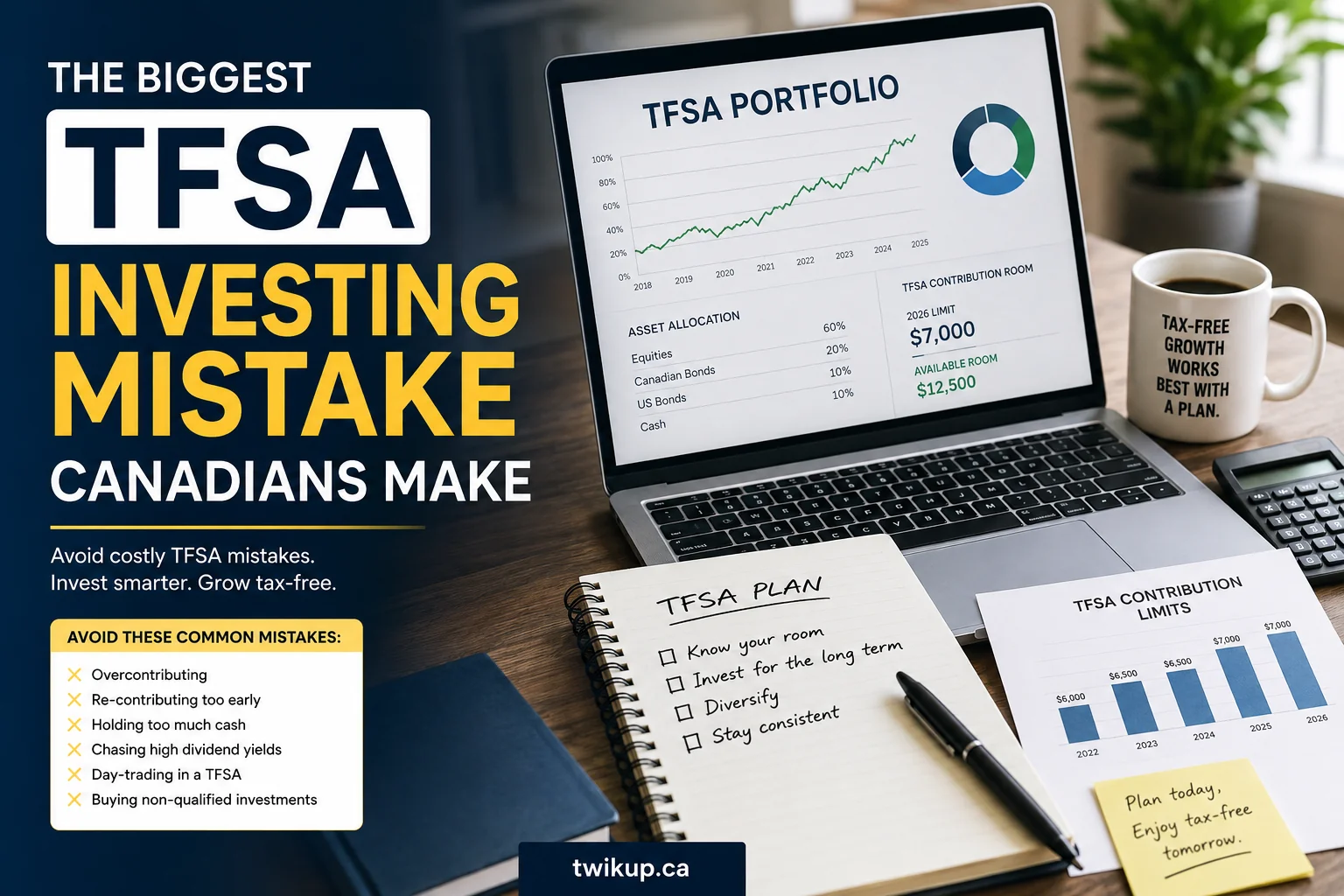
The biggest TFSA investing mistake Canadians make is treating the TFSA like a regular savings account instead of a long-term tax-free investment account.
A TFSA can hold cash, but using it only for low-interest savings may waste its biggest benefit: tax-free growth. The second major mistake is misunderstanding TFSA contribution room — especially withdrawing money and recontributing it in the same year, which can trigger overcontribution tax.
Twikup Insight
The TFSA is not just a “tax-free savings account.” For many Canadians, it is a tax-free wealth-building account.
The real mistake is not choosing the wrong stock or ETF. The real mistake is using the TFSA without a plan: holding too much idle cash, chasing risky short-term trades, overcontributing by accident, or buying investments without understanding the rules.
A TFSA works best when Canadians use it for goals where tax-free growth matters — long-term investing, dividend income, ETF growth, and flexible retirement savings.
What Is a TFSA?
A Tax-Free Savings Account, or TFSA, is a registered account that allows eligible Canadians to earn investment income tax-free.
That means interest, dividends, and capital gains earned inside the account are generally not taxed when withdrawn.
But the name can be misleading. A TFSA is not limited to a basic savings account. Depending on the financial institution, it can hold different types of qualified investments, including cash, mutual funds, GICs, stocks, bonds, and ETFs.
This is why the biggest TFSA mistake is often behavioural: many Canadians open a TFSA, deposit money, leave it in cash, and never actually invest it.
The Biggest TFSA Mistake: Using It Only Like a Savings Account
There is nothing wrong with keeping emergency money in a TFSA if that fits your situation.
But if your TFSA is filled only with low-interest cash for years, you may be wasting one of the most powerful tax-free tools available in Canada.
The TFSA becomes more valuable when the investments inside it have meaningful growth potential.
For example:
- Cash interest may grow slowly.
- GICs may provide stability but limited upside.
- Broad-market ETFs can offer long-term growth potential.
- Dividend ETFs can create tax-free income.
- Growth ETFs can compound tax-free over time.
That does not mean every Canadian should take high risk. It means the TFSA should match your goal.
If your goal is long-term wealth, using the TFSA only as a parking account may be a costly mistake.
For younger investors, this connects closely with the bigger question of whether dividend investing makes sense early in life. Twikup has explained that here: Dividend Investing Before Age 30 — Smart Strategy or Too Early?
Mistake #2: Thinking Withdrawals Can Be Replaced Anytime
This is one of the most common TFSA mistakes in Canada.
When you withdraw money from a TFSA, that withdrawal amount is generally added back to your contribution room — but not immediately. It is added back at the beginning of the next calendar year.
That means if you withdraw money and recontribute it in the same year without having enough unused room, you may overcontribute.
Simple Example
Imagine you have no unused TFSA room left.
You withdraw $5,000 from your TFSA in July 2026.
You cannot automatically put that same $5,000 back in August 2026 unless you already have unused room available.
That $5,000 withdrawal room comes back on January 1, 2027.
This is where many Canadians get surprised.
The TFSA feels flexible, but the recontribution rule is strict.
Mistake #3: Overcontributing Without Realizing It
The CRA says the TFSA dollar limit for 2026 is $7,000. Unused contribution room can carry forward, but every person’s available room is different.
Your TFSA contribution room depends on:
- your age,
- your Canadian residency status,
- your past contributions,
- your withdrawals,
- your unused room from previous years.
The problem is that CRA My Account may not always show the most up-to-date number early in the year because financial institutions report TFSA transactions after year-end.
So if you rely only on the CRA number without checking your own records, you can accidentally overcontribute.
The CRA applies a 1% tax per month on the highest excess TFSA amount for each month the excess remains.
This is why TFSA tracking matters.
Mistake #4: Holding the Wrong Type of Risk Inside a TFSA
A TFSA can be powerful, but it is not a magic account.
If you buy a risky stock and it crashes, the loss still hurts. Worse, unlike a non-registered account, you generally cannot claim a capital loss from investments inside a TFSA.
That means speculative investing inside a TFSA can be dangerous.
A better TFSA approach for many Canadians may be simple:
- broad-market ETFs,
- diversified dividend ETFs,
- balanced portfolios,
- long-term index funds,
- GICs for short-term goals,
- cash only for near-term needs.
If you are comparing ETFs for long-term growth, this Twikup guide may help: XEQT vs VEQT vs VFV vs VOO: Which ETF Is Best for Long-Term Investing in 2026?
Mistake #5: Chasing High Dividend Yield Without Understanding It
Many Canadians love the idea of earning tax-free dividends inside a TFSA.
That can make sense.
But chasing only the highest yield can be risky. A high yield may come from a falling stock price, a risky fund structure, or a strategy that sacrifices long-term growth.
Dividend investing is not just about yield. It is about quality, sustainability, diversification, and total return.
For Canadians comparing dividend ETFs and growth ETFs, Twikup has covered the trade-off here: Dividend ETFs vs Growth ETFs: Should You Chase High Dividend Yields?
Covered-call ETFs are another area where investors should be careful. They may offer high monthly income, but the structure can limit upside in strong markets.
Read more here: Covered-Call ETFs Explained: Passive Income Strategy or Performance Trap?
Mistake #6: Treating a TFSA Like a Day-Trading Account
A TFSA is meant for tax-free savings and investing, not necessarily active business-like trading.
The CRA can review cases where someone appears to be carrying on a trading business inside a TFSA. If income is considered business income, it may not receive the normal tax-free treatment.
This does not mean Canadians cannot buy and sell investments in a TFSA.
But frequent trading, speculative activity, short holding periods, and business-like behaviour can create tax risk.
For most Canadians, the safer TFSA strategy is simple: invest based on a long-term plan rather than constant trading.
Mistake #7: Forgetting That Not Every Investment Is Allowed
TFSAs can only hold qualified investments.
The CRA also has rules around prohibited investments and non-qualified investments. These rules matter because holding the wrong type of investment can create tax consequences.
For most everyday investors using a major Canadian brokerage or bank, common stocks, ETFs, GICs, mutual funds, and cash products are usually straightforward.
But investors should be careful with private company shares, related-party investments, unusual products, foreign structures, or anything not clearly permitted.
If you are unsure, check with your financial institution or a qualified tax professional before buying it inside a TFSA.
So What Should Canadians Actually Do?
A strong TFSA strategy starts with one question:
What is this money for?
If the money is for emergencies
Cash or high-interest savings may make sense.
If the money is for a home purchase soon
GICs or low-risk options may be better than stocks.
If the money is for long-term wealth
Diversified ETFs may make more sense than cash.
If the money is for retirement flexibility
A mix of growth ETFs, dividend ETFs, and broad-market funds may work depending on risk tolerance.
The TFSA is flexible, but flexibility can become a problem if there is no strategy.
A Simple TFSA Checklist
Before contributing to a TFSA, ask:
- How much contribution room do I actually have?
- Did I withdraw money this year?
- Am I recontributing too early?
- Is this money short-term or long-term?
- Am I holding too much cash?
- Am I taking too much risk?
- Is this investment qualified for a TFSA?
- Am I investing or just chasing hype?
This checklist can prevent most TFSA mistakes.
Final Takeaway
The biggest TFSA mistake Canadians make is not just overcontributing or picking the wrong investment.
It is misunderstanding what the TFSA is really for.
A TFSA can be a savings account, but it can also be a tax-free investing engine. Used casually, it may only save a few dollars in tax. Used strategically, it can become one of the most powerful long-term wealth tools available to Canadians.
The smartest TFSA strategy is simple:
Know your room. Avoid overcontributions. Invest according to your timeline. Let tax-free growth do the work.
Sources
-
Canada Revenue Agency — Tax-Free Savings Account Guide for Individuals https://www.canada.ca/en/revenue-agency/services/forms-publications/publications/rc4466/tax-free-savings-account-tfsa-guide-individuals.html
-
Canada Revenue Agency — Calculate Your TFSA Contribution Room https://www.canada.ca/en/revenue-agency/services/tax/individuals/topics/tax-free-savings-account/contributing/calculate-room.html
-
Canada Revenue Agency — If You Over-Contribute to a TFSA https://www.canada.ca/en/revenue-agency/services/tax/individuals/topics/tax-free-savings-account/contributing/overcontribute.html
-
Canada Revenue Agency — Withdrawing From a TFSA https://www.canada.ca/en/revenue-agency/services/tax/individuals/topics/tax-free-savings-account/withdraw.html
-
Canada Revenue Agency — TFSA Dollar Limits https://www.canada.ca/en/revenue-agency/services/tax/registered-plans-administrators/pspa/mp-rrsp-dpsp-tfsa-limits-ympe.html
-
Canada Revenue Agency — Qualified Investments https://www.canada.ca/en/revenue-agency/services/tax/technical-information/income-tax/income-tax-folios-index/series-3-property-investments-savings-plans/series-3-property-investments-savings-plan-folio-10-registered-plans-individuals/income-tax-folio-s3-f10-c1-qualified-investments-rrsps-resps-rrifs-rdsps-tfsas.html
-
Canada Revenue Agency — Prohibited Investments https://www.canada.ca/en/revenue-agency/services/tax/technical-information/income-tax/income-tax-folios-index/series-3-property-investments-savings-plans/series-3-property-investments-savings-plan-folio-10-registered-plans-individuals/income-tax-folio-s3-f10-c2-prohibited-investments-rrsps-rrifs-tfsas.html