
Quick Answer
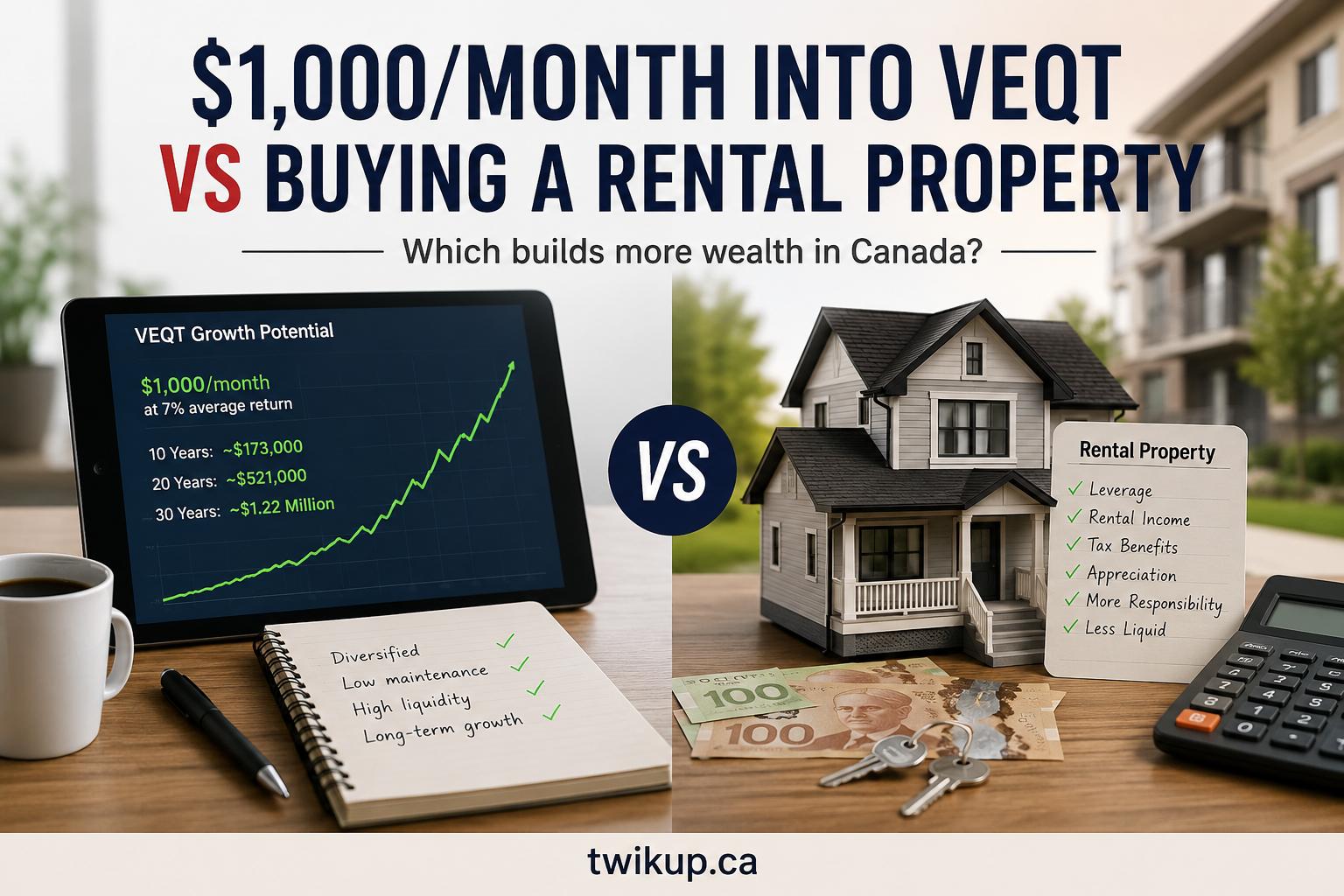
Investing $1,000 per month into VEQT will usually be the simpler, more diversified and more liquid strategy. At an illustrative 7% average annual return, consistent monthly investments could grow to approximately:
- $173,000 after 10 years
- $521,000 after 20 years
- $1.22 million after 30 years
A rental property could potentially produce a larger return on the investor’s original down payment because a mortgage provides leverage. However, the result depends heavily on the purchase price, mortgage rate, rent, vacancies, repairs, property taxes and future home-price appreciation.
The rental property may win when it is purchased at a sensible price, produces sustainable cash flow and is held for many years. VEQT may win when the property requires continuous additional cash, experiences weak appreciation or creates major repair and tenant-related costs.
Neither option is automatically better. The stronger choice depends on whether you want a passive, diversified investment or a leveraged real-estate business.
TwikUp Insight
The biggest mistake in the VEQT-versus-rental-property debate is comparing only the final property value with the ETF balance.
A $700,000 rental property is not the same as a $700,000 investment portfolio. The landlord may still owe hundreds of thousands of dollars on the mortgage and may have contributed a large down payment, closing costs, repairs and monthly cash-flow shortfalls.
A fair comparison must measure:
Final net wealth after debt, taxes, selling costs and every dollar personally contributed.
That calculation often produces a much closer contest than social-media examples suggest.
$1,000 a Month Into VEQT vs Buying a Rental Property
Many Canadians see two popular paths to building long-term wealth:
- Invest regularly in a globally diversified ETF such as VEQT.
- Use savings as a down payment on a rental property.
Both strategies can work. Both can also disappoint.
VEQT offers global stock-market exposure through one fund. A rental property offers leverage, rental income and the possibility of property appreciation. But real estate also comes with a mortgage, concentrated risk and ongoing operating responsibilities.
The right question is not simply:
“Will stocks or Canadian real estate rise faster?”
The more useful question is:
“Which strategy produces the strongest net result for the amount of money, time and risk I am actually contributing?”
This article uses illustrative Canadian examples to examine that question.
What Is VEQT?
VEQT is an all-equity asset-allocation ETF. It holds a diversified portfolio of Canadian, U.S., international and emerging-market stocks through underlying ETFs.
Because it is effectively invested entirely in equities, VEQT is designed for investors who:
- Have a long investment horizon
- Can tolerate significant market declines
- Want broad diversification
- Prefer a low-maintenance investment
- Do not require the money in the immediate future
VEQT can experience substantial losses during stock-market downturns. An investor must be prepared to continue holding—and potentially continue investing—even when the account balance declines.
That behavioural requirement matters. As explained in Why Most ETF Investors Underperform Their Own ETFs, the investment itself is often not the problem. Investors may underperform because they stop contributing, chase recent winners or sell during market declines.
How Much Could $1,000 Per Month Grow?
Suppose an investor contributes $1,000 at the end of every month and reinvests all distributions.
The following are illustrative projections, not forecasts:
| Investment period | 5% annual return | 7% annual return | 9% annual return |
|---|---|---|---|
| 10 years | About $155,000 | About $173,000 | About $194,000 |
| 20 years | About $411,000 | About $521,000 | About $668,000 |
| 30 years | About $832,000 | About $1.22 million | About $1.83 million |
Total contributions
Over those periods, the investor would personally contribute:
| Investment period | Total contributed |
|---|---|
| 10 years | $120,000 |
| 20 years | $240,000 |
| 30 years | $360,000 |
At a hypothetical 7% return, the 30-year balance of approximately $1.22 million would include roughly:
- $360,000 of contributions
- $860,000 of investment growth
This demonstrates why time and consistency can matter more than finding the “perfect” ETF.
However, returns will not arrive smoothly. One year could produce a large gain, while another could produce a substantial decline. The 5%, 7% and 9% figures are mathematical scenarios—not promises about VEQT’s future performance.
Can You Put the Full $1,000 Per Month Into a TFSA?
Not necessarily.
The annual TFSA dollar limit for 2026 is $7,000, although an individual may have additional unused contribution room from previous years.
Investing $1,000 per month equals $12,000 annually. Therefore, someone with only $7,000 of available room could not contribute the full amount to a TFSA without overcontributing.
The remaining amount might be invested through:
- An RRSP, when appropriate
- A first home savings account, if eligible and saving for a qualifying first home
- A non-registered investment account
- A combination of registered accounts
Always verify your available contribution room before contributing. CRA account information may not immediately reflect very recent contributions or withdrawals.
Read The Biggest TFSA Investing Mistake Canadians Make before moving money between accounts or attempting to replace a TFSA withdrawal.
The Rental-Property Alternative
Now consider a Canadian buying a rental property for $500,000.
This is an illustrative example rather than a recommendation or a representation of every Canadian market.
Example purchase assumptions
| Item | Illustrative amount |
|---|---|
| Purchase price | $500,000 |
| Down payment | $100,000 |
| Mortgage | $400,000 |
| Mortgage rate | 5% |
| Amortization | 25 years |
| Approximate mortgage payment | $2,338 per month |
| Estimated closing and setup costs | $10,000 |
| Total initial cash required | About $110,000 |
A $500,000 property therefore cannot normally be purchased with only a new $1,000 monthly commitment. The investor first needs substantial capital for the down payment, closing costs and an emergency reserve.
Saving $110,000 at $1,000 per month would take more than nine years without investment growth.
This starting-capital difference is one of the most frequently ignored parts of the comparison.
What If the Property Rents for $2,600 Per Month?
Suppose the property generates monthly rent of $2,600.
A beginner might calculate:
$2,600 rent − $2,338 mortgage = $262 monthly profit.
But the mortgage is not the only property expense.
Illustrative monthly operating costs
| Expense | Illustrative monthly amount |
|---|---|
| Mortgage payment | $2,338 |
| Property taxes | $350 |
| Insurance | $125 |
| Maintenance reserve | $200 |
| Vacancy reserve | $100 |
| Total estimated monthly cost | $3,113 |
| Monthly rent | $2,600 |
| Estimated cash flow | −$513 |
Under these assumptions, the owner would need to contribute approximately $513 per month before considering:
- Property management
- Legal or accounting expenses
- Utilities paid by the landlord
- Condominium fees
- Licensing or inspection costs
- Major capital repairs
- Unpaid rent
- Damage not covered by a deposit or insurance
- Income-tax consequences
This does not automatically mean the investment is bad. Part of the mortgage payment reduces the principal balance and builds equity.
However, mortgage principal is not free profit. The owner had to fund the down payment and may be adding hundreds of dollars every month to keep the property operating.
The Mortgage Payment Contains Two Different Parts
A mortgage payment consists primarily of:
- Interest
- Principal repayment
Interest is a borrowing cost. Principal repayment reduces the debt and increases the owner’s equity.
In the early years of a conventional mortgage, a larger portion of each payment generally goes toward interest. Over time, more of the payment is applied to principal.
This creates a real-estate advantage: the tenant’s rent may help the landlord pay down the mortgage.
But the property still has to be evaluated as a complete investment. Mortgage paydown cannot erase an excessive purchase price, persistent negative cash flow or expensive repairs.
What Could the Rental Property Be Worth in 20 Years?
Consider three possible appreciation scenarios for the $500,000 property.
| Annual property appreciation | Estimated value after 20 years |
|---|---|
| 2% | About $743,000 |
| 3% | About $903,000 |
| 4% | About $1.10 million |
At first glance, these figures can appear much more attractive than the VEQT example.
But property value is not the same as net equity.
After 20 years, the owner may still have a mortgage balance. Selling may also involve real-estate commissions, legal fees, mortgage discharge costs and potential tax on the gain.
A proper comparison should use:
Property value − mortgage balance − selling costs − applicable taxes
It should then subtract the initial down payment, closing costs, renovations and monthly cash injected by the owner.
A More Complete 20-Year Rental Example
Suppose the property:
- Was purchased for $500,000
- Used a $100,000 down payment
- Had $10,000 of closing and setup costs
- Appreciated by 3% annually
- Was worth approximately $903,000 after 20 years
- Had an estimated mortgage balance of roughly $120,000
- Cost approximately 5% of the sale price to sell
Simplified net-sale calculation
| Item | Illustrative amount |
|---|---|
| Property value | $903,000 |
| Less estimated selling costs | −$45,000 |
| Less remaining mortgage | −$120,000 |
| Approximate equity before tax | $738,000 |
That looks significantly better than the approximately $521,000 VEQT balance produced by investing $1,000 per month at 7%.
However, this is not yet an equal comparison.
The property investor also contributed:
- $100,000 down payment
- Approximately $10,000 in initial costs
- Potentially $513 per month in negative cash flow
- Additional money for major repairs or renovations
A $513 monthly shortfall over 20 years would total approximately $123,000, without adjusting for rent increases, expense increases or changing mortgage rates.
The property investor’s simplified personal contributions could therefore exceed $230,000 before major repairs.
Meanwhile, the VEQT investor contributed $240,000 over 20 years.
Once the cash contributions become more comparable, the contest becomes much closer.
What Happens If Rent Increases?
Rental income may increase over time, but landlords should not automatically assume that rent will rise at the same rate as their expenses.
Actual rent increases can depend on:
- Provincial rent-control rules
- Whether the unit is covered by those rules
- The local rental market
- Tenant turnover
- The condition and location of the property
- Vacancy levels
- Permitted annual increases
- Lease terms
At the same time, the following expenses may also rise:
- Property taxes
- Insurance premiums
- Repairs
- Contractor charges
- Utilities
- Property-management fees
- Condominium fees
A property that is cash-flow negative in year one may eventually become positive. But investors should model that improvement instead of assuming it will happen automatically.
The Real Advantage of a Rental Property: Leverage
Leverage is the strongest argument in favour of rental real estate.
With $100,000 down, an investor may control a $500,000 asset.
If the property rises by 3%, its market value increases by $15,000 in the first year. That equals 15% of the original $100,000 down payment before expenses, financing costs and taxes.
But leverage works in both directions.
If the property falls by 10%, its value declines by $50,000. That decline equals half of the original down payment, even though the market value fell by only 10%.
Leverage magnifies outcomes. It does not guarantee positive outcomes.
The Real Advantage of VEQT: Diversification
A rental-property investor may have a large portion of their net worth tied to:
- One property
- One neighbourhood
- One city
- One provincial housing market
- One tenant or household
- One mortgage-renewal cycle
VEQT spreads investment exposure across thousands of companies operating in multiple countries, industries and currencies.
It still carries market risk, and global stock markets can fall together during severe downturns. Nevertheless, VEQT avoids the highly concentrated property-specific risks of a single rental home.
Investors concerned about excessive exposure to a small group of large technology companies should also understand how broad-market funds are constructed. Read Are You Overinvested in AI? The Truth About Tech Stocks and the Magnificent Seven.
Rental Property Taxation in Canada
Rental income generally must be reported for Canadian income-tax purposes.
The owner typically calculates net rental income by subtracting eligible expenses from gross rental income. Depending on the facts, deductible expenses may include reasonable amounts related to:
- Mortgage interest
- Property taxes
- Insurance
- Advertising
- Professional fees
- Management expenses
- Eligible repairs and maintenance
- Certain utilities
- Other costs incurred to earn rental income
The mortgage principal repayment is not the same as mortgage interest and is generally not deducted as a rental expense.
Capital improvements are also treated differently from current repairs. For example, repairing a broken component may not receive the same tax treatment as replacing or substantially improving a major part of the property.
Rental owners generally report the property’s income and expenses using Form T776.
Because rental-property tax treatment can depend on ownership structure, personal use, capital cost allowance and the nature of each expense, investors should consult an appropriate tax professional for their circumstances.
What Happens When the Rental Property Is Sold?
A rental property is generally not treated in the same way as a qualifying principal residence.
If the property is sold for more than its adjusted cost base and eligible selling expenses, the owner may realize a capital gain. Tax treatment can become more complicated when:
- Capital cost allowance was claimed
- The property changed from personal to rental use
- Only part of the property was rented
- The owner lived in the property during part of the ownership period
- Major capital improvements were completed
- Ownership was shared
- The property was held through a corporation or partnership
The after-tax proceeds—not merely the selling price—should be used when comparing the property with a TFSA or non-registered investment portfolio.
VEQT Taxation Depends on the Account
VEQT held inside a TFSA
Investment income and capital gains earned inside a TFSA are generally tax-free, including when funds are withdrawn, subject to the TFSA rules.
Contributions are not tax-deductible, and investors must remain within their available contribution room.
VEQT held inside an RRSP
Eligible RRSP contributions may produce a tax deduction. Investments can grow tax-deferred, but withdrawals are generally included in taxable income.
The value of an RRSP balance should therefore not always be compared dollar-for-dollar with a TFSA balance.
VEQT held in a non-registered account
Distributions and realized capital gains may create taxable income. Adjusted cost base records must be maintained accurately, particularly when distributions are reinvested.
The investor’s account type can materially affect the after-tax outcome.
Liquidity: VEQT Has a Major Advantage
VEQT units can generally be sold during market hours. Settlement and withdrawal timing still apply, but an investor can sell part of the holding without liquidating the entire portfolio.
A rental property is much less liquid.
Accessing its equity may require:
- Selling the property
- Refinancing
- Obtaining a home-equity product
- Passing a lender’s qualification process
- Paying appraisal, legal or financing costs
A property can also take weeks or months to sell, and the final price may be lower than expected.
Liquidity can be especially valuable during job loss, illness, relocation or another financial emergency.
Time and Work: A Rental Is Not Fully Passive
VEQT requires relatively little ongoing administration beyond:
- Making contributions
- Rebalancing is handled within the fund
- Reviewing account and tax records
- Avoiding emotional trading decisions
A rental property may require:
- Advertising the unit
- Screening tenants
- Preparing leases
- Collecting rent
- Managing late payments
- Responding to maintenance calls
- Hiring contractors
- Maintaining records
- Filing tax information
- Understanding provincial tenancy rules
- Handling disputes or eviction processes
- Arranging inspections, insurance and licensing
A property manager can reduce the workload, but that service reduces the property’s cash flow.
The investor should decide whether this work is an acceptable part of the return.
VEQT Can Also Test Your Emotions
VEQT is operationally simple but emotionally difficult.
A severe market decline may reduce a six-figure portfolio by tens of thousands of dollars. The balance is visible every day, which can tempt investors to sell.
Rental-property prices are not displayed continuously. This can make real estate feel less volatile, even when its underlying market value has fallen.
The lack of a daily price does not eliminate risk. It only makes the risk less visible.
Successful ETF investors need the discipline to remain invested through downturns. Successful landlords need the discipline to manage debt, vacancies, repairs and changing housing markets.
What If You Already Have $100,000?
This creates a more meaningful comparison.
An investor with $100,000 could potentially:
Option A: Invest the $100,000 and add $1,000 monthly
At an illustrative 7% average annual return, the portfolio could grow to approximately:
- $311,000 after 10 years
- $908,000 after 20 years
- $2.03 million after 30 years
These estimates assume continuous monthly contributions and no withdrawals.
For another long-term lump-sum example, see Invested $100,000 in XEQT? Here’s What Could Happen Over 10, 20 and 30 Years.
Option B: Use the $100,000 as a rental-property down payment
The investor gains control of a larger asset through a mortgage but must also cover:
- Closing costs
- Initial repairs
- Emergency reserves
- Potential negative cash flow
- Future capital expenditures
- Mortgage renewal risk
This is the true decision: diversified liquid capital versus leveraged concentrated property ownership.
Which Strategy Could Perform Better?
VEQT may perform better when:
- Global stock markets produce strong long-term returns
- The investor contributes consistently
- Investments are held in tax-efficient accounts
- The rental property would be significantly cash-flow negative
- Property appreciation is weak
- Major repairs reduce the property’s return
- The investor values liquidity and diversification
- The investor avoids panic selling
A rental property may perform better when:
- It is purchased below or near fair value
- Rental income comfortably supports expenses
- The property is in a durable rental market
- Financing remains manageable
- Appreciation is reasonably strong
- Vacancies and repairs remain controlled
- The owner holds it for many years
- Leverage is used responsibly
- The owner adds value through renovations or improved operations
The property does not need extraordinary appreciation to perform well if rental income covers expenses and tenants steadily help reduce the mortgage.
Conversely, even strong appreciation may not save a poorly financed property with years of large cash-flow losses.
VEQT vs Rental Property: Side-by-Side Comparison
| Factor | VEQT | Rental property |
|---|---|---|
| Starting capital | Can begin with a small amount | Usually requires substantial upfront cash |
| Monthly investment | Flexible | Mortgage and expenses must be paid |
| Diversification | Thousands of companies | Usually one property and location |
| Leverage | Usually none | Commonly uses mortgage leverage |
| Liquidity | High | Low |
| Time required | Low | Moderate to high |
| Income | Distributions, not guaranteed | Rent, subject to vacancy and collection risk |
| Maintenance | None for the investor | Ongoing repairs and management |
| Tax complexity | Depends on account | Generally higher |
| Transaction costs | Usually relatively low | Potentially substantial |
| Emotional challenge | Market volatility | Debt, tenants and unexpected expenses |
| Control | Limited control over underlying firms | Greater control over property operations |
| Maximum loss exposure | Investment value can decline significantly | Equity can be lost while debt remains payable |
The Better Choice for a Beginner
For many beginners, regularly investing in a diversified ETF may be the more manageable starting point because it:
- Requires less upfront capital
- Creates immediate diversification
- Is easier to automate
- Has fewer surprise expenses
- Does not require landlord expertise
- Allows contributions to be adjusted
- Provides greater liquidity
However, a financially prepared investor may prefer rental property when they have:
- A sufficient down payment
- Separate closing-cost funds
- A substantial emergency reserve
- Stable employment income
- Strong credit
- A realistic cash-flow analysis
- Knowledge of local tenancy laws
- The willingness to operate the property like a business
A rental should not be purchased solely because “Canadian real estate always goes up.” Property markets can stagnate or decline, and heavily leveraged investors may be forced to sell at an unfavourable time.
Could You Own Both?
For many households, the strongest long-term plan may not require choosing only one asset.
A person might:
- Build a diversified ETF portfolio first.
- Maintain an emergency fund.
- Accumulate a separate property down payment.
- Purchase a rental only when the numbers work.
- Continue smaller ETF contributions after the purchase.
Owning both can reduce dependence on a single outcome, but it can also create overextension if the investor does not have enough cash reserves.
Do not drain retirement accounts, emergency savings and all available credit merely to become a landlord.
Before Buying VEQT
Ask yourself:
- Can I leave this money invested for at least 10 years?
- Could I tolerate a temporary decline of 30% or more?
- Do I understand that historical returns do not guarantee future performance?
- Am I using the most appropriate account?
- Have I verified my TFSA or RRSP contribution room?
- Will I continue contributing during a market decline?
- Does an all-equity portfolio fit my risk tolerance?
For a broader comparison of popular all-in-one and index ETFs, read XEQT vs VEQT vs VFV vs VOO: Which ETF Is Best for Long-Term Investing in 2026?.
Before Buying a Rental Property
Calculate:
- Down payment
- Land-transfer taxes
- Legal fees
- Inspection and appraisal costs
- Immediate repairs
- Mortgage payment
- Property taxes
- Insurance
- Vacancy allowance
- Maintenance allowance
- Property-management fees
- Utilities
- Licensing or condominium fees
- Major future replacements
- Income-tax impact
- Potential selling costs
- The effect of higher mortgage rates at renewal
Then test the property under difficult conditions:
- What happens if it is vacant for three months?
- What happens if the furnace fails?
- What happens if mortgage rates rise?
- What happens if rent cannot be increased?
- What happens if property prices remain flat for five years?
- What happens if the tenant stops paying?
- Can you support the property without relying on credit cards?
A property is not affordable merely because a lender approves the mortgage.
Final Verdict
For someone starting with no large down payment, investing $1,000 per month into VEQT is generally the more accessible and straightforward strategy.
It provides:
- Immediate global diversification
- High liquidity
- Flexible contributions
- Minimal ongoing administration
- The potential for long-term compounding
A well-selected rental property may generate a stronger return through leverage, mortgage paydown and appreciation. But that potential comes with higher starting capital, concentrated exposure, debt, taxes, transaction costs and significant operational responsibility.
The comparison can be summarized this way:
VEQT is primarily an investment. A rental property is an investment combined with financing and a small operating business.
VEQT may be more appropriate for investors seeking simplicity and diversification. Rental property may be more suitable for investors with adequate cash, property knowledge, risk capacity and the willingness to become active landlords.
The best result will not necessarily come from choosing the asset with the highest theoretical return. It will come from choosing a strategy you can afford, understand and continue through difficult periods.
Important Disclaimer
This article is for general educational and informational purposes only. It does not constitute financial, investment, mortgage, tax, accounting, legal or real-estate advice.
VEQT and other equity investments can decline significantly in value, and past performance does not guarantee future results. Rental properties can experience vacancies, repairs, negative cash flow, price declines, legal disputes and financing risks.
All calculations are simplified illustrations based on hypothetical assumptions. They exclude or simplify certain taxes, trading costs, product fees, changing mortgage rates, rent increases, inflation, renovations, capital cost allowance and individual circumstances.
Before investing or purchasing a rental property, consider consulting qualified financial, mortgage, tax, legal and real-estate professionals.