
Quick Answer
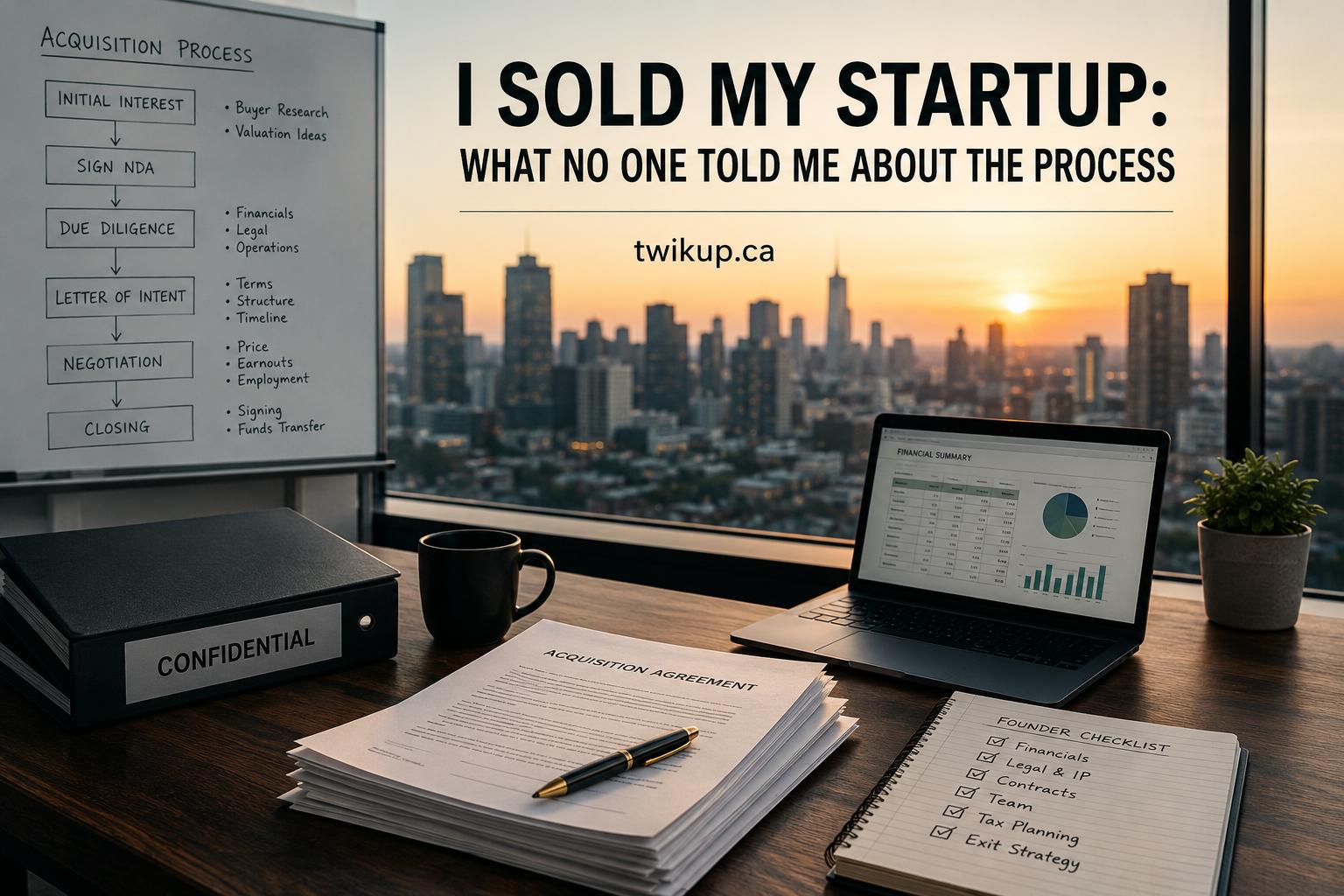
Selling a startup is rarely one dramatic meeting followed by a life-changing payment. It is usually a long, confidential process involving buyer conversations, financial reviews, legal negotiations, customer analysis, employee decisions, tax planning and months of uncertainty.
The headline sale price is also not necessarily what the founder receives. Debt, investor preferences, employee options, transaction expenses, taxes, escrow holdbacks and earnout conditions can all reduce or delay the final payout.
For many founders, the hardest parts are not finding a buyer. They are maintaining the business while negotiations continue, surviving due diligence, accepting the loss of control and discovering that closing the deal does not always produce the freedom they expected.
TwikUp Insight
Founders often prepare extensively to raise capital but spend very little time preparing to sell.
That is a mistake.
A company becomes easier to acquire when its financial records are clean, intellectual property is properly assigned, customer contracts are transferable, the cap table is accurate and the business can function without the founder controlling every decision.
The strongest exit preparation often begins years before an acquisition offer arrives.
The Offer Was Only the Beginning
When a buyer first expresses interest, it can feel as though the difficult work is over.
Someone values what you built. A number may be mentioned. Advisors begin discussing transaction structures. Friends may assume the sale is almost complete.
But early acquisition discussions are not the same as a completed sale.
A buyer can express serious interest and still withdraw later. The valuation can change after financial records are examined. Payment terms can become less attractive during negotiations. A deal that initially appears simple can become dependent on performance targets, employee retention or continued founder involvement.
Until the transaction closes and the required funds are transferred, the company has not been sold.
That distinction changes how founders should behave throughout the process.
You must continue operating the company, supporting customers, leading employees and protecting cash flow while simultaneously managing one of the most complex events in the company’s history.
Startup Sales Usually Begin Before the Official Process
Not every startup is sold through a formal auction involving investment bankers and dozens of bidders.
Many acquisitions begin through existing relationships:
- A strategic partnership
- A customer conversation
- An investor introduction
- A competitor showing interest
- A larger company exploring integration
- A founder discussing long-term plans with industry contacts
The first conversation may sound casual.
A potential buyer might ask whether you would ever consider selling, how quickly the company is growing or whether your investors are looking for liquidity.
Those questions can be exploratory, but they may also be an early attempt to understand your expectations before the buyer commits resources.
Founders should avoid sharing sensitive financial, customer or technical information too early. Initial conversations should establish whether the buyer is credible, strategically aligned and financially capable of completing the transaction.
Interest alone is not enough.
The Buyer May Value Your Company Differently Than You Do
Founders often value their startups according to years of work, personal sacrifice, future potential and the size of the market opportunity.
Buyers usually evaluate something different.
They may care about:
- Revenue and growth
- Gross margins
- Recurring contracts
- Customer concentration
- Proprietary technology
- Intellectual property
- Distribution advantages
- Strategic market access
- The strength of the team
- The cost of building the same capability internally
- The risk of a competitor acquiring the company first
A buyer may not be purchasing the business for the reason the founder expects.
A software company might believe its product is the main asset, while the buyer primarily wants its engineering team. A media platform might focus on its audience, while the buyer is more interested in its data or distribution relationships. A growing startup might expect a revenue-based valuation, while the buyer treats the acquisition as a defensive strategic purchase.
Understanding the buyer’s motivation can influence both the price and the transaction structure.
It also helps the founder identify which issues could threaten the deal.
The Headline Price Is Not the Same as the Founder’s Payout
A company may be described publicly as having sold for a certain amount, but that number can hide important details.
The total announced value may include:
- Cash paid at closing
- Shares in the acquiring company
- Future earnout payments
- Employee retention packages
- Debt assumed by the buyer
- Funds placed in escrow
- Performance-based consideration
- Payments that vest over several years
The amount available to shareholders must then be distributed according to the company’s ownership structure and financing agreements.
Investors may have liquidation preferences that allow them to receive their money before common shareholders. Employees may have vested stock options. Advisors or early contributors may own equity. Transaction expenses must be paid. Outstanding debts may need to be cleared.
This is why founders should understand dilution, investor rights and ownership economics long before an exit.
TwikUp’s guide to how startup dilution works explains how successive funding rounds can reduce a founder’s ownership percentage.
The company’s cap table determines who owns what, but the financing documents may determine who gets paid first.
A founder can own a meaningful percentage of a company and still receive much less than expected after the distribution waterfall is applied.
In some cases, founders can receive little or nothing. TwikUp explains that risk in Why Startup Founders Can Get Nothing After Selling Their Company.
The Letter of Intent Is Important—but It Is Not the Final Agreement
Once the buyer and seller reach a preliminary understanding, they may sign a letter of intent, commonly called an LOI.
The LOI typically outlines the proposed:
- Purchase price
- Payment structure
- Assets or shares being acquired
- Expected timeline
- Founder employment arrangements
- Exclusivity period
- Due-diligence requirements
- Conditions for completing the sale
Some provisions may be non-binding, while confidentiality, exclusivity and expense-related clauses can still create real obligations.
Exclusivity deserves particular attention.
During this period, the founder may be prohibited from negotiating with other buyers. That gives the selected buyer time to investigate the company, but it can weaken the seller’s leverage if the buyer later attempts to reduce the price.
A founder should understand exactly when exclusivity begins, how long it lasts and what happens if the buyer delays the process.
The LOI establishes the commercial direction of the deal. Terms that appear harmless at this stage can become difficult to renegotiate later.
Due Diligence Can Feel Like the Company Is Being Taken Apart
Due diligence is the buyer’s investigation of the startup.
The buyer is trying to confirm that the company is what the founder says it is and uncover liabilities that could become the buyer’s responsibility after closing.
The process can involve hundreds of requests covering:
Corporate records
The buyer may review incorporation documents, shareholder resolutions, board minutes, ownership records, option grants and previous financing agreements.
Financial information
Expect requests for bank statements, revenue records, financial statements, forecasts, expenses, tax filings, accounts receivable, liabilities and cash-flow history.
Customer relationships
The buyer may examine major contracts, renewal rates, churn, pricing, customer concentration, complaints and termination clauses.
Technology and intellectual property
The review can include source-code ownership, software licences, patents, trademarks, cybersecurity controls, open-source dependencies and intellectual-property assignments.
Employees and contractors
The buyer may request employment agreements, compensation details, option grants, contractor arrangements, confidentiality terms and information about key-person dependencies.
Legal and regulatory exposure
The review can include disputes, threatened claims, privacy practices, industry obligations, permits, insurance coverage and compliance policies.
Commercial performance
The buyer may test the accuracy of growth claims, customer pipelines, market assumptions and future projections.
Due diligence becomes far more difficult when records are scattered across personal email accounts, spreadsheets, messaging platforms and unsigned agreements.
A well-organized virtual data room can make the business appear more credible and reduce delays.
Small Documentation Problems Can Become Large Deal Problems
Early-stage startups frequently operate informally.
A friend builds the first website. A contractor writes code without signing an intellectual-property assignment. An early employee receives an option promise through email. Customer agreements are copied from old templates. Board approvals are postponed because everyone is busy.
These shortcuts may not stop the company from operating.
They can, however, become major problems during an acquisition.
A buyer wants confidence that the startup legally owns the product it is selling. If a former contractor could claim ownership of important code, the buyer may demand that the issue be resolved before closing.
Similar concerns can arise when:
- Equity grants were not properly documented
- Former employees retain system access
- Customer data was collected without adequate permissions
- Contracts contain change-of-control restrictions
- Open-source software obligations were ignored
- Company expenses were mixed with personal spending
- Financial projections cannot be reconciled with accounting records
- The company depends heavily on one customer
- Key agreements can be terminated after acquisition
Not every problem kills a transaction.
But each unresolved issue gives the buyer another reason to delay, reduce the price, demand protection or walk away.
You Still Have to Run the Company During the Sale
One of the most difficult parts of an acquisition is that the operating business cannot be neglected.
The sale process can consume enormous amounts of founder time. There are legal calls, financial questions, buyer meetings, document requests, employee discussions and constant revisions to the transaction agreement.
At the same time:
- Customers still need support
- Employees still need direction
- Sales targets still matter
- Product releases must continue
- Cash must be managed
- Competitors remain active
- Investors expect updates
If business performance deteriorates during negotiations, the buyer may reconsider the valuation or use the decline as leverage.
Founders should establish a small internal transaction team and limit access to confidential information. The broader company should continue operating with as little disruption as possible.
A sale process is not a substitute for business performance.
Strong performance can preserve negotiating power. Weakening performance can transfer leverage to the buyer.
Keeping the Process Secret Can Be Emotionally Difficult
Acquisition negotiations are usually highly confidential.
Founders may be unable to tell employees, customers, friends or even some senior managers what is happening.
This creates a strange period in which the founder is making decisions that could change everyone’s future while continuing to behave as though business is normal.
Employees may notice unusual meetings, document requests or changes in the founder’s behaviour. Rumours can spread. Key team members may worry about layoffs or leadership changes.
But announcing a possible transaction too early can create serious risks.
The deal may fail. Employees may leave. Customers may delay renewals. Competitors may exploit the uncertainty. The buyer may view the disclosure as a breach of confidentiality.
Founders need trusted legal, financial and personal advisors with whom they can speak openly.
Trying to carry the entire process alone can affect judgment at precisely the moment clear thinking matters most.
The Buyer Will Negotiate More Than the Price
Founders naturally focus on valuation, but many other provisions can determine whether the sale is ultimately successful.
Cash versus buyer shares
Cash provides immediate liquidity. Shares in the acquiring company may offer future upside but expose the founder to market, business and liquidity risk.
Escrow or holdback
Part of the purchase price may be withheld for a defined period to cover potential claims, inaccurate representations or undisclosed liabilities.
Earnout
Additional payments may depend on the acquired company reaching future revenue, profit, customer or product targets.
Earnouts can bridge a valuation gap, but they can also create disputes when the buyer controls the resources needed to achieve the targets.
Founder employment
The buyer may require the founder to remain for a transition period. Compensation, responsibilities, decision-making authority, termination rights and equity vesting should be clearly defined.
Employee retention
Some of the transaction value may be allocated to keeping important employees rather than paying existing shareholders.
Non-compete and non-solicitation terms
The founder may be restricted from launching a competing business, hiring former employees or approaching former customers for a specified period.
Representations and warranties
The seller may be required to make detailed statements about the company’s finances, contracts, technology, employees, taxes and legal position.
Indemnification
The agreement may explain when sellers are responsible for losses arising from inaccurate disclosures or pre-closing liabilities.
A higher price with aggressive conditions may be less attractive than a slightly lower price with certainty, immediate payment and limited future obligations.
Earnouts Are More Complicated Than They Sound
An earnout allows the seller to receive additional money if the business reaches agreed targets after the acquisition.
This can sound fair.
The founder believes the company will continue growing. The buyer is unwilling to pay fully for that expected growth upfront. The earnout appears to connect payment with performance.
The problem is that the business will no longer be fully controlled by the founder.
After closing, the buyer may change:
- Product priorities
- Pricing
- Marketing budgets
- Staffing
- Sales territories
- Accounting policies
- Customer strategy
- Technology investment
- Internal cost allocations
Any of these decisions can affect whether the earnout target is reached.
Earnout terms should define the performance metric, measurement period, accounting method, founder authority and buyer obligations as precisely as possible.
Ambiguous targets can turn a successful acquisition into years of conflict.
Losing Control Can Be Harder Than Expected
Founders spend years making final decisions.
They decide what to build, whom to hire, how the brand should sound and which customers the company should pursue.
After an acquisition, those decisions may belong to someone else.
Even when the founder remains as an executive, the company is no longer independent. Budgets may require approval. Product plans may change. Hiring can slow down. The startup may be integrated into a larger division. Processes that once took hours can take weeks.
The buyer may have valid reasons for these changes, but the loss of control can still be psychologically difficult.
Founders should evaluate more than the buyer’s offer.
They should ask:
- What will happen to the product?
- Will the brand continue?
- How will employees be treated?
- Who will control the roadmap?
- What will my role be after closing?
- How will performance be measured?
- What happens if the relationship stops working?
- Can I leave, and under what conditions?
A founder who wants immediate freedom should not assume that selling the company automatically provides it.
Employees Experience the Transaction Differently
For founders and investors, an acquisition may represent liquidity and validation.
For employees, it can represent uncertainty.
They may worry about:
- Job security
- Reporting lines
- Compensation
- Remote-work policies
- Benefit changes
- Unvested equity
- Product cancellation
- Office relocation
- Cultural differences
- Redundancies between the two companies
Some employees may receive meaningful payouts. Others may discover that their options have little value after exercise prices, investor preferences and taxes are considered.
The communication plan matters.
Employees need clear information about what is changing, what is not changing and when additional decisions will be made. Overpromising can destroy trust if the buyer later changes direction.
Founders should also understand that employee interests may not perfectly align with investor or buyer interests.
A responsible transaction process considers the people who helped create the company’s value.
Investors Can Influence Whether and When You Sell
Founders do not always have complete authority to accept an acquisition offer.
The company’s board, shareholders and financing agreements may affect the decision.
Investor rights can include:
- Board approval requirements
- Voting rights
- Preferred-share protections
- Drag-along provisions
- Information rights
- Consent rights over major transactions
- Liquidation preferences
- Participation rights
An offer that appears attractive to the founder may not provide the return expected by investors.
The reverse can also occur. Investors may support an exit that produces a strong financial return even when the founder believes the company could become much larger.
These tensions are shaped by decisions made during fundraising.
Founders considering outside capital should understand what investors look for before funding a startup, but they should also understand what those investors will expect when an exit opportunity appears.
A startup term sheet is not only about raising money. Its provisions can influence control and economics throughout the company’s life.
Earlier Fundraising Decisions Follow You Into the Exit
Every financing round leaves a footprint.
SAFEs, convertible notes, preferred shares, employee options and investor rights all affect the final distribution.
A company that raised several rounds may have a complicated capitalization structure involving different conversion prices, valuation caps and liquidation rights.
Founders should understand how their instruments convert before entering sale negotiations.
TwikUp’s SAFE Notes Explained guide covers how early investment agreements can become equity later.
The comparison of convertible notes versus SAFE notes explains how these instruments differ in structure and obligations.
The more complicated the cap table becomes, the more important it is to model possible exit outcomes before accepting an offer.
Founders should ask for a transaction waterfall showing how money would be distributed under different purchase prices and payment structures.
Do not rely on ownership percentage alone.
Taxes Should Be Discussed Before the Deal Structure Is Final
The way a startup is sold can affect the founder’s tax outcome.
A transaction may be structured as a purchase of shares or a purchase of assets. Consideration may include cash, shares, earnouts or deferred payments. The founder may also receive separate compensation for employment, consulting, retention or restrictive covenants.
Those components may not all receive the same tax treatment.
Waiting until the final agreement is nearly complete can limit planning options.
Founders should involve qualified tax and legal professionals early enough to evaluate the structure before commercial terms become fixed.
The largest number in the agreement matters less than the amount the founder ultimately keeps, when it is received and what obligations remain attached to it.
The Deal Can Collapse Very Late
A signed letter of intent and months of due diligence do not guarantee closing.
Transactions can fail because:
- The buyer cannot obtain approval
- Financing becomes unavailable
- The buyer’s share price falls
- Market conditions change
- Due diligence uncovers a problem
- The parties disagree over legal protections
- Business performance declines
- A major customer leaves
- Key employees resign
- Regulatory concerns emerge
- The buyer changes strategy
- The founders and buyer lose trust
This creates a dangerous operational period.
The company may have spent substantial money on legal and financial advisors. Employees may sense uncertainty. Other potential buyers may have disappeared because of exclusivity. The founder may be mentally prepared to leave.
Founders should therefore protect the standalone business throughout the process.
The company must remain capable of continuing independently if the transaction fails.
Closing Day May Feel Surprisingly Ordinary
Founders often imagine closing day as a dramatic moment.
In reality, it may involve emails, electronic signatures, wire confirmations and lawyers checking closing conditions.
There may be no celebration, no stage and no immediate sense that everything has changed.
Some payments may not arrive at closing. Funds can remain in escrow. Buyer shares may be subject to restrictions. Earnout periods may continue for years. The founder may return to work the next morning as an employee of the acquiring company.
The emotional reaction can also be unexpected.
Relief may be mixed with exhaustion. Pride may be mixed with grief. Financial security may arrive alongside the loss of identity, purpose and community.
Building the company may have structured the founder’s life for years.
When that structure disappears, the absence can feel disorienting.
Selling a Company Does Not Automatically Solve Burnout
Founders sometimes view an acquisition as the finish line that will resolve stress.
But the transaction process itself can intensify burnout, and post-closing obligations may extend it.
A founder may have to:
- Integrate systems
- Transfer customer relationships
- Retain key employees
- Meet earnout targets
- Report to new executives
- Navigate corporate processes
- Continue representing the product publicly
- Resolve pre-closing issues
The founder may possess more financial security while having less control over daily work.
This does not mean selling is the wrong decision.
It means the founder should evaluate the life created by the deal, not only the price printed in the agreement.
What I Would Prepare Before Receiving an Offer
The best time to prepare for a startup sale is before a buyer approaches.
1. Keep the cap table accurate
Every share, option, SAFE and convertible instrument should be recorded correctly.
2. Document intellectual-property ownership
Employees, founders and contractors should sign appropriate invention and intellectual-property assignment agreements.
3. Maintain clean financial records
Revenue, expenses, liabilities, taxes and cash movements should be easy to verify.
4. Review major contracts
Identify change-of-control clauses, assignment restrictions, unusual termination rights and customer concentration risks.
5. Reduce founder dependency
Create processes, delegate decisions and build leadership capacity so the business can operate without constant founder involvement.
6. Organize corporate governance records
Board approvals, shareholder decisions and equity issuances should be properly documented.
7. Strengthen data and security practices
Understand what information the company collects, where it is stored, who can access it and what commitments have been made to users.
8. Build relationships before you need a buyer
Partnerships, investor connections and industry credibility can create future strategic opportunities.
9. Model the payout waterfall
Understand what founders, investors and employees would receive at several hypothetical sale prices.
10. Choose advisors carefully
Founders need professionals who understand startup transactions, not only general business matters.
Questions Founders Should Ask Before Accepting an Offer
Before committing to a buyer, founders should understand the complete transaction rather than focusing exclusively on valuation.
Ask:
- How much will be paid at closing?
- How much will be held in escrow?
- Is any payment dependent on future performance?
- What happens to debt and outstanding liabilities?
- How will proceeds be distributed among shareholders?
- What happens to employee options?
- Will the consideration be cash, shares or both?
- Are the buyer’s shares liquid?
- How long must the founders remain?
- What authority will the founders retain?
- What happens if the founder is terminated?
- What restrictions continue after departure?
- Which employees will be retained?
- What happens to the product and brand?
- Who bears responsibility for pre-closing claims?
- What could allow the buyer to withdraw?
- What tax consequences could arise?
- What happens if the transaction does not close?
The best offer is not always the one with the largest headline number.
It is the offer with the strongest combination of value, certainty, timing, acceptable risk and alignment with the founder’s goals.
Selling Too Early Versus Waiting Too Long
There is rarely a perfect moment to sell.
Selling early can mean giving up future growth. Waiting can expose the company to competition, market changes, financing risks or founder exhaustion.
The decision depends on several factors:
- Current growth rate
- Available capital
- Competitive pressure
- Founder motivation
- Investor expectations
- Market conditions
- Buyer quality
- Transaction certainty
- Potential downside
- Personal financial needs
- The company’s ability to remain independent
Founders should compare the offer not with an imaginary future valuation, but with realistic outcomes.
A billion-dollar valuation may be possible, but possibility is not probability. TwikUp’s guide to how unicorn startups reach billion-dollar valuations shows how rare and demanding that path can be.
A smaller, certain exit may sometimes be more valuable than pursuing a much larger but highly uncertain outcome.
In other cases, selling can be premature when the company has strong growth, adequate capital and a clear independent future.
The correct answer depends on what the founder is optimizing for.
Fundraising Strategy Can Shape Exit Strategy
Founders often treat fundraising and selling as separate chapters.
They are connected.
The amount raised, the valuation accepted, the investors selected and the rights granted can all influence future exit options.
Raising at an extremely high valuation can create pressure to pursue an even larger exit. Accepting too much capital can make smaller acquisitions economically unattractive to investors. Choosing the wrong financing partner can create conflict over timing.
First-time founders should begin with How First-Time Founders Can Raise Their First Investment.
They should also understand why startup pitches fail even when the idea is good and how startup valuations work before revenue.
Each financing decision should be evaluated not only for the money it provides today, but also for the options it creates or removes tomorrow.
The Exit Is a Process, Not a Single Event
Selling a startup can be rewarding.
It can provide liquidity, validate years of work, give employees new opportunities and help the product reach a larger market.
But the process is rarely simple.
The buyer will investigate the company deeply. Advisors will negotiate details that founders may never have considered. Investors and employees will have different priorities. The headline price may not equal the final payout. The founder may exchange ownership for years of new obligations.
The most important lesson is that founders should build companies that are ready for scrutiny even when they are not actively planning to sell.
Clean records, clear ownership, transferable contracts, disciplined governance and a business that can operate without the founder do more than support an acquisition.
They create a stronger company.
And whether the eventual destination is an acquisition, continued independence or a public offering, that preparation preserves the founder’s choices.
Continue the TwikUp Startup Founder Series
Explore the complete journey from the first investor conversation to a possible exit:
- How First-Time Founders Can Raise Their First Investment
- What Investors Look For Before Funding a Startup
- Why Most Startup Pitches Fail Even When the Idea Is Good
- How Startup Dilution Works
- How Startup Valuations Actually Work Before Revenue
- How Startup Cap Tables Work
- SAFE Notes Explained
- Convertible Notes vs SAFE Notes
- Startup Term Sheets Explained
- Why Startup Founders Can Get Nothing After Selling Their Company
- Angel Investors vs Venture Capitalists
- Seed Round vs Series A
- How Unicorn Startups Reach Billion-Dollar Valuations
- The Complete Startup Fundraising Roadmap: From Idea to IPO
Important: This article provides general educational information and does not constitute legal, tax, accounting, investment or transaction advice. Startup acquisitions can have significant financial and legal consequences. Founders should obtain advice from qualified professionals familiar with their company, jurisdiction and proposed transaction.