
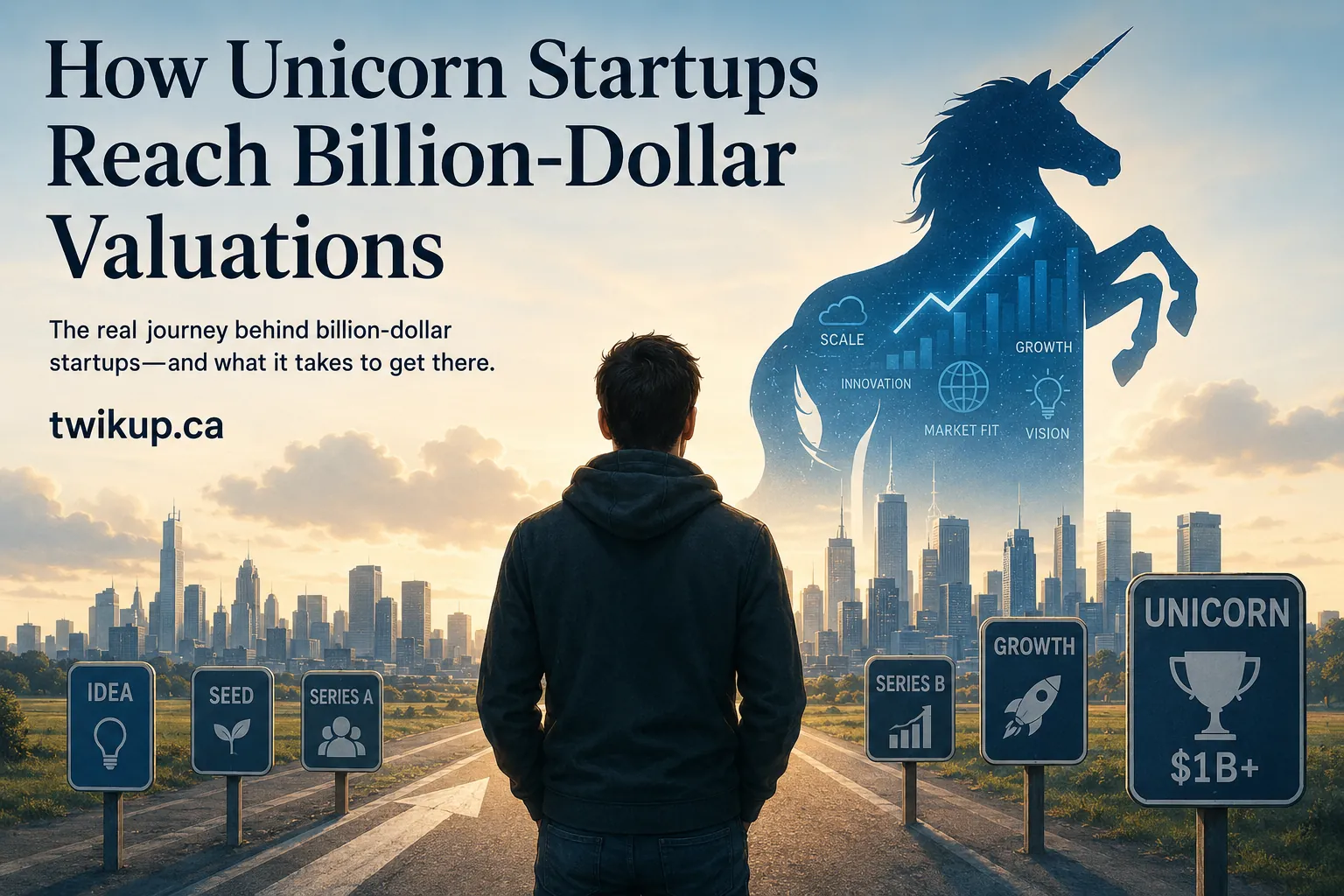
How Unicorn Startups Reach Billion-Dollar Valuations
Every startup founder dreams of building the next billion-dollar company.
Companies like Stripe, Canva, OpenAI, Figma, Airbnb, Databricks, SpaceX, Shopify, and Revolut have become symbols of extraordinary success. Their stories dominate headlines, attract billions in investment, and inspire entrepreneurs across the world.
But there is one misconception that almost everyone has.
Unicorn startups do not become worth $1 billion overnight.
Behind every billion-dollar valuation are years of product development, customer feedback, fundraising, hiring, market expansion, and relentless execution.
More importantly, a unicorn valuation is not simply about how much money a company makes today.
It represents what investors believe that company could become tomorrow.
Whether you're a founder preparing for your first investment round or simply curious about how venture capital works, understanding unicorn valuations provides valuable insight into how modern startups are built.
In this guide, you'll learn:
- What defines a unicorn startup
- How startups progress toward billion-dollar valuations
- Why investors sometimes value loss-making companies so highly
- The metrics that matter most
- Lessons from real unicorn companies
- Common myths founders should avoid
Continue Reading the Startup Investing Series
Before understanding unicorns, it's helpful to understand how startup fundraising works from the beginning.
Part 1: How First-Time Founders Can Raise Their First Investment
https://twikup.ca/money/investing/how-first-time-founders-can-raise-their-first-investment
Later in this guide we'll also reference:
Part 5: How Startup Valuations Actually Work Before Revenue
https://twikup.ca/money/investing/how-startup-valuations-actually-work-before-revenue
and
Part 13: Seed Round vs Series A: What Changes for Founders?
https://twikup.ca/money/investing/seed-round-vs-series-a-what-changes-for-founders-2026-guide
Part 15: The Complete Startup Fundraising Roadmap: From Idea to IPO (2026 Complete Founder Guide)
What Is a Unicorn Startup?
A Unicorn Startup is a privately held company valued at US$1 billion or more before being acquired or going public through an IPO.
The term was introduced by venture capitalist Aileen Lee in 2013 because companies reaching this milestone were considered incredibly rare.
Although hundreds of unicorns now exist worldwide, they still represent only a tiny fraction of all startups created every year.
Millions of businesses launch annually.
Only a small percentage receive venture capital.
Even fewer survive multiple funding rounds.
An even smaller group eventually reaches a valuation exceeding one billion dollars.
A Billion-Dollar Valuation Doesn't Mean the Company Has a Billion Dollars
One of the biggest misunderstandings in startup investing is confusing valuation with cash.
If a startup becomes a unicorn, it does not mean:
- It has $1 billion in the bank.
- It generates $1 billion in annual revenue.
- It earns $1 billion in profits.
Instead, valuation reflects what investors believe the company is worth based on its future growth potential.
Example
Suppose a venture capital firm invests:
- $50 million
for
- 5% ownership
The implied valuation becomes:
$50 million ÷ 5% = $1 billion
Even if the company is still losing money, investors may believe its future earnings justify that valuation.
For a deeper explanation of startup pricing, read:
Part 5: How Startup Valuations Actually Work Before Revenue
https://twikup.ca/money/investing/how-startup-valuations-actually-work-before-revenue
The Typical Journey to Unicorn Status
Most startups follow a similar funding journey.
| Funding Stage | Typical Valuation |
|---|---|
| Idea Stage | $1M–5M |
| Pre-Seed | $3M–10M |
| Seed | $8M–20M |
| Series A | $20M–80M |
| Series B | $80M–250M |
| Series C | $250M–700M |
| Growth Stage | $700M–$1B+ |
Each funding round raises expectations.
Investors expect:
- stronger revenue
- better product-market fit
- larger customer base
- international expansion
- increasing market share
Learn more about these stages in:
Part 13: Seed Round vs Series A: What Changes for Founders?
https://twikup.ca/money/investing/seed-round-vs-series-a-what-changes-for-founders-2026-guide
Investors Buy the Future—Not Just Today's Numbers
Traditional businesses are often valued based on profits.
High-growth startups are different.
Investors ask questions like:
- Can this become a global platform?
- Is the market large enough?
- Can revenue grow tenfold?
- Will customers continue using the product?
- Can competitors catch up?
- Does the company have a lasting competitive advantage?
If the answers are convincing, investors may assign enormous valuations even before the company becomes profitable.
The Five Ingredients Nearly Every Unicorn Shares
1. Massive Total Addressable Market (TAM)
The opportunity must be enormous.
Investors generally look for markets worth tens or even hundreds of billions of dollars.
Examples include:
- Artificial Intelligence
- Cloud Computing
- FinTech
- Cybersecurity
- Healthcare Technology
- Enterprise Software
- Marketplaces
- Climate Technology
A startup serving only a small local niche may become profitable but is unlikely to become a unicorn.
2. Strong Product-Market Fit
Customers genuinely love the product.
Signs include:
- high retention
- repeat purchases
- referrals
- increasing usage
- organic growth
- low churn
Without product-market fit, additional investment usually accelerates failure rather than success.
3. Exceptional Growth
Venture investors reward growth.
Many unicorns grow revenue or users by over 100% annually during their early years.
Rapid growth signals market demand and execution capability.
4. Scalable Business Models
Investors love businesses where revenue can grow much faster than expenses.
Examples include:
- SaaS
- AI software
- Marketplaces
- Cloud infrastructure
- FinTech platforms
- Digital subscriptions
These businesses often have high gross margins and recurring revenue.
5. Outstanding Founders
Investors frequently say:
"We invest in founders first."
They evaluate:
- leadership
- execution
- resilience
- technical expertise
- hiring ability
- vision
- adaptability
A brilliant idea without strong execution rarely becomes a unicorn.
Metrics That Drive Billion-Dollar Valuations
Revenue alone rarely tells the full story.
Professional investors examine a wide range of metrics.
Revenue Growth
Fast growth usually matters more than current revenue.
Growing from:
$5 million → $15 million
may be viewed more positively than:
$50 million → $55 million
because the growth rate is significantly higher.
Annual Recurring Revenue (ARR)
Subscription businesses are often valued based on recurring revenue.
Stable monthly or annual subscriptions make future cash flows more predictable.
Gross Margin
High-margin businesses scale more efficiently.
Software companies commonly report gross margins above 70%.
Customer Retention
Investors want evidence that customers continue paying year after year.
Strong retention reduces risk and increases long-term value.
Customer Acquisition Cost (CAC)
How much does it cost to acquire a customer?
Lower acquisition costs improve profitability.
Customer Lifetime Value (LTV)
How much revenue will one customer generate over their lifetime?
A healthy LTV:CAC ratio is a hallmark of scalable startups.
Why Some Unicorns Lose Money for Years
Many famous unicorns were unprofitable for long periods.
Examples include:
- Uber
- Airbnb
- Spotify
- Amazon (during its early years)
These companies invested heavily in:
- technology
- hiring
- infrastructure
- international expansion
- marketing
Investors accepted temporary losses because they believed market leadership would create massive long-term returns.
Real Examples of Unicorn Success
Stripe
Stripe simplified online payments for developers.
Instead of solving dozens of problems, it solved one problem exceptionally well.
Its rapid adoption by startups and enterprises helped it become one of the world's highest-valued private technology companies.
Canva
Canva made professional design accessible to everyone.
Its freemium model encouraged viral adoption.
As businesses upgraded to paid subscriptions, recurring revenue accelerated.
Airbnb
Airbnb initially struggled to raise funding.
The founders even sold themed cereal boxes to keep the business alive.
After proving demand and expanding globally, Airbnb became one of the world's most valuable travel platforms.
Figma
Figma transformed collaborative design by moving professional design software into the browser.
Its network effects and viral adoption made it one of Silicon Valley's fastest-growing software companies.
OpenAI
OpenAI experienced extraordinary growth through advances in generative AI, enterprise adoption, and strategic partnerships.
Its rapid expansion significantly increased its private valuation.
Common Myths About Unicorn Startups
Myth 1: Every Unicorn Is Profitable
False.
Many billion-dollar startups remain unprofitable for years.
Myth 2: Raising More Money Guarantees Success
Funding only amplifies execution.
Without product-market fit, more capital often accelerates failure.
Myth 3: Valuation Equals Company Value Forever
Valuations can rise—or fall.
Many startups have experienced "down rounds" where later funding valued them below previous rounds.
Myth 4: Every Founder Should Chase Unicorn Status
Not necessarily.
Many founders build companies worth tens or hundreds of millions while maintaining profitability and greater ownership.
For many entrepreneurs, that creates more personal wealth than pursuing hypergrowth.
🇨🇦 Canadian Unicorns Prove Global Companies Can Be Built Here
Canada has produced several internationally recognized unicorns, including:
- Shopify
- Cohere
- Clio
- 1Password
- Wealthsimple
- ApplyBoard
Canada's strengths include:
- world-class AI research
- skilled engineering talent
- government innovation support
- strong venture capital ecosystem
- access to North American markets
For Canadian founders, building a billion-dollar company is increasingly achievable—but success still requires solving global problems rather than purely local ones.
TwikUp Insight 💡
The biggest lesson from unicorn startups isn't their billion-dollar valuation.
It's the discipline behind it.
Nearly every successful unicorn spent years validating customer demand, refining its product, improving unit economics, hiring exceptional talent, and executing consistently before investors rewarded that progress with larger funding rounds.
Too many founders focus on becoming the next unicorn.
The better goal is becoming the company customers cannot imagine living without.
Valuation follows value creation—not hype.
Key Takeaways
✅ Unicorn startups are private companies valued above US$1 billion.
✅ Valuation reflects future expectations—not cash or profit.
✅ Massive markets, scalable business models, recurring revenue, and exceptional execution drive billion-dollar valuations.
✅ Venture investors prioritize long-term growth over short-term profitability.
✅ Becoming a unicorn usually takes years—not months.
✅ Building a valuable business matters more than chasing headlines.
Continue Reading the Complete Startup Investing Series
-
Part 1: How First-Time Founders Can Raise Their First Investment
https://twikup.ca/money/investing/how-first-time-founders-can-raise-their-first-investment -
Part 2: What Investors Look For Before Funding a Startup
https://twikup.ca/money/investing/what-investors-look-for-before-funding-a-startup -
Part 3: Why Most Startup Pitches Fail Even When the Idea Is Good
https://twikup.ca/money/investing/why-most-startup-pitches-fail-even-when-the-idea-is-good -
Part 4: How to Build a Pitch Deck That Investors Actually Read
https://twikup.ca/money/investing/how-startup-dilution-works-what-happens-when-investors-buy-equity -
Part 5: How Startup Valuations Actually Work Before Revenue
https://twikup.ca/money/investing/how-startup-valuations-actually-work-before-revenue -
Part 6: How Startup Dilution Works
https://twikup.ca/money/investing/how-startup-dilution-works-what-happens-when-investors-buy-equity -
Part 7: How Startup Cap Tables Work
https://twikup.ca/money/investing/how-startup-cap-tables-work-and-why-founders-must-understand-them -
Part 8: SAFE Notes Explained
https://twikup.ca/money/investing/safe-notes-explained-how-startups-raise-money-before-a-valuation -
Part 9: Convertible Notes vs SAFE Notes
https://twikup.ca/money/mortgages/convertible-notes-vs-safe-notes-which-fundraising-method-is-better-for-startups-in-2026 -
Part 10: Startup Term Sheets Explained
https://twikup.ca/money/investing/startup-term-sheets-explained-the-investment-agreement-every-founder-must-understand -
Part 11: Why Startup Founders Can Get Nothing After Selling Their Company
https://twikup.ca/money/investing/why-startup-founders-can-get-nothing-after-selling-their-company -
Part 12: Angel Investors vs Venture Capitalists: Which Is Right for Your Startup?
https://twikup.ca/money/investing/angel-investors-vs-venture-capitalists-which-is-right-for-your-startup -
Part 13: Seed Round vs Series A: What Changes for Founders?
https://twikup.ca/money/investing/seed-round-vs-series-a-what-changes-for-founders-2026-guide
Sources & Helpful References
-
CB Insights – Global Unicorn Club
https://www.cbinsights.com/research-unicorn-companies -
Crunchbase – Unicorn Board
https://news.crunchbase.com/unicorn-board -
PitchBook – Venture Capital Reports
https://pitchbook.com/news/reports -
NVCA – Venture Capital Resources
https://nvca.org -
Y Combinator Startup Library
https://www.ycombinator.com/library -
BDC – Business Development Bank of Canada
https://www.bdc.ca -
MaRS Discovery District
https://www.marsdd.com -
Startup Genome
https://startupgenome.com -
OECD Entrepreneurship Research
https://www.oecd.org/industry/smes -
World Bank Entrepreneurship Resources
https://www.worldbank.org