
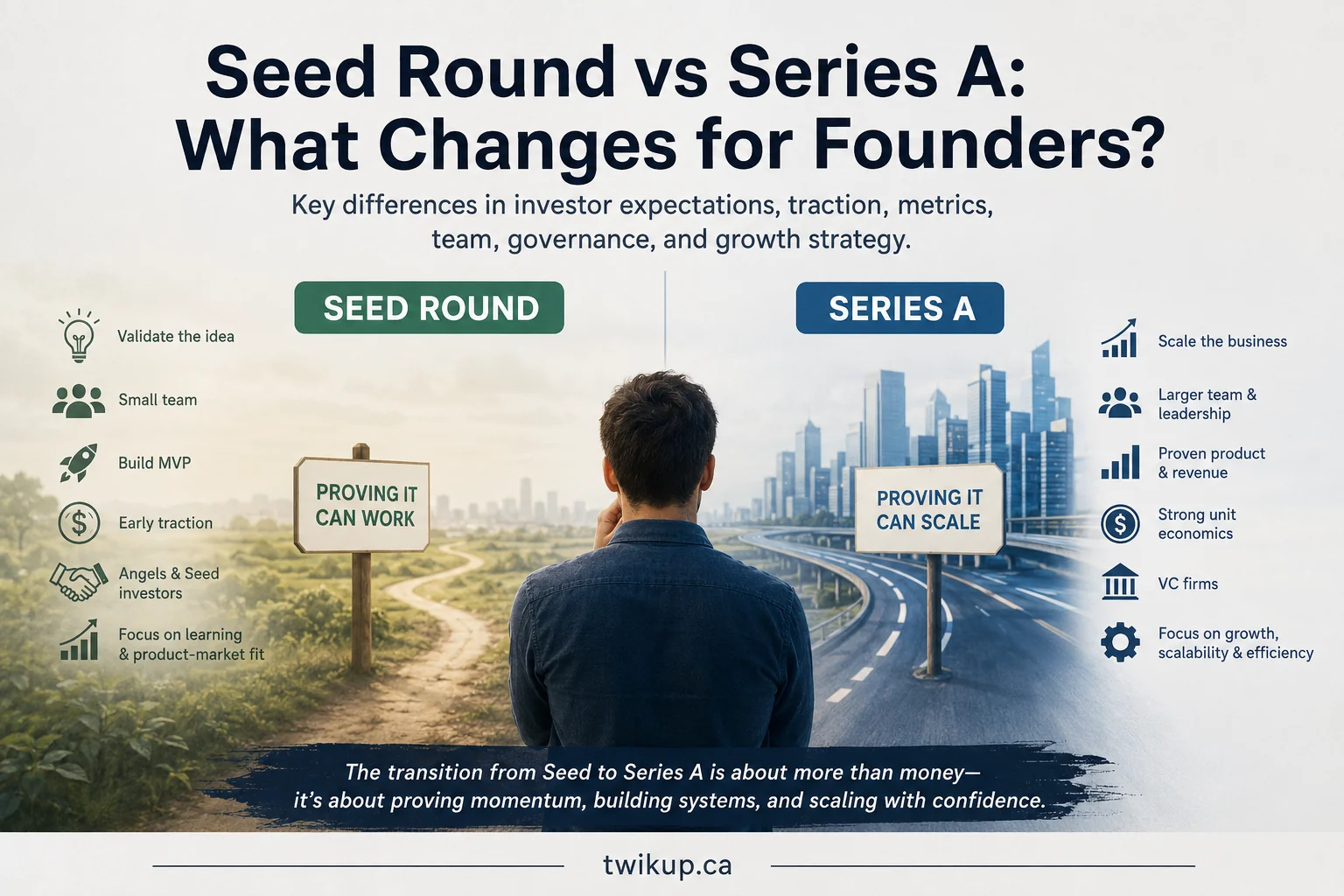
Seed Round vs Series A: What Changes for Founders?
For many startup founders, raising a Seed round feels like reaching the summit. In reality, it's only the beginning.
The transition from Seed funding to Series A is one of the biggest shifts a startup will experience. Investors stop betting primarily on vision and begin demanding evidence that the business can scale. What impressed Seed investors may not be enough to convince Series A venture capital firms.
Understanding these differences before you start fundraising can significantly improve your chances of closing your next investment round.
In this guide, we'll explain exactly what changes between Seed and Series A funding, what investors expect at each stage, common mistakes founders make, and how to prepare your company for the next level.
Quick Answer
Seed funding helps validate your product, market, and early business model.
Series A funding helps scale a proven business through larger teams, predictable growth, and repeatable revenue.
The biggest difference isn't simply the amount of money raised—it's the level of proof investors expect before writing a cheque.
Continue Reading the Startup Investment Series
If you're new to this series, start from the beginning:
-
Part 1: How First-Time Founders Can Raise Their First Investment https://twikup.ca/money/investing/how-first-time-founders-can-raise-their-first-investment
-
Part 2: What Investors Look For Before Funding a Startup https://twikup.ca/money/investing/what-investors-look-for-before-funding-a-startup
-
Part 3: Why Most Startup Pitches Fail Even When the Idea Is Good https://twikup.ca/money/investing/why-most-startup-pitches-fail-even-when-the-idea-is-good
-
Part 4: How to Build a Pitch Deck That Investors Actually Read https://twikup.ca/money/investing/how-startup-dilution-works-what-happens-when-investors-buy-equity
-
Part 5: How Startup Valuations Actually Work Before Revenue https://twikup.ca/money/investing/how-startup-valuations-actually-work-before-revenue
-
Part 6: How Startup Dilution Works https://twikup.ca/money/investing/how-startup-dilution-works-what-happens-when-investors-buy-equity
-
Part 7: How Startup Cap Tables Work https://twikup.ca/money/investing/how-startup-cap-tables-work-and-why-founders-must-understand-them
-
Part 8: SAFE Notes Explained https://twikup.ca/money/investing/safe-notes-explained-how-startups-raise-money-before-a-valuation
-
Part 9: Convertible Notes vs SAFE Notes https://twikup.ca/money/mortgages/convertible-notes-vs-safe-notes-which-fundraising-method-is-better-for-startups-in-2026
-
Part 10: Startup Term Sheets Explained https://twikup.ca/money/investing/startup-term-sheets-explained-the-investment-agreement-every-founder-must-understand
-
Part 11: Why Startup Founders Can Get Nothing After Selling Their Company https://twikup.ca/money/investing/why-startup-founders-can-get-nothing-after-selling-their-company
-
Part 12: Angel Investors vs Venture Capitalists: Which Is Right for Your Startup? https://twikup.ca/money/investing/angel-investors-vs-venture-capitalists-which-is-right-for-your-startup
-
Part 14: How Unicorn Startups Reach Billion-Dollar Valuations https://twikup.ca/money/investing/how-unicorn-startups-reach-billion-dollar-valuations
-
Part 15: The Complete Startup Fundraising Roadmap: From Idea to IPO (2026 Complete Founder Guide) https://twikup.ca/money/investing/the-complete-startup-fundraising-roadmap-from-idea-to-ipo-2026-complete-founder-guide
What Is a Seed Round?
A Seed round is designed to help startups prove that their idea deserves to become a real business.
Investors know that many assumptions are still untested. Rather than expecting perfection, they're looking for signs that the founding team can execute.
Seed capital is commonly used for:
- Building an MVP
- Hiring the first employees
- Product development
- Finding product-market fit
- Early customer acquisition
- Initial marketing experiments
At this stage, founders are primarily selling potential.
What Is Series A Funding?
Series A funding begins once a startup has shown that customers genuinely want its product.
The focus shifts from proving demand to scaling efficiently.
Series A capital often funds:
- Rapid hiring
- Sales teams
- Marketing expansion
- Engineering growth
- Customer success
- International expansion
- Operational systems
Instead of asking:
"Can this startup work?"
Investors now ask:
"Can this startup become a large company?"
Seed vs Series A: The Biggest Differences
| Category | Seed Round | Series A |
|---|---|---|
| Main Goal | Validate the business | Scale the business |
| Product | MVP or early product | Proven product |
| Customers | Early adopters | Growing customer base |
| Revenue | Optional in some sectors | Usually expected |
| Investors | Angels, Seed funds, Accelerators | Institutional VC firms |
| Team Size | Small founding team | Department leaders emerging |
| Governance | Lightweight | Formal board oversight |
| Metrics | Product usage | Revenue efficiency and growth |
| Due Diligence | Moderate | Extensive |
Investor Expectations Change Dramatically
Many founders mistakenly reuse their Seed pitch deck for Series A fundraising.
That rarely works.
Series A investors want evidence instead of assumptions.
Instead of hearing:
- "We think customers need this."
They want to see:
- Customer retention
- Revenue growth
- Sales efficiency
- Gross margins
- Customer acquisition costs
- Lifetime value
- Churn rates
- Expansion opportunities
Every major claim should be backed by data.
Product-Market Fit Becomes Critical
Seed investors often invest before product-market fit exists.
Series A investors usually expect founders to demonstrate it.
Signs of product-market fit include:
- Customers returning consistently
- Organic referrals
- Increasing demand
- Strong retention
- High engagement
- Low churn
- Positive customer testimonials
A startup still searching for product-market fit may struggle to raise a strong Series A.
Revenue Starts Becoming the Story
Revenue isn't everything during Seed fundraising.
By Series A, however, revenue often becomes one of the strongest indicators of execution.
Investors look beyond total revenue and examine quality.
Important metrics include:
- Monthly Recurring Revenue (MRR)
- Annual Recurring Revenue (ARR)
- Revenue growth
- Gross margins
- Customer Lifetime Value (LTV)
- Customer Acquisition Cost (CAC)
- CAC Payback Period
- Net Revenue Retention (NRR)
The conversation changes from:
"How much money are you making?"
to
"How efficiently are you growing?"
Hiring Changes Completely
During Seed funding, founders usually wear multiple hats.
The CEO might also manage:
- Sales
- Customer support
- Recruiting
- Finance
- Product management
Series A changes this.
Companies begin hiring specialists and experienced leaders.
Typical Series A hires include:
- Head of Sales
- VP Engineering
- Marketing Lead
- Finance Manager
- Customer Success Manager
- Product Manager
Investors want founders spending more time on strategy than daily operations.
Governance Becomes More Structured
Seed startups often operate informally.
Series A introduces greater accountability.
Founders can expect:
- Formal board meetings
- Investor reporting
- Budget reviews
- Financial forecasting
- Audit preparation
- Internal controls
- KPI dashboards
Professional governance reassures investors that the business can handle larger amounts of capital responsibly.
Due Diligence Gets Much Deeper
Series A investors investigate nearly every part of the business.
Typical due diligence includes:
- Financial statements
- Cap table verification
- Customer contracts
- Employee agreements
- Intellectual property
- Security practices
- Legal compliance
- Market analysis
- Unit economics
- Technical architecture
Preparing a clean data room before fundraising can significantly speed up the process.
Twikup Insight 💡
One of the biggest misconceptions among first-time founders is believing that Series A is simply a larger Seed round.
It isn't.
Seed investors are investing in what your company could become. Series A investors are investing in what your company has already demonstrated.
A startup that raises a strong Seed round but fails to build repeatable customer acquisition, improve retention, or establish reliable financial reporting often struggles to secure Series A—even if the product itself is excellent.
The founders who consistently raise successful Series A rounds usually spend the months after Seed funding obsessing over execution rather than immediately preparing for another fundraising process.
Common Founder Mistakes Between Seed and Series A
Many startups fail to bridge this transition because they:
- Raise too much money before proving demand
- Hire too quickly
- Ignore unit economics
- Focus only on user growth instead of revenue
- Delay financial reporting
- Build features customers don't need
- Continue pitching vision instead of traction
Avoiding these mistakes dramatically improves fundraising readiness.
How to Prepare for a Successful Series A
If you've recently completed your Seed round, your priorities should include:
✅ Achieve strong product-market fit
✅ Build predictable revenue
✅ Improve customer retention
✅ Understand unit economics
✅ Create repeatable sales processes
✅ Strengthen leadership
✅ Maintain accurate financial records
✅ Build relationships with Series A investors months before fundraising
Series A preparation starts long before the actual fundraising process begins.
Frequently Asked Questions (FAQs)
Is revenue required for Series A?
Not always, particularly in deep-tech or biotech startups. However, most software and SaaS companies are expected to demonstrate meaningful revenue or exceptionally strong user traction before raising Series A.
How much larger is Series A than Seed?
Series A rounds are generally much larger than Seed rounds, although exact amounts vary by industry, geography, and market conditions.
Can angel investors participate in Series A?
Yes. Existing angel investors may continue investing, but institutional venture capital firms usually lead Series A rounds.
How long after Seed do startups raise Series A?
Many startups target Series A within 12–24 months after their Seed round, though timing depends on achieving key milestones rather than following a fixed schedule.
Do founders lose more ownership during Series A?
Typically, yes. Founders usually issue additional equity in each funding round, making it important to understand dilution and negotiate terms carefully.
Key Takeaways
- Seed funding proves the business can work.
- Series A proves the business can scale.
- Investors shift from evaluating vision to evaluating measurable execution.
- Revenue quality, retention, and unit economics become increasingly important.
- Governance, financial reporting, and leadership maturity matter much more at Series A.
- Preparation should begin well before fundraising starts.
Final Thoughts
Every startup dreams of raising a successful Series A, but very few reach that milestone without changing how they operate.
The founders who make the leap successfully understand that fundraising evolves alongside the business. The skills that secure a Seed round—vision, storytelling, and ambition—must eventually be matched by operational excellence, financial discipline, and measurable traction.
Treat your Seed funding as an opportunity to build evidence, not just a product. When you can clearly demonstrate sustainable growth, satisfied customers, and repeatable execution, you'll be in a much stronger position to attract high-quality Series A investors and continue scaling your company.
Sources & Helpful References
To dive deeper into startup fundraising, Seed rounds, and Series A financing, explore these trusted resources:
-
National Venture Capital Association (NVCA) – Model Legal Documents
Industry-standard venture capital financing documents and legal templates.
https://nvca.org/model-legal-documents/ -
Y Combinator – Startup Library
Practical guides on fundraising, startup growth, investor expectations, and scaling.
https://www.ycombinator.com/library -
Y Combinator – SAFE Financing Documents
Official SAFE templates and guidance for founders, including Canadian SAFE documents.
https://www.ycombinator.com/documents -
Business Development Bank of Canada (BDC)
Financing options, growth resources, and expert advice for Canadian entrepreneurs.
https://www.bdc.ca/ -
BDC – Startup Financing
Learn about financing solutions available for startups and growing businesses in Canada.
https://www.bdc.ca/en/financing -
Investopedia – Venture Capital & Startup Funding Guides
Educational articles explaining venture capital, Seed funding, Series A rounds, startup valuation, and investment terminology.
https://www.investopedia.com/ -
Startup Genome
Global startup ecosystem research, fundraising benchmarks, and scaling reports.
https://startupgenome.com/ -
CB Insights – Venture Capital Research
Data-driven insights into startup funding trends, venture capital markets, unicorns, and startup failures.
https://www.cbinsights.com/research/
Editor's Note: While fundraising principles are broadly similar worldwide, investment terms, regulations, and market expectations can vary by country. Founders should also consult local legal and financial advisors before completing any financing round.