
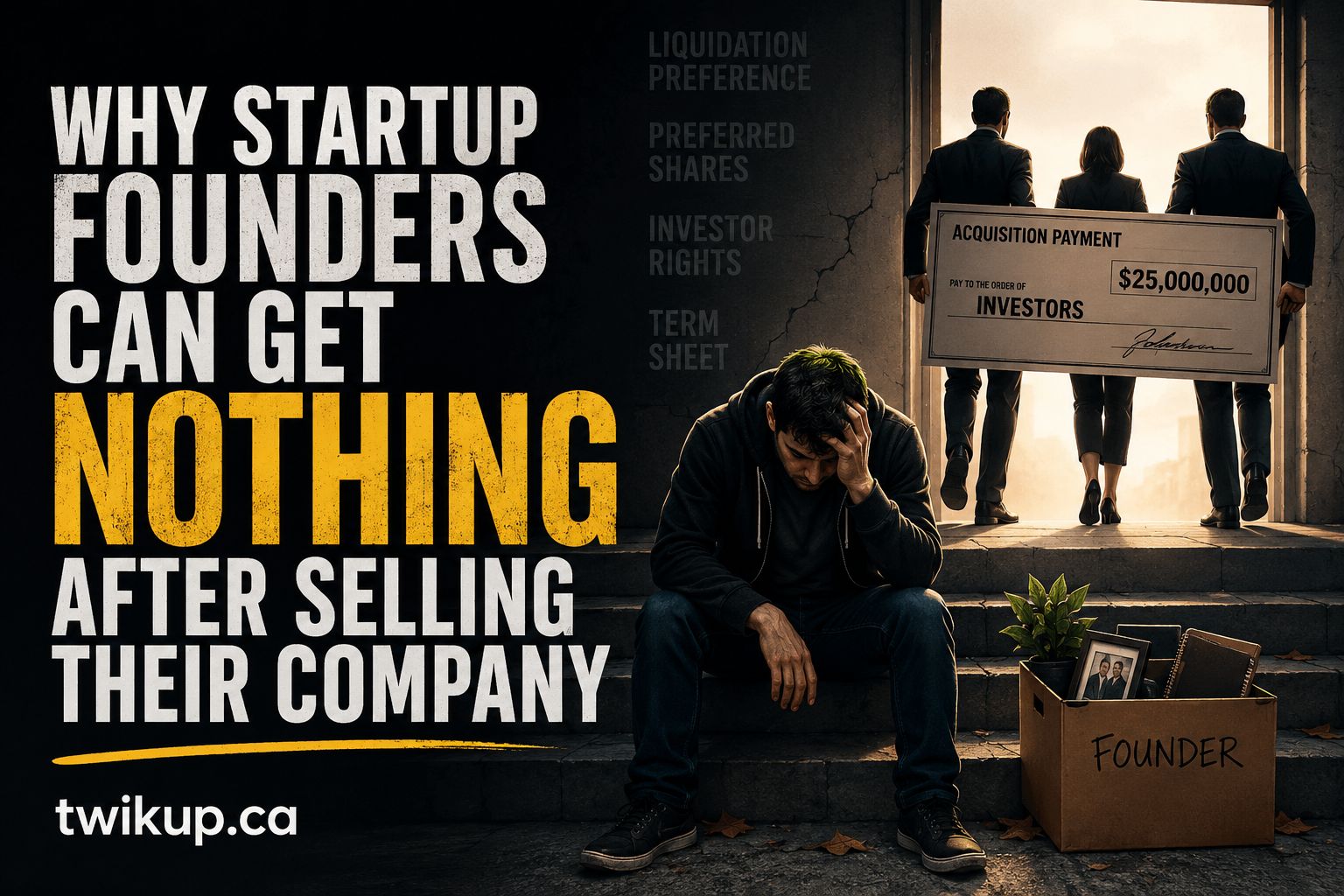
Liquidation Preference Explained: Why Founders Sometimes Get Nothing After an Exit
Quick Answer
A liquidation preference is a term in a startup investment agreement that decides who gets paid first when the company is sold, acquired, shut down, or liquidated.
In most venture-backed startups, investors receive preferred shares, while founders and employees usually hold common shares. If the company exits for a lower-than-expected amount, investors may recover their money first before common shareholders receive anything.
That is why a startup can be sold for millions of dollars and the founders may still walk away with little or nothing.
Key Takeaways
- Liquidation preference determines the payout order during an exit.
- Investors with preferred shares usually get paid before founders and employees.
- A “1x liquidation preference” means investors get back their original investment before common shareholders receive proceeds.
- Participating preferred shares can be much more founder-unfriendly than non-participating preferred shares.
- Multiple funding rounds can create a liquidation stack that makes small or medium exits unattractive for founders.
- A high valuation does not always mean a good outcome if the liquidation terms are aggressive.
- Founders must understand liquidation preference before signing a term sheet.
Why This Matters for Founders
Many first-time founders focus heavily on valuation.
They ask:
“How much is my company worth?”
But experienced investors often focus on something more important:
“What happens if the company sells?”
That question is where liquidation preference becomes critical.
A founder may raise money at a high valuation, celebrate the round, hire a team, build the product, and eventually sell the company. But when the exit proceeds are distributed, the founder may discover that investors get paid first and there is not much left for the founding team.
This is not always because the investor did something wrong. It is usually because the founder did not fully understand the economics of the term sheet.
That is why liquidation preference is one of the most important startup financing terms every founder must understand.
Previous Articles in This Startup Investing Series
If you are new to startup fundraising, read the earlier parts first:
- Part 1: How First-Time Founders Can Raise Their First Investment
- Part 2: What Investors Look For Before Funding a Startup
- Part 3: Why Most Startup Pitches Fail Even When the Idea Is Good
- Part 4: How to Build a Pitch Deck That Investors Actually Read
- Part 5: How Startup Valuations Actually Work Before Revenue
- Part 6: How Startup Dilution Works
- Part 7: How Startup Cap Tables Work
- Part 8: SAFE Notes Explained
- Part 9: Convertible Notes vs SAFE Notes: Which Fundraising Method Is Better for Startups in 2026?
- Part 10: Startup Term Sheets Explained
This article is Part 11.
What Is Liquidation Preference?
Liquidation preference is a contractual right that gives certain investors priority when money is distributed after a liquidity event.
A liquidity event can include:
- Selling the company
- Merging with another company
- Being acquired
- Winding down the business
- Liquidating company assets
- Sometimes, major asset sales or change-of-control events
In simple words:
Liquidation preference decides who gets paid first when the startup exits.
Most venture investors receive preferred shares. Founders and employees usually hold common shares.
Preferred shares often come with special rights. One of the most important rights is liquidation preference.
Why Do Investors Ask for Liquidation Preference?
Investors ask for liquidation preference because startup investing is risky.
Most startups fail or return less than expected. Investors want some downside protection if the company sells for less than the valuation used during fundraising.
For example:
- Investor puts in $2 million.
- Startup is valued at $10 million post-money.
- Investor owns 20%.
- Later, the startup sells for only $3 million.
Without liquidation preference, the investor may receive only 20% of $3 million, which is $600,000.
With a 1x liquidation preference, the investor may recover the full $2 million first.
That protection is the reason liquidation preference exists.
The Basic Formula
The basic idea is:
Investor payout = liquidation preference amount before common shareholders receive proceeds.
The most common structure is:
Investment amount × liquidation preference multiple
So if an investor invests $2 million with a 1x liquidation preference:
$2 million × 1 = $2 million preference
If the investor has a 2x liquidation preference:
$2 million × 2 = $4 million preference
This means the investor must receive $4 million before common shareholders participate.
Example 1: Simple 1x Liquidation Preference
Let’s say a startup raises:
- $2 million investment
- $8 million pre-money valuation
- $10 million post-money valuation
- Investor ownership: 20%
- Investor receives 1x non-participating preferred shares
Now the company sells for $6 million.
Without Liquidation Preference
Investor owns 20%.
So investor receives:
20% of $6 million = $1.2 million
Founder and other shareholders receive:
$4.8 million
With 1x Liquidation Preference
Investor has the right to get the original $2 million back first.
So investor receives:
$2 million
Remaining amount:
$6 million - $2 million = $4 million
That remaining $4 million goes to common shareholders, depending on the cap table.
This is why liquidation preference matters.
The investor’s ownership percentage may be 20%, but their payout may be higher in a downside exit.
Example 2: Founder Gets Nothing
Now imagine the same company sells for only $2 million.
Investor invested:
$2 million
Investor has:
1x liquidation preference
Exit value:
$2 million
The investor receives the full $2 million.
Remaining amount:
$0
Founder payout:
$0
This is the harsh reality.
A founder may build the company, raise money, employ people, and still receive nothing from the exit if the exit value does not clear the liquidation preference stack.
What Is the Liquidation Stack?
The liquidation stack is the order in which investors get paid during an exit.
If a company raises multiple rounds, each round may have its own liquidation preference.
For example:
| Round | Amount Raised | Liquidation Preference |
|---|---|---|
| Seed | $1 million | 1x |
| Series A | $5 million | 1x |
| Series B | $10 million | 1x |
| Total Preference Stack | $16 million |
Now imagine the company sells for $14 million.
Total investor preference:
$16 million
Exit value:
$14 million
Result:
Investors may receive all proceeds. Founders and employees may receive nothing.
This is why founders must understand not only dilution, but also preference stacking.
A cap table may show the founder still owns 30% of the company, but that does not mean the founder will receive 30% of the exit proceeds.
Ownership percentage and payout rights are not always the same thing.
Common Types of Liquidation Preference
There are three common types founders should know:
- Non-participating preferred
- Participating preferred
- Capped participating preferred
Each one creates a different exit outcome.
1. Non-Participating Preferred
This is usually the most founder-friendly common structure.
With non-participating preferred shares, the investor typically chooses between:
- Taking the liquidation preference, or
- Converting into common shares and taking their ownership percentage
The investor does not usually get both.
Example
Investor invests $2 million for 20% ownership with a 1x non-participating liquidation preference.
Company sells for $20 million.
Investor can choose:
Option 1:
Take 1x preference = $2 million
Option 2:
Convert to common and take 20% of $20 million = $4 million
The investor will choose $4 million.
In a strong exit, non-participating preferred behaves more like normal equity ownership.
In a weak exit, it protects the investor’s original investment.
2. Participating Preferred
Participating preferred is more investor-friendly.
With participating preferred, the investor may receive:
- Their liquidation preference first, and then
- Their ownership percentage of the remaining proceeds
This is sometimes called “double dipping.”
Example
Investor invests $2 million for 20% ownership with 1x participating preferred.
Company sells for $10 million.
Step 1:
Investor gets preference first:
$2 million
Remaining proceeds:
$8 million
Step 2:
Investor also gets 20% of remaining proceeds:
20% of $8 million = $1.6 million
Total investor payout:
$2 million + $1.6 million = $3.6 million
Founder and others receive:
$6.4 million
If the same investor had non-participating preferred, they would likely choose between $2 million or 20% of $10 million, which is $2 million.
So participating preferred gives the investor a much better result.
It gives the founder a worse result.
3. Capped Participating Preferred
Capped participating preferred is a middle ground.
The investor can receive the liquidation preference and participate in remaining proceeds, but only up to a maximum return.
For example:
- 1x participating preferred
- 3x cap
- Investor invested $2 million
Maximum investor payout:
$2 million × 3 = $6 million
This protects the investor but limits the upside taken before common shareholders benefit.
What Does “1x,” “2x,” or “3x” Mean?
The multiple tells you how much the investor receives before common shareholders.
| Preference Multiple | Meaning |
|---|---|
| 1x | Investor gets original investment back first |
| 2x | Investor gets two times the investment first |
| 3x | Investor gets three times the investment first |
A 1x liquidation preference is common in many venture deals.
A 2x or 3x preference is much more aggressive and can seriously reduce founder outcomes, especially in a modest exit.
Example: 1x vs 2x vs 3x Preference
Investor invests:
$5 million
Company sells for:
$12 million
Founder and employees own common shares.
With 1x Preference
Investor receives:
$5 million
Remaining:
$7 million
With 2x Preference
Investor receives:
$10 million
Remaining:
$2 million
With 3x Preference
Investor preference:
$15 million
But exit value is only:
$12 million
Investor may receive all $12 million.
Remaining for founders:
$0
This is why founders should be extremely careful with high multiple liquidation preferences.
Senior vs Pari Passu Liquidation Preference
Liquidation preference is not only about amount. It is also about priority.
There are two common structures:
- Senior preference
- Pari passu preference
Senior Liquidation Preference
Senior preference means later investors get paid before earlier investors.
Example:
| Round | Amount Raised | Preference Priority |
|---|---|---|
| Series B | $10 million | Paid first |
| Series A | $5 million | Paid second |
| Seed | $1 million | Paid third |
| Common shareholders | Paid last |
This can make outcomes worse for early investors, employees, and founders.
Pari Passu Liquidation Preference
Pari passu means investors share proceeds proportionally within the same preference layer.
Instead of one round getting paid fully before another, investors share based on their preference amounts.
This can be more balanced than a fully senior structure.
Why Founders Sometimes Get Nothing After an Exit
Founders may get nothing after an exit because the company’s sale price is lower than the total liquidation preference stack.
This usually happens when:
- The company raised too much money
- The exit valuation is lower than expected
- Investors have aggressive preference terms
- Multiple rounds created a large liquidation stack
- Later rounds have senior rights
- Employees and founders hold common shares only
- The company sells before reaching venture-scale growth
The startup may look successful from the outside.
News headline:
“Startup acquired for $25 million.”
But behind the scenes:
- Investors invested $30 million.
- Preference stack is $30 million or more.
- Acquisition price is $25 million.
- Founders receive little or nothing.
That is why acquisition headlines can be misleading.
A company can sell for millions and still not create meaningful wealth for founders.
The Trap: High Valuation With Bad Terms
Many founders celebrate high valuations.
But a high valuation with aggressive terms can be dangerous.
For example:
Option A:
- $10 million valuation
- 1x non-participating preference
- Clean terms
Option B:
- $20 million valuation
- 2x participating preference
- Senior rights
- Heavy investor control
Option B may look better because the valuation is higher.
But in a modest exit, Option A may give founders a better outcome.
This is why founders should not judge a term sheet only by valuation.
As explained in Part 10: Startup Term Sheets Explained, the valuation is only one part of the deal. The terms can completely change the economic outcome.
How Liquidation Preference Connects to Dilution
Dilution affects how much of the company you own.
Liquidation preference affects when and whether your ownership converts into real money.
A founder might say:
“I still own 35% of my company.”
But that 35% may sit behind investor preferences.
If the exit price is high enough, the founder benefits.
If the exit price is not high enough, the liquidation preference stack may absorb most or all proceeds.
That is why founders should read this article together with:
Your cap table tells you ownership.
Liquidation preference tells you payout priority.
You need both to understand the real deal.
How Liquidation Preference Connects to SAFE Notes and Convertible Notes
SAFE notes and convertible notes usually convert into equity during a priced round.
Once they convert, investors may receive preferred shares depending on the financing terms.
That means founders should understand what happens after conversion.
The important questions are:
- What class of shares will the SAFE or note convert into?
- Will those shares have liquidation preference?
- Will the preference be the same as the new money investors?
- Does the conversion increase the preference stack?
- Are there discounts, valuation caps, or side letters that change the outcome?
This connects directly to:
A SAFE may look simple at the beginning, but the real economics appear when it converts into equity.
Founder-Friendly vs Investor-Friendly Terms
Here is a simple comparison.
| Term | More Founder-Friendly | More Investor-Friendly |
|---|---|---|
| Preference multiple | 1x | 2x or 3x |
| Participation | Non-participating | Participating |
| Cap | Capped participation | Uncapped participation |
| Priority | Pari passu | Senior to earlier rounds |
| Conversion | Investor chooses best outcome | Investor gets preference plus participation |
| Exit impact | Founders participate sooner | Investors recover more first |
Not every investor-friendly term is unfair.
Investors take real risk and deserve downside protection.
But founders must understand what they are signing.
The problem is not liquidation preference itself.
The problem is signing liquidation preference terms without modelling exit outcomes.
Simple Exit Waterfall Example
Let’s build a simple exit waterfall.
A startup has:
- Founder ownership: 60%
- Employee option pool: 10%
- Investor ownership: 30%
- Investor investment: $3 million
- Liquidation preference: 1x non-participating
Exit Scenario A: Company Sells for $2 Million
Investor preference:
$3 million
Exit value:
$2 million
Investor receives:
$2 million
Founder and employees receive:
$0
Exit Scenario B: Company Sells for $6 Million
Investor can choose:
Preference:
$3 million
Or convert to common:
30% of $6 million = $1.8 million
Investor chooses preference:
$3 million
Remaining:
$3 million
Founder and employees share the remaining proceeds.
Exit Scenario C: Company Sells for $30 Million
Investor can choose:
Preference:
$3 million
Or convert to common:
30% of $30 million = $9 million
Investor chooses conversion:
$9 million
In a strong exit, the preference becomes less important because the investor earns more by converting.
Breakpoint: When Does the Investor Convert?
With non-participating preferred, the investor compares:
- Liquidation preference amount
- Ownership percentage of exit proceeds
The investor converts when ownership value is higher than the preference.
Formula:
Conversion breakpoint = investment amount ÷ ownership percentage
Example:
- Investor invested $3 million
- Investor owns 30%
Breakpoint:
$3 million ÷ 30% = $10 million
If the company sells below $10 million, the investor likely takes preference.
If the company sells above $10 million, the investor likely converts to common.
This is a useful founder calculation.
It shows how big the exit must be before everyone truly participates like normal shareholders.
Why Employees Should Also Care
Liquidation preference does not only affect founders.
It also affects employees with stock options.
Many startup employees think:
“I have 1% equity.”
But employee options usually represent common shares.
Common shareholders are paid after preferred shareholders.
So if the preference stack is large and the exit is modest, employee options may be worth little or nothing.
This is why startup employees should ask careful questions before joining:
- How much money has the company raised?
- What was the last valuation?
- What is the approximate liquidation preference stack?
- Are there participating preferred shares?
- How much preference sits ahead of common shares?
- What exit value would make employee options meaningful?
Employees do not always get full details, but they should understand the concept.
Red Flags Founders Should Watch For
Founders should be careful if they see:
- 2x or 3x liquidation preference
- Participating preferred without a cap
- Senior preferences that heavily favour later investors
- Multiple investor side letters
- Terms that are hard to understand
- A high valuation paired with aggressive downside protection
- Pressure to sign quickly without legal review
- No exit waterfall model attached to the term sheet
- Investors avoiding clear answers about payout scenarios
One red flag does not always mean the deal is bad.
But it does mean founders should slow down and ask questions.
Questions Founders Should Ask Before Signing
Before signing a term sheet, founders should ask:
- Is the liquidation preference 1x, 2x, or higher?
- Is it participating or non-participating?
- If participating, is there a cap?
- Is the preference senior or pari passu with earlier investors?
- Does the preference include unpaid dividends?
- What happens in a sale, merger, asset sale, or shutdown?
- Do SAFEs or convertible notes convert into the same preferred shares?
- What does the exit waterfall look like at different sale prices?
- At what exit value do founders and employees receive meaningful proceeds?
- How does this term affect future fundraising rounds?
The most important request is simple:
“Please show me the exit waterfall.”
A serious investor should be willing to explain how proceeds are distributed under different exit scenarios.
What Is an Exit Waterfall?
An exit waterfall is a table that shows how money is distributed when the company exits.
It usually includes scenarios like:
- $5 million exit
- $10 million exit
- $25 million exit
- $50 million exit
- $100 million exit
For each scenario, the waterfall shows:
- Investor payout
- Founder payout
- Employee option pool payout
- Remaining common shareholder payout
- Impact of liquidation preference
- Impact of participation rights
Founders should never sign a major financing round without modelling the exit waterfall.
A cap table alone is not enough.
Sample Exit Waterfall Table
Assume:
- Investor invested $5 million
- Investor owns 25%
- 1x non-participating preference
| Exit Value | Investor Takes Preference or Converts? | Investor Payout | Remaining for Others |
|---|---|---|---|
| $3 million | Preference | $3 million | $0 |
| $5 million | Preference | $5 million | $0 |
| $10 million | Preference | $5 million | $5 million |
| $20 million | Convert | $5 million | $15 million |
| $50 million | Convert | $12.5 million | $37.5 million |
At $20 million, the investor is indifferent because:
25% of $20 million = $5 million
Above $20 million, the investor converts.
Below $20 million, the investor takes the preference.
That $20 million is the breakpoint.
Twikup Insight: The Real Founder Mistake Is Not Raising Money — It Is Raising Money Without Knowing the Exit Math
Many founders think fundraising success means:
- Bigger round
- Higher valuation
- Famous investor
- Press announcement
- Larger team
- More runway
But the real test is this:
If the company sells for a realistic amount, who gets paid?
A founder can own a meaningful percentage on paper but receive very little in practice if the liquidation stack is heavy.
Twikup’s view is simple:
Founders should negotiate funding like builders, not like dreamers.
That means:
- Understand the best-case outcome.
- Understand the downside outcome.
- Understand the “okay but not amazing” exit.
- Know what happens if the company sells for less than expected.
- Know how much must be sold for before common shareholders benefit.
A clean 1x non-participating liquidation preference from a high-quality investor is often reasonable.
But aggressive terms can quietly turn founder equity into an illusion.
Do not just ask:
“What valuation are you giving me?”
Ask:
“At what exit value do founders and employees actually make money?”
That one question can change the entire negotiation.
How Founders Can Negotiate Liquidation Preference
Founders may not always have full leverage, especially in difficult fundraising markets. But they can still negotiate intelligently.
1. Push for 1x Non-Participating Preferred
This is often considered a cleaner and more balanced structure.
It gives investors downside protection but does not allow them to double dip.
2. Avoid Uncapped Participating Preferred
If participating preferred is required, try to negotiate a cap.
For example:
- 2x cap
- 3x cap
- Automatic conversion after a certain return
3. Model Multiple Exit Scenarios
Do not negotiate in theory.
Use numbers.
Ask your lawyer or finance advisor to model exits at:
- Low outcome
- Moderate outcome
- Strong outcome
- Venture-scale outcome
4. Watch the Total Preference Stack
Each new round may add more preference.
Before raising another round, ask:
“How much exit value is now sitting ahead of common shareholders?”
5. Do Not Trade Bad Terms for a Higher Valuation
A higher valuation may feel good today but create pressure later.
Sometimes a lower valuation with cleaner terms is better for founders.
6. Understand Future Financing Impact
Bad terms today can make future fundraising harder.
New investors may demand equal or better rights, which can worsen the stack.
7. Use Experienced Legal Counsel
Startup financing terms are not simple.
A general business lawyer may not be enough.
Founders should work with counsel who understands venture financing, preferred shares, SAFEs, convertible notes, and Canadian or cross-border startup structures.
Canadian Founder Context
For Canadian startups, liquidation preference can appear in venture financing documents involving preferred shares, shareholder agreements, subscription agreements, and term sheets.
Canadian founders should be especially careful when dealing with:
- Canadian angel groups
- Canadian venture funds
- U.S. investors investing into Canadian companies
- Cross-border Delaware or Canadian corporate structures
- SAFEs converting into priced preferred rounds
- Strategic investors with special rights
- Government-backed or institutional capital structures
The legal wording may vary depending on whether the company is federally incorporated, provincially incorporated, or structured through a U.S. parent company.
But the economic question remains the same:
Who gets paid first when the company exits?
Liquidation Preference vs Valuation: Which Matters More?
Both matter.
Valuation determines how much ownership you give up.
Liquidation preference determines how exit proceeds are distributed.
A founder should never evaluate one without the other.
Example:
| Deal | Valuation | Liquidation Preference | Founder Outcome |
|---|---|---|---|
| Deal A | Lower valuation | 1x non-participating | Cleaner exit economics |
| Deal B | Higher valuation | 2x participating | Investors may capture more in modest exit |
The headline valuation may look better in Deal B.
But the actual founder payout may be better in Deal A.
That is why experienced founders negotiate the whole term sheet, not just the valuation.
How Liquidation Preference Can Affect Future Rounds
Once a company accepts aggressive liquidation preference terms, future investors may ask for similar or better rights.
This can create a chain reaction.
For example:
- Seed investor gets 1x non-participating
- Series A investor asks for senior 1x
- Series B investor asks for senior 1.5x
- Bridge investor asks for 2x preference
- Strategic investor asks for special participation rights
Over time, the stack becomes heavy.
Then, even if the company sells for a respectable amount, common shareholders may receive little.
This is why early terms matter.
Bad terms can compound.
What Happens in a Down Round?
A down round happens when a startup raises money at a lower valuation than its previous round.
In down rounds, investors may ask for stronger downside protection, including:
- Higher liquidation preference
- Senior preference
- Participation rights
- Anti-dilution protection
- Pay-to-play provisions
- Board control changes
Founders may accept these terms to keep the company alive.
Sometimes that is necessary.
But founders should understand the cost.
A rescue round can save the company while reducing the founder’s economic upside.
Does Liquidation Preference Apply in an IPO?
In many cases, preferred shares convert into common shares during an IPO, depending on the financing documents and conversion terms.
When preferred shares convert, liquidation preference may no longer apply in the same way.
However, most startups do not reach IPO.
For many founders, the more realistic liquidity event is:
- Acquisition
- Strategic sale
- Asset sale
- Merger
- Shutdown
That is where liquidation preference can matter most.
Founder Checklist Before Accepting a Term Sheet
Before signing, review this checklist:
- Do I know the liquidation preference multiple?
- Is it participating or non-participating?
- Is there a participation cap?
- Is the preference senior or pari passu?
- Does it include dividends?
- Are there multiple classes of preferred shares?
- How do SAFEs or convertible notes convert?
- What is the total preference stack after the round?
- Have I seen an exit waterfall?
- Do I know my payout at different exit values?
- Have I reviewed the terms with startup-focused legal counsel?
- Am I choosing terms based on real economics, not ego valuation?
If you cannot answer these questions, you are not ready to sign.
Common Founder Misunderstandings
Misunderstanding 1: “I own 40%, so I get 40% of the exit.”
Not always.
Your ownership percentage may be behind investor preferences.
Misunderstanding 2: “A 1x preference is always bad.”
Not necessarily.
A simple 1x non-participating preference can be reasonable investor protection.
Misunderstanding 3: “Valuation is the most important term.”
Valuation is important, but liquidation preference can matter more in modest exits.
Misunderstanding 4: “This only matters if the company fails.”
No.
Liquidation preference can apply in acquisitions, mergers, and other liquidity events.
Misunderstanding 5: “My lawyer will handle it.”
Your lawyer can explain the legal wording, but founders must understand the business outcome.
Practical Founder Example
Imagine two founders build a SaaS startup.
They raise:
- $1 million seed round
- $5 million Series A
- $8 million Series B
Total raised:
$14 million
All rounds have 1x liquidation preference.
The company later sells for:
$18 million
At first, this sounds like a successful exit.
But the preference stack is:
$14 million
That leaves:
$4 million
From that $4 million, proceeds may still need to account for transaction expenses, employee arrangements, debt, legal costs, and other obligations.
The founders may receive far less than expected.
Now imagine the company sells for:
$12 million
Investors may receive all or almost all proceeds.
Founder payout may be zero.
This is why founders must understand the difference between:
Exit headline
and
Founder payout
They are not the same thing.
When Liquidation Preference Is Fair
Liquidation preference is not automatically unfair.
It can be fair when:
- It is 1x
- It is non-participating
- It does not include excessive dividends
- It is clearly explained
- It aligns investor and founder incentives
- It does not punish founders in reasonable exit scenarios
- It fits the risk level of the investment
Investors deserve protection.
Founders deserve clarity.
The best deals create alignment between both sides.
When Liquidation Preference Becomes Dangerous
Liquidation preference becomes dangerous when it:
- Multiplies investor return before common shareholders
- Allows double dipping
- Stacks heavily across rounds
- Makes moderate exits worthless for founders
- Gives later investors too much priority
- Encourages founders to reject reasonable acquisition offers
- Makes employee equity unattractive
- Creates misalignment between investors and operators
If founders no longer have meaningful upside, motivation can suffer.
That is bad for everyone.
Final Thoughts
Liquidation preference is one of the most important terms in startup financing.
It can decide whether founders, employees, and early shareholders receive meaningful money after an exit.
A startup may sell for millions and still leave founders with nothing if the exit value does not clear the investor preference stack.
That is why founders must stop looking only at valuation.
The real question is not:
“What is my company worth today?”
The real question is:
“If we sell tomorrow, who gets paid first, and how much is left?”
Before signing any term sheet, founders should understand the exit waterfall, liquidation stack, preference multiple, participation rights, and conversion mechanics.
Raising capital can help you grow faster.
But raising capital without understanding liquidation preference can quietly change the entire reward structure of your company.
Helpful References
-
Y Combinator: SAFE Financing Documents https://www.ycombinator.com/documents
-
NVCA: Model Legal Documents https://nvca.org/model-legal-documents/
-
CVCA: Model Legal Documents https://www.cvca.ca/resources/model-legal-documents/
-
BDC Capital: Venture Capital https://www.bdc.ca/en/bdc-capital/venture-capital
-
RBCx: Term Sheet Economics Every Founder Should Know https://www.rbcx.com/ideas/startup-insights/term-sheet-economics-every-founder-should-know/
-
Torys: Startup Terms Glossary https://www.torys.com/services/services/transactions/emerging-companies-and-vc/startup-terms-glossary
-
Silicon Valley Bank: Preferred Stock for Startup Founders https://www.svb.com/startup-insights/startup-equity/startup-founders-should-know-preferred-stock/