
Quick Answer
Bootstrapping is the process of starting and growing a business primarily with the founder’s own resources and money generated by customers rather than selling equity to outside investors.
A bootstrapped founder might use personal savings, employment income, early sales, subscriptions, pre-orders, consulting revenue or reinvested profits to finance the company.
Bootstrapping can help founders preserve more ownership and decision-making control. However, it can also mean slower growth, limited hiring capacity and greater personal financial risk.
It works best when a business can launch at a relatively low cost, reach paying customers early and reinvest revenue into sustainable growth.
TwikUp Insight
Bootstrapping is not simply refusing investor money. It is using customer demand as the startup’s primary financing system.
A founder who reaches paying customers before raising capital may enter future investor negotiations with stronger evidence, a clearer valuation story and more leverage to reject unfavourable terms.
However, bootstrapping is not automatically the safer strategy.
It stops being an advantage when a lack of capital prevents a startup from building the necessary product, hiring critical talent or entering a time-sensitive market before competitors.
The real question is not:
“Should every founder avoid investors?”
It is:
“Can this business reach meaningful revenue before limited capital becomes a competitive disadvantage?”
What Does Bootstrapping Mean in Business?
Bootstrapping means building a company without depending primarily on angel investors, venture capital firms or other outside equity investors.
The founder finances the early business through resources such as:
- Personal savings
- Employment or freelance income
- Customer payments
- Pre-orders
- Subscription revenue
- Consulting or service revenue
- Reinvested profits
- Business credit or loans
- Support from co-founders
Bootstrapping does not always mean that one person owns 100% of the business.
A bootstrapped company may have multiple founders, employees with stock options, lenders or strategic partners. The defining characteristic is that the company has not made external equity investment its primary source of operating capital.
The founder may still raise money later.
Many businesses bootstrap until they have validated demand, established recurring revenue or reached a stage where outside capital can accelerate an already functioning model.
How Does Bootstrapping Work?
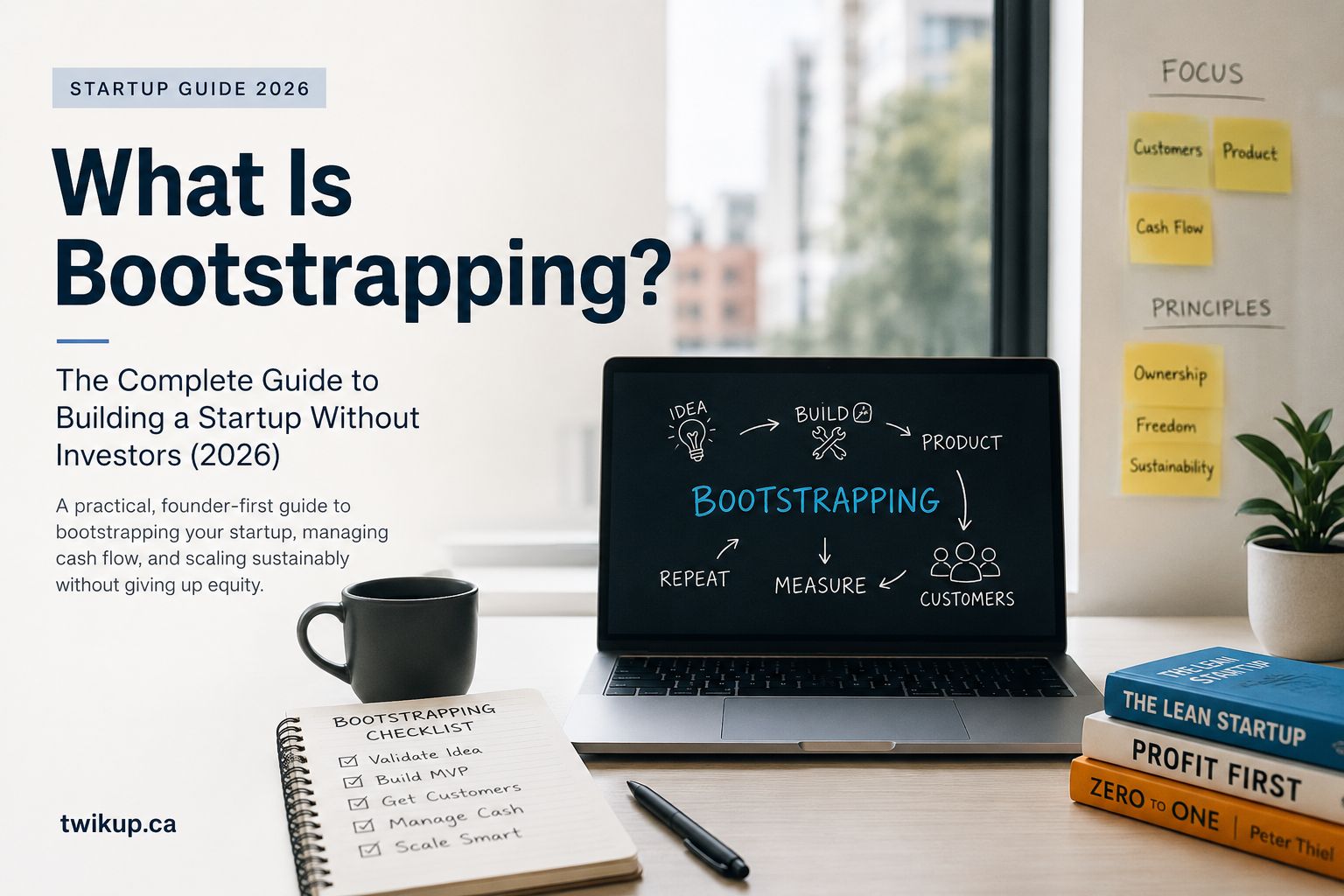
A typical bootstrapped startup grows through the following cycle:
- The founder identifies a specific customer problem.
- The founder validates that people are willing to pay for a solution.
- A small initial product or service is launched.
- The first customers generate revenue.
- Revenue is reinvested into product development and customer acquisition.
- The company improves retention, margins and operational efficiency.
- Hiring occurs only when the business can support it.
- The founder continues bootstrapping or raises capital from a stronger position.
In an investor-funded startup, outside money may pay for product development, hiring and customer acquisition before the company generates meaningful revenue.
In a bootstrapped startup, spending capacity is usually connected more closely to actual sales and available cash.
That creates financial discipline, but it can also restrict how quickly the company can grow.
The Main Types of Bootstrapping
Bootstrapping is not one fixed financing model. Founders can use several different approaches.
1. Personal-savings bootstrapping
The founder uses personal savings to cover incorporation, product development, technology, marketing and operating expenses.
This approach is simple, but it places the founder’s own money at risk.
A founder should establish a maximum personal-loss limit before investing heavily. Money required for housing, emergency savings, taxes, essential family expenses or high-priority debt payments should generally be separated from the startup budget.
2. Side-income bootstrapping
The founder keeps a job, contract position or freelance business while developing the startup outside working hours.
This can reduce immediate financial pressure because employment income continues to cover personal expenses.
The trade-off is time. Product development and customer acquisition may move more slowly when the founder cannot work on the startup full-time.
3. Customer-funded bootstrapping
Customers finance the company by purchasing products, subscriptions or services.
This is one of the strongest forms of bootstrapping because funding comes from demonstrated market demand rather than the founder’s savings alone.
Customer-funded growth may include:
- Monthly subscriptions
- Annual contracts
- Paid pilots
- Setup fees
- Advance payments
- Product sales
- Usage-based fees
The company then reinvests part of that revenue into growth.
4. Pre-order bootstrapping
Customers pay before the final product is fully delivered.
Pre-orders can help validate demand and finance production, but the founder must manage delivery risk carefully. If development takes longer than expected or costs increase, the business may still owe customers a product or refund.
Pre-order money should not be treated as unrestricted profit.
5. Service-to-product bootstrapping
A founder initially sells consulting, development, design, marketing or another service and uses the profits to finance a more scalable product.
For example, a software founder might build custom tools for clients and use the service revenue to develop a subscription platform.
This model can generate cash early, but service work may consume time that would otherwise be spent building the product.
6. Debt-assisted bootstrapping
Some founders combine personal investment and customer revenue with loans, lines of credit or other debt.
This can allow the founder to avoid selling equity, but debt creates repayment obligations regardless of whether the business succeeds.
A startup with predictable recurring revenue may eventually explore specialized financing such as venture debt. However, venture debt is generally not a replacement for revenue, profitability or responsible cash management.
7. Profit-funded bootstrapping
The business finances growth entirely through retained earnings.
Instead of distributing all available profit to the founders, the company reinvests it in areas such as:
- Product development
- Marketing
- Sales
- Infrastructure
- Customer service
- Hiring
- Geographic expansion
This is usually the most sustainable bootstrapping stage because the company is no longer depending mainly on the founder’s personal money.
A Practical Bootstrapping Example
Consider a founder building a subscription-based software product.
The founder contributes $24,000 in startup capital.
Initial startup costs
| Expense | Estimated cost |
|---|---|
| Incorporation, contracts and accounting | $2,000 |
| Initial product development | $8,000 |
| Website, design and branding | $2,000 |
| Software and infrastructure setup | $1,000 |
| Initial marketing and sales expenses | $2,000 |
| Contingency reserve | $3,000 |
| Total initial costs | $18,000 |
After paying these costs, the company has $6,000 in available cash.
Its monthly operating expenses are:
| Monthly expense | Amount |
|---|---|
| Hosting and software | $600 |
| Contractors | $2,000 |
| Marketing | $800 |
| Accounting and administration | $300 |
| Other expenses | $300 |
| Gross monthly burn | $4,000 |
The startup generates $1,500 per month in collected customer revenue.
Its approximate net burn is:
Net burn = Monthly cash expenses − Monthly collected cash revenue

Net burn = $4,000 − $1,500

Net burn = $2,500 per month
Its estimated runway is:
Runway = Available cash ÷ Monthly net burn

Runway = $6,000 ÷ $2,500

Runway = 2.4 months
The company therefore has only about 2.4 months of runway, assuming revenue and expenses remain unchanged.
That does not give the founder much room for product delays, customer churn, unexpected bills or slower-than-expected sales.
The founder must now make one or more changes:
- Reduce expenses
- Increase customer revenue
- Delay non-essential development
- Add consulting revenue
- Contribute more personal capital
- Secure a loan
- Raise equity financing
- Pause the business
This is why founders must monitor startup burn rate and cash runway even when they are generating revenue.
Revenue alone does not determine whether a company can survive. The timing of cash entering and leaving the business matters.
Bootstrapping vs Venture Capital
| Factor | Bootstrapping | Venture capital |
|---|---|---|
| Primary funding source | Founder resources and customer revenue | External equity investors |
| Founder dilution | Usually limited or delayed | Founders sell part of the company |
| Growth speed | Usually gradual | Can support rapid expansion |
| Financial discipline | Spending is constrained by available cash | Larger budgets may be available |
| Decision-making | Founders generally retain more control | Investors may receive governance rights |
| Financial risk | Greater personal financial exposure | Investors assume part of the capital risk |
| Growth expectations | Can prioritize profitability | Usually expected to pursue substantial growth |
| Exit pressure | Often lower | Investors usually seek a future return or exit |
| Suitable businesses | Capital-efficient, early-revenue models | Large or time-sensitive market opportunities |
Venture capital is generally designed for companies that could become significantly more valuable by deploying large amounts of capital quickly.
Bootstrapping is usually more suitable when the company can reach customers and revenue without a large upfront investment.
Venture capital is not free money. Investors receive equity and may negotiate voting, information, liquidation, board or protective rights.
Founders considering institutional investment should understand how venture capital firms obtain their money and generate returns. A VC fund operates under its own return expectations, timelines and responsibilities to its investors.
Bootstrapping vs Angel Investment
Angel investors typically invest their own money into early-stage companies in exchange for equity or another investment instrument.
Compared with venture capital, angel investment may involve:
- Smaller investment amounts
- Earlier-stage companies
- More flexible decision-making
- Individual rather than institutional investors
- Mentorship and founder support
- Less formal governance in some cases
Bootstrapping preserves more ownership, while angel funding can give a company additional capital, expertise and industry connections.
The correct decision depends on what the business needs.
A founder should not give up equity simply because an investor is interested. The investment should solve a specific problem or create an opportunity that the company could not reasonably achieve through customer revenue alone.
Bootstrapping vs Venture Debt
Venture debt allows eligible startups to borrow money without selling the same amount of equity that an equity financing round would require.
However, the company must repay the debt, usually with interest and contractual conditions. Some arrangements may also include warrants or other rights.
| Bootstrapping | Venture debt |
|---|---|
| Uses founder resources or operating revenue | Uses borrowed capital |
| No mandatory investor repayment | Principal and interest must be repaid |
| Usually no lender covenants | Loan conditions may apply |
| Growth depends on available cash | Additional capital can extend runway |
| Lower financial leverage | Higher repayment and default risk |
Debt may be useful when a company has predictable revenue and a clear plan for using the money.
It can be dangerous when used to finance an unproven business model with no dependable repayment source.
Advantages of Bootstrapping
1. Founders can preserve more ownership
Every equity financing round can reduce the founders’ percentage ownership.
A founder who delays raising money until the company has customers, revenue or stronger negotiating leverage may be able to raise capital at a higher valuation and surrender less equity.
Bootstrapping does not guarantee permanent ownership. Co-founder equity, employee stock options and later financing can still affect the ownership structure.
However, it can help founders avoid unnecessary early dilution.
2. Greater decision-making independence
Bootstrapped founders are generally free from the direct influence of external equity investors.
They can make decisions about:
- Product direction
- Pricing
- Hiring
- Profitability
- Market selection
- Growth speed
- Founder compensation
- Whether to sell the company
After raising capital, founders may still lead the company, but investors can receive important governance rights.
In some circumstances, investor-appointed directors may influence leadership decisions. Founders should understand why a startup’s board may have the authority to remove its founder from the CEO position.
3. Customer demand becomes the main validation signal
A bootstrapped business cannot depend indefinitely on investor enthusiasm.
It must persuade customers to pay.
This can help founders concentrate on:
- Solving an urgent problem
- Delivering measurable value
- Improving retention
- Responding to customer feedback
- Creating repeatable revenue
- Reducing unnecessary features
Investor interest can be encouraging, but a customer payment usually provides stronger evidence that a real commercial problem is being solved.
4. Spending tends to be more disciplined
Limited cash forces founders to evaluate spending carefully.
They may ask:
- Will this hire remove a measurable bottleneck?
- Will this campaign generate profitable customers?
- Does this feature improve acquisition or retention?
- Can this process be automated?
- Is this software subscription essential?
- Can we negotiate better payment terms?
This discipline can help build a more resilient company.
5. The company can choose sustainable growth
A bootstrapped company does not necessarily need to pursue hypergrowth or a billion-dollar valuation.
It may instead optimize for:
- Profitability
- Predictable cash flow
- Founder control
- Long-term dividends
- A smaller but defensible market
- Sustainable employee growth
- A strategic acquisition
A profitable company does not need to become a unicorn to create significant value for its founders.
6. Future fundraising may become easier
Bootstrapping first does not prevent a company from raising capital later.
Revenue, retention and customer growth can help demonstrate that:
- The market exists
- Customers will pay
- The product provides value
- The team can execute
- The business model may be repeatable
That evidence does not guarantee an investment. Investors can still reject companies they like due to market size, portfolio strategy, ownership concerns, timing or return expectations. TwikUp’s guide on why investors say no even when they like a startup explains this distinction.
Disadvantages and Risks of Bootstrapping
1. Growth may be slower
A bootstrapped company may not have enough capital to hire large teams, enter several markets or spend aggressively on customer acquisition.
This can become a serious disadvantage when market leadership depends on speed.
2. Founders assume personal financial risk
A founder may lose savings, defer income or accumulate personal debt.
This risk becomes more serious when the founder:
- Uses emergency savings
- Borrows at high interest rates
- Guarantees business debt personally
- Withdraws retirement funds
- Underestimates personal living expenses
- Continues funding the business without clear milestones
Founders should separate confidence from financial capacity.
Believing in an idea does not make unlimited personal risk responsible.
3. Limited hiring can create bottlenecks
A founder may try to handle product development, sales, marketing, finance, customer service and administration alone.
This can reduce quality, slow decisions and increase burnout.
Bootstrapping should encourage efficiency—not permanent understaffing.
4. Underinvestment can damage the business
Excessive cost-cutting can be as harmful as reckless spending.
A startup may fail because it did not invest enough in:
- Product reliability
- Security
- Compliance
- Customer support
- Marketing
- Sales
- Technical infrastructure
- Experienced employees
The goal is not to spend as little as possible. The goal is to spend deliberately on activities that improve the company’s probability of survival and growth.
5. Competitors may have more resources
An investor-funded competitor may be able to:
- Hire faster
- Offer lower introductory prices
- Buy more advertising
- Enter new markets earlier
- Develop more features
- Acquire smaller competitors
- Offer higher salaries
A bootstrapped founder needs a defensible advantage that cannot be overcome simply by spending more money.
6. The founder may wait too long to raise capital
Some founders treat fundraising as failure.
That can become dangerous when capital is genuinely needed to capture an opportunity.
Bootstrapping is a financing strategy—not an identity.
A company should reconsider its strategy when limited capital becomes the main factor preventing otherwise rational growth.
What Types of Startups Are Easier to Bootstrap?
Bootstrapping tends to work better for businesses that have:
- Low initial development costs
- High gross margins
- Short sales cycles
- Early customer payments
- Recurring revenue
- Limited inventory requirements
- A small initial team
- Affordable distribution
- A clearly defined target customer
Potential examples include:
- Software-as-a-service businesses
- Digital products
- Specialized media companies
- Online education platforms
- Professional services
- Consulting companies
- Agencies
- Niche marketplaces
- Mobile or web applications
- Membership businesses
- Certain e-commerce brands
This does not mean every company in these categories can be bootstrapped. Development complexity, advertising costs, regulation and competition can make even a digital business capital-intensive.
Which Startups May Need Outside Capital?
Outside financing may be more appropriate when a startup requires:
- Major scientific research
- Clinical trials or regulatory approvals
- Manufacturing facilities
- Specialized laboratories
- Large inventory purchases
- Expensive hardware development
- Nationwide logistics
- Significant licensing costs
- A large team before the first sale
- Rapid market entry before competitors
- Long development periods without revenue
Some companies are simply too capital-intensive to finance through founder savings and early sales.
In those cases, attempting to bootstrap indefinitely may delay the company without meaningfully reducing risk.
How Much Money Do You Need to Bootstrap a Startup?
There is no universal amount.
The required capital depends on:
- Product-development cost
- Founder living expenses
- Time to first customer
- Monthly operating expenses
- Equipment and inventory
- Legal and compliance requirements
- Sales cycle length
- Customer payment terms
- Marketing costs
- Hiring needs
- Contingency reserves
A useful starting calculation is:
Required starting capital =
Initial startup costs
+ Expected operating losses before break-even
+ Contingency reserve
For example:
Initial startup costs:                  $15,000
Expected monthly net burn:               $4,000
Months required to reach break-even:         10
Contingency reserve:                    $10,000
------------------------------------------------
Estimated starting capital:             $65,000
This is only a planning estimate.
The actual requirement could be higher if sales are delayed, customers pay late, development costs increase or unexpected expenses occur.
A founder should prepare at least three financial scenarios:
- Expected case
- Downside case
- Severe downside case
The bootstrapping decision should remain survivable even if results are worse than the expected case.
How to Calculate Bootstrapping Runway
Runway estimates how long the company can continue operating before its available cash is exhausted.
Gross burn
Gross burn is the total amount of cash the business spends during a period.
Gross burn = Total monthly cash expenses
Net burn
Net burn accounts for cash collected from customers.
Net burn = Monthly cash expenses − Monthly cash collected
Runway
Runway = Available cash ÷ Monthly net burn
Example:
Available cash:              $40,000
Monthly cash expenses:        $9,000
Monthly cash collected:       $5,000
Monthly net burn:             $4,000

Runway = $40,000 ÷ $4,000
Runway = 10 months
This calculation assumes expenses and revenue remain constant, which rarely happens.
A stronger forecast should account for:
- Customer churn
- New sales
- Annual subscriptions
- Delayed invoices
- Tax payments
- Seasonal changes
- Hiring
- Infrastructure growth
- Debt payments
- Refunds
- Unexpected costs
Cash collected should be used in runway planning—not revenue that has been invoiced but not yet received.
Bootstrapping Metrics Founders Should Track
Monthly recurring revenue
Monthly recurring revenue measures predictable subscription revenue generated each month.
Gross margin
Gross margin =
(Revenue − Direct cost of delivering the product)
÷ Revenue
× 100
A company with a weak gross margin may struggle to finance growth through revenue.
Gross burn
The total cash spent each month.
Net burn
The amount of cash lost after accounting for collected customer revenue.
Cash runway
The estimated number of months before available cash runs out.
Customer acquisition cost
Customer acquisition cost =
Total sales and marketing spending
÷ Number of new customers acquired
Customer lifetime value
Customer lifetime value estimates the gross profit a customer may generate throughout the relationship.
Churn
Churn measures the customers or recurring revenue lost during a period.
A company can grow sales while quietly becoming weaker if customers leave too quickly.
Payback period
The customer-acquisition payback period estimates how long it takes to recover the cost of acquiring a customer.
Cash conversion cycle
The cash conversion cycle measures how long money remains tied up before it returns to the company as collected cash.
This is particularly important for inventory and invoice-based businesses.
Revenue concentration
A bootstrapped company may become dependent on one large client.
Founders should monitor how much revenue comes from their largest customers and what would happen if one left.
How to Bootstrap a Startup: Step-by-Step
Step 1: Validate the problem before building
Speak with potential customers before developing a complete product.
Try to determine:
- How frequently the problem occurs
- How customers solve it today
- What the current solution costs
- Why existing options are inadequate
- Who controls the purchasing decision
- Whether the problem is urgent
- What customers would realistically pay
Interest is not the same as purchase intent.
The strongest validation includes paid pilots, pre-orders, deposits or signed contracts.
Step 2: Define the smallest sellable product
An MVP should not be a broken or careless product.
It should be the smallest version that delivers the core customer outcome.
Avoid spending heavily on:
- Unvalidated features
- Complex automation
- Expensive branding
- Large product teams
- Premium offices
- Broad advertising
- Multiple customer segments
The first goal is learning—not scale.
Step 3: Set a personal financial limit
Decide in advance:
- How much personal money you can afford to lose
- How many months you can operate without a full salary
- Which savings are completely unavailable
- Whether personal debt will be permitted
- What milestone would justify additional investment
- What result would cause you to stop
Making these decisions before the company enters a crisis can prevent emotional overspending.
Step 4: Create a cash-flow forecast
Forecast expected cash inflows and outflows by month.
Do not assume that a signed sale means immediate cash.
Account for:
- Payment terms
- Refunds
- Taxes
- Contractor invoices
- Software renewals
- Payroll
- Insurance
- Inventory
- Marketing
- Debt payments
- Founder compensation
Update the forecast regularly as actual results become available.
Step 5: Find the first paying customers
Early customers should provide more than revenue.
They should help the founder understand:
- Which use case matters most
- Which features create value
- Why customers purchase
- Why prospects refuse
- What pricing customers accept
- What creates retention
- Which customer segment is most attractive
A narrow group of highly satisfied customers is often more useful than a large number of uncommitted users.
Step 6: Reinvest selectively
Prioritize spending that improves one of four areas:
- Product value
- Customer acquisition
- Customer retention
- Operational capacity
Every major expense should have an intended business outcome.
That does not mean every investment will work. It means spending should be connected to a testable hypothesis.
Step 7: Hire at measurable bottlenecks
Do not hire merely because the company looks busy.
Hire when:
- The founder cannot serve additional paying customers
- Product quality is declining
- Sales opportunities are being missed
- A specialist can remove a critical risk
- The expected value of the role exceeds its full cost
- Revenue and runway can reasonably support the position
The full cost of hiring includes salary, benefits, payroll costs, equipment, software, recruiting and management time.
Step 8: Review the financing strategy regularly
A company’s financing needs change.
Review whether bootstrapping remains appropriate after major milestones such as:
- Product launch
- First 10 customers
- First profitable month
- Major contract
- Entry into a new market
- Significant competitor funding
- Rapid customer demand
- A critical hiring requirement
- Reaching limited runway
The correct strategy at launch may not remain correct two years later.
Bootstrapping in 2026: What Has Changed?
Bootstrapping in 2026 can be more accessible for some digital startups because founders can use cloud software, automation and AI-assisted tools to complete work that once required larger teams.
Depending on the business, these tools may assist with:
- Software development
- Customer support
- Research
- Content production
- Administrative workflows
- Data analysis
- Product prototyping
- Sales preparation
- Marketing operations
However, lower building costs do not automatically create a successful company.
When many founders can launch products more quickly, competition can also increase. Product development may become less expensive while customer trust, brand authority, distribution and retention become more important.
Founders should also be cautious about assuming that software subscriptions are inexpensive simply because each individual tool has a low monthly price. A large technology stack can create substantial recurring costs.
The broader financing environment also matters. The OECD’s 2026 financing review notes that financing conditions have remained affected by economic uncertainty and that interest rates, despite recent reductions in some markets, remain elevated compared with the period before the COVID-19 pandemic.
For bootstrapped companies, this means debt must be evaluated carefully. The ability to borrow money does not necessarily mean the loan is affordable or appropriate.
When Does Bootstrapping Become Dangerous?
Bootstrapping may be creating excessive risk when:
- The founder is repeatedly using personal debt
- Taxes or supplier payments are being delayed
- The company has no dependable cash forecast
- The founder cannot meet essential personal expenses
- Critical security or compliance work is being postponed
- Customer service is deteriorating
- The business depends on one customer
- Demand exists but the company cannot fulfil orders
- Competitors are capturing a time-sensitive market
- Employee compensation is consistently delayed
- The founder keeps investing without measurable progress
- The company is only surviving through new personal contributions
More personal investment is not always evidence of commitment.
It can also be evidence that the business model has not yet become financially sustainable.
When Should a Bootstrapped Startup Raise Money?
A bootstrapped startup may consider outside capital when it has a credible opportunity to use the money productively.
Possible reasons include:
- Demand exceeds the company’s capacity
- A proven sales model can be expanded
- A critical market opportunity is time-sensitive
- The business needs specialized talent
- Product development requires significant capital
- A larger distribution network can accelerate growth
- International expansion has been validated
- The company needs a strategic investor’s expertise or relationships
- A competitor could capture the market through faster execution
A founder should be able to explain:
- How much money is required
- What the money will fund
- Which milestones it should achieve
- How long the capital should last
- What happens if growth is slower than expected
- Why equity financing is better than revenue or debt
- How much ownership and control may be surrendered
The amount raised should be connected to a milestone—not simply the largest amount investors are willing to provide.
Can You Bootstrap First and Raise Investment Later?
Yes.
Bootstrapping and venture capital are not mutually exclusive.
A founder might bootstrap through:
- Customer discovery
- MVP development
- First revenue
- Product-market validation
- Initial profitability
The company might then raise money to:
- Build a larger team
- Expand geographically
- Accelerate customer acquisition
- Develop a more advanced product
- Enter an enterprise market
- Complete an acquisition
Bootstrapping first may improve leverage, but it does not guarantee favourable investment terms.
Investors will still evaluate the market, team, growth rate, competition, ownership structure, business model and potential return.
Founders preparing to raise should study the complete startup fundraising roadmap from idea to IPO.
They should also understand what happens after the financing closes. TwikUp’s guide on what founders should expect after raising millions explains why receiving capital is the beginning of a new operating phase—not the finish line.
Bootstrapping Decision Framework
Give your startup one point for each statement that is true.
- We can build a useful initial product without substantial outside capital.
- We can realistically reach paying customers within 6–12 months.
- Customers pay quickly enough to support cash flow.
- Our gross margin leaves room to reinvest in growth.
- A small team can operate the initial business.
- We can focus on a narrow and defensible market.
- The market does not require immediate national or global expansion.
- The founders can manage a limited-income period safely.
- We have defined a maximum personal-loss limit.
- We can track burn, runway and cash flow monthly.
- We value control more than maximum short-term growth.
- We can raise capital later if the business proves itself.
Interpreting the result
9–12 points: Strong bootstrapping potential
The company may be well suited to a customer-funded growth strategy, although the financial assumptions should still be tested.
6–8 points: Consider a hybrid approach
The startup may be able to bootstrap its validation stage but require debt, grants, angel investment or venture capital later.
0–5 points: External financing may be necessary
The business may require more capital, speed or infrastructure than bootstrapping can reasonably provide.
This framework is only a planning tool. It does not replace professional financial, legal or tax advice.
Common Bootstrapping Mistakes
Building too much before selling
Founders often build a complete product before confirming that customers will pay.
This increases financial risk and delays useful feedback.
Confusing revenue with available cash
A sale does not improve runway until the payment is collected.
Invoice-based businesses can appear profitable while facing a cash shortage.
Pricing too low
Founders may underprice products because they lack confidence or want to win early customers.
Low prices can attract poor-fit customers and leave too little margin for support, product development and growth.
Hiring too early
A large team can consume runway quickly.
Founders should hire to solve demonstrated bottlenecks, not to imitate larger companies.
Refusing to spend on important areas
Bootstrapping does not mean choosing the cheapest possible option in every situation.
Security, legal advice, accounting, customer support and product reliability may require meaningful investment.
Depending on one customer-acquisition channel
A company may become vulnerable if most customers come from one advertising platform, marketplace, social network or search engine.
Developing multiple acquisition channels can reduce platform risk.
Ignoring founder burnout
A startup cannot remain healthy if the founder is consistently exhausted, making poor decisions or unable to support customers.
Sustainable bootstrapping requires operational boundaries and realistic priorities.
Treating outside investment as failure
External capital may be appropriate when it unlocks a proven opportunity.
The goal is to choose the right financing—not to win an ideological argument.
Raising money without understanding the consequences
Founders who move from bootstrapping to equity financing must understand valuation, dilution, governance and investor rights.
Before accepting an offer, study how investors value startups and review every major term in the proposed agreement.
A high headline valuation does not automatically produce founder-friendly economics. TwikUp’s guide to startup term sheets explains why clauses can matter as much as the investment amount.
Bootstrapping Checklist
Before launching
- Define the customer problem.
- Interview potential buyers.
- Identify the smallest sellable product.
- Calculate initial startup costs.
- Establish a personal-loss limit.
- Separate business and personal finances.
- Prepare expected and downside cash forecasts.
- Determine pricing and payment terms.
- Define a launch deadline.
- Identify the first acquisition channel.
After launching
- Track collected revenue.
- Measure gross and net burn.
- Update runway monthly.
- Track gross margin.
- Monitor customer acquisition cost.
- Measure customer retention and churn.
- Review customer feedback.
- Delay non-essential hiring.
- Maintain a contingency reserve.
- Review whether bootstrapping remains appropriate.
Before raising outside capital
- Determine exactly how much money is needed.
- Connect the raise to specific milestones.
- Understand valuation and dilution.
- Review governance rights.
- Model downside scenarios.
- Understand investor return expectations.
- Review the term sheet professionally.
- Consider debt and revenue alternatives.
- Prepare for due diligence.
- Confirm that raising money improves the company’s long-term probability of success.
Frequently Asked Questions
What is bootstrapping in simple terms?
Bootstrapping means building a business mainly with the founder’s own resources and money generated from customers instead of raising equity capital from external investors.
Is bootstrapping the same as self-funding?
Self-funding is one form of bootstrapping.
Bootstrapping can also include customer revenue, pre-orders, consulting income, reinvested profits and certain forms of debt.
Can you start a business with no money?
Some service businesses can begin with very little capital, but almost every business has costs.
Even when no large cash investment is required, the founder contributes time, equipment, software, expertise and lost income opportunities.
Is bootstrapping better than venture capital?
Neither strategy is automatically better.
Bootstrapping may preserve ownership and control, while venture capital may help a company grow faster or fund a business that requires significant upfront investment.
Can a bootstrapped startup become a large company?
Yes, but the ability to scale depends on the market, business model, margins, team, distribution and customer demand.
Bootstrapping does not limit a company to remaining small, although growth may occur more gradually.
Do bootstrapped founders keep 100% of the company?
Not necessarily.
There may be multiple founders, employee equity, strategic shareholders or later investment rounds. Bootstrapping generally means avoiding or delaying external equity financing—not guaranteeing that one founder owns the entire company.
Can a bootstrapped company have a board?
Yes.
A bootstrapped company can have a board of directors or advisors. The difference is that outside equity investors may negotiate the right to appoint directors or influence certain company decisions.
Can a startup bootstrap and raise money later?
Yes.
A company can bootstrap through product validation and early revenue, then raise capital to accelerate a proven business model.
Is using a business loan still bootstrapping?
It can be considered debt-assisted bootstrapping if the founders have not sold outside equity.
However, debt introduces repayment risk and should be separated conceptually from pure customer-funded growth.
What is the biggest risk of bootstrapping?
The largest risks include running out of cash, losing personal savings, growing too slowly, underinvesting in critical areas and exhausting the founder.
How long should a startup bootstrap?
There is no fixed period.
The company should continue bootstrapping while the strategy supports progress and remains financially responsible. It should reconsider when limited capital prevents the business from reaching rational, validated opportunities.
Why do venture capitalists invest if bootstrapping is possible?
Some startups require large amounts of capital, specialized talent, rapid market entry or years of development before meaningful revenue.
VC firms also seek companies capable of generating returns large enough to support their investment model. This is one reason venture capitalists expect many portfolio startups to fail while relying on a smaller number of major successes.
Final Thoughts
Bootstrapping is one of the most powerful ways to build a startup—but it should not be romanticized.
It can help founders preserve ownership, remain close to customers and develop strong financial discipline. It can also expose them to personal losses, limited resources and slower execution.
The best bootstrapped companies are not simply the companies that spend the least.
They are the companies that:
- Validate demand before expanding
- Understand their cash flow
- Track burn and runway
- Invest selectively
- Protect the founders from unlimited personal risk
- Build around paying customers
- Reconsider their financing strategy as the company evolves
Raising capital is not proof of success.
Avoiding capital is not proof of discipline.
The strongest financing strategy is the one that gives the business the best chance of creating durable customer value without exposing its founders to unnecessary risk.
For some startups, that means remaining bootstrapped indefinitely.
For others, it means bootstrapping long enough to prove the business—and then raising capital from a position of strength.
Sources
- U.S. Small Business Administration — Fund Your Business: Overview of self-funding, venture capital, crowdfunding and business financing.
- Business Development Bank of Canada — Eight Sources of Start-Up Financing: Overview of personal investment, angel financing, venture capital, grants, loans and other startup-financing options.
- Business Development Bank of Canada — Six Steps to Making Financial Projections: Guidance on cash-flow projections, expected payment timing and financial planning.
- Business Development Bank of Canada — Taking Control of Your Cash Flow: Guidance on tracking cash flow, forecasting and managing the cash-conversion cycle.
- Business Development Bank of Canada — How to Start a Business in Canada: Guidance covering market validation, business planning, financing and early financial management.
- OECD — Financing SMEs and Entrepreneurs 2026: Current analysis of SME financing, credit conditions, equity financing and economic uncertainty across participating countries.
This article is for general educational purposes and does not constitute financial, legal, investment, accounting or tax advice. Startup founders should consult qualified professionals before making financing, ownership, debt or governance decisions.