
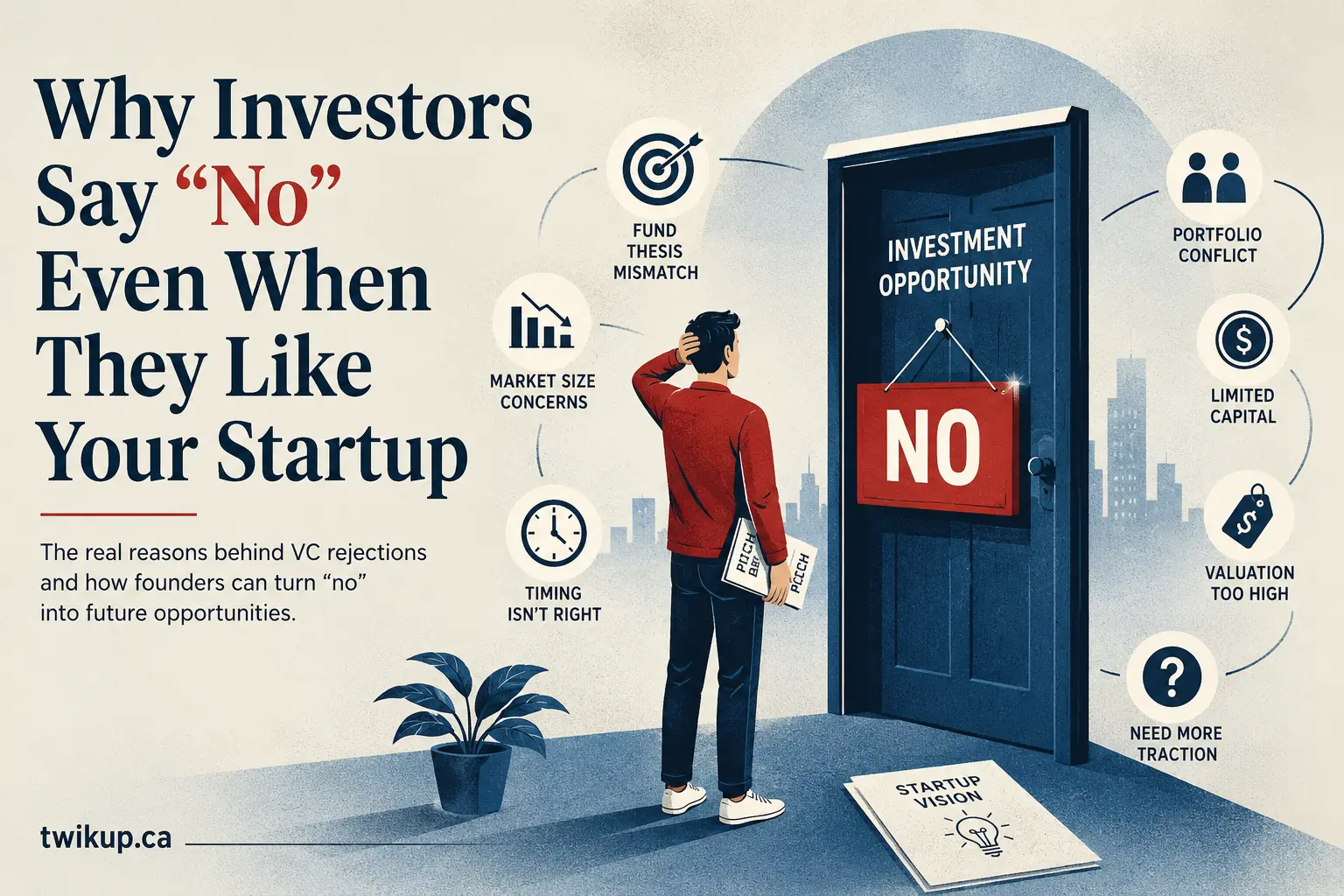
Why Investors Say “No” Even When They Like Your Startup
Quick Answer
Investors say “no” even when they like your startup because venture capital is not just about liking the idea. They need the right market size, timing, traction, valuation, fund fit, portfolio fit, and internal conviction.
A startup can be good, promising, and well-run — but still not match what a specific investor needs at that moment.
Key Takeaways
- A “no” does not always mean your startup is bad.
- Many investors reject companies because of fund thesis, timing, valuation, or portfolio conflicts.
- Investors are looking for outsized returns, not just good businesses.
- Weak traction, unclear market size, or uncertain founder-market fit can stop a deal.
- The best founders use rejection as feedback, not failure.
- “Keep us updated” can become a future investment if execution improves.
Why Investor Rejection Feels So Confusing
Fundraising often feels personal.
A founder spends months building a product, talking to customers, preparing a pitch deck, and finally meeting investors. The meeting goes well. The investor likes the founder. They like the market. They even say the idea is interesting.
Then comes the email:
“We like what you’re building, but we’re going to pass for now.”
For many founders, this feels contradictory.
But in venture capital, liking a startup and investing in it are two different decisions.
Investors are not only asking:
“Is this a good startup?”
They are also asking:
“Can this become a fund-returning company?”
That is a much higher bar.
Twikup Insight
A startup does not need to be bad to get rejected. It only needs to be a poor fit for that investor, that fund, that timing, or that risk-return profile.
This is why founders should not treat every rejection as a judgment on the business. Sometimes the investor is saying no to the deal structure, the timing, the market size, or their own fund limitations — not the founder.
1. Your Startup Does Not Fit Their Investment Thesis
Every investor has a thesis.
Some funds focus on AI. Some focus on climate tech. Some invest only in B2B SaaS. Some prefer healthcare, fintech, deep tech, marketplaces, or consumer apps.
Even if your startup is strong, an investor may reject it because it does not match their fund strategy.
For example, if a VC fund is focused on enterprise software, they may not invest in a consumer marketplace — even if they like the idea.
This is one of the most common reasons founders hear “no.”
2. The Market Is Not Big Enough for Venture Capital
Many founders confuse a good business with a venture-scale business.
A company can be profitable, useful, and loved by customers — but still not be large enough for VC returns.
Venture capital funds usually need a few companies to generate most of the fund’s returns. That means investors look for markets where a startup could potentially become very large.
If the market feels too small, investors may pass.
Not because the business is bad.
Because the upside may not match the VC model.
Quick Answer: What Does “Market Too Small” Mean?
It means investors do not believe the company can grow into a large enough outcome to justify the risk.
A startup solving a narrow problem for a small customer segment may still become profitable, but it may not become a billion-dollar company.
3. The Investor Likes the Problem, But Not the Timing
Timing matters.
Some startups are too early. Customers are not ready. Regulations are unclear. Technology is not mature. Distribution is expensive. The market may need five more years to develop.
Other startups are too late. The market is already crowded, competitors are well-funded, and customer acquisition costs are rising.
Investors may like your startup but still believe the timing is wrong.
CB Insights’ 2026 startup failure research shows that poor product-market fit, timing, and business-model issues continue to be major reasons startups fail.
4. They Are Not Fully Convinced About Founder-Market Fit
Founder-market fit means investors believe the founder is the right person to solve this problem.
They look at:
- Industry knowledge
- Customer understanding
- Technical ability
- Sales ability
- Execution speed
- Leadership maturity
- Resilience under pressure
A founder does not need to have everything figured out. But investors want to see why this team has a unique advantage.
If the founder sounds passionate but not deeply informed, investors may hesitate.
5. The Startup Does Not Have Enough Traction Yet
Many investors say they invest early.
But “early” does not always mean “idea only.”
They may still want proof such as:
- Paying customers
- Revenue growth
- Active users
- High retention
- Strong waitlist
- Pilot projects
- Signed letters of intent
- Repeat usage
- Clear customer pain
Traction reduces uncertainty.
The less traction you have, the more investors must rely on belief. In a tighter funding environment, belief alone is often not enough.
Twikup Insight
Investors rarely fund confidence alone. They fund evidence.
A strong founder story helps, but traction makes the story believable.
6. Your Valuation Is Too High
Sometimes investors like the startup but reject the price.
Valuation affects investor ownership, future fundraising, dilution, and expected return.
If the valuation is too high for the company’s current stage, traction, revenue, or risk level, investors may pass even if they like the business.
This often happens when founders compare themselves to later-stage companies or peak-market valuations.
A better approach is to connect valuation to:
- Current traction
- Market size
- Revenue growth
- Comparable rounds
- Team strength
- Strategic progress
- Future milestones
7. They Already Invested in a Similar Company
Portfolio conflict is another common reason.
A VC may like your company but already have a similar startup in their portfolio.
They may reject the deal because investing in both could create:
- Competitive conflict
- Confidentiality concerns
- Founder trust issues
- Brand risk
- Internal portfolio tension
This type of rejection has little to do with your startup’s quality.
8. The Partner Likes You, But the Firm Does Not Have Conviction
In many VC firms, one partner liking your startup is not enough.
The deal may still need approval from:
- Other partners
- Investment committee
- Fund leadership
- Due diligence team
A founder may leave a meeting feeling excited because one investor showed interest.
But internally, the firm may not reach consensus.
That is why founders should not treat positive feedback as a committed investment.
Paul Graham’s fundraising advice warns founders that deals can fall through and that they should not assume investor interest equals money in the bank.
9. The Fund Has Limited Capital Available
VC funds do not have unlimited money.
Even if they like your startup, they may have limited capital left for new investments.
They may be reserving money for existing portfolio companies. They may have already made too many investments that quarter. They may be waiting for a new fund close.
In this case, the rejection is more about timing than your company.
10. They Like the Startup, But Not Enough to Lead
One of the most frustrating investor responses is:
“We are interested, but we do not lead rounds.”
This often means the investor may participate only if another strong investor commits first.
Paul Graham advises founders to prioritize investors who can lead because investors who do not lead may not move the round forward.
For founders, this matters because fundraising momentum depends on real commitments, not polite interest.
Key Takeaways: Why Investors Say No
| Reason | What It Usually Means | Can Founder Fix It? |
|---|---|---|
| Fund thesis mismatch | Wrong investor fit | No |
| Market too small | Not venture-scale enough | Sometimes |
| Poor timing | Market is too early or crowded | Sometimes |
| Weak traction | Not enough proof yet | Yes |
| Founder-market fit concern | Investor doubts execution advantage | Yes |
| Valuation too high | Risk-reward does not work | Yes |
| Portfolio conflict | Investor backed a competitor | No |
| No internal consensus | One partner liked it, others did not | Sometimes |
| Limited fund capital | Timing issue inside the fund | No |
| No lead investor | Interest without commitment | Yes |
What Founders Should Do After Hearing “No”
Do not argue.
Do not become defensive.
Do not disappear.
Instead, ask one useful question:
“What would need to change for this to become a stronger investment opportunity in six months?”
This can reveal whether the issue is traction, market size, valuation, team, product clarity, or investor fit.
Then use that feedback.
How to Turn Investor Rejection Into Progress
After a rejection, founders should:
- Track the reason for the rejection.
- Look for patterns across investors.
- Improve the pitch if the story is unclear.
- Improve traction if proof is missing.
- Revisit valuation if pricing is the issue.
- Target better-fit investors.
- Send investor updates every 1–2 months.
- Keep building momentum.
A single rejection means little.
Repeated rejection for the same reason means there may be a real issue to fix.
Twikup Insight
The best founders do not collect investor meetings. They collect investor learning.
Every “no” should make the next pitch sharper, clearer, and more evidence-based.
How to Reduce Rejections Before You Pitch
Before contacting investors, founders should check:
- Does this investor fund my stage?
- Do they invest in my sector?
- Do they write cheques of my target size?
- Have they backed similar companies?
- Do they usually lead rounds?
- Does my valuation match my traction?
- Can I explain my market clearly?
- Can I show why now is the right time?
- Do I know my key metrics?
- Can I explain how this becomes a large company?
Most fundraising mistakes happen before the pitch starts.
Poor investor targeting wastes time and creates unnecessary rejection.
Quick Answer: Is Investor Rejection Always Bad?
No.
Investor rejection can be useful if it shows founders what is missing.
A rejection may reveal that the pitch is unclear, the market story is weak, traction is not strong enough, or the wrong investors are being approached.
The problem is not rejection.
The problem is ignoring repeated feedback.
Internal Link: Continue the Fundraising Series
For a complete step-by-step view of startup fundraising, read:
The Complete Startup Fundraising Roadmap: From Idea to IPO — 2026 Complete Founder Guide
That guide explains how founders move from idea-stage funding to angel investment, seed rounds, Series A, venture capital, growth rounds, exits, and IPO preparation.
Founder Checklist: Before Your Next Investor Meeting
Use this checklist before pitching again:
- Can I explain the problem in one sentence?
- Can I show proof that customers care?
- Can I explain why this market is large?
- Can I show why now is the right time?
- Can I explain why our team is uniquely suited?
- Can I defend my valuation?
- Can I show traction clearly?
- Can I explain how investor capital accelerates growth?
- Can I answer why this can become a large outcome?
- Can I explain why this investor is the right fit?
If the answer is weak on any of these, fix it before the next meeting.
Final Thoughts
Investors often say “no” to startups they genuinely like.
That is because venture capital is not just about liking an idea. It is about conviction, timing, ownership, market size, fund fit, and return potential.
For founders, the goal is not to convince every investor.
The goal is to find the right investors — the ones whose thesis, timing, risk appetite, and belief align with the company you are building.
A “no” is not the end of the fundraising journey.
Sometimes, it is the feedback that helps founders build a stronger company.
Sources and Helpful References
- Y Combinator — Startup Library: https://www.ycombinator.com/library
- Paul Graham — How to Raise Money: https://paulgraham.com/fr.html
- Paul Graham — A Fundraising Survival Guide: https://www.paulgraham.com/fundraising.html
- CB Insights — Why Startups Fail: https://www.cbinsights.com/research/report/startup-failure-reasons-top/
- PitchBook — Private Capital Research: https://pitchbook.com/news/reports
- NVCA / PitchBook Venture Monitor: https://nvca.org/pitchbook-nvca-venture-monitor/