
Quick Answer
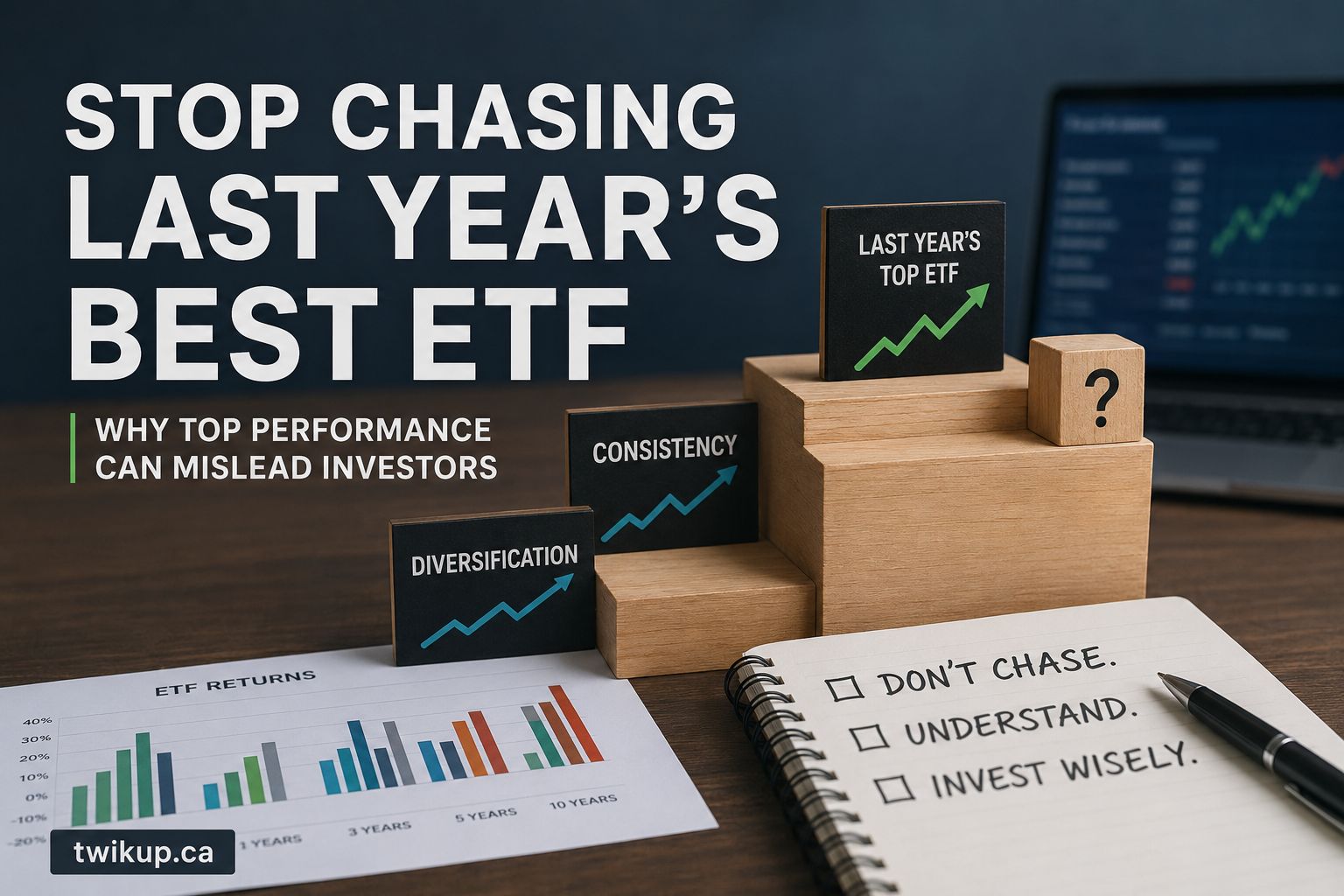
The ETF that delivered the highest return last year is not automatically the best ETF to buy this year.
Strong recent performance may result from temporary market conditions, rising valuations, sector concentration, currency movements, or one unusually successful group of companies.
Instead of selecting an ETF because it appears on a list of the best last-year ETF returns, investors should examine:
- What the ETF owns
- How concentrated it is
- Whether it fits their risk tolerance
- Its fees, trading costs, and tax considerations
- How it performed during difficult markets
- Whether it complements their existing portfolio
- Whether they could continue holding it after a significant decline
Historical returns provide useful context, but they cannot reliably predict which ETF will lead next.
The most successful ETF is not necessarily the one with the highest recent return. It may be the diversified, affordable fund that an investor can consistently hold through several market cycles.
TwikUp Insight
Searching for the best-performing ETFs over the last 2, 3, 5, or 10 years feels like careful research, but it can quietly become performance chasing.
The critical question is not:
Which ETF produced the highest return?
It is:
What caused that return, what risks were required to achieve it, and are those conditions likely to continue?
A technology-heavy ETF may dominate when technology stocks are rising. A Canadian energy ETF may outperform when oil prices surge. A gold ETF may rise during economic uncertainty. A covered-call ETF may appear attractive when investors prioritize distributions.
None of those outcomes proves that the same ETF will lead during the next period.
A long-term portfolio should be constructed around the investor’s objectives—not around whichever investment recently reached the top of a performance table.
Why Investors Chase Last Year’s Winning ETF
ETF performance rankings are appealing because they simplify a complicated decision.
Instead of evaluating asset allocation, diversification, valuation, volatility, and personal objectives, an investor can look at a table, find the largest number, and assume the winner is obvious.
This behaviour is reinforced by searches such as:
- Last year ETF returns Canada
- Last year ETF returns Vanguard
- Best last-year ETF returns
- Best-performing ETFs last 2 years
- Top 10 best-performing ETFs last 3 years
- Best-performing ETFs last 5 years
- Best-performing ETFs last 10 years
- ETF returns last 10 years
These are reasonable starting points for research.
The danger begins when historical performance becomes the main reason for purchasing an ETF.
An ETF’s return tells you what happened during a particular period. It does not tell you whether the ETF is attractively valued today, whether its holdings overlap with your portfolio, or whether you can tolerate its future volatility.
📊 Example: The "Best ETF" Trap
Imagine two ETFs.
| ETF | Last Year's Return |
|---|---|
| ETF A | +42% |
| ETF B | +14% |
Most investors immediately choose ETF A.
But suppose the next year looks like this:
| ETF | Next Year's Return |
|---|---|
| ETF A | -32% |
| ETF B | +12% |
If you invested $10,000:
ETF A
Year 1
$10,000 → $14,200
Year 2
$14,200 × 0.68 = $9,656
ETF B
Year 1
$10,000 → $11,400
Year 2
$11,400 × 1.12 = $12,768
The ETF that looked "boring" actually produced the better two-year outcome.
The lesson is simple:
Buying yesterday's winner doesn't guarantee tomorrow's winner.
The Performance-Chasing Cycle
Performance chasing often follows a predictable pattern:
- A sector, country, or investment theme begins outperforming.
- Its strong returns attract media attention and investor interest.
- More investors purchase funds connected to the trend.
- Valuations and expectations rise.
- New investors buy after much of the increase has already occurred.
- Performance slows, reverses, or becomes more volatile.
- Disappointed investors sell and move to the next recent winner.
The problem is not that a winning ETF must immediately decline. Some market trends can continue for years.
The problem is that the investor may be buying for the wrong reason and without understanding the risks.
When an ETF is purchased only because it recently performed well, the investor may have no framework for deciding what to do when it eventually underperforms.
💡 Example: Why Big Losses Hurt More Than Big Gains
Suppose your ETF falls 50%.
Your investment changes from:
$20,000 → $10,000
How much must it earn to get back?
Many people answer:
"50%."
The correct answer is:
100%.
Why?
$10,000 × 2 = $20,000
Large losses require disproportionately larger recoveries.
That is why experienced investors often care more about limiting severe drawdowns than chasing the highest annual return.
Why Last Year’s Best ETF May Not Win Again
1. Different market environments favour different investments
Markets move through changing economic conditions.
Falling interest rates may benefit certain growth-oriented assets. Rising commodity prices may support energy producers. Economic uncertainty may increase interest in defensive assets. A strengthening US dollar can increase the Canadian-dollar return from certain foreign investments.
An ETF’s recent success may therefore reflect an environment that will not continue indefinitely.
Buying the previous winner assumes that yesterday’s market conditions will remain in place.
That is possible—but it should not be treated as certain.
2. High returns can increase valuation risk
When a sector performs exceptionally well, the prices of its holdings may rise faster than their revenue, earnings, or cash flow.
The underlying companies may still be excellent businesses. However, a strong company and an attractive investment are not always the same thing at every price.
Investors purchasing after a major rally may be accepting:
- Higher valuations
- Greater expectations
- Less room for disappointment
- More severe declines if growth slows
The ETF may continue rising, but the margin for error can become smaller.
📈 Example: Buying After Headlines
Imagine a technology ETF.
Year 1
+55%
Financial media begins calling it the "best ETF."
Thousands of new investors buy.
The following year it returns 0%.
The ETF didn't fail.
It simply couldn't continue growing at the same extraordinary pace.
The people who bought after seeing last year's ranking may feel disappointed—not because the ETF was bad, but because expectations became unrealistic.
3. A winning ETF may be heavily concentrated
An ETF can hold dozens or hundreds of securities while remaining economically concentrated.
Much of its performance might depend on:
- A small number of mega-cap companies
- One industry
- One country
- One commodity
- One investing factor
- One market narrative
The number of holdings alone does not establish meaningful diversification.
Investors should examine the weight of the largest holdings, sector exposure, geographic allocation, and overlap with investments they already own.
4. Currency movements may have helped the result
For a Canadian investor, the return from a foreign ETF can be affected by:
- The performance of the underlying investments
- The movement of the Canadian dollar against the foreign currency
A US equity ETF may produce a stronger Canadian-dollar return when the US dollar appreciates against the Canadian dollar. The reverse can also occur.
Comparing ETF returns without checking whether funds are currency-hedged or unhedged can produce an incomplete conclusion.
5. The ranking may begin at a favourable point
The selected measurement period can dramatically change which ETF appears to be the winner.
The best-performing ETF over one year may not lead over:
- Two years
- Three years
- Five years
- Ten years
- A complete bull-and-bear market cycle
Even a 10-year return can depend heavily on the starting date, particularly when the period begins near a market decline or immediately before an extended sector rally.
Historical rankings should be viewed as snapshots, not permanent scorecards.
What “Best-Performing ETF” Actually Means
Before relying on a performance ranking, determine what the ranking is measuring.
Price return versus total return
Price return measures the change in an ETF’s market price.
Total return generally includes:
- Changes in the ETF’s value
- Reinvested distributions
For income-producing investments, these figures can differ significantly.
Comparisons should use the same return methodology whenever possible.
Annual return versus annualized return
A one-year return describes one specific period.
An annualized return converts performance over several years into an average compounded yearly rate. It does not mean the ETF earned that exact amount every year.
An ETF may produce strong gains in one year, a loss in another, and modest returns afterward while still reporting an attractive multi-year annualized figure.
Index return versus investor return
The return of an index does not necessarily represent the return an investor receives.
An ETF investor may incur:
- Management fees
- Operating expenses
- Trading commissions
- Bid-ask spreads
- Currency-conversion costs
- Taxes in non-registered accounts
- Foreign withholding taxes in certain situations
The return of an underlying index and the return received by an ETF investor may therefore differ.
Market price versus net asset value
ETFs trade on exchanges throughout the day.
Their market prices can sometimes differ slightly from the value of their underlying holdings, known as net asset value.
This is one reason investors should understand bid-ask spreads and use care when placing trades, especially in less-liquid ETFs.
The Biggest Mistakes Investors Make
| Mistake | Better Approach |
|---|---|
| Buying the ETF with the highest return | Understand why it performed well |
| Looking only at one-year returns | Review multiple market cycles |
| Ignoring fees | Compare total ownership costs |
| Chasing technology after a rally | Build a diversified portfolio |
| Switching funds every year | Follow a long-term investment plan |
Last Year ETF Returns in Canada: How to Use Them Properly
Reviewing last year’s ETF returns in Canada can still be useful when the information is used as a diagnostic tool rather than a shopping list.
Ask:
- Which asset classes led the market?
- Was the return driven by company earnings or expanding valuations?
- Did currency movements contribute?
- Was the ETF broadly diversified or narrowly concentrated?
- How volatile was it?
- How far did it decline during the period?
- Would it add diversification or duplicate existing holdings?
- Was the result caused by a temporary event?
This transforms a return table from a list of products to chase into a way of understanding market behaviour.
Last Year ETF Returns for Vanguard Funds
Investors also frequently search for last year ETF returns Vanguard.
A fund provider’s official website can be a useful place to review:
- Standardized performance information
- Fund objectives
- Holdings
- Fees
- Risk disclosures
- ETF Facts documents
- Prospectuses
However, the provider’s highest-returning ETF is not automatically its most suitable fund for every investor.
A narrow sector ETF may outperform a diversified portfolio during a strong year while carrying substantially different risks.
The appropriate question is not simply:
Which Vanguard ETF earned the most?
It is:
Which investment objective, asset allocation, and risk level align with my financial plan?
ETF Returns Over the Last 10 Years: Useful but Incomplete
Searching ETF returns over the last 10 years can provide more perspective than examining only one year.
A decade may include:
- Several interest-rate environments
- Economic expansions and slowdowns
- Market corrections
- Sector rotations
- Changes in currency values
- Periods of high and low inflation
Nevertheless, even a 10-year result has limitations.
Some ETFs do not have 10 years of history
A newer ETF may track an established index but lack a complete live performance record.
Back-tested or index performance can be informative, but it is not identical to an investor’s real-world experience in the ETF.
One decade may favour a particular market
A 10-year period can be dominated by the exceptional performance of one country, sector, or investing style.
Investors should not automatically assume that the same leadership will persist during the following decade.
Returns do not reveal the full experience
Two ETFs could produce similar annualized returns while delivering very different levels of volatility.
One may experience relatively moderate declines. The other may lose a much larger percentage of its value before recovering.
For an investor who sells during the decline, the long-term average shown in the performance table may become irrelevant.
Best-Performing ETFs Over the Last 2 Years
Two-year returns are highly sensitive to short-term market conditions.
A fund leading this category may have benefited from:
- A rebound following an earlier decline
- A commodity cycle
- A surge in one industry
- A currency movement
- A speculative trend
- A small group of high-performing companies
A two-year history is generally too short to demonstrate how an ETF behaves across multiple economic environments.
It can reveal recent momentum, but it should not be mistaken for evidence of durable superiority.
Top 10 Best-Performing ETFs Over the Last 3 Years
A list of the top 10 best-performing ETFs over the last 3 years may contain funds with completely different structures and risks.
It could include:
- Broad-market equity ETFs
- Technology ETFs
- Commodity funds
- Leveraged ETFs
- Cryptocurrency-related ETFs
- Country-specific funds
- Sector ETFs
- Thematic funds
Ranking all of them together can create a misleading comparison.
A diversified global equity ETF and a leveraged sector ETF are not competing solutions for the same portfolio role. They serve different purposes and carry different risk profiles.
Before comparing returns, group ETFs by:
- Asset class
- Investment objective
- Geography
- Use of leverage
- Currency exposure
- Distribution policy
- Diversification level
Only then does the comparison become more meaningful.
Best-Performing ETFs Over the Last 5 Years
Five-year returns can help reveal whether an ETF’s performance persisted beyond a brief market event.
However, investors should still investigate:
- Maximum historical decline
- Volatility
- Concentration
- Valuation changes
- Distribution consistency
- Performance during weak markets
- Changes to the underlying index or strategy
A fund that delivered the highest five-year return may also have required an investor to withstand the greatest uncertainty.
Performance and suitability remain separate questions.
Best-Performing ETFs Over the Last 10 Years
Long-term performance is more informative than a one-year leaderboard, but it does not remove hindsight bias.
Today’s winners are easy to identify because we already know what happened.
Ten years ago, investors did not know:
- Which companies would become dominant
- Which technologies would succeed
- How interest rates would change
- Which geopolitical events would occur
- Which sectors would outperform
- How currencies would move
A ranking can show where wealth was created. It cannot prove where the next decade’s wealth will be created.
What to Examine Instead of Last Year’s Return
1. Investment objective
Read what the ETF is designed to accomplish.
Does it track:
- The S&P 500?
- The Canadian stock market?
- Global equities?
- Government or corporate bonds?
- A dividend index?
- A specific sector?
- A covered-call strategy?
- A commodity?
Two ETFs should not be compared merely because they both trade on a stock exchange.
2. Portfolio role
Decide whether the ETF will be:
- A long-term core holding
- A source of fixed income
- A small satellite position
- A tactical investment
- A source of distributions
- A geographic diversifier
A specialized ETF might be appropriate as a small satellite position but unsuitable as an investor’s entire portfolio.
3. Diversification
Check exposure across:
- Companies
- Sectors
- Countries
- Currencies
- Asset classes
- Company sizes
Canadian investors seeking a one-ticket global equity portfolio may compare funds such as XEQT and VEQT rather than selecting whichever narrow sector happened to win last year.
Read TwikUp’s comparison of XEQT, VEQT, VFV, and VOO for long-term investing.
4. Concentration
Review the combined weight of the ETF’s largest holdings.
An ETF with 100 holdings may still depend heavily on five companies.
This is particularly important for technology and artificial-intelligence-related investments. Investors who own an S&P 500 ETF, a Nasdaq ETF, and a technology ETF may discover that all three have substantial exposure to many of the same companies.
TwikUp explains this risk in Are You Overinvested in AI? The Truth About Tech Stocks and the Magnificent Seven.
5. Fees and trading costs
A fund’s management fee is important, but it is not the only potential cost.
Consider:
- Management expense ratio
- Trading commissions
- Bid-ask spread
- Currency conversion
- Tracking difference
- Tax consequences
- Frequency of trading
Small differences in annual costs can compound over long periods.
However, investors should not select a fund based on fees alone when the funds provide materially different exposures.
6. Risk rating and volatility
Canadian ETF Facts documents include standardized information intended to help investors assess the fund, including its risk classification.
The rating is useful, but it does not capture every type of risk and should not be interpreted as a prediction of future losses.
Look beyond the label and consider:
- Largest historical decline
- Recovery time
- Sector concentration
- Currency exposure
- Interest-rate sensitivity
- Credit risk
- Use of leverage
7. Behaviour during market declines
An ETF’s return during a strong market shows only part of the story.
Investigate how it behaved during:
- Equity-market corrections
- Recessions
- Interest-rate increases
- Commodity declines
- Currency reversals
- Periods when its primary sector underperformed
Then ask whether you could realistically continue holding it.
A theoretically strong portfolio becomes ineffective when an investor abandons it during normal volatility.
8. Tax treatment and account type
The same ETF can have different after-tax outcomes depending on whether it is held in:
- A TFSA
- An RRSP
- An FHSA
- A non-registered account
Canadian-listed and US-listed ETFs can also differ in currency, foreign withholding-tax considerations, and administrative complexity.
Investors comparing VFV and ZSP can review TwikUp’s detailed guide: VFV vs ZSP: Which S&P 500 ETF Makes More Sense for Canadians?.
Those deciding between a Canadian-listed ETF and direct US-market exposure can read Should Canadians Buy VFV or Invest Directly in the S&P 500?.
Why Buying Only the S&P 500 Can Still Be a Concentrated Decision
An S&P 500 ETF may provide exposure to hundreds of major US companies, but it does not represent every country, asset class, or segment of the global market.
An investor relying entirely on VFV may be heavily exposed to:
- Large US companies
- The US dollar
- US market valuations
- A relatively small group of mega-cap businesses
- US economic and regulatory conditions
That does not make VFV unsuitable.
It means investors should understand the role it plays.
TwikUp examines when a single US equity fund may or may not be enough in Is One S&P 500 ETF Enough? VFV vs VOO for Long-Term Wealth.
High Distributions Do Not Automatically Mean Better Performance
Investors chasing last year’s winners may also be attracted to ETFs advertising high distribution yields.
However, a distribution is not free additional return.
Depending on the fund, distributions can consist of:
- Dividends
- Interest
- Capital gains
- Option premiums
- Return of capital
A high yield does not necessarily mean the underlying portfolio is growing more quickly.
Covered-call ETFs, for example, may generate additional cash flow by selling call options, but the strategy can limit some upside participation under certain market conditions.
Read Covered-Call ETFs Explained: Passive Income Strategy or Performance Trap?.
Investors comparing income and growth strategies should also review Dividend ETFs vs Growth ETFs: Should You Chase High Dividend Yields?.
Younger investors evaluating whether to prioritize distributions can read Dividend Investing Before Age 30—Smart Strategy or Too Early?.
A Better ETF Selection Framework
Before buying an ETF, write down answers to these questions.
| Question | Why it matters |
|---|---|
| What does the ETF own? | Reveals the actual source of returns and risk |
| What index or strategy does it follow? | Explains how securities are selected and weighted |
| What role will it play? | Prevents random accumulation of overlapping funds |
| How concentrated is it? | Identifies dependence on a sector, country, or small group of companies |
| What are the total costs? | Shows how much return may be lost to fees and trading |
| How volatile has it been? | Helps assess whether the investor can tolerate the experience |
| How did it behave during declines? | Provides more context than performance during a rally |
| Does it overlap with existing ETFs? | Prevents accidental concentration |
| What account will hold it? | Affects taxes, contribution room, and currency considerations |
| Why am I buying it now? | Exposes decisions driven mainly by recent performance |
| What would make me sell? | Establishes discipline before volatility begins |
| Can I hold it for 10 years? | Tests whether it matches a genuine long-term plan |
If the only answer to “Why am I buying it?” is “because it had the highest return last year,” the research is not complete.
An Example of Performance Chasing
Imagine an investor owns a diversified global equity ETF.
After seeing that a technology ETF greatly outperformed during the previous year, the investor sells the diversified fund and moves everything into technology.
The following year, another sector becomes the market leader while technology slows. The investor then switches again.
Even when each selected ETF is legitimate, repeated switching can cause:
- Buying after prices have already risen
- Selling after performance weakens
- Higher trading and currency-conversion costs
- Taxable capital gains in non-registered accounts
- Greater portfolio concentration
- Loss of a consistent investment strategy
The investor may repeatedly own yesterday’s winner instead of tomorrow’s.
This behavioural gap helps explain why investors can underperform the funds they purchase.
Read Why Most ETF Investors Underperform Their Own ETFs.
Should You Sell an ETF That Has Performed Poorly?
Poor recent performance is not automatically a reason to sell, just as strong recent performance is not automatically a reason to buy.
Consider selling or replacing an ETF when:
- Its investment objective no longer fits your plan
- The index or strategy has materially changed
- Costs are no longer competitive
- A simpler fund provides the same exposure
- The ETF creates unwanted portfolio overlap
- Your risk tolerance or time horizon has changed
- The position has become disproportionately large
- Your original investment thesis was incorrect
Temporary underperformance alone may not justify a change.
Diversification naturally means some parts of a portfolio will underperform others at any given time.
If every holding is rising and falling together, the portfolio may not be meaningfully diversified.
Should You Buy an ETF After a Strong Year?
A strong year does not automatically make an ETF a bad investment.
The ETF may still be appropriate when:
- It fills a required portfolio allocation
- Its underlying exposure matches your long-term plan
- You understand the risks
- Its valuation remains acceptable to you
- You are not replacing a diversified portfolio with a concentrated trend
- You can tolerate a substantial decline
- You plan to hold it through different market environments
The goal is not to avoid every fund that recently performed well.
The goal is to avoid confusing recent performance with evidence of permanent superiority.
TFSA Investors Must Be Especially Careful
Frequent switching inside a TFSA does not directly create tax on gains, but withdrawals and recontributions must follow Canada Revenue Agency rules.
A TFSA withdrawal is generally added back to contribution room in the following calendar year—not immediately.
Investors who withdraw and recontribute during the same year without sufficient unused room can create an overcontribution.
Performance chasing can also lead investors to fill valuable TFSA room with highly speculative or concentrated positions that do not match their long-term objectives.
Read The Biggest TFSA Investing Mistake Canadians Make.
Red Flags in “Best ETF” Rankings
Approach an ETF ranking cautiously when it:
- Focuses only on one-year returns
- Mixes leveraged and non-leveraged ETFs
- Ignores volatility and maximum declines
- Compares unrelated asset classes
- Excludes funds that closed or performed poorly
- Uses price returns for some funds and total returns for others
- Does not explain currency effects
- Ignores fees and taxation
- Treats distribution yield as total return
- Provides no information about holdings or concentration
- Suggests future performance is likely to resemble historical performance
A ranking can be factually accurate and still lead to a poor investment decision when important context is missing.
What Long-Term ETF Investors Can Do Instead
A more disciplined process may involve:
- Establishing a financial goal and time horizon.
- Choosing an appropriate stock-and-bond allocation.
- Selecting broadly diversified and understandable investments.
- Keeping costs and unnecessary trading under control.
- Contributing on a consistent schedule.
- Rebalancing according to a plan rather than headlines.
- Reviewing the portfolio periodically instead of reacting daily.
- Changing investments only when the strategy—not merely recent performance—has changed.
Staying disciplined does not guarantee a profit or protect against losses.
It can, however, reduce the likelihood of repeatedly abandoning a long-term strategy to purchase whichever ETF has recently become popular.
Frequently Asked Questions
What was the best ETF last year in Canada?
The answer depends on which ETFs are included, the measurement dates, whether total returns are used, and whether leveraged, commodity, or cryptocurrency-related products are eligible.
More importantly, the highest-returning ETF may have carried risks that are unsuitable for a typical long-term portfolio.
What are the best-performing ETFs over the last 10 years?
The leaders vary by ending date, currency, fund category, and calculation methodology.
Historical leaders often reflect the sectors, regions, and companies that performed exceptionally well during that particular decade.
Investors should compare funds within the same category and examine risk, concentration, fees, and drawdowns alongside returns.
Should I buy last year’s best-performing ETF?
Not solely because it was last year’s winner.
Purchase an ETF when its objective, underlying holdings, risk, fees, and portfolio role align with your plan.
Recent performance can be part of the research, but it should not become the entire investment thesis.
Are five-year ETF returns more useful than one-year returns?
Five-year data provides more context, but it remains backward-looking and may still represent only one favourable market environment.
Review difficult-market performance, volatility, concentration, and rolling periods in addition to the final annualized return.
Is a 10-year ETF return enough to make a decision?
No.
It is useful historical evidence, but it does not show whether current valuations, market leadership, or economic conditions will continue.
It should be considered alongside the fund’s strategy, holdings, costs, risks, and suitability.
Is the ETF with the highest return also the riskiest?
Not necessarily.
However, unusually high returns can be associated with concentration, leverage, smaller companies, volatile sectors, or favourable timing.
Risk must be examined directly rather than inferred from the return alone.
How many ETFs should a Canadian investor own?
There is no universal number.
One broadly diversified asset-allocation ETF may provide exposure to thousands of securities, while several specialized ETFs can still leave an investor highly concentrated.
What the ETFs collectively own matters more than the number of ticker symbols.
The Bottom Line
Last year’s ETF winner tells you what recently worked. It cannot tell you with certainty what will work next.
The same caution applies to lists showing:
- Best-performing ETFs over two years
- Top 10 ETFs over three years
- Best-performing ETFs over five years
- Best-performing ETFs over ten years
Historical returns should be used to understand an ETF—not to replace the work of understanding it.
Before investing, examine the fund’s objective, holdings, diversification, concentration, fees, volatility, currency exposure, account location, and role inside the complete portfolio.
The best ETF is rarely the one with the most impressive number on a performance table.
It is the one that fits a sound plan—and that the investor can continue holding when it is no longer last year’s winner.
Important Disclaimer
This article is provided for general educational and informational purposes only. It does not constitute investment, financial, tax, accounting, or legal advice, and it is not a recommendation or solicitation to buy, sell, or hold any ETF, security, or investment strategy.
ETF values can rise or fall. Investment funds are not guaranteed, and past performance may not be repeated. Examples in this article are illustrative and do not predict future returns. Tax treatment depends on individual circumstances and may change.
Before investing, review the ETF Facts document, prospectus, holdings, fees, risks, and tax implications. Consider consulting a qualified financial adviser, tax professional, or appropriately registered professional who understands your objectives, financial circumstances, risk tolerance, and time horizon.
Sources
- Ontario Securities Commission — CSA Mutual Fund Risk Classification Methodology
- Canada Revenue Agency — Tax-Free Savings Account
- Canada Revenue Agency — Calculate Your TFSA Contribution Room
- Canada Revenue Agency — Withdrawing From a TFSA
- Vanguard Canada — Principles for Investing Success
- Vanguard Canada — ETF Information and Risk Disclosures
- iShares Canada — Asset-Allocation ETFs