
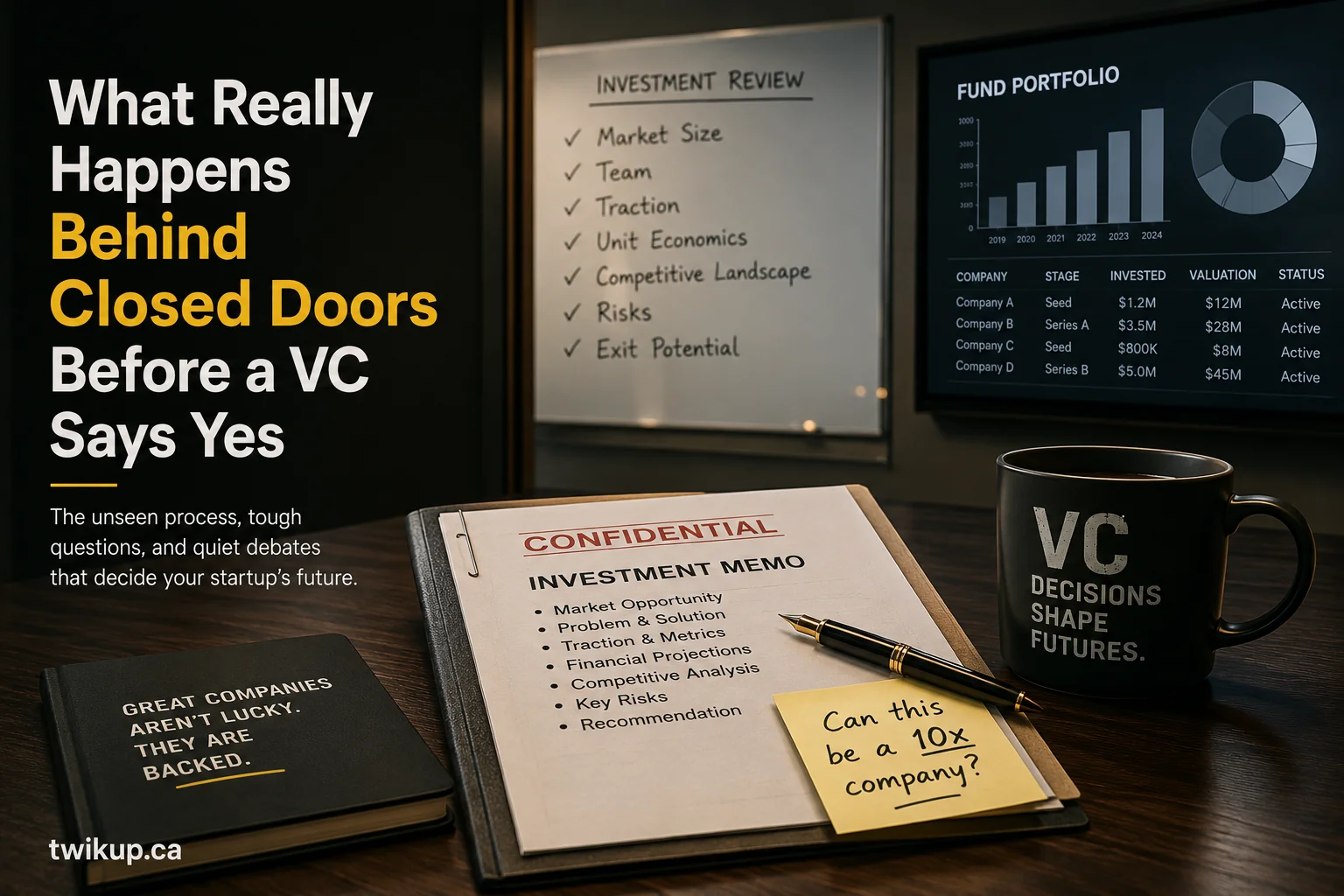
What Really Happens Behind Closed Doors Before a VC Says Yes
Quick Answer
Before a venture capitalist says yes, the startup usually goes through a quiet internal process: partner interest, market sizing, founder checks, customer validation, financial review, legal due diligence, investment committee debate, term sheet negotiation, and final approval.
The founder often sees only the pitch meetings. Behind closed doors, the VC is asking a harder question: can this company become large enough, fast enough, to justify the risk of many other investments failing?
That is why a “yes” from a VC is rarely just about liking the idea. It is about conviction, risk, ownership, fund strategy, exit potential, and whether the firm believes this startup can return a meaningful part of the fund.
TwikUp Insight
VC decisions look emotional from the outside, but inside the firm they are usually structured around one question:
“Can we defend this deal to our partners, our investment committee, and eventually our own investors?”
A founder may think the pitch went well because the VC was excited. But excitement is only the first door. The real decision happens later, when the investor must explain the deal without the founder in the room.
That is where weak markets, unclear traction, messy cap tables, founder conflict, poor margins, unrealistic projections, or legal issues can quietly kill a deal.
The VC “Yes” Is Not One Decision
Most founders imagine fundraising like this:
- Pitch the VC
- VC likes the startup
- VC says yes
- Term sheet arrives
In reality, the process usually looks more like this:
- A junior or partner-level investor takes the first meeting
- The investor tests the idea internally
- The firm asks for more data
- The startup is discussed in a partner meeting
- Customers, market, product, team, and numbers are checked
- The investor builds an internal case
- The investment committee debates the risks
- A term sheet is proposed
- Legal and confirmatory diligence continue
- Final documents are signed
A founder may only see the visible part. The most important conversation often happens when the founder is not present.
Step 1: The First Meeting Is About Pattern Recognition
In the first meeting, the VC is rarely trying to understand every detail. They are trying to decide whether the startup fits a familiar high-return pattern.
They usually look for:
- A large or fast-growing market
- A founder who understands the problem deeply
- Early signs of customer demand
- A product that could become hard to replace
- A business model that can scale
- A reason this company could win now
- A possible path to a major exit
This is why founders should not treat the first meeting like a full business lecture. The goal is to create enough conviction for the investor to want the second meeting.
For a deeper founder-side view of why investors think this way, read TwikUp’s guide on why venture capitalists expect most startups to fail before they invest.
Step 2: The Investor Tests the Deal Internally
After the first meeting, the investor may bring the company up with partners or associates.
This is where the startup gets tested through internal questions:
- Is the market big enough?
- Why now?
- Why this founder?
- Why would customers switch?
- What is the company’s unfair advantage?
- How much ownership can we get?
- What price makes sense?
- Could this return the fund?
- What could kill this company?
This is also where many deals die quietly. The founder may receive a polite “let’s stay in touch,” but internally the firm may have decided the opportunity is not strong enough.
This does not always mean the startup is bad. It may simply not fit the VC’s fund size, stage, sector, geography, return target, or current portfolio.
Step 3: The VC Builds an Investment Memo
If the investor remains interested, they usually prepare an internal investment memo.
This memo may include:
- Company overview
- Founder background
- Market size
- Competitive landscape
- Product analysis
- Traction and revenue data
- Customer feedback
- Financial projections
- Cap table review
- Proposed valuation
- Ownership target
- Exit possibilities
- Key risks
- Reasons to invest
This memo matters because it becomes the investor’s argument for why the firm should say yes.
A founder is not just pitching the VC. The founder is helping the VC pitch the startup internally.
Step 4: Market Size Gets Challenged Hard
VCs usually need outcomes that are much larger than normal small-business success.
A profitable company can still be a poor VC investment if it cannot grow big enough. That is one of the biggest misunderstandings in fundraising.
Behind closed doors, the VC may ask:
- Can this become a billion-dollar company?
- Is the market expanding or shrinking?
- Is the startup creating a new category or entering an existing one?
- Are customers already spending money on this problem?
- Is the market too crowded?
- Can this company reach global scale?
This is why a founder should not only say, “This is a big problem.” They need to show why the market can support venture-scale returns.
If your startup is not built for that type of outcome, other funding paths may be better than VC.
Step 5: The Team Is Reviewed Like a Risk Factor
VCs invest in people, but not in a vague motivational way. They look at the team as a risk variable.
They may ask:
- Has the founder built before?
- Does the founder understand the customer?
- Can the team recruit strong talent?
- Are the co-founders aligned?
- Is there founder-market fit?
- Can this CEO raise future rounds?
- Will this team survive pressure?
This is also where reference checks happen. VCs may speak with former colleagues, customers, angel investors, advisors, or people in their network.
A founder’s reputation can help or hurt before the term sheet appears.
Step 6: Traction Is Checked Against the Story
Founders often pitch a story. VCs then test whether the numbers support that story.
They may review:
- Revenue growth
- Customer retention
- Churn
- Gross margin
- Sales cycle length
- Customer acquisition cost
- Payback period
- Pipeline quality
- Usage data
- Contract size
- Repeat purchase behaviour
If the startup says demand is strong, the data should show it. If the company says customers love the product, retention and usage should support it.
This is where weak metrics can damage trust.
A founder does not need perfect numbers, especially at an early stage. But they do need honest numbers.
Step 7: Customer Calls Can Make or Break the Deal
Customer diligence is one of the most important behind-the-scenes steps.
The VC may ask customers:
- Why did you buy this product?
- What did you use before?
- How painful was the problem?
- Would you be upset if the product disappeared?
- How does it compare with alternatives?
- Would you expand usage?
- Is this a must-have or nice-to-have?
A startup can survive many weaknesses if customers are clearly desperate for the product.
But if customers sound lukewarm, confused, or price-sensitive, the VC may lose conviction quickly.
Step 8: The Cap Table Is Reviewed
The cap table tells the investor who owns the company and whether future financing will be difficult.
VCs look for issues such as:
- Too much equity already given away
- Too many small investors
- Unclear advisor grants
- Founder ownership already too low
- SAFEs or notes with confusing terms
- Previous investors with unusual rights
- Option pool problems
- Control provisions that block future rounds
A messy cap table does not always kill a deal, but it can slow the process or reduce valuation.
This is why founders should understand term sheets before they raise. TwikUp’s guide on startup term sheets explains the clauses founders should watch before signing.
Step 9: The VC Checks Whether the Deal Fits the Fund
A startup can be strong and still be wrong for a specific fund.
VC firms have their own constraints:
- Fund size
- Stage focus
- Sector focus
- Geography
- Ownership target
- Check size
- Time left in the fund’s investment period
- Existing portfolio conflicts
- Reserve strategy for follow-on rounds
For example, a large fund may not invest if the round is too small. A seed fund may pass if the company is already too late-stage. A specialist fund may pass if the startup is outside its thesis.
That is why “no” does not always mean “bad company.” Sometimes it means “wrong fit.”
To understand the money behind VC firms, read TwikUp’s explainer on who funds venture capitalists and how VC firms make money.
Step 10: The Investment Committee Debates the Deal
The investment committee is where the internal yes or no becomes serious.
The sponsoring investor may present the deal and defend it against tough questions:
- What if growth slows?
- What if a bigger company enters?
- What if the founder cannot scale?
- What if the valuation is too high?
- What if the exit market is weak?
- What if the next round is hard to raise?
- What evidence proves this is not just hype?
This is where a deal can go from exciting to rejected.
A founder may never hear the real reason. They may simply get a polite email saying the firm is passing.
For more on this side of fundraising, TwikUp’s article on why investors say no even when they like your startup explains the hidden reasons behind polite rejections.
Step 11: A Term Sheet Is Not the Finish Line
When a VC sends a term sheet, the founder may feel the deal is done.
It is not.
A term sheet is a serious milestone, but final closing still depends on legal documents, confirmatory diligence, investor alignment, and sometimes board or committee approval.
The term sheet may cover:
- Valuation
- Investment amount
- Ownership percentage
- Liquidation preference
- Board seats
- Protective provisions
- Pro rata rights
- Option pool
- Founder vesting
- Information rights
- Closing conditions
Some clauses affect control. Some affect future fundraising. Some affect how much founders receive in an exit.
That is why founders should not only celebrate the valuation. They should understand the full deal.
Step 12: Legal Due Diligence Looks for Hidden Problems
Legal diligence may include reviewing:
- Incorporation documents
- Shareholder agreements
- Intellectual property ownership
- Employment agreements
- Contractor agreements
- Customer contracts
- Privacy policies
- Tax issues
- Litigation risk
- Regulatory exposure
- Previous financing documents
One common problem is unclear IP ownership. If contractors, early employees, or co-founders helped build the product without proper agreements, the investor may see major risk.
Another issue is compliance. A startup operating in fintech, health, education, data, employment, or regulated markets may face deeper review.
Due diligence is not only about catching fraud. It is about finding problems that could damage the company later.
Step 13: The VC Thinks About Control After the Investment
Once a VC invests, the relationship changes.
The investor may receive:
- Board representation
- Information rights
- Approval rights
- Future financing rights
- Major decision protections
- Reporting requirements
This is why raising capital is not just about getting money. It changes governance.
Founders should understand that a board can become powerful after financing. TwikUp’s article on how your board can fire you after raising capital explains why founder control can shift after investment.
Step 14: The VC Imagines the Next Round Before Saying Yes
A good VC does not only ask whether this round makes sense. They ask whether the next round will be possible.
They may consider:
- What milestones must be hit before Series A?
- Will the company have enough runway?
- Can this team raise from top-tier investors later?
- Will the valuation leave room for an up-round?
- Will the company need too much capital?
- Can this become attractive to acquirers or public markets?
This is why some startups raise money and then struggle. They win the first check but fail to reach the next proof point.
TwikUp’s guide on what happens after raising millions explains where many founders go wrong after the celebration.
What Founders Should Prepare Before the VC Says Yes
Before serious fundraising, founders should prepare:
- A clear pitch deck
- Clean financial model
- Updated cap table
- Customer references
- Revenue and usage metrics
- Legal documents
- IP assignment records
- Market research
- Hiring plan
- Use-of-funds plan
- Fundraising target
- Clear milestone plan
The goal is not to look perfect. The goal is to look prepared, honest, and investable.
A founder who can answer hard questions clearly builds trust faster.
Why VCs Sometimes Disappear After Showing Interest
Founders often feel confused when a VC seems excited and then goes quiet.
Possible reasons include:
- The partner meeting did not go well
- The market was considered too small
- The valuation felt too high
- Customer feedback was weak
- Another partner blocked the deal
- The fund had a conflict
- The firm changed priorities
- The startup did not fit the fund’s ownership target
- Diligence uncovered risk
- The VC liked the founder but not enough to invest
This is painful, but common.
A founder should not treat early enthusiasm as commitment. Until a term sheet is signed and money is wired, the process is still uncertain.
The Best Founders Make the VC’s Internal Pitch Easier
A strong founder does not only pitch the company. They help the investor explain the company internally.
That means giving the VC:
- A simple story
- Strong evidence
- Clear metrics
- Honest risks
- Customer proof
- Market logic
- A believable growth plan
- A reason to act now
The easier it is for the VC to defend the deal internally, the higher the chance of moving forward.
This is why fundraising is not just storytelling. It is evidence-building.
Final Takeaway
Before a VC says yes, the startup is being tested from every angle: market, founder, traction, customers, cap table, legal risk, fund fit, valuation, and exit potential.
The founder sees meetings. The VC sees risk.
The founder wants capital. The VC needs conviction.
The best founders understand this difference. They do not just ask, “How do I impress investors?” They ask, “How do I help investors believe this company can become big enough to justify the risk?”
For a full fundraising path, read TwikUp’s complete startup fundraising roadmap from idea to IPO.
Disclaimer
This article is for general educational information only. It is not legal, financial, investment, tax, or fundraising advice. Startup financing terms can materially affect ownership, control, taxation, governance, and future fundraising options. Founders should consult qualified legal, tax, and financial professionals before signing investment documents or making financing decisions.
Sources
- U.S. Securities and Exchange Commission — Due diligence overview: https://www.sec.gov/resources-small-businesses/glossary
- Innovation, Science and Economic Development Canada — Seed and early-stage funding environment in Canada: https://ised-isde.canada.ca/site/sme-research-statistics/en/research-reports/untangling-seed-and-early-stage-funding-environment-canada
- Business Development Bank of Canada — Due diligence and business review concepts: https://www.bdc.ca/en/articles-tools/start-buy-business/buy-business/buying-business-conducting-due-diligence
- Ontario Securities Commission — Raising capital primer for small and medium-sized enterprises: https://www.osc.ca/sites/default/files/2020-12/sme_20150121_raising-capital.pdf
- Immigration, Refugees and Citizenship Canada — Venture capital fund investment threshold under Start-up Visa: https://ircc.canada.ca/english/helpcentre/answer.asp?qnum=656&top=6