
Key Takeaways
- AutoDNA, an AI-native laboratory built at Shanghai Jiao Tong University, orchestrates more than 20 types of instruments across more than 11,000 steps of biomolecular work.
- In four test applications it matched expert DNA-synthesis yields, ran concurrent protocols 3.2 times faster, completed a DNA data-storage write-and-read cycle with exact recovery,
- Humans are still in the loop for restocking reagents and labware and for hardware maintenance — and all performance figures are the builders' own measurements.
The Lab Runs Itself. The Humans Bring the Bottles.
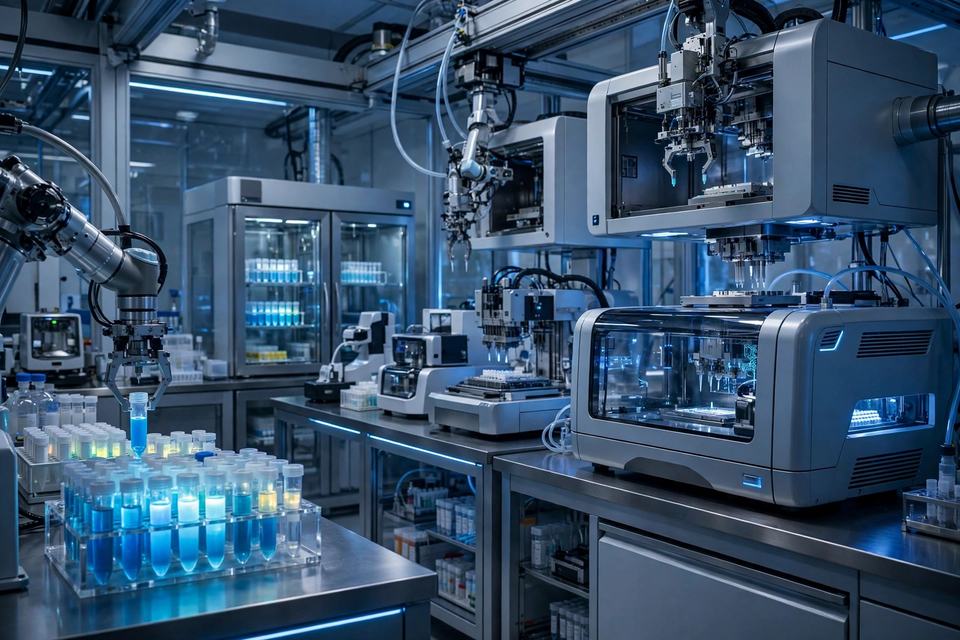
Most "AI in the lab" stories involve software suggesting experiments. AutoDNA, developed by a Shanghai Jiao Tong University team and described in Nature, goes much further: it's an AI-native laboratory that plans and executes biomolecular experiments itself.
The system orchestrates more than 20 types of instruments across more than 11,000 automated steps, handling DNA synthesis, transcription, amplification and sequencing. Human intervention is largely limited to replenishing reagents and labware and maintaining the hardware.
And it isn't just moving samples around.
Across four demonstrations, AutoDNA matched expert-optimized yields in enzymatic DNA synthesis, accelerated concurrent protocol execution by 3.2-fold, wrote digital data into DNA and recovered the original content exactly, and identified and validated a clinically detected KRAS G13D cancer mutation.
Behind the operation is a multi-agent AI system that divides the work between planning, protocol design and hardware control.
What the Results Actually Mean
The impressive numbers need some context.
The 3.2-fold improvement refers to executing multiple protocols concurrently rather than sequentially. It doesn't mean every individual experiment finishes 3.2 times faster.
The DNA storage demonstration showed that digital information could be written into DNA and recovered exactly. It's a proof of concept, not evidence that the technology can already replace conventional data storage.
The KRAS G13D result demonstrates the system's ability to identify and validate a clinically detected mutation. It doesn't establish that AutoDNA is ready to replace clinical cancer diagnostics.
The laboratory is also specialized for nucleic-acid work, not every kind of biological experiment. And while the system's results are published in Nature, its reported performance comes from the research team's own experiments. Independent replication has not yet been established.
The Twikup Take
The biggest breakthrough isn't any single experiment. It's how much of the laboratory's daily work can now happen without someone physically performing every step.
When humans are left mainly with restocking supplies and maintaining machines, the bottleneck in this corner of science starts shifting from hands to ideas.
Image: AI-generated illustration.