
Key Takeaways
- NASA's twin ESCAPADE spacecraft are using powered Earth flybys — gravity plus a roughly nine-minute engine burn at closest approach — to head for Mars.
- The first flyby was set for about 5 a.m. EST on Nov. 7 and the second follows about 6 a.m. EST on Nov. 9, at 600 to 1,100 miles above Earth.
- The fridge-sized probes reach Mars on Sept. 7 and 9, 2027, becoming the first multi-spacecraft mission to fly in formation around the planet.
Two Refrigerator-Sized Probes Are About to Pull Off a Never-Before-Flown Mars Maneuver
Most spacecraft get a speed boost from a planet and keep going. NASA's twin ESCAPADE probes are taking that trick one step further: they're firing their engines at the exact moment they swing closest to Earth.
It's called an Oberth maneuver. By firing their engines while moving at extremely high speed, the spacecraft can get more energy from the same engine burn.
NASA says no Mars-bound spacecraft has successfully executed this kind of powered Earth flyby before. ESCAPADE is attempting it twice, once with each spacecraft.
The roughly refrigerator-sized twins launched in November 2025, when Earth and Mars were on opposite sides of the Sun, making a direct journey impossible.
So instead of heading straight to Mars, they took an unusual detour. They looped around the Earth-Sun Lagrange point 2 in a kidney-bean-shaped holding pattern, exploring a distant stretch of Earth's magnetotail along the way.
Then they headed back toward Earth, waiting for the planets to line up.
The Nine-Minute Burn That Changes Everything
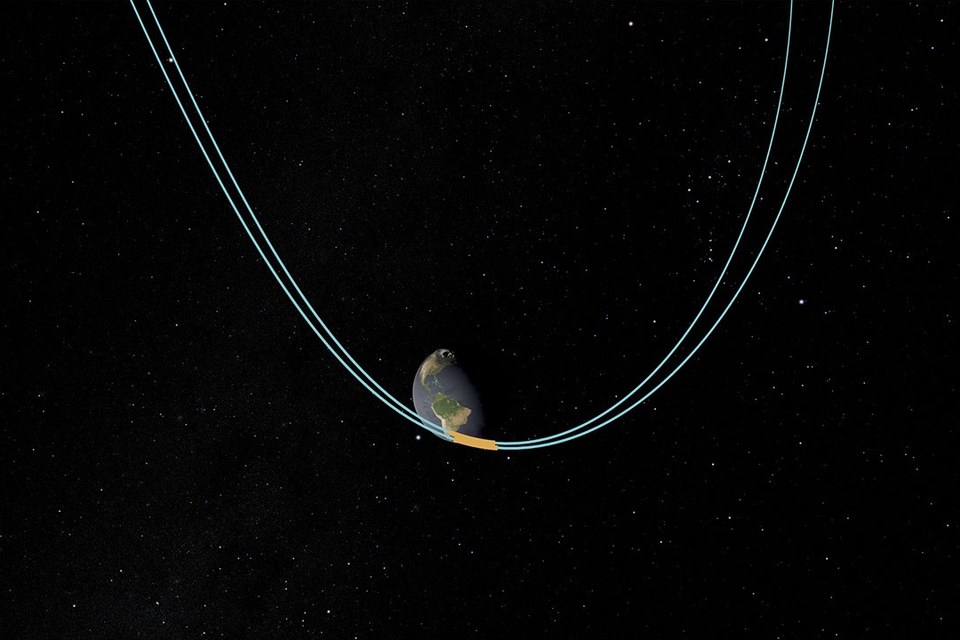
Each spacecraft combines Earth's gravitational pull with a roughly nine-minute engine burn at its closest approach.
Flying over southern Australia, the probes fire their engines at altitudes between 600 and 1,100 miles above Earth.
The burn adds more than 1,000 mph to each spacecraft's speed, taking it from about 6.3 to 6.7 miles per second.
The first flyby was scheduled for approximately 5 a.m. EST on Saturday, November 7. The second is scheduled for approximately 6 a.m. EST on Monday, November 9.
After the manoeuvres, the twins face a 10-month cruise before reaching Mars on September 7 and 9, 2027.
Their mission there is just as interesting: studying how the solar wind strips away the planet's atmosphere. They will also fly in formation around Mars, a first for a multi-spacecraft mission around another planet.
The Twikup Take
A year spent looping around a gravitational parking spot, just to return to Earth and fire an engine at precisely the right moment — twice.
ESCAPADE is taking an extraordinary detour to Mars, and its second big manoeuvre is scheduled for early Monday morning.
Image: NASA illustration of the ESCAPADE twin spacecraft's Earth flyby trajectories, with the orange segment marking the engine burn, NASA.