
Key Takeaways
- The Moon illusion is created by the brain's visual processing — photographs show the Moon is the same width at the horizon and high in the sky.
- The Moon's angular size stays nearly constant through a night at about 0.52 degrees; a separate real effect, perigee, can make a full Moon up to 14% bigger and 30% brighter.
- Science still has no settled explanation — apparent-distance, flattened-sky, size-contrast and Ponzo theories all compete, and astronauts in orbit see the illusion too.
The Moon Looks Enormous at Sunset. Your Brain May Be Fooling You.
Watch the full Moon rise. It looms over the rooftops, huge and close, like a movie prop — then, hours later, it looks small again.
Nothing changed. NASA calls it the Moon illusion, and that is exactly what it is: an illusion. It does not come from the atmosphere. It comes from your brain.
The proof: the Moon never changes size
Photograph the Moon at the horizon and again high overhead, at the same zoom. It is exactly the same width in both pictures.
The numbers agree. All night, the Moon's angular size stays about 0.52 degrees — roughly your thumbnail at arm's length. Whatever swells and shrinks is happening inside you, not in the sky.
Four theories — and none has won
Because the physics is settled, the argument is about perception. Scientists have backed competing ideas for centuries, and the case is still open.
Apparent distance. The oldest theory says your brain treats the horizon Moon as farther away, so the same angular size reads as physically bigger. Experiments by Kaufman and Kaufman, published in PNAS in 2000, supported this idea. But there is a famous problem: most people say the horizon Moon looks closer, not farther.
The flattened sky. In the 11th century, Ibn al-Haytham proposed that we picture the sky as flattened, not as a perfect dome. The horizon feels farther than the zenith. Kaufman and Rock developed the idea in 1962, linking it to Emmert's law: a fixed-size image looks larger when projected onto a surface judged more distant.
Size contrast. Beside trees, rooftops, and towers, the Moon has company to be compared against. High in an empty sky, it has none. This Ebbinghaus-style contrast may make the low Moon look oversized.
The Ponzo illusion. In the classic Ponzo drawing, two identical bars between converging lines look different in size. Some researchers argue the horizon Moon works the same way, with the landscape as the converging lines. NASA's verdict is measured: it is, in the agency's words, "not a perfect explanation."
The twist: astronauts see it too
Here is the fact that keeps every theory honest. Astronauts in orbit see the Moon illusion too — with no trees, no rooftops, and no landscape at all.
Foreground explanations like size contrast therefore cannot be the whole story. Something deeper in the visual system is at work.
The real size change: supermoons
The Moon can genuinely look bigger — just not over one evening. Its elliptical orbit takes about 27 days, swinging between perigee at roughly 363,300 km and apogee at roughly 405,500 km.
A full Moon near perigee can appear up to 14% bigger and 30% brighter than the farthest full Moon of the year. Those supermoons arrive three to four times a year — a real effect, but one that plays out over weeks, not between sunset and bedtime.
Why the low Moon also looks orange and squashed
Two genuine atmospheric effects ride along with the illusion, and they are not illusions at all. A low Moon can look slightly squashed vertically because the atmosphere acts as a weak lens. And it glows orange because its light takes a longer path through the air, and the blue wavelengths scatter away, leaving the warmer colours to reach your eyes.
Test it yourself tonight
NASA suggests a few simple experiments. Hold your fingernail at arm's length against the Moon — it matches, high or low. Look through a paper tube, shutting out the landscape, and watch the effect fade. Bend over and look back at it between your legs. Or photograph it at the same zoom at the horizon and overhead, and measure both discs.
Every test says the same thing: the Moon held still.
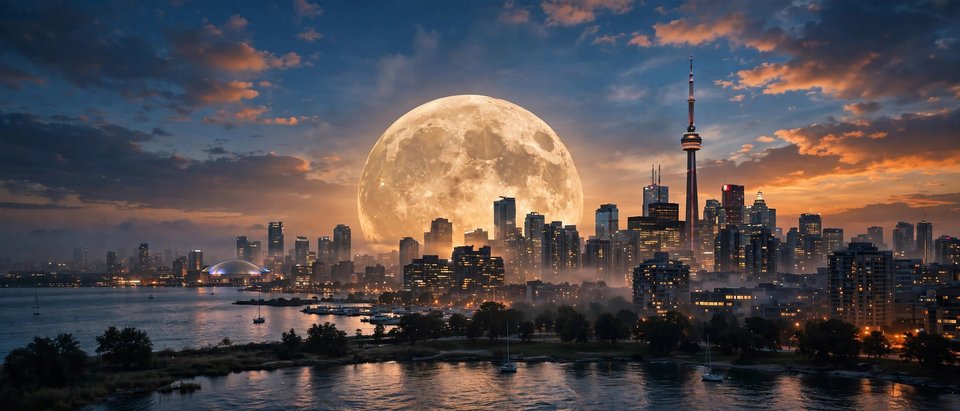
And those jaw-dropping photos of a gigantic Moon crushing a skyline? They are made with long zoom lenses on distant ground objects — a photographer's trick, not what your eyes saw.
The Twikup Take
The Moon illusion may be the oldest unsolved problem you can see with your own eyes tonight — recorded since the 7th century B.C.E., argued over since Aristotle, and still without a settled answer in the age of spaceflight.
The camera, the measurements, and your own fingernail agree: the Moon never changes. The drama is in the perceiving, not the sky — and since astronauts see it too, surrounded by blackness, the final explanation is still out there waiting.
Image: AI-generated illustration.