
Key Takeaways
- Three previously unknown blue nebulas were found near IC 59 and IC 63 after 100 hours of observation.
- The objects show ionized oxygen, though astronomers do not yet know what is ionizing it.
- Object 3 may be a bow shock, while Object 1 could be a planetary nebula if a white dwarf is found.
It took 100 hours of observation and a special oxygen filter for an image to capture three faint nebulas hidden in the Cassiopeia constellation. NASA featured the image as its Astronomy Picture of the Day on October 21, 2026.
The original ghosts
The new clouds sit near IC 59 and IC 63, a pair of nebulas known as the "Ghosts of Cassiopeia," near the multi-star system Gamma Cassiopeiae. Energetic light from Gamma Cassiopeiae causes hydrogen gas in IC 59 and IC 63 to glow red, while their dust reflects and scatters bluish-white starlight.
Three blue phantoms
The newly discovered clouds, called Object 1, Object 2 and Object 3, appear as faint blue phantoms. Their colour reveals the presence of ionized oxygen — but astronomers do not yet know what is ionizing it.
One possibility presented in the APOD explanation is that Gamma Cassiopeiae may be piling up material as the system moves through interstellar gas and dust, like the bow of a speeding boat. Object 3 may be the compressed and heated oxygen of that bow shock. Object 1 could be a planetary nebula if a central white dwarf is identified.
Helping the observing team
The discovery image was captured by Louis Leroux-Géré, Thibault Rouillée, Vincent Martin and Cédric de Decker of Starfront Observatories. The APOD page directs readers to more information on how they can help the observing team.
For now, the origins of the three ghosts remain "a mystery to be solved."
Sources
- NASA — Astronomy Picture of the Day: https://science.nasa.gov/image-article/apod-2026-october-21-new-ghosts-revealed-in-cassiopeia/
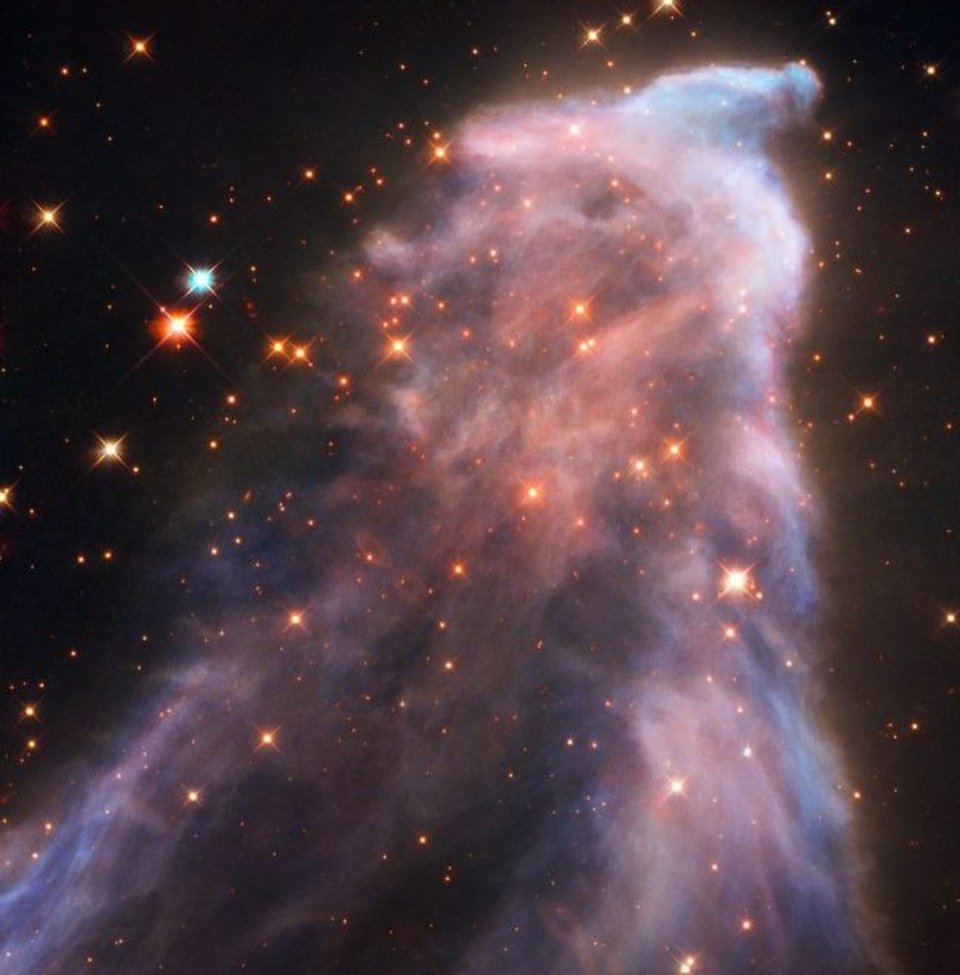
Image: ESA/Hubble, NASA (CC BY 4.0) — IC 63, the "Ghost of Cassiopeia" nebula, photographed by the Hubble Space Telescope.