
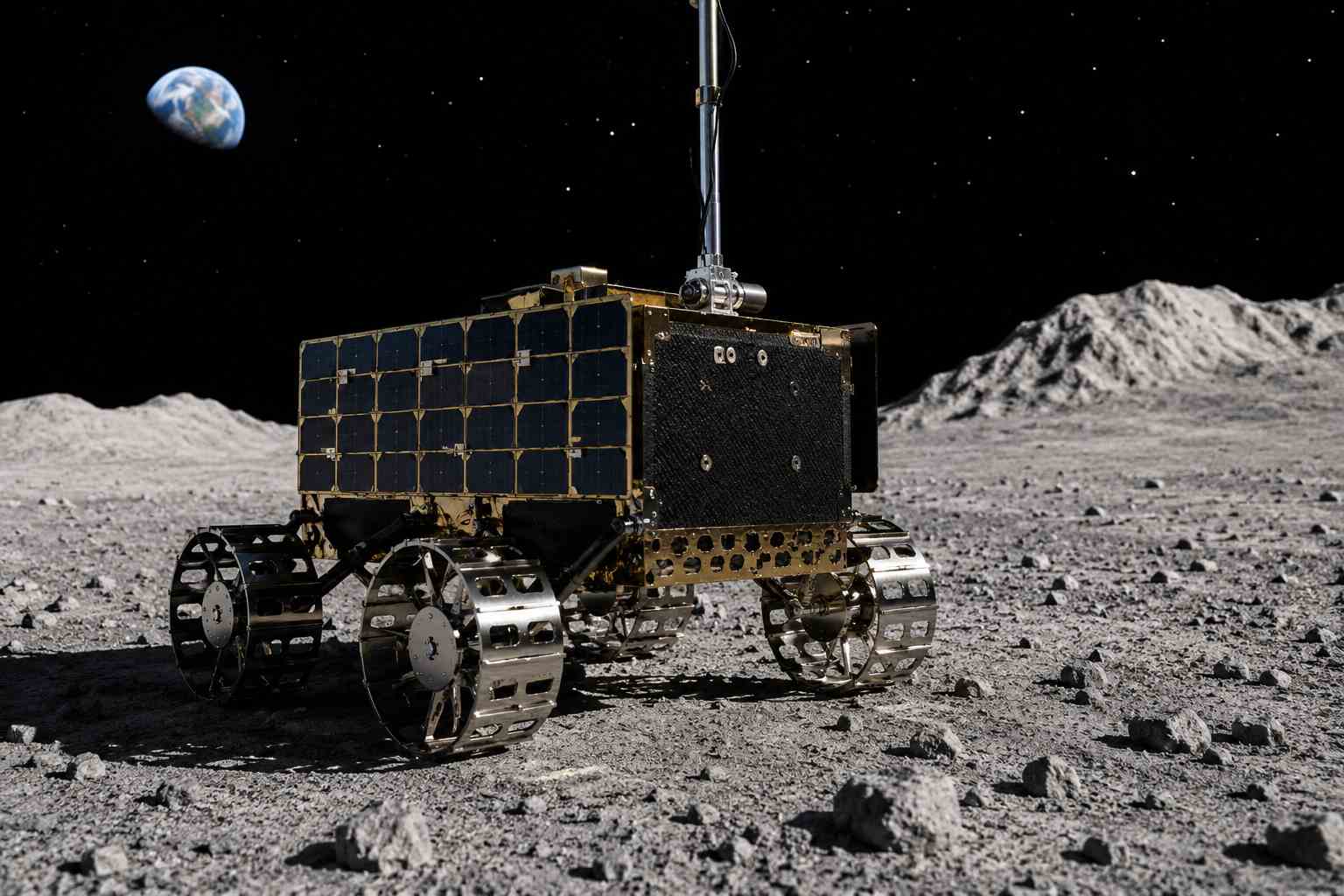
Key Takeaways
- MAGPIE is ESA’s first lunar rover and is planned to reach the Moon’s south polar region in 2029.
- The rover will use a drill, radar, neutron detector and volatile analyser to study ice, volatiles and subsurface geology.
- MAGPIE is designed to operate for roughly 10 Earth days after landing and remains under development.
Quick Answer
MAGPIE stands for Mission for Advanced Geophysics and Polar Ice Exploration.
ESA has selected ispace-Europe as the mission's prime contractor, and the rover is planned to travel to the Moon aboard ispace's Mission 4 lunar lander in 2029.
Its destination is especially interesting: the Moon's south polar region.
Some areas near the lunar poles remain in permanent shadow. These extremely cold environments may preserve water ice for extraordinarily long periods.
MAGPIE is being built to help scientists understand what's actually there — including the distribution and stability of water ice and other volatile materials, as well as the properties of the lunar soil and what lies beneath it.
And for such a small rover, it is bringing some serious tools.
This Little Rover Is Basically a Lunar Detective
Think of MAGPIE as a robotic prospector.
It won't have a pickaxe.
It will have something considerably more useful on the Moon.
A drill will allow the mission to investigate material beneath the immediate surface.
A ground-penetrating radar will help scientists examine structures hidden underground without having to excavate everything above them.
A neutron detector can help map hydrogen — an important clue when scientists are investigating possible water-bearing material.
And a volatile analyser will examine substances such as water and other materials that can become gases.
Together, those instruments will help MAGPIE investigate one surprisingly simple mystery:
What's hiding underneath the Moon?
Finding Water Is Only the Beginning
Scientists already have strong evidence that water exists on the Moon.
The bigger mystery is what that water looks like on the ground.
Where is it concentrated?
How is it distributed?
How stable is it?
And perhaps most importantly for future exploration:
Could any of it eventually become a usable lunar resource?
MAGPIE isn't going to answer every one of those questions by itself.
But it could provide scientists with valuable measurements from the lunar surface.
The rover is designed to move across the terrain and collect measurements from different locations, allowing researchers to compare conditions from one patch of lunar ground with another.
That matters because finding water somewhere is one thing.
Understanding how it changes across the landscape is much more useful.
Why Is Everyone So Interested in Lunar Water?
Finding water on the Moon isn't like discovering a hidden lake where future astronauts can go swimming.
Water near the lunar poles may exist as ice within extremely cold environments and lunar material.
But even frozen water could become extremely valuable if humans eventually establish a longer-term presence on the Moon.
The obvious reason is that humans need water.
But there is another reason.
Water is made from hydrogen and oxygen.
Those elements could potentially support life-support systems and, eventually, contribute to producing propellant for future exploration.
That creates a fascinating possibility.
Every kilogram of equipment or supplies carried from Earth requires transportation across hundreds of thousands of kilometres.
If future explorers can eventually use some resources already available on the Moon, they may not need to bring absolutely everything with them.
But before anyone starts building lunar filling stations, scientists need much better answers to some basic questions.
Where are the resources?
How much is actually accessible?
And what does the underground environment look like?
MAGPIE is designed to help investigate that puzzle.
MAGPIE Has Roughly 10 Days
This may be the most fascinating part of the entire mission.
ESA says MAGPIE is designed to operate on the lunar surface for roughly 10 Earth days.
Think about that timeline.
Years of engineering.
Manufacturing and testing.
A journey to another world.
A precision landing near the Moon's south pole.
Then the clock starts ticking.
During its relatively short operational life, the rover is expected to move across the lunar surface, use its scientific instruments, investigate the ground and send information back.
Europe's mission will essentially become a race against time:
Explore. Drill. Scan. Analyse. Send the data home.
Roughly 10 days to learn as much as possible about ground that has been sitting there for billions of years.
But MAGPIE Isn't Sitting on a Launch Pad Yet
There is an important reality check.
MAGPIE is still under development.
ESA awarded ispace-Europe a €65 million Phase 2 contract in July 2026.
The contract covers the remaining delivery of the mission, including rover and payload development, manufacturing, testing, transportation to the lunar surface, mission operations and delivery of scientific data to ESA.
ESA and ispace-Europe formally marked the agreement during the Space for Inspiration 2026 event in Copenhagen on September 1.
So the latest announcement doesn't mean a completed rover is waiting for launch.
There are still years of engineering, manufacturing and testing ahead.
The current plan calls for MAGPIE to travel aboard ispace's Mission 4 lunar lander in 2029.
The transportation arrangement is being enabled through cooperation between ESA and the Japan Aerospace Exploration Agency (JAXA).
And as with any space mission planned years in advance, timelines can change.
Europe Is Testing Another Idea With MAGPIE
There's another experiment happening here — and it isn't taking place on the Moon.
It is how Europe gets there.
MAGPIE is ESA's first lunar small mission.
Instead of treating every lunar mission as an enormous standalone program, ESA describes MAGPIE as part of a faster, lower-cost approach intended to enable more frequent exploration missions.
ispace-Europe is the prime contractor.
The rover will ride aboard an ispace lunar lander.
Transportation is connected to ESA-JAXA cooperation.
The result is a mission that combines a European space agency, a commercial lunar company and international cooperation.
So MAGPIE could test two things at once:
What's underneath the Moon — and whether Europe can explore it differently.
The Moon's South Pole Is Becoming One of Space Exploration's Most Important Destinations
MAGPIE isn't being sent to a random patch of lunar ground.
The Moon's south polar region has become especially important because some areas receive extremely little — or effectively no — direct sunlight.
Inside these permanently shadowed environments, temperatures can remain extraordinarily low.
That means frozen materials could survive for immense periods.
Understanding those materials could tell scientists more about the lunar environment and its history.
And water ice could eventually become important for missions attempting to remain on the Moon for longer periods.
MAGPIE therefore isn't really about finding something astronauts can drink tomorrow.
It's about answering the questions that need to come first.
Where is the water ice?
How is it distributed?
How stable is it?
What else is mixed into the lunar ground?
And what is hiding beneath the surface?
TwikUp Insight
MAGPIE is small compared with the Moon.
Its planned working life is tiny compared with the years required to design, build, test and send it there.
But that's exactly what makes this mission fascinating.
Europe plans to spend years preparing a robot that could get roughly 10 Earth days to investigate one of the most scientifically valuable regions on another world.
And despite all the sophisticated technology aboard it, one of MAGPIE's most interesting ideas is also one of humanity's oldest:
Dig and see what's underneath.
Except this time, the shovel is a robotic drill.
And the ground is the Moon.