
Key Takeaways
- CHIME made its first standalone detection of hydrogen from a universe about five billion years old.
- The measurement could help scientists investigate cosmic expansion and competing explanations for dark energy.
- Researchers used 94 nights of observations collected in 2019 and spent more than a year validating the faint signal.
Canadian CHIME Telescope Maps Ancient Hydrogen Glow to Explore Dark Energy
Canada’s CHIME radio telescope has achieved a major milestone in astronomy by detecting the faint glow of hydrogen from a time when the universe was about five billion years old. The September 28 announcement from the University of British Columbia says this is the telescope’s first standalone detection of this signal using only its own observations.
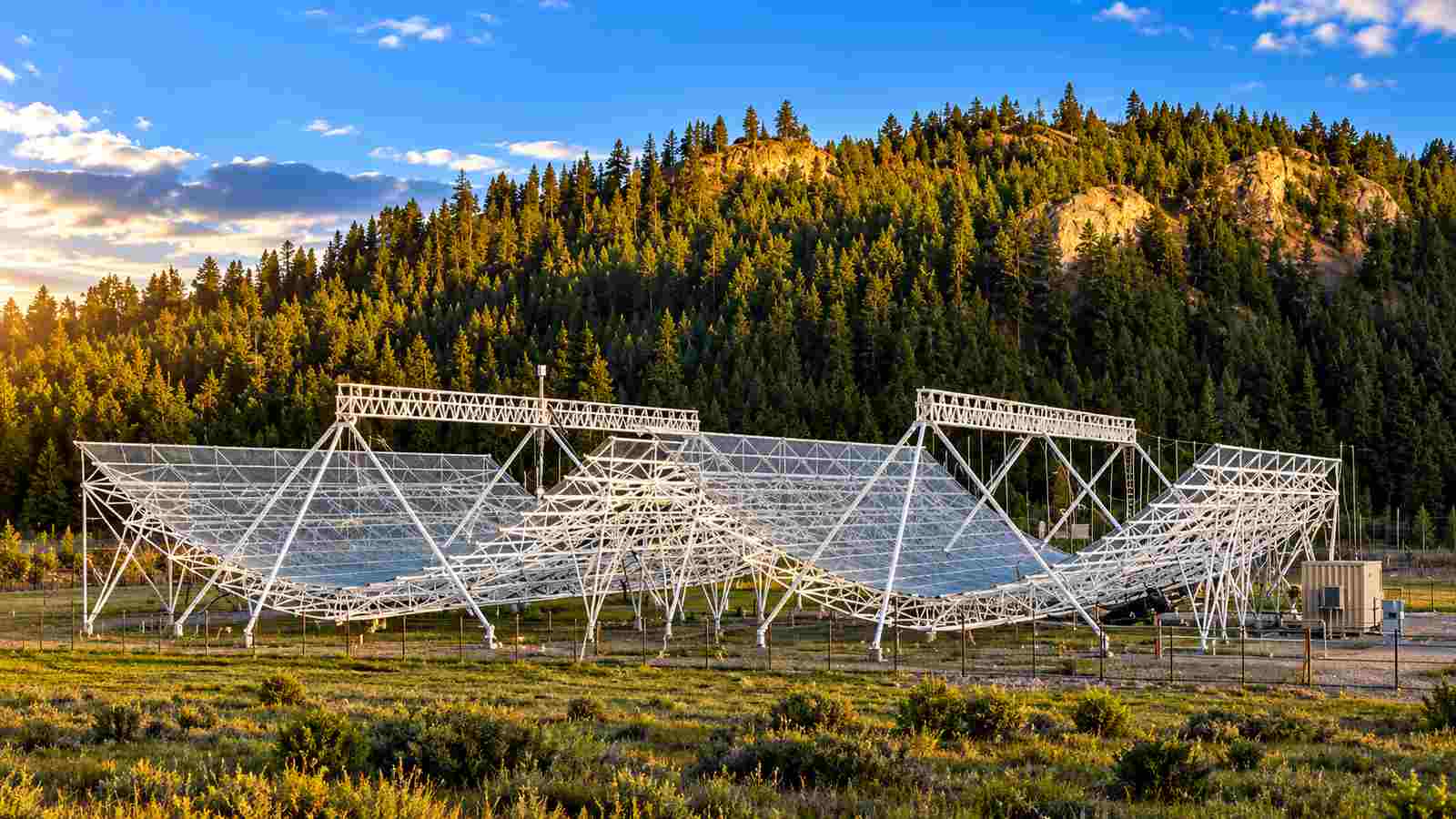
The Canadian Hydrogen Intensity Mapping Experiment, or CHIME, is located near Penticton, British Columbia, at the National Research Council of Canada’s Dominion Radio Astrophysical Observatory. The pan-Canadian project involves researchers from the University of British Columbia, McGill University, the University of Toronto and the observatory.
CHIME Captures Hydrogen From the Distant Universe
Hydrogen is the most common element in the universe, and its faint radio emission can be used as a tracer of how matter is distributed across space.
CHIME was designed to map neutral hydrogen across a huge volume of the universe. By measuring the hydrogen signal and how it is distributed, astronomers can study the history of cosmic expansion and investigate the role of dark energy.
The latest result is significant because CHIME previously relied on cross-correlation with galaxy survey data from other telescopes. The new measurement demonstrates that CHIME can identify the hydrogen signal independently from its own observations.
A Difficult Signal to Detect
The research team had to separate an extremely faint cosmic signal from much stronger sources of background noise, including human technology and the telescope itself.
Researchers analyzed observations from 94 nights collected in 2019. They then spent more than a year testing the result to determine whether the detected signal was genuine.
The analysis indicated that roughly 2% of the hydrogen in the observed period was in neutral atomic form. Researchers said the result was broadly consistent with other measurements.
What the Discovery Could Mean
The ability to map hydrogen directly gives scientists another method for examining the structure and evolution of the universe. Measuring how hydrogen is distributed and clustered can also provide information about how galaxies formed and evolved.
The technique could eventually allow researchers to study large regions of the observable universe without depending on conventional galaxy surveys. UBC says this approach could be conducted at a fraction of the cost of some traditional surveys while reaching further across cosmic history.
TwikUp’s Perspective
The importance of the CHIME result extends beyond a single astronomical measurement. It demonstrates how a Canadian-built research instrument can generate an independent dataset for one of modern cosmology’s biggest questions.
The next stage will be especially important because researchers have nearly seven years of CHIME observations available. Expanding the analysis could provide measurements from earlier periods of cosmic history and create a larger dataset for testing models of cosmic expansion.
For Canadian science, the result also highlights the value of long-term investment in specialized research infrastructure. CHIME combines radio astronomy, large-scale computing and advanced data analysis in a project designed around questions that cannot be answered through ordinary optical observations alone.
What Comes Next
Researchers are now working to extend the analysis to earlier periods when the universe was about three billion years old. More observations could help determine how effectively hydrogen intensity mapping can be used as an independent tool for studying cosmic history.
The latest detection therefore represents both a scientific result and a demonstration of CHIME’s intended capability. Its expanding archive could give astronomers a new way to examine the evolution of the universe and investigate the physics behind its accelerating expansion.