
Key Takeaways
- ESA's Hera spacecraft has imaged the asteroid Didymos from 56 kilometres away, with its moonlet Dimorphos peeking out from behind it.
- Didymos spins once every 2.2 hours — so fast it is close to coming apart — and its surface material may have sloughed off to form Dimorphos in the first place.
- Hera is investigating the aftermath of NASA's 2022 DART impact, which slowed Dimorphos's orbit by about 33 minutes; detailed images of both asteroids arrive November 25.
The moonlet is playing peekaboo
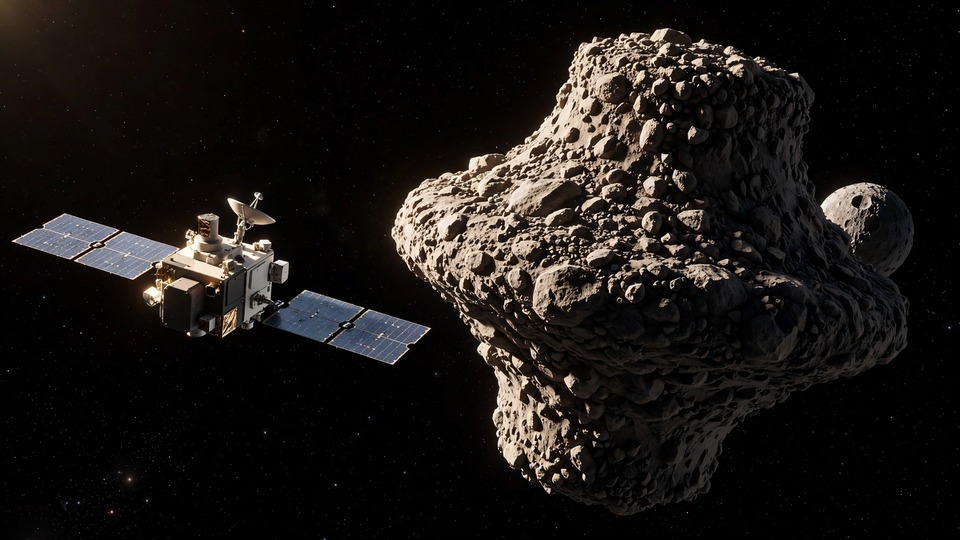
Four years after NASA deliberately crashed a spacecraft into an asteroid moon, Europe's follow-up mission has sent home its first close look. ESA's Hera spacecraft imaged the asteroid Didymos from 56 kilometres away, catching one face of the 780-metre rock with its small moonlet, Dimorphos, peeking out from near the top — boulders visible along its upper side.
Didymos itself is a strange world. Shaped like a spinning top, it rotates once every 2.2 hours, fast enough that it is close to coming apart. Its equator carries a surprisingly sharp equatorial ridge, and models suggest the spin drags surface material down to the equator — and that material sloughed off the spinning asteroid may be how Dimorphos came to exist at all. The 151-metre moonlet orbits a little more than a kilometre away.
Why fly back to a crash site?
On September 26, 2022, NASA's 580-kilogram DART spacecraft hit Dimorphos at 6.1 kilometres per second in the first planetary-defence test of its kind. The impact threw a debris plume 10,000 kilometres across space and slowed the moonlet's orbit by about 33 minutes — a bigger deflection than simulations predicted.
Hera's job is the crash-site investigation: did DART leave a crater, or did it reshape the whole moonlet? What is Dimorphos made of, exactly, and what is its mass? Detailed images of both asteroids will be unveiled on November 25, and over the coming months Hera will move in closer still, deploying two shoebox-sized CubeSats and eventually attempting a landing.
The Twikup Take
Planetary defence only works as a proven technique if someone goes back and measures the result. DART showed we can move an asteroid; Hera is finding out by how much, why, and whether we could do it on purpose, precisely, with a planet at stake. November 25 is the next date to circle.
Image: Illustrative image.