
Key Takeaways
- ESA's Euclid telescope has released data covering 1,900 square degrees of sky — an area the size of 9,500 full Moons — cataloguing more than 900 million galaxies.
- The release contains about 15,000 strong gravitational lens candidates, more than all previous lens catalogues combined, and over 60 million quasar candidates.
- This is only about 14% of the sky Euclid will survey; the full data release completes in mid-2027.
A billion objects, and the survey is barely started
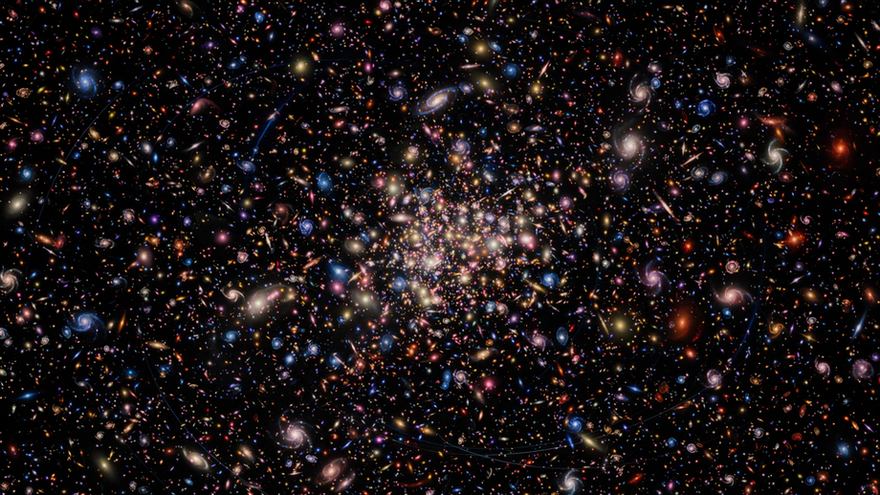
The European Space Agency's Euclid space telescope has made its first major data release — and the scale is difficult to say plainly. The catalogues contain more than 900 million galaxies within a total of over a billion objects, drawn from 1.7 million gigabytes of data covering 1,900 square degrees of sky, an area equal to 9,500 full Moons. And this is roughly 14% of what Euclid will eventually survey.
"These are far more than beautiful pictures; today marks a scientific milestone in our study of the cosmos," said Carole Mundell, ESA's Director of Science, calling it "the largest space-based survey of its kind."
Two by-products are records in themselves. The release holds about 15,000 strong gravitational lens candidates — where a foreground galaxy bends the light of one behind it — more than all previous lens catalogues combined, found by machine learning and thousands of citizen scientists. It also lists over 60 million quasar candidates, the brilliant cores of distant galaxies, some dating to when the universe was just 5% of its current age.
Why count galaxies at all?
Euclid's real target is the part of the universe you cannot see. By mapping billions of galaxies and measuring distances to millions of them, astronomers are building a 3D map tracing 10 billion years of cosmic history — and charting the invisible scaffolding of dark matter and the dark energy pushing the universe's expansion apart. A gravitational lens lets scientists "weigh" a galaxy, dark matter included, by how much it bends light.
The complete first data release, including the subtle weak-lensing measurements, arrives in mid-2027.
The Twikup Take
Every generation of astronomy gets one instrument that changes the unit of counting. For Euclid it is this: a single data drop with more galaxies than every catalogue in history held combined a few decades ago — delivered at 14% throttle. The dark universe has been theorized for half a century; this is what measuring it looks like.
Image: Illustrative image.