
Key Takeaways
- Two papers published November 10 in The Astrophysical Journal show that a future space observatory, LISA, could detect planets orbiting pairs of dead stars by listening for wobbles
- In a test system about 490 light-years away, the method could pick up a single Jupiter-mass planet — and far heavier planets clear across the galaxy.
- Nothing has been detected yet: LISA does not launch until the mid-2030s, and the Webb telescope would be needed to confirm any candidate.
A planet you find by listening, not looking
Some planets hide where telescopes cannot follow — orbiting pairs of white dwarfs, the Earth-sized embers of dead stars. Two studies published November 10 in The Astrophysical Journal show how a future observatory could find them anyway: by listening.
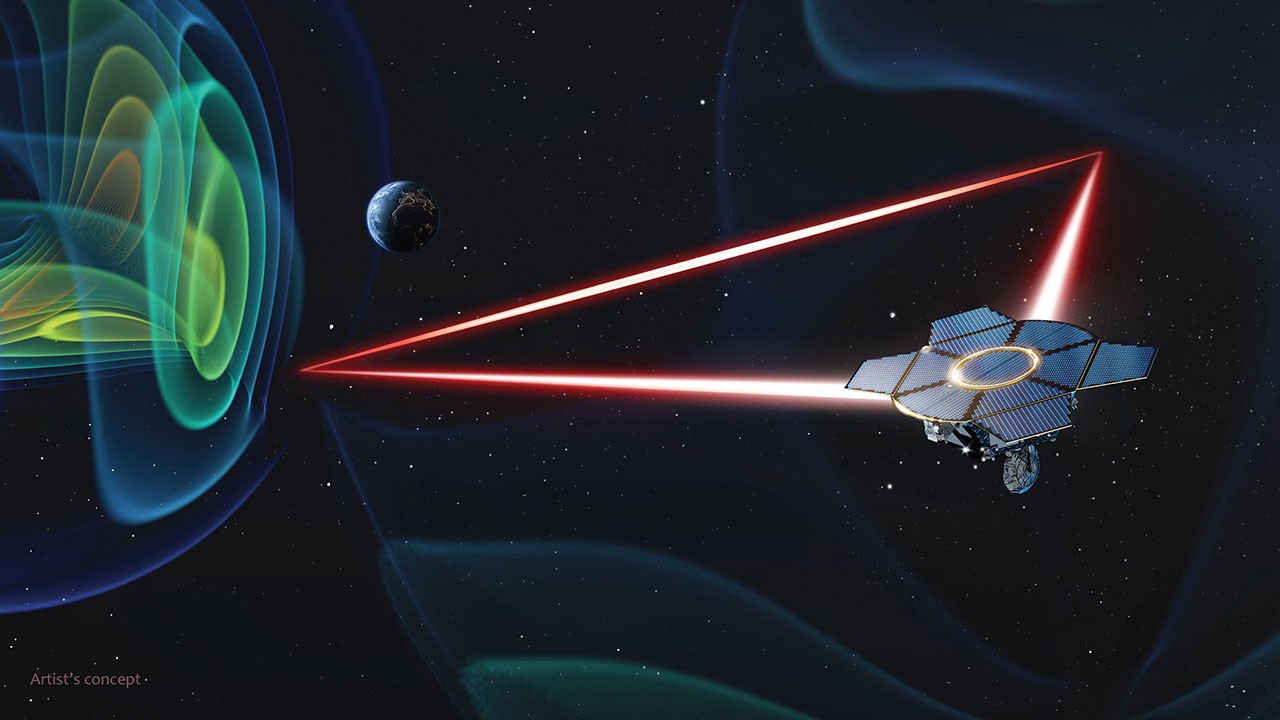
The mission is LISA, an ESA-led gravitational-wave observatory planned for the mid-2030s. A pair of white dwarfs in a tight orbit emits a nearly constant gravitational wave — a carrier tone. If a planet orbits both stars, its gravity makes the pair wobble, and that wobble stamps faint sidebands above and below the carrier frequency, the same principle that puts sidebands on an FM radio signal. The idea, first proposed by Naoki Seto in 2008, is the gravitational-wave version of the radial-velocity method astronomers already use with light.
The numbers are striking. The Milky Way holds an estimated 10 million double-white-dwarf systems with orbits under an hour; LISA should resolve about 10,000 of them. In a test case modelled on a real system about 490 light-years away, the method could detect a single Jupiter-mass planet — and because gravitational waves fade slowly with distance, planets heavier than about seven Jupiters could be picked up around similar systems even at the centre of the galaxy.
Confirmation would fall to the Webb telescope: a planet in such a system glows in infrared beyond what the two white dwarfs produce alone, an excess Webb could spot hundreds of light-years away.
The honesty beat matters here. This is theory, not discovery — no planet has ever been confirmed around a binary white dwarf, LISA has not launched, and the authors themselves call their detection limits optimistic, built on perfectly known systems. False alarms are a real concern, which is exactly why Webb's confirmation role is built into the plan.
The Twikup Take
Planet-hunting has always been about light. This is a credible plan to hunt by gravity instead — and the targets, worlds orbiting two dead suns, are a population astronomy has never been able to census at all.
Image: Artist's concept of the LISA mission by ESA, via NASA.