
Key Takeaways
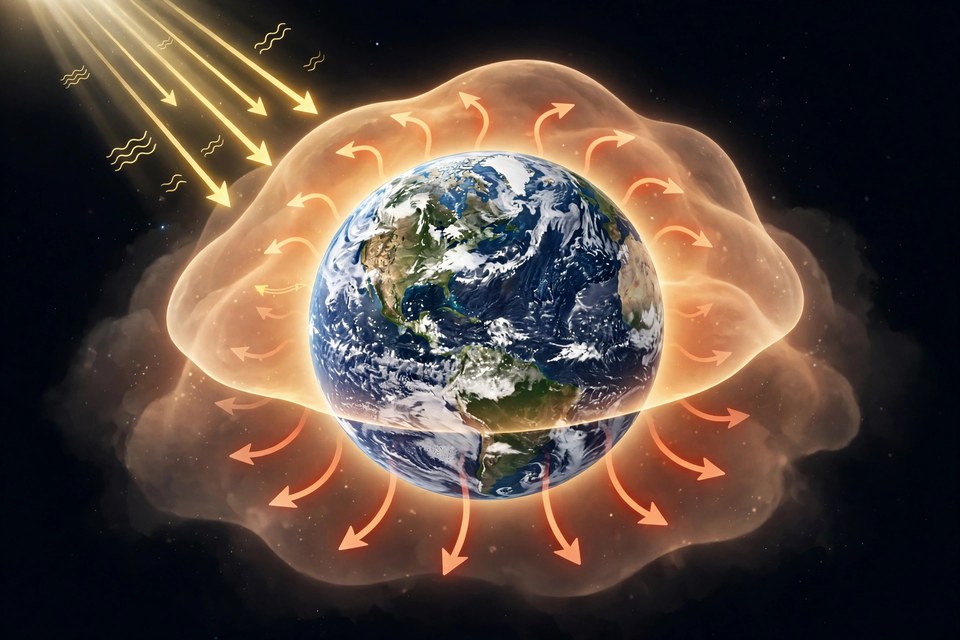
- Sunlight arrives as visible light and leaves as infrared heat; greenhouse gases let the light in but absorb about 90% of the outgoing heat, per NASA.
- Without any greenhouse effect, Earth's surface would be about 33°C colder — the effect is natural and necessary; the issue is that humans have thickened it, raising CO2 from ~280 t
- Water vapour amplifies warming as a feedback, but the long-lived gases — CO2, methane, nitrous oxide — are the control knobs.
Earth Has a Blanket, and It Is Supposed to Be There
Start with the part that isn't controversial anywhere in science: without the greenhouse effect, Earth would be a frozen rock.
Sunlight reaches the surface mostly as visible light, warms the ground, and the ground sends that energy back toward space as infrared radiation — heat. Certain gases in the atmosphere absorb infrared. Per NASA, greenhouse gases absorb about 90% of that outgoing heat and re-radiate it in all directions, including back down.
Without greenhouse gases, Earth's surface temperature would drop by roughly 33°C (59°F), from its actual average of about 15°C to something closer to a permanent deep freeze.
Life as we know it runs on this blanket.
The gases doing the work are a short list: carbon dioxide, methane, nitrous oxide, ozone, chlorofluorocarbons and water vapour.
NASA sorts them into two jobs. The long-lived gases — CO2, methane and nitrous oxide — act as control knobs: they don't condense or wash out quickly, so their amounts in the atmosphere influence Earth's temperature.
Water vapour is the amplifier. It's the most abundant greenhouse gas, but it condenses, so its level follows temperature. Warmer air holds about 7% more water vapour per degree, which traps more heat, which warms things further.
NASA estimates that this feedback more than doubles the warming CO2 alone would cause.
So What's the Problem?
Thickness.
Ice cores show the air held about 280 parts per million of CO2 for thousands of years before industry.
The observatory at Mauna Loa measured a weekly average of 428.57 ppm in early November 2026 — about 50% higher. NASA confirms through carbon's chemical fingerprint that the increase comes primarily from fossil fuels.
Methane is the sharp second act. By mass, it traps heat about 28 times more effectively than CO2 over a century — and far more over 20 years. It breaks down in about a decade, while CO2 persists for centuries.
For the extreme version of the same physics, look at Venus.
A runaway greenhouse effect under a crushing CO2 atmosphere keeps its surface at about 467°C — hot enough to melt lead, hotter than Mercury despite being farther from the Sun.
Nobody is predicting Venus for Earth. Venus is simply proof of how extreme the greenhouse effect can become.
The blanket keeps us alive at 33 degrees of warming. The question climate science investigates is what happens as we keep sewing extra layers onto it.
The Twikup Take
The greenhouse effect isn't the villain of the climate story — it's the reason there's a story at all.
Earth without it is a snowball; the entire debate is about how much thicker than the original the blanket should get.
Image: Illustrative image.