
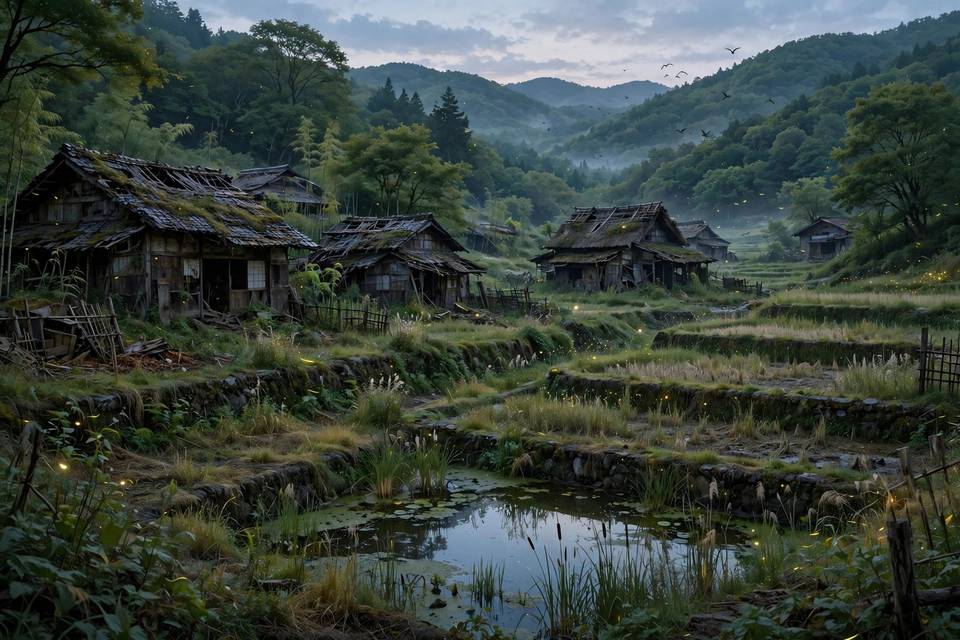
When People Leave, the Wildlife Leaves Too
Here's a twist on the usual story: when people leave the countryside, nature doesn't always bounce back. Sometimes, it fades with them.
A major study of rural Japan found exactly that.
Researchers led by Kei Uchida of Tokyo City University analysed more than 1.5 million wildlife records from 158 farmed "satoyama" valley landscapes across Japan. They tracked 464 species of birds, butterflies, fireflies and frogs, plus 2,922 plant species, for up to 17 years from 2004.
What the Study Found
The results were striking.
Against local population change — up at 43 sites, down at 64, steady at 51 — biodiversity declined both where populations were growing and where they were shrinking.
Only where populations were stable did species richness and abundance hold broadly steady.
And in depopulating areas, nearly every group declined, often more steeply.
Why? Because satoyama is a human-made habitat.
For centuries, farmers flooded rice paddies, thinned woodlands and cut grass, creating a patchwork frogs, fireflies and insects depend on. When people leave, irrigation stops, paddies dry out, forests close over — and the niches vanish.
The Caveats
The pattern was not identical for every species — butterflies were mixed, and a few groups rose in some growing areas.
The finding is also specific to landscapes shaped by low-intensity farming — it does not mean all wilderness needs people.
But in Japan, whose total population fell by four million between 2015 and 2025, the researchers found no automatic "depopulation dividend" for nature.
The Twikup Take
Japan is the world's test case for shrinking populations, and the lesson is uncomfortable: empty land is not wild land.
If we want the wildlife these farming landscapes support, someone has to keep working them — or manage them deliberately in the farmers' place.
Image: AI-generated illustration.