
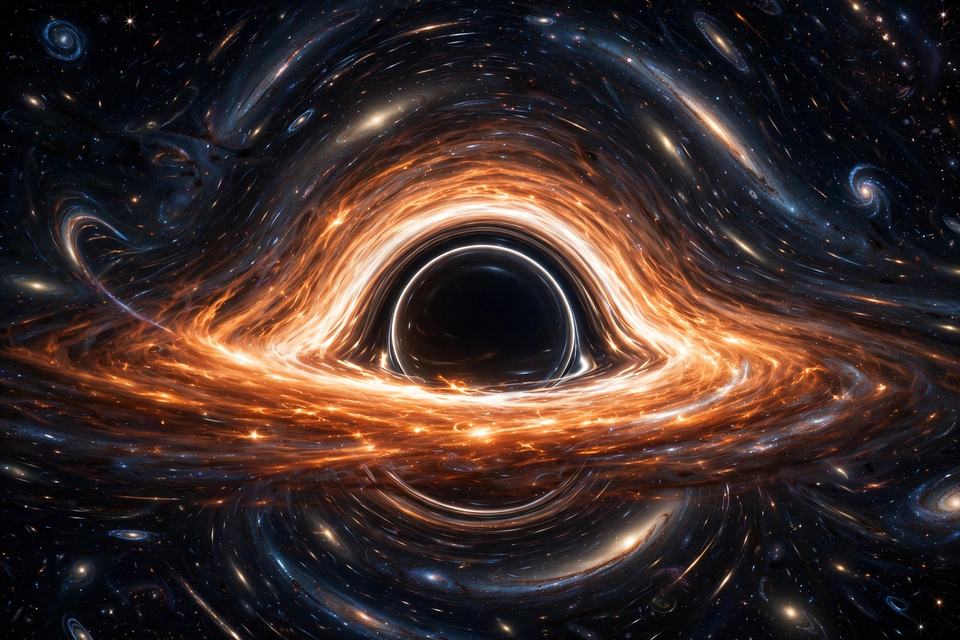
Fall Into a Black Hole, and the Universe Changes the Rules
Imagine falling toward a black hole. Behind you, the stars still shine. Ahead, darkness waits.
Then you cross an invisible boundary.
No alarm sounds. No wall stops you. But something extraordinary has happened: you can never escape. Not even light can.
That boundary is called the event horizon, and it marks the point beyond which escaping would require travelling faster than light.
A black hole forms when so much mass is compressed into such a small space that gravity becomes overwhelming. Once matter, radiation or information crosses the horizon, none can escape back out.
But what happens next is where the story gets truly strange.
First, Gravity Could Turn You Into Spaghetti
Approach a black hole, and gravity begins pulling harder on the parts of your body closest to it.
If you fall feet-first, your feet experience a stronger pull than your head.
The difference can become so extreme that your body stretches into a long, thin stream of atoms.
Scientists have a surprisingly playful name for this terrifying process: spaghettification.
But here's the twist.
Near a smaller, stellar-mass black hole, those forces would tear you apart before you reached the event horizon.
Near a supermassive black hole, however, you could theoretically cross the horizon without noticing anything unusual at that exact moment.
You could pass the point of no return without realizing you'd crossed it.
What Happens Beyond the Point of No Return?
According to Einstein's general relativity, once you're inside the event horizon, every possible future path leads deeper into the black hole.
The theory predicts a destination called the singularity, where matter is crushed to infinite density and our current physics can no longer describe what happens.
But that doesn't mean scientists know what's actually there.
Infinite density is a warning sign that our current understanding of physics has reached its limits.
What really happens at the centre of a black hole remains one of science's greatest unanswered questions.
Black Holes Come in Two Very Different Sizes
Not every black hole is a monster weighing billions of Suns.
Stellar-mass black holes typically contain a few to a few dozen times the Sun's mass.
They can form when enormous stars die. A star with more than about 20 times the Sun's mass can run out of fuel, collapse under its own weight, and blast its outer layers away in a supernova.
If the remaining core is massive enough, no known force can stop its collapse.
NASA estimates that as many as 100 million stellar-mass black holes may exist in the Milky Way alone.
Then come the giants.
Supermassive black holes contain hundreds of thousands to billions of solar masses and occupy the centres of most large galaxies.
How they became so enormous so early in the universe's history remains a mystery.
There's a Giant Black Hole in Our Own Galaxy
At the centre of the Milky Way, roughly 26,000 light-years from Earth, sits Sagittarius A*.
It weighs approximately 4 million times the mass of the Sun.
Astronomers discovered its presence by watching stars race around something they couldn't see. Their orbits revealed the mass doing the pulling.
In 2022, the Event Horizon Telescope collaboration released the first image of Sagittarius A*.
The picture showed a glowing orange ring of hot gas surrounding a dark centre.
That darkness was the black hole's shadow.
And it wasn't humanity's first look at one.
The First Black Hole Image Changed Astronomy in 2019
In 2019, astronomers revealed the first-ever image of a black hole.
It was the giant at the centre of galaxy M87, approximately 55 million light-years away, weighing more than 6 billion solar masses.
To capture it, the Event Horizon Telescope connected eight radio observatories into an Earth-sized virtual telescope.
The result was extraordinary: a dark shadow surrounded by glowing material.
But here's an important distinction.
Scientists didn't photograph the event horizon itself. They photographed the black hole's shadow and the glowing material around it.
The darkness marks a region from which light fails to reach our telescopes.
If Black Holes Trap Light, Why Do They Glow?
Black holes themselves don't emit the light we see in these images.
Their surroundings do.
Gas and dust spiralling inward can form an accretion disk, where friction heats material to millions of degrees.
That superheated matter can glow intensely, including in X-rays, allowing astronomers to detect black holes by the light of material about to fall in.
And not everything approaching a black hole falls inside.
Some material can become part of powerful jets that shoot outward at nearly the speed of light.
So while the event horizon is a one-way boundary, the surrounding region can be among the brightest places in the universe.
Stephen Hawking Found a Possible Escape Clause
In 1974, physicist Stephen Hawking proposed something astonishing.
Black holes might slowly evaporate.
His calculations suggested that quantum effects associated with the event horizon should produce faint radiation — now called Hawking radiation.
As a black hole emits this radiation, it should gradually lose mass.
Given enough time, it could eventually evaporate completely.
But don't imagine a black hole disappearing tomorrow.
For astrophysical black holes, the predicted process takes vastly longer than the universe has existed.
And there's an important scientific catch.
Hawking radiation has never been directly observed coming from a real black hole.
It remains a well-developed theoretical prediction, and the expected radiation is far too faint for today's instruments to detect.
The Twikup Take
Black holes aren't cosmic vacuum cleaners sucking up everything around them. And despite their name, they aren't really holes at all.
They're regions where gravity changes what escape even means.
We've photographed their shadows, watched stars orbit invisible giants and developed theories suggesting they might slowly evaporate.
Yet we still don't know what truly happens at their centres.
The universe has shown us the edge of a black hole. What lies beyond it remains one of its greatest mysteries.
Image: AI-generated illustration.