
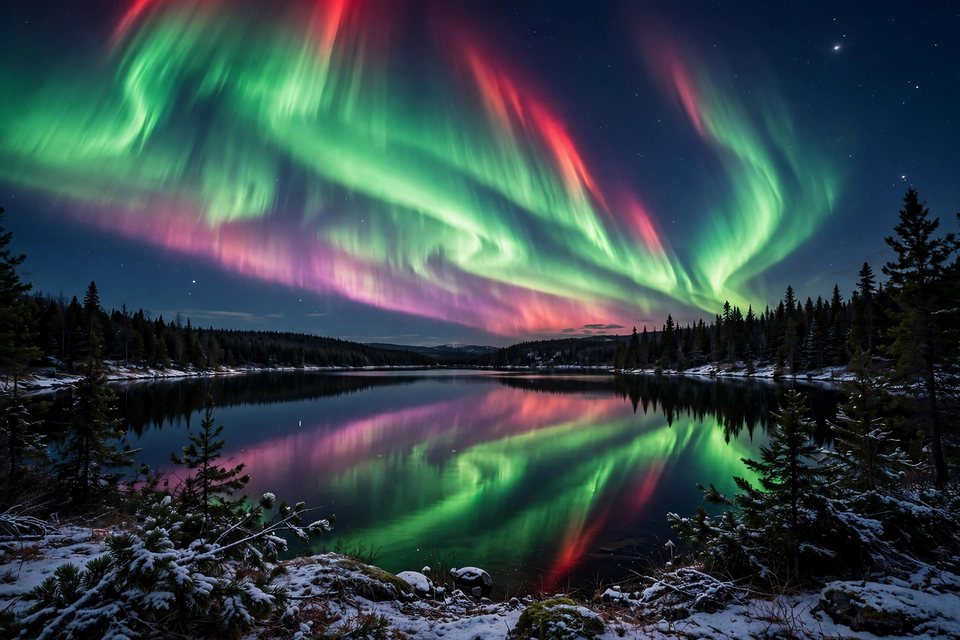
The Night the Sky Starts to Move
Stand in a dark field on a cold Canadian night — and the sky ripples.
Green curtains hang overhead, fold, brighten, then slide sideways like someone shaking out a glowing bedsheet. Just light, dancing more than 100 kilometres above your head.
That is the aurora borealis. And the wildest part? The show starts on the Sun, 150 million kilometres away.
It Begins With a Wind From the Sun
The Sun constantly blows a stream of charged particles into space: the solar wind. Usually a breeze — sometimes a tantrum.
The biggest tantrums are coronal mass ejections — CMEs. NOAA describes a CME as a billion tons of plasma ejected from the Sun, travelling at a million miles per hour. Aimed at Earth, one can trigger the biggest geomagnetic storms — and the brightest auroras.
Earth's Magnetic Shield Does the Steering
Earth's magnetosphere deflects most of the solar wind around the planet. But the shield has two soft spots: the poles.
When a strong solar wind or CME shakes the magnetosphere, electrons accelerate down the field lines toward the magnetic poles — at nearly a tenth of the speed of light, NOAA notes, about 20,000 kilometres per second.
More than 100 km up, they slam into atoms and molecules in the upper atmosphere. Each collision excites an atom, which releases the energy as light when it relaxes. Billions at once become the glow you see — NOAA compares it to a neon sign.
Why Green? Why Red? It's the Gas — and the Height
Green is the star. It comes from atomic oxygen at a specific wavelength — 557.7 nanometres — at altitudes of about 100 to 300 km, per the Canadian Space Agency's AuroraMAX program.
Red is the rare top layer. Higher up — roughly 300 to 400 km, per AuroraMAX — oxygen glows deep red instead, mostly during strong storms.
Pink and purple trim the edges. Electrons striking nitrogen around 100 km up produce the pink fringe on a curtain's lower edge, and sunlight hitting the tops of tall rays near sunrise or sunset can turn them purple.
The Ring Overhead: The Auroral Oval
The electrons map down the field lines into a ring around each magnetic pole — the auroral oval. Under average conditions, NOAA's glossary puts it at about 67 degrees magnetic latitude at midnight. Northern Canadian communities sit under it — the CSA notes they get regular displays. When activity ramps up, the oval expands south — and the lights spill over the rest of the country.
The One Number to Watch: Kp
Aurora hunters live by one number: the Kp index, which measures how disturbed Earth's magnetic field is — 0 (quiet) to 9 (severely disturbed). NOAA ties the aurora's location and brightness directly to it.
At Kp 7 to 9, expect bright aurora with the oval pushed far south. At Kp 5 or 6 the display is more moderate, closer to the poles — roughly where southern Canada's chances begin, from a dark site.
Why Winter — and Why Right Now
Auroras happen all year, but you can only see them under a truly dark sky. Canada's long winter nights are prime time — the CSA notes the aurora tends to appear a few hours after sunset and grow most intense around midnight.
The Sun runs on a roughly 11-year cycle, and in October 2024 NASA and NOAA announced it had reached the solar maximum period of Solar Cycle 25 — its most active phase, with activity slightly exceeding expectations. Canadians got a taste in May 2024, when flares and CMEs created the strongest geomagnetic storm at Earth in two decades.
How to Actually See Them
No telescope needed — the CSA's advice is simple:
- Check the forecast first — Kp outlook and the oval's real-time position.
- Escape city lights, which make faint auroras invisible.
- Pick a clear, moonless night — clouds and a full Moon wash out the display.
- Look everywhere, not just north — in strong activity, auroras can appear anywhere, even overhead.
- Be patient around midnight, when displays peak — and bundle up.
- Can't travel? AuroraMAX broadcasts the lights live from Yellowknife during the aurora season.
One last trick: your phone camera is more sensitive than your eyes — a faint haze to you can bloom green and purple on screen.
The Twikup Take
The northern lights feel like magic, but the recipe is wonderfully mechanical: the Sun exhales, Earth's magnetic shield funnels the energy to the poles, and the sky becomes the screen.
On the next clear winter night with a strong Kp forecast, drive somewhere dark, look up — and watch physics dance.
Image: AI-generated illustration.