
Scientists Have Found 6,445 Alien Worlds Without Seeing Most of Them
Imagine trying to spot a firefly beside a stadium floodlight. That's roughly the problem astronomers face when hunting for planets beyond our solar system. A planet is incredibly faint compared with the star it orbits. The star's glare can completely drown it out.
And yet, astronomers keep finding them.
As of the NASA Exoplanet Archive's October 8, 2026 update, scientists had confirmed 6,445 exoplanets — and six more were added the following week.
The remarkable part? Almost all were discovered without anyone actually photographing them.
Instead, scientists watch for tiny clues: a star that wobbles, a sudden dip in brightness or a brief flash of light. Each clue tells a different part of the story.
Welcome to the cosmic detective kit.
The First Breakthrough: A Star That Wouldn't Sit Still
In 1995, astronomers confirmed the first exoplanet around a Sun-like star: 51 Pegasi b.
It was a hot gas giant completing an orbit in just four days.
But nobody had actually seen the planet. They spotted something much stranger: its star was moving back and forth.
The explanation? The planet's gravity was tugging on the star as both travelled around a shared centre of gravity.
That tiny movement was enough to reveal an entirely new world.
Astronomers had found a way to discover planets by watching stars misbehave. And the search was about to explode.
Method 1: The Wobble — Catching a Star's Gravitational Dance
A planet doesn't simply circle its star while the star sits perfectly still. Both orbit a shared centre of gravity.
Because the planet pulls on its star, the star makes a tiny movement of its own — first slightly towards us, then slightly away.
That movement leaves a fingerprint in the star's light.
As the star approaches, its light waves are squeezed together. As it moves away, they stretch out. This is the Doppler effect, the same physics that makes a passing siren change pitch.
Measure those changes carefully enough and astronomers can work out the planet's orbit and estimate its mass. A heavier planet produces a stronger gravitational tug.
This method is particularly good at finding massive planets in tight orbits, which explains why so many early discoveries were hot Jupiters.
Its weakness? It reveals how massive a planet is, but tells us relatively little about its actual size.
Method 2: The Blink — Watching a Planet Steal a Little Starlight
Imagine staring at a bright light and watching something tiny pass in front of it.
That's essentially what astronomers do with the transit method.
When a planet crosses directly between its star and Earth, it blocks a small amount of starlight. The star briefly becomes dimmer.
Then it happens again. And again.
These regularly repeating dips reveal the planet's orbital period — essentially, how long its year lasts. The depth of the dip also tells astronomers how large the planet is.
NASA turned this tiny flicker into a planet-hunting machine.
The Kepler Space Telescope operated from 2009 to 2018. For four years, it fixed its gaze on one small patch of sky, monitoring 150,000 stars simultaneously.
The result? More than 2,600 confirmed exoplanets, the biggest bounty of any telescope ever flown.
NASA says the vast majority of all known exoplanets were discovered using this method.
Its successor, TESS, launched in 2018 to scan the entire sky using the same basic technique. In October 2026, it passed 1,000 confirmed planets from its data.
But there's a catch: the planet's orbit must line up almost perfectly with our viewpoint. If it doesn't cross in front of its star from our perspective, there is no blink to catch.
There could be countless planets out there that simply never pass between us and their stars.
Method 3: The Photograph — Actually Seeing Another World
This is the method most people imagine when they hear about discovering an exoplanet.
Point a telescope at a distant star. Take a picture. There's the planet.
Simple, right?
Not even close.
A planet is incredibly faint compared with its star. Trying to photograph one is like trying to capture a candle beside a searchlight.
Astronomers fight that glare using a device called a coronagraph. It uses internal masks and mirrors to block the star's light, allowing the much fainter planet to become visible.
Even then, the conditions have to be right.
Direct imaging works best for young planets far from their stars. These planets are still glowing with heat left over from their formation, making them easier to detect.
One of the most famous examples involves HR 8799, where images from Hawaii's Keck Observatory were combined into a time-lapse movie showing four giant planets orbiting their star.
And the next generation is already on the scene.
NASA's Nancy Grace Roman Space Telescope, launched August 30, 2026, carries a coronagraph as a technology demonstration. It is helping develop the technology needed for future telescopes designed to image planets more directly.
For astronomers, this is the difference between detecting a distant world and actually seeing it.
Two More Tricks That Expand the Search
The first three methods rely on a planet blocking light, tugging on a star or becoming visible after the star's glare is suppressed.
But astronomers have two more tricks — and one of them borrows directly from Einstein.
Microlensing: Using Gravity as a Giant Magnifying Glass
Imagine two stars lining up almost perfectly from Earth's perspective.
One sits in the foreground. The other is much farther away.
The gravity of the foreground star bends and magnifies the light coming from the distant star. This is gravitational lensing, a prediction of Einstein's theory of general relativity.
Now add a planet to the foreground star.
Its gravity creates an additional, smaller spike in the background star's brightness. Astronomers can use that brief signal to identify the planet.
The catch? These alignments happen once and never repeat.
But microlensing has a remarkable advantage: it can reveal planets thousands of light-years away, far beyond the reach of the other methods.
NASA's Roman Space Telescope will hunt for planets using this technique too.
Astrometry: Watching a Star Move Sideways
Remember the wobble method?
Astrometry looks for the same gravitational dance, but from a different angle.
Instead of measuring a star moving towards or away from us, astronomers measure its position shifting almost imperceptibly across the sky.
The planet's gravity makes the star trace a tiny movement around their shared centre of gravity.
The challenge is precision. Those shifts are extraordinarily small, which is why astrometry has contributed only a small share of the confirmed exoplanet catalogue.
But it offers something valuable: it can help pin down planetary orbits that other detection methods may miss.
Why Scientists Need All Five Methods
No single technique can find every kind of planet.
Each method has its own strengths and blind spots:
- Transit: Finds planets that pass in front of their stars from our viewpoint. Reveals their size.
- Radial velocity: Detects a star's movement towards and away from us. Helps estimate planetary mass.
- Direct imaging: Captures light from the planet itself. Favours young, hot planets far from their stars.
- Microlensing: Uses gravity to magnify distant starlight. Can reveal planets thousands of light-years away.
- Astrometry: Measures a star's sideways movement. Helps determine planetary orbits.
The real magic happens when astronomers combine techniques.
A transit tells scientists a planet's size. A radial velocity measurement helps establish its mass.
Put those measurements together and they can calculate its density — an important first clue about whether the world might be rocky, gaseous or something in between.
NASA's confirmation standard also reflects the importance of reliable evidence: the same planet can be confirmed through two techniques.
And the discoveries have already changed how we understand our galaxy.
Kepler's data showed that there are more planets than stars in the Milky Way.
Think about that for a moment. The night sky isn't simply filled with distant stars. Those stars are surrounded by worlds we are only beginning to uncover.
The challenge is no longer whether planets exist elsewhere. It's learning what those planets are actually like.
The Twikup Take
For centuries, planets beyond our solar system were invisible possibilities. Then, in 1995, astronomers confirmed the first one around a Sun-like star.
Today, the confirmed count stands at 6,445, with six more added the following week.
And most were discovered without a photograph. Just a wobble, a blink or a brief gravitational flash was enough.
Now the mission is changing. Webb and Roman are moving astronomy beyond simply finding planets and towards studying their atmospheres.
We've spent decades discovering that other worlds exist. The next chapter is finding out what those worlds are made of — and whether any of them could resemble our own.
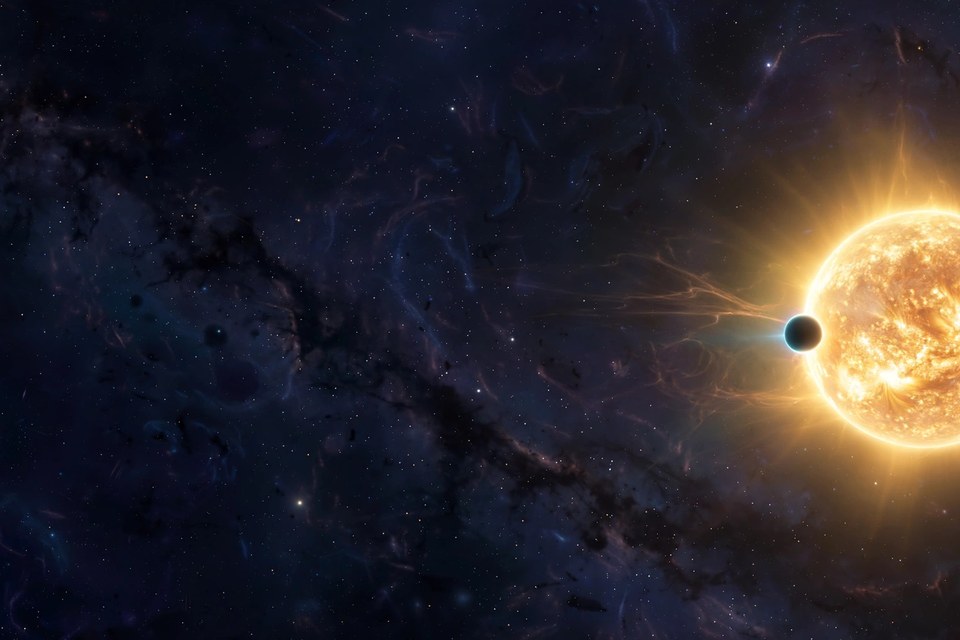
Image: AI-generated illustration.