
Key Takeaways
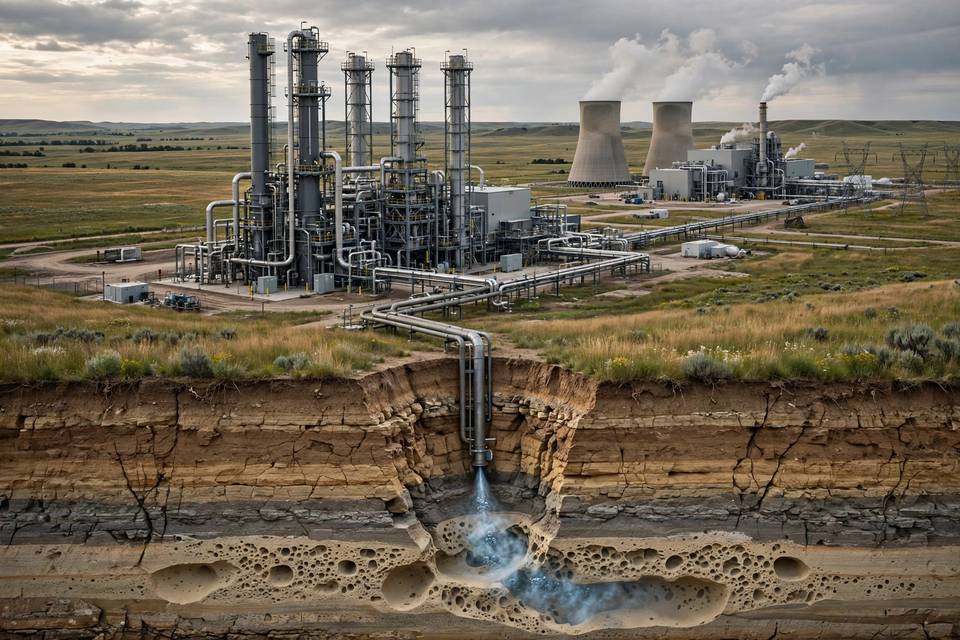
- Carbon capture and storage scrubs CO2 out of exhaust (most often with amine solvents), compresses it into a dense fluid, and pumps it at least 800 metres underground into porous ro
- Saskatchewan's Boundary Dam, the world's first power-plant CCS project (2014), was designed for about 1 million tonnes a year and captured 721,239 tonnes in 2025.
- All the world's operating CCS captures under 0.2% of annual energy emissions, at roughly $60–$114 a tonne, while using 20–30% of a host coal plant's own power.
Catch It, Squeeze It, Bury It
What If You Could Catch Carbon Before It Reached the Sky?
Imagine a power plant pumping out exhaust. Instead of letting its carbon dioxide escape into the atmosphere, you intercept it, separate the gas and send it underground.
That's carbon capture and storage — CCS.
The mature way to do this at a power plant is called post-combustion capture. The fuel burns as usual, but the exhaust bubbles through a liquid amine solvent that grabs the CO2. Heat the solvent and it releases a concentrated stream of CO2, ready to be used again.
There are two other routes: separating the CO2 before combustion, or burning fuel in pure oxygen so the exhaust is nearly pure CO2 to begin with.
Once captured, the gas is compressed into a dense, liquid-like fluid and sent by pipeline to a storage site.
But here's where things get interesting.
The Underground Isn't a Giant Cave
The CO2 isn't pumped into some enormous underground cavern. It's injected into porous rock — the same kind of rock that holds water and oil — at least 800 metres down, where pressure keeps it dense.
There are several ways to store it.
Deep saline aquifers offer the most room. Depleted oil and gas reservoirs are proven traps that held hydrocarbons for millions of years under solid caprock.
And then there's the particularly fascinating option: basalt.
In reactive rock like basalt, CO2 slowly mineralizes. It literally turns into stone.
Sites are monitored for years to confirm the gas stays put.
Saskatchewan Ran the First Real Test
Canada didn't just experiment with this technology. Saskatchewan became home to the world's first commercial-scale CCS project on a coal power plant.
SaskPower's Boundary Dam Unit 3, near Estevan, opened in October 2014. It was designed to capture about 90% of the unit's CO2 — roughly 1 million tonnes a year.
But capturing carbon isn't necessarily the end of the journey.
Most of the captured CO2 is sold and piped about 70 km to the Weyburn oilfield, where it's injected to push out more oil. This is called enhanced oil recovery.
The rest goes to the Aquistore research site, where it's injected about 3.4 km down into a saline aquifer.
So, how well has it worked?
The performance record is honest, not triumphant.
Boundary Dam captured 721,239 tonnes in 2025, and about 7.3 million tonnes total in its first 11 years. At its original design pace of a million tonnes a year, it would have captured 11 million tonnes.
It is capturing better now than ever, but the gap is the story of CCS everywhere.
The Arithmetic Problem
Step back from Saskatchewan and look at the global picture.
The Global CCS Institute counts 113 commercial projects in operation worldwide, with 68 million tonnes a year of capture capacity.
There's an important distinction here: capacity is what these facilities could capture, not what they actually capture.
The IEA puts 2025 energy-related emissions at nearly 38.4 billion tonnes.
Even if all that operating CCS capacity captured CO2 at its full annual rate, it would amount to under 0.2% of those emissions — roughly one tonne of annual capture capacity for every 560 tonnes emitted.
And the historical comparison is even more striking.
Everything CCS has stored since 1996 — over 400 million tonnes — equals about four days of current emissions.
It isn't cheap, either.
US DOE analysis puts first-generation power-plant capture at $60–$114 per tonne avoided.
There's another catch: running the equipment consumes about 20–30% of a coal plant's own output. That means the plant must burn more fuel to deliver the same electricity, and its other pollutants need separate controls.
None of this makes CCS fake.
The rock physics works. Saskatchewan's CO2 is staying underground. And for industries like cement and steel, where emissions come from the chemistry rather than just the fuel, capture may be the only deep-cut option.
But CCS has a scale problem, a cost problem and an energy problem.
It's a real tool at a small scale with a high price, not a substitute for emitting less.
The Twikup Take
Burying CO2 works — a decade of Saskatchewan rock says so. The uncomfortable part is the arithmetic: thirty years of effort built a technology that, running flat out, catches about four days of emissions a year.
Image: Illustrative image.