
Key Takeaways
- Lightning starts when collisions between ice particles inside a thundercloud sort electric charge — negative at the cloud's base, positive at the top — until the air itself breaks
- The flash you see is the return stroke racing up from the ground, which carries more than 99% of the bolt's light and heats the air to about 50,000°F — roughly five times hotter th
- Most lightning never reaches the ground, and the current safety rule is simple: when thunder roars, go indoors, and stay there 30 minutes after the last clap.
It Starts With Ice Crashing Into Ice
A thundercloud is a sorting machine. Strong updrafts carry tiny ice crystals upward while heavier soft hail — graupel — falls through them. Billions of rebounding collisions between the two strip and transfer electric charge.
NOAA's scientists are candid that the exact physics of the transfer isn't completely understood. But the result is: the crystals that rise carry one charge, the graupel that sinks carries the other, and the cloud ends up layered — typically negative near the base, positive near the top.
Air is an excellent insulator, so the charge builds and builds, toward a potential of roughly 100 million volts, until the air can't hold out any longer.
The Bolt You See Travels Up, Not Down
The discharge happens in two acts.
First, a stepped leader: a faint, negatively charged channel zigzags down from the cloud in steps of about 50 metres, branching as it goes. It takes roughly 50 milliseconds to reach the ground.
It's nearly invisible.
As it nears the surface, the electric field drags positive streamers up from tall objects — trees, poles, buildings. When a streamer meets the leader, usually 30 to 100 metres above the ground, the circuit closes.
Then comes the return stroke — the part you actually see.
A wave of current races up the channel at around 60,000 miles per second, producing more than 99% of the bolt's light. The return stroke itself takes less than a tenth of a millisecond, though leftover charge often fires dart leaders down the same channel, producing up to 20 strokes in one flickering flash.
So a lightning bolt does come from the cloud — but the blinding part travels ground-to-sky.
Hotter Than the Surface of the Sun
The return stroke dumps its energy into a channel of air a few centimetres wide, heating it to about 50,000°F (roughly 28,000°C) — about five times hotter than the surface of the Sun.
Air heated that fast has no time to expand gently: it explodes outward as a shock wave that decays, within metres, into the sound wave we call thunder.
Because every point along a miles-long channel makes its own sound, thunder rumbles and rolls instead of cracking once.
Most lightning is private weather.
By NOAA's count, roughly 75–80% of flashes happen inside the cloud itself, and NASA's satellite instruments count about 40 flashes per second somewhere on Earth, among some 2,000 thunderstorms in progress at any moment.
"Heat lightning" isn't a separate phenomenon — it's a storm too far away for its thunder to reach you.
That last fact is the safety rule in disguise: if you can hear thunder, lightning is within striking distance.
The old 30-30 rule has been retired. Current guidance from the National Weather Service is simpler — when thunder roars, go indoors, and stay inside until 30 minutes after the last clap.
The Twikup Take
Lightning is a cloud arguing with itself until the air surrenders — and the flash of light you see is the ground answering back. Forty times a second, somewhere on Earth, the sky runs the same experiment: ice, charge, and a 50,000-degree spark.
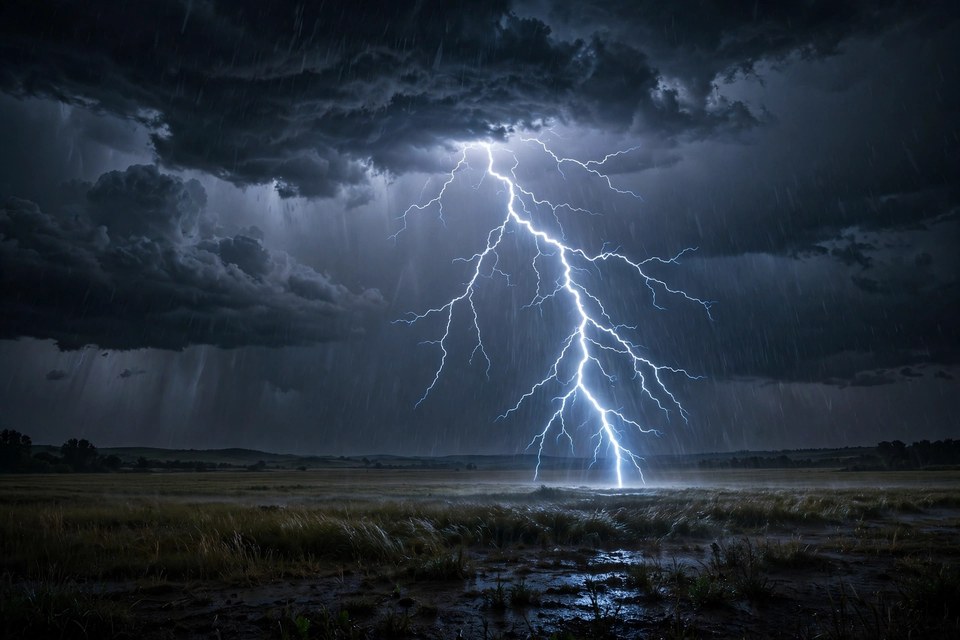
Image: AI-generated illustration.