
Key Takeaways
- Sunlight bouncing off air molecules scatters short wavelengths far more than long ones — blue and violet scatter about 10 times more than red, an effect called Rayleigh scattering.
- The sky looks blue rather than violet because some violet is absorbed high in the atmosphere, the Sun emits less violet than blue, and human eyes are less sensitive to violet.
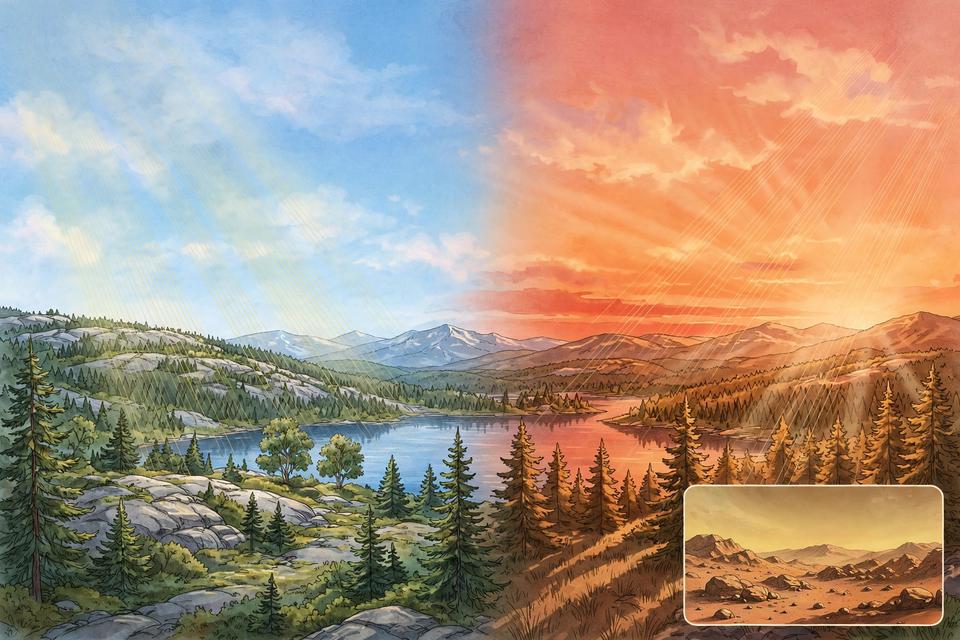
- Sunsets turn red for the same reason the sky is blue: the long path through the air strips the blue out, leaving the reds and oranges travelling straight to your eyes.
A Physicist, an Equation, and a Sky Full of Scattered Light
Sunlight looks white, but it is a mixture of every colour — and Earth's air treats those colours very differently. As sunlight enters the atmosphere, it collides with gas molecules far smaller than the wavelength of light itself and ricochets in every direction. This is Rayleigh scattering, named for the British physicist Lord Rayleigh (John William Strutt), who described it in the 1870s.
The rule he found is ruthless: scattering strength rises with the inverse fourth power of the wavelength (1/λ⁴). Halve the wavelength and scattering jumps 16-fold. A red light wave runs about 750 nanometres; a blue or violet wave, about 400. The result, as NASA puts it, is that blue and violet light are scattered roughly 10 times more than red across the sky — and the scattered short wavelengths are what reach your eyes from every direction. That is the blue you see.
So Why Not Violet?
Violet actually scatters more than blue — three things conspire to hide it. Some violet light is absorbed by the upper atmosphere before it can scatter down to you. The Sun emits less violet than blue in the first place. And your own eyes are simply less sensitive to violet than to blue. What reaches your retina is a mix dominated by blue, and blue is what your brain reports.
The Same Trick, at Sunset
Lower the Sun and its light must cross far more air to reach you. Along that longer path, nearly all the blue and violet is scattered out of the beam — leaving the reds, oranges and yellows to travel straight through to your eyes. Dust and pollution can deepen the effect, which is why hazy evenings produce the most theatrical sunsets. The paler blue near the horizon at midday is the flip side: light from low in the sky has been scattered and re-scattered so many times that the colours mix back toward white.
One Planet Over, the Sky Runs in Reverse
Mars has a thin carbon-dioxide atmosphere full of fine dust, and dust plays by different rules. By day the Martian sky is a hazy butterscotch; at sunset, the dust scatters blue light forward toward the viewer, so a blue glow hugs the setting Sun — Earth's colour scheme, upside down, confirmed by NASA rovers since Viking.
The Twikup Take
The blue sky is not a property of the air — the air is colourless. It's a property of arithmetic: one exponent (that fourth power) sorting sunlight by wavelength, all day, everywhere you look.
Image: AI-generated illustration.