
Key Takeaways
- NASA has confirmed both ESCAPADE spacecraft — the twin UC Berkeley orbiters Blue and Gold — successfully completed powered Earth flybys on November 7 and 9.
- The refrigerator-sized twins, launched in November 2025, are now on a 10-month cruise to Mars, arriving in September 2027.
- From June 2028 they will fly in formation to study how the solar wind strips Mars' atmosphere.
Earth Just Gave Two Spacecraft a Double Boost Toward Mars
Getting to Mars usually means waiting for the planets to line up. NASA's latest mission found another way — and just pulled it off twice in two days.
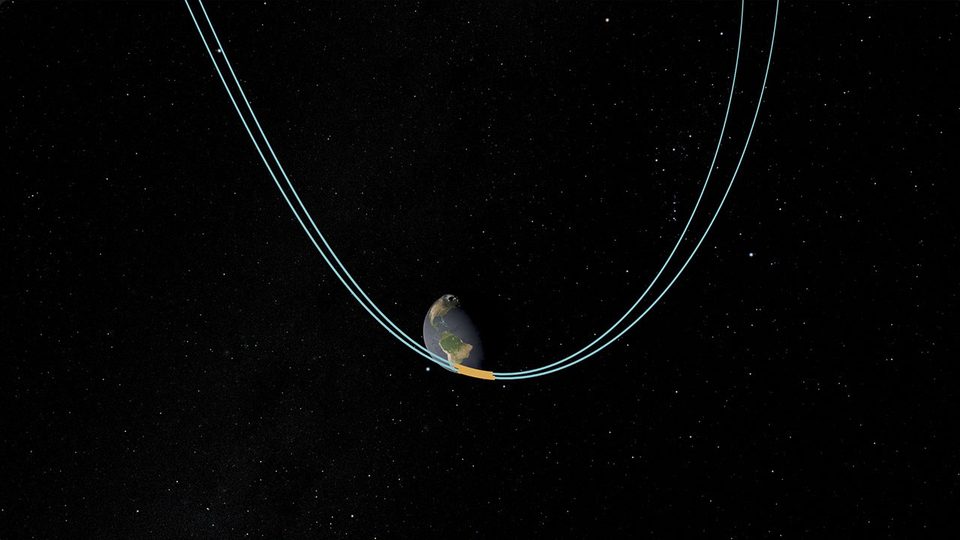
The agency's twin ESCAPADE spacecraft have each successfully completed a powered Earth flyby, combining Earth's gravity with a sustained engine burn to propel themselves toward Mars.
The first spacecraft made its closest approach on November 7. Its twin followed on November 9. Each fired its engine for roughly nine minutes during the manoeuvre.
"This is the first time NASA has used a powered Earth flyby to propel a spacecraft toward Mars, and we've now executed this maneuver twice, flawlessly, in just two days," said Asal Naseri of NASA's Heliophysics Division.
Two spacecraft. Two separate flybys. One entirely new way for NASA to send a mission toward the Red Planet.
Why These Spacecraft Took the Scenic Route
The twins, nicknamed Blue and Gold, are each about the size of a standard refrigerator. Built by Rocket Lab and led by UC Berkeley's Space Sciences Laboratory, they launched on November 13, 2025, aboard Blue Origin's New Glenn.
But Mars wasn't ready for a direct trip.
Earth and Mars were on opposite sides of the Sun when the spacecraft launched. Instead of heading straight for Mars, the pair spent about a year in a wide "loiter" orbit, waiting for the planets to line up.
That detour wasn't wasted time. The spacecraft collected bonus science while travelling through Earth's distant magnetotail.
Now comes the 10-month cruise to Mars.
The spacecraft have Mars orbit insertion burns scheduled for September 7 and 9, 2027, two days apart. Science operations are expected to begin in June 2028.
Two Spacecraft, One Planet and a Solar-Wind Mystery
Once they reach Mars, Blue and Gold will do something particularly interesting: fly in formation to investigate how the planet interacts with the Sun.
Sometimes the twins will fly minutes apart on the same orbit. At other stages, they'll split up, with one observing the incoming solar wind and the other studying the planet.
Their target is Mars' hybrid magnetosphere — the magnetic environment that interacts with the million-mile-per-hour solar wind and plays a role in the planet's atmospheric loss.
Understanding that process could help scientists investigate how Mars evolved into the world we see today.
The Twikup Take
NASA didn't just send two spacecraft toward Mars. It demonstrated a new way to get there, using Earth's gravity and an engine burn to turn a planetary flyby into a powerful launch boost.
Two refrigerator-sized explorers. Two successful flybys. One new route to Mars. Space just found another shortcut.
Image: NASA's ESCAPADE mission graphic showing the twin spacecraft's powered Earth flyby trajectories. Credit: NASA.