
Key Takeaways
- Astronomers have recorded at least 27 outbursts since 2012 from AT 2016blu, a massive star about 30 million light-years away whose eruptions mimic a supernova .
- New Chandra observations, published in The Astrophysical Journal, show a hidden companion — a stellar-mass black hole or neutron star — feeding on the star's ejected material .
- It is the first X-ray detection of this class of erupting star.
It Exploded 27 Times. Something Was Keeping It Alive.
Imagine watching a star appear to explode, dim down, and then do it all over again.
That's exactly what astronomers have witnessed with AT 2016blu.
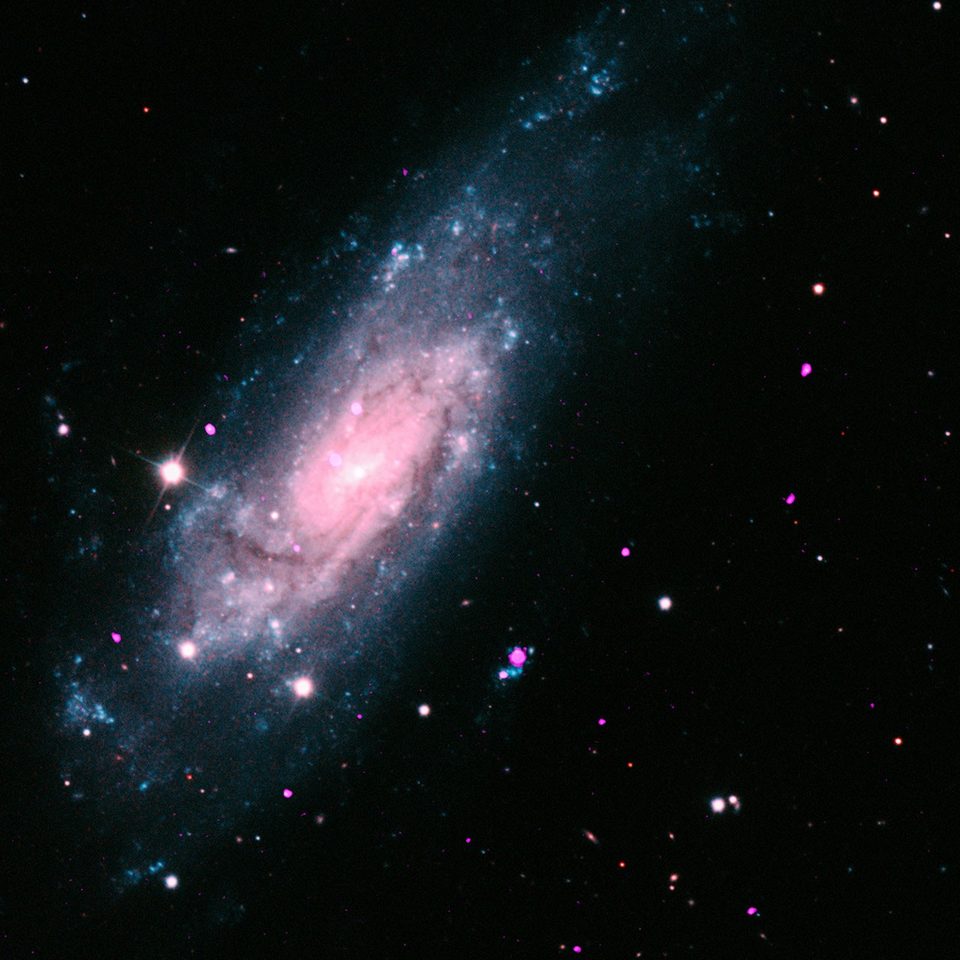
The luminous blue variable — a hot, unstable star at least 33 times the Sun's mass, in the galaxy NGC 4559 about 30 million light-years away — has erupted at least 27 times between 2012 and 2026, roughly every 113 days.
Each eruption looks like a supernova. But there's one enormous problem with that explanation: the star keeps surviving.
Astronomers call these events "supernova impostors." For 15 years, the mystery was what kept triggering them.
Now, NASA may have found the answer.
Something Was Feeding on the Star
Observations from NASA's Chandra X-ray Observatory in March 2026, timed to catch an outburst in progress, revealed something extraordinary.
The system was at least 100 times brighter in X-rays than it had been in 2001–2002, before the eruptions began.
The study, published Monday in The Astrophysical Journal, points to a previously hidden companion: a stellar-mass black hole or a neutron star.
The suspected companion follows an oval-shaped orbit around AT 2016blu. When the two objects swing close to each other, the companion captures material thrown off by the massive star.
That material spirals around the compact object at extremely high speeds, approaching the speed of light. As it heats up, it produces powerful X-rays.
Those X-rays then heat the surrounding gas, making it glow in visible light and producing the spectacular eruptions seen from Earth.
The companion itself has never been imaged. And astronomers still cannot determine whether it's a black hole or a neutron star.
"For 15 years, astronomers have been watching this star get really bright and then dim again on a regular basis," said lead author Mojgan Aghakhanloo of the University of Virginia. "Until we were able to get Chandra data at the right time, we couldn't figure out what was making this happen."
The Twikup Take
AT 2016blu wasn't repeatedly destroying itself. Something much smaller and denser was apparently stealing its material, turning each close encounter into a cosmic light show.
Twenty-seven eruptions, 113 days apart, and one hidden companion. Sometimes the biggest astronomical mysteries have the smallest suspects.
Image: AT 2016blu as seen by NASA's Chandra X-ray Observatory. Credit: NASA/Chandra X-ray Center.