
Key Takeaways
- Researchers have documented 280 engravings, including 55 animal figures, in a Catalan cave that has welcomed tourists for nearly 70 years.
- The art went unnoticed because it is intermingled with modern graffiti and nearly invisible under ordinary light.
- Based on style and on evidence of human presence in the deep galleries between about 40,800 and 25,900 years ago, the authors attribute many of the figures to pre-Magdalenian phase
The Masterpieces Were on the Tour Route
For nearly three decades, visitors on the "Adventure Route" of the Cova de la Font Major walked straight past some of the oldest art in Catalonia. It was on the walls the whole time — mixed in with the graffiti.
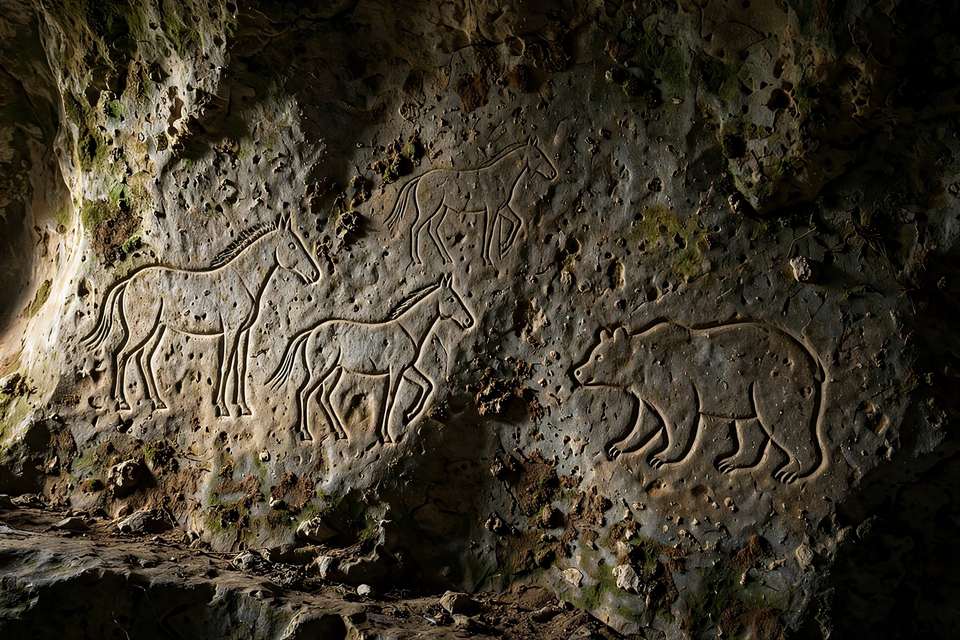
A study published this week in the journal Antiquity documents 280 engravings in the cave near Espluga de Francolí, in Spain's Tarragona province — including 55 animal figures: horses, deer, goats, an aurochs drawn with its horns in frontal perspective, and a rare bear. By animal-figure count, the authors say, it is the third-largest Palaeolithic cave-art assemblage on the entire Iberian Mediterranean coast, behind only Ardales and La Pileta in the south — and the first major one ever found in the eastern peninsula.
The cave has been open to the public since 1957 and has operated as a museum since 1993. People have been entering parts of the system since at least the 12th century — an inscription dated 1199 sits in the same deep galleries. The art was finally spotted on October 30, 2019, when one of the researchers, during an excavation campaign, noticed that among the countless names and dates scratched by modern visitors, some engravings looked unmistakably ancient.
How Does Ice Age Art Hide in a Tourist Cave?
Three reasons, the researchers say. First, camouflage: visitors literally carved their own names over the ancient figures, and most walls were damaged by decades of touching and scratching. Second, light: the grooves are only 3 to 7 millimetres wide and cut into soft marl layers, and under a head-on lamp they all but vanish — they appear only when light rakes across the wall at an angle. Third, assumptions: the walls are rough conglomerate rock, long considered unsuitable for Palaeolithic engraving, so nobody had ever seriously looked.
Most of the 280 motifs are not animals at all, but parallel lines, circles and quadrangular forms — on one panel, hundreds of small loop shapes in rows. The animal figures are simple outlines, typically 15 to 45 centimetres long, with little internal detail. About 30% could not be identified to species.
How Old Is It, Really?
Here the study is more careful than the headlines it is generating. The engravings themselves have not been directly dated. One figure covered by calcite deposits can eventually be dated by uranium-series analysis — but that work, the authors say, "will be undertaken at a later stage."
What exists today is a two-legged argument. Radiocarbon dates show humans were present in the cave's deep galleries between about 40,810 and 25,850 years ago — and, on current evidence, at no time between then and the 8th century BCE. And certain drawing conventions in the figures — double Y-shaped legs, three-lined heads — match other Mediterranean art linked to early periods. Together, the authors conclude, the evidence is "consistent with an attribution of the engravings to pre-Magdalenian phases" — broadly, the era before roughly 19,000 years ago — while cautioning that later engravings cannot yet be ruled out.
One cautionary example shows how easily this science gets garbled: charcoal found inside one engraved groove has been reported in coverage as dating the art. In the paper, that charcoal belongs to the mysterious loop-shaped panel, and it shows only that some of those incisions are no older than the 17th century — the loops sit under a 1199 inscription, so they are older than that, but their age is explicitly unresolved.
Why It Matters Beyond One Cave
Before this find, all of Catalonia had just two tentative pieces of Palaeolithic wall art — one of them stolen shortly after its discovery. Iberia holds more than half of Europe's known Palaeolithic cave art, but clustered in the north and south; Font Major fills a conspicuous gap on the map — hence the paper's title, "Filling gaps."
The discovery has already changed how researchers treat other caves: a nearby cave once dismissed the same way, Cova Simanya, has since yielded Palaeolithic art too. The authors' message is pointed: no cave should be written off in advance, however rough its walls or heavy its foot traffic.
The Twikup Take
The most remarkable thing about Font Major is not its age — it is that thousands of people stood in front of it, flashlights in hand, and saw only graffiti. Sometimes the discovery is not finding something new; it is finally looking properly at something old.
Image: Illustrative image.