
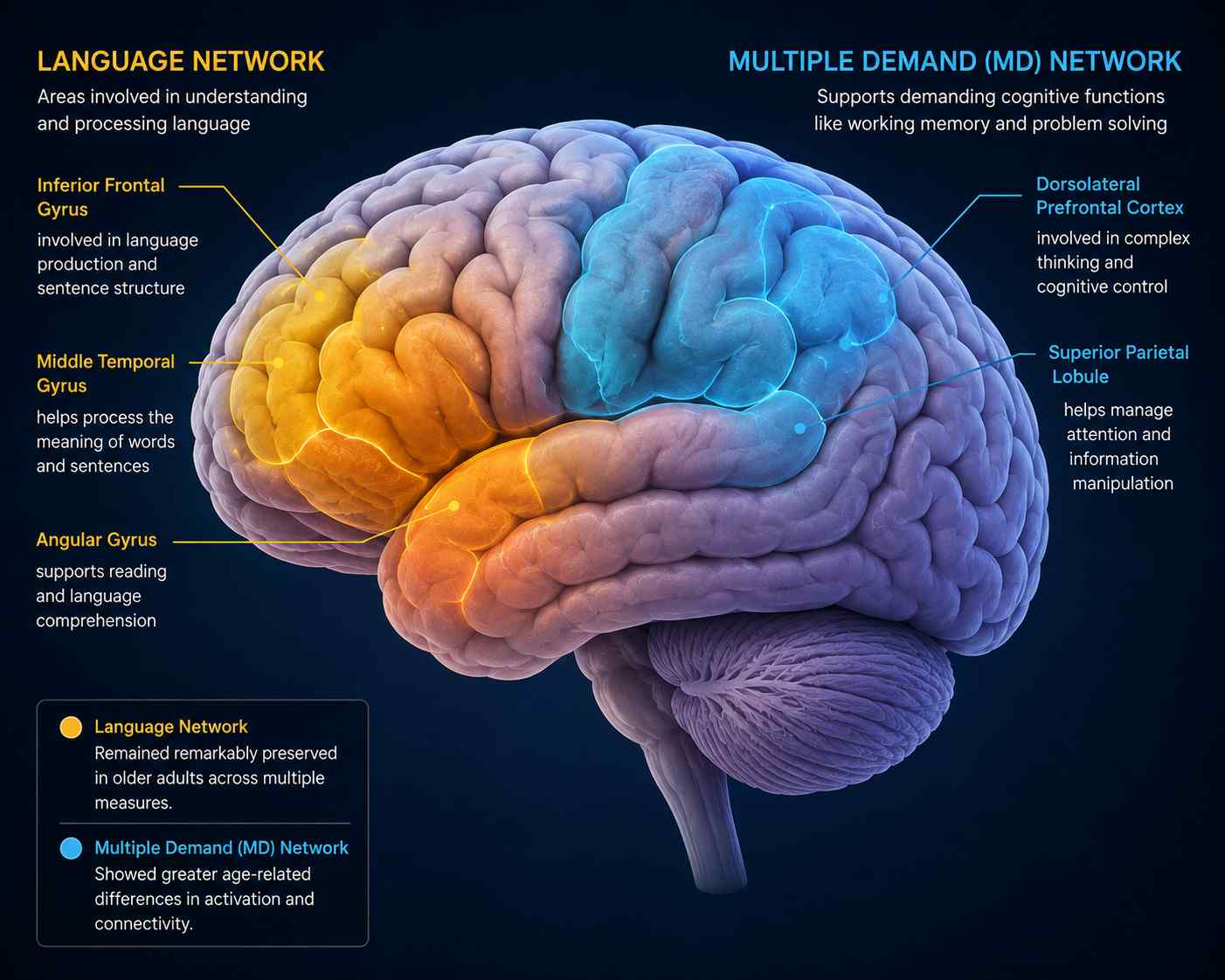
Key Takeaways
- The language network remained similar across age groups in location, left-hemisphere specialization, selectivity and functional connectivity.
- Older adults showed weaker, less extensive and less connected activation in the Multiple Demand network during demanding executive tasks.
- The findings suggest brain aging can affect networks differently and challenge the idea that healthy aging always reduces specialization.
Getting older can make some mental tasks feel harder.
Holding several pieces of information in mind. Switching between demanding tasks. Remembering exactly why you walked into a room.
But aging may not affect every system in the brain in the same way.
A new peer-reviewed study published August 24 in Nature Communications compared brain activity in younger and older adults and found a striking contrast: while a network involved in flexible cognitive control showed several age-related differences, the brain's specialized language network remained remarkably similar across age groups on multiple measures.
That doesn't mean language never changes with age—or that scientists have found a part of the brain that simply doesn't age.
Instead, the research points toward a more interesting possibility:
Different networks inside the same aging brain may follow very different trajectories.
Scientists compared two very different brain networks
Researchers led by scientists at MIT and Boston University studied 64 adults between roughly 41 and 80 years old and compared them with data from 483 younger adults ages 17 to 39.
They used functional magnetic resonance imaging, or fMRI, to examine two systems.
The first was the language network, a collection of brain regions that helps us understand and process language.
The second was the Multiple Demand, or MD, network, a more general-purpose system involved in demanding cognitive tasks such as working memory and cognitive control.
That comparison matters because some language abilities remain relatively strong during healthy aging, while executive functions and working memory are generally more vulnerable.
The researchers wanted to know whether those differences in behaviour could also be seen in the organization and activity of the brain itself.
They found that they could.
The language network was surprisingly stable
The researchers didn't judge the language network using just one measurement.
They examined several characteristics, including where language regions were located, how strongly the network favoured the left hemisphere, how selectively it responded to language and how strongly different language regions were functionally connected.
Across these measures, older adults looked remarkably similar to younger adults.
The basic organization of the network was preserved.
Its characteristic left-hemisphere specialization remained.
Different areas of the language network continued to show strong functional connectivity with one another.
And when participants processed language, those regions remained strongly and selectively responsive.
The finding becomes even more interesting when you look at what happened when the language itself became difficult.
The older brain still noticed when language got harder
During part of the research, participants listened to naturalistic language that contained differences in linguistic complexity and predictability.
Unusual words or constructions create more processing demands because the brain has to work harder to interpret what it is hearing.
The language network in older adults continued to show the characteristic response to those challenges.
In other words, researchers didn't simply find that language areas were still "lighting up."
They found evidence that those regions continued responding to properties of language in broadly similar ways.
That makes the next part of the experiment especially revealing.
Another network showed a very different aging pattern
When researchers examined the Multiple Demand network, the picture changed.
Older adults showed weaker activation during a demanding executive task, less spatially extensive activation, greater variability in where activation occurred and lower functional connectivity within the network.
There were also age-related differences in how strongly the MD system responded when the task became harder.
So within the same older adults, scientists were seeing two substantially different patterns.
One specialized network appeared remarkably preserved across the properties researchers measured.
Another flexible, general-purpose network showed much clearer age-related differences.
That contrast may be more important than either finding by itself.
Your brain may not have a single "aging mode"
It's tempting to talk about the aging brain as though the entire organ gradually changes in the same direction.
This research suggests that picture may be too simple.
Different neural systems have different jobs, different organizational properties and potentially different vulnerabilities to aging.
The language network is highly specialized. Over decades, people also continue accumulating linguistic knowledge—words, meanings, expressions and experience using language.
The Multiple Demand network works differently. It acts more like a flexible cognitive resource that can be recruited across many different difficult tasks.
Why one system appears more resilient than the other remains an open scientific question.
But the difference offers researchers another clue about why some cognitive abilities can remain remarkably strong later in life while others become more difficult.
The study also challenges another idea about the aging brain
Scientists have proposed that aging can cause some functional brain networks to become less distinct from one another—a phenomenon often described as neural dedifferentiation.
If that were broadly happening to these systems, the boundary between the language and Multiple Demand networks might become less clear in older adults.
The new study instead found strong evidence that the two systems remained functionally distinct.
Their response patterns differed, and their connectivity patterns remained distinguishable.
The researchers argue that their results therefore challenge a broad interpretation in which healthy aging necessarily causes brain networks to lose their specialization.
Instead, the findings are consistent with the idea of brain maintenance: some neural systems may retain important characteristics remarkably well as people age.
But this does not mean language never declines
There is an important distinction between saying that the language network was preserved on the measurements used in this study and saying that language does not change with age.
The second claim would go too far.
Older adults can experience word-finding problems, including those familiar moments when a word feels available but remains frustratingly out of reach.
The study also focused heavily on language comprehension.
It therefore cannot tell us that every aspect of language—particularly spontaneous speech production and retrieving individual words—remains unchanged throughout aging.
Nor did researchers follow the same people from age 20 to age 80.
They compared people of different ages at a particular point in time. That means the study reveals age-related differences between groups, rather than directly observing how each individual's brain changed over several decades.
Those distinctions matter.
The bigger mystery is why
Perhaps the most interesting result isn't simply that the language network appeared stable.
It's that a nearby cognitive system did not show the same pattern.
Both networks exist inside the same brain.
Both have been accumulating decades of biological aging.
Yet their functional characteristics appear to differ substantially in how they relate to age.
Understanding why could eventually help neuroscientists distinguish between the changes that are broadly associated with brain aging and the characteristics that allow some cognitive systems to remain resilient.
For now, the research offers a more nuanced way to think about getting older.
The brain may age.
But it doesn't necessarily age as one system.
TwikUp Insight
The most important lesson from this study isn't that scientists found a "young" part of an older brain.
It's that brain aging may be much more selective than the phrase "cognitive decline" makes it sound.
If researchers can understand why some specialized networks maintain their organization and function while other networks show stronger age-related differences, they may eventually gain a clearer picture of what healthy brain aging actually looks like—and why cognitive abilities can follow such different paths.