
Key Takeaways
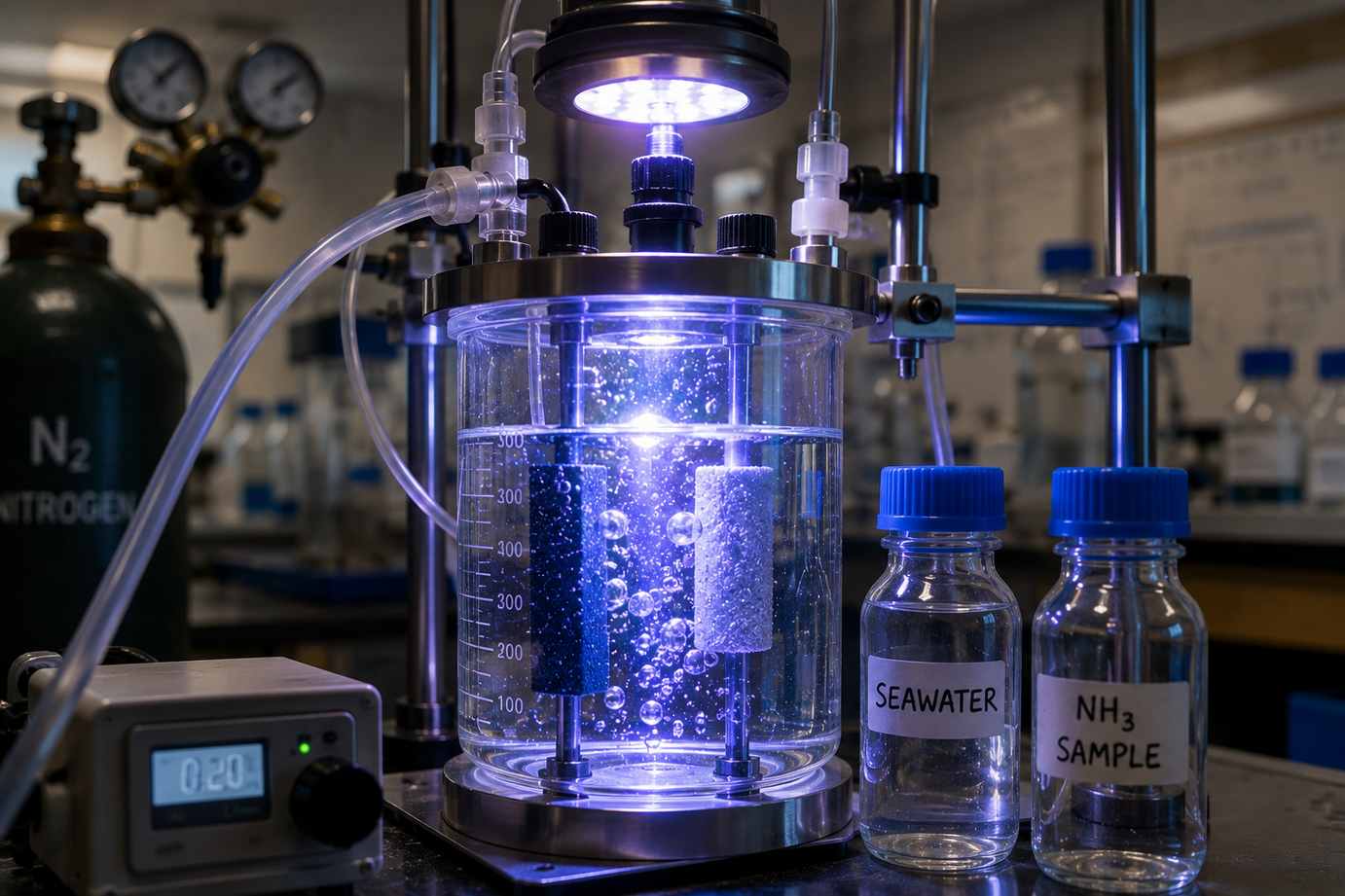
- The researchers converted nitrogen to ammonia with water at room temperature and atmospheric pressure using a light-driven system.
- The chemistry remained functional with unpurified natural seawater and, in separate tests, ambient air as the nitrogen source.
- UV-C dependence and unanswered scaling, durability and energy questions mean the work is proof of chemistry, not industrial replacement.
Why ammonia matters far beyond the laboratory
Ammonia, NH₃, might sound like an obscure industrial chemical.
It isn't.
Ammonia is fundamental to nitrogen fertilizers and therefore deeply connected to modern food production.
The problem is how humanity makes enormous quantities of it.
Industrial ammonia production predominantly relies on the Haber–Bosch process, which combines nitrogen and hydrogen under high temperatures and pressures.
The hydrogen used in conventional production is also commonly derived from fossil fuels.
According to the new Nature Chemistry paper, ammonia production is responsible for approximately 1.8% of global greenhouse-gas emissions.
That makes an alternative capable of using abundant ingredients such as nitrogen, water and renewable energy scientifically compelling.
What the scientists actually did
The researchers developed an artificial photosynthetic system.
The idea takes inspiration from photosynthesis's broader principle: use light energy to drive chemistry that would otherwise be difficult.
In this system, two reactions are coupled.
Water is oxidized while molecular nitrogen is reduced into ammonia.
That matters because nitrogen gas is everywhere around us—the atmosphere is mostly nitrogen—but molecular nitrogen is exceptionally stable.
Breaking its strong chemical bond and converting it into useful nitrogen compounds is difficult.
The researchers found that their photocatalytic system could accomplish nitrogen reduction under comparatively mild conditions.
Instead of hundreds of degrees Celsius and enormous pressures, the principal experiments operated at room temperature and atmospheric pressure.
Light supplies the energy needed to help drive the chemistry.
Then the researchers tried seawater
A laboratory system working with carefully purified ingredients is one thing.
Real-world water is considerably messier.
Natural seawater contains salts, minerals and many other chemical species that could interfere with a reaction.
So the researchers tested their system using unpurified natural seawater.
Ammonia production continued.
That doesn't mean somebody can put seawater into a machine tomorrow and manufacture fertilizer.
It does, however, answer an important scientific question: the chemistry does not inherently require ultrapure laboratory water.
And seawater wasn't the only less-controlled source they investigated.
They also tested ordinary air
Many nitrogen-reduction experiments use a concentrated supply of nitrogen gas.
That is useful scientifically, but separating nitrogen from air adds another step if the ultimate goal is practical ammonia production.
The researchers therefore tested whether the system could operate using ambient air as its nitrogen source.
It could.
That creates an unusually simple conceptual picture:
Air supplies nitrogen.
Water supplies hydrogen.
Light supplies energy.
The chemistry turns those ingredients toward ammonia.
The actual experimental system is considerably more complicated than those three sentences, but that is what makes the underlying concept noteworthy.
How efficiently did it work?
One of the important measurements in photochemistry is quantum yield.
In simplified terms, it describes how effectively absorbed photons produce the desired chemical event.
Under room-temperature and atmospheric-pressure conditions, the researchers reported an ammonia-production quantum yield of approximately 5.0%.
When they increased nitrogen pressure, the quantum yield reached 10.8%.
The researchers also reported high selectivity for ammonia.
These figures demonstrate that the reaction is more than simply a barely detectable chemical curiosity.
But they should not be confused with the overall energy efficiency or economics of an industrial ammonia plant.
Quantum yield and commercial production efficiency are very different measurements.
There is a major catch: the light
This may be the most important limitation for understanding the research.
The system relies on UV-C irradiation.
That matters because UV-C represents only a very small—and effectively unavailable at Earth's surface—portion of natural sunlight because the atmosphere absorbs it.
So describing this as a system that simply uses "sunlight, seawater and air" would go beyond what the experiment demonstrated.
A future practical system would need to address questions such as whether the chemistry can efficiently use more readily available wavelengths of light, whether artificial illumination could ever be energy-efficient enough, and whether the catalysts can remain stable and economical at much larger scales.
Those aren't small engineering details.
They could determine whether this chemistry eventually becomes useful outside a laboratory.
Why room-temperature ammonia is so interesting
The traditional ammonia industry succeeds partly because the Haber–Bosch process is extraordinarily optimized.
Its harsh operating conditions exist for a reason: nitrogen is difficult to activate.
That creates an interesting scientific challenge.
Instead of trying to incrementally improve the existing process, researchers around the world are exploring fundamentally different ways to fix nitrogen—including electrochemical, biological and photochemical approaches.
This study belongs to that broader effort.
Its significance isn't that Haber–Bosch has suddenly become obsolete.
It is that researchers demonstrated another route for performing extraordinarily difficult nitrogen chemistry under mild conditions while using water rather than externally supplied molecular hydrogen.
Seawater may be more important than it initially sounds
Fresh water is already a constrained resource in many parts of the world.
Any future technology that required highly purified freshwater as a major feedstock would carry an additional environmental and infrastructure burden.
Showing that ammonia formation remains possible in natural seawater therefore expands the scientific possibilities.
But the result needs to remain in perspective.
The researchers demonstrated compatibility with seawater.
They did not demonstrate a coastal commercial plant continuously producing fertilizer from the ocean.
Questions around catalyst durability, contamination, reaction rates, product separation, energy use and scaling would all matter before such a system could compete industrially.
Could this eventually change fertilizer production?
Possibly—but that is a long-term question, not the conclusion of this experiment.
A commercially useful technology would need to satisfy far more than chemical feasibility.
It would have to produce ammonia rapidly enough, operate continuously, survive for long periods, minimize expensive materials, use energy efficiently and ultimately compete with one of the world's most mature industrial chemical processes.
The new research does not answer all of those questions.
What it does demonstrate is something more fundamental:
Nitrogen can be converted to ammonia through an artificial photosynthetic reaction using water, at room temperature, with the chemistry remaining functional even when the water source is natural seawater or the nitrogen source is ordinary air.
That is the scientific achievement.
Whether engineers can turn it into useful technology comes next.
TwikUp Insight
The most fascinating part of this study isn't simply that scientists produced ammonia.
Humanity already produces enormous amounts of ammonia every year.
The interesting part is what the researchers were able to start with—and the conditions under which they did it.
Nitrogen is already abundant in the atmosphere.
Water is abundant.
Light can provide energy.
If researchers eventually develop systems capable of efficiently bringing those ingredients together at scale using renewable energy, ammonia production could look fundamentally different from today's centralized, fossil-fuel-intensive model.
But this experiment should be understood as a proof of chemistry, not proof of industry.
The researchers have shown that an unusual pathway works.
Now comes the much harder question:
Can it ever work cheaply, efficiently and continuously enough to matter outside the laboratory?