
Key Takeaways
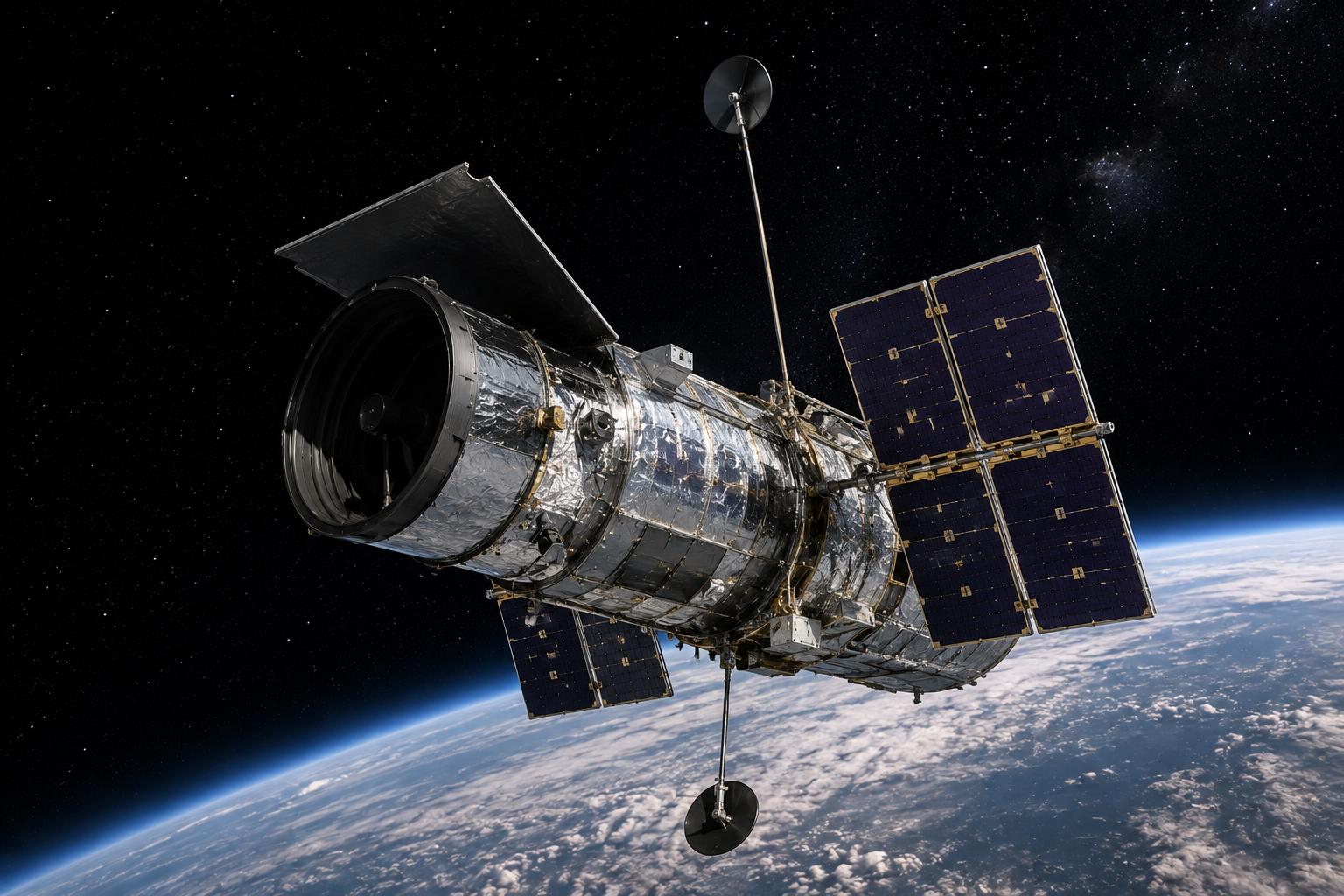
- Roman has a Hubble-sized 2.4-metre mirror but can capture at least 100 times more sky in a single observation.
- NASA says Roman could survey up to 1,000 times faster than Hubble with comparable sensitivity and infrared resolution.
- Roman will study dark matter, dark energy, galaxies and exoplanets after reaching L2 and completing commissioning.
Imagine Hubble — Then Open the View 100 Times Wider
For more than three decades, Hubble has given humanity extraordinary close-up views of the universe.
Roman is designed for a different kind of job.
Imagine looking through a window and seeing one incredibly detailed piece of a city.
Now imagine keeping roughly that level of detail but suddenly making the window 100 times larger.
That is essentially the advantage Roman brings to astronomy.
Roman has a 7.9-foot (2.4-metre) primary mirror, the same diameter as Hubble’s. But its Wide Field Instrument can capture an area of sky at least 100 times larger than Hubble can in a comparable pointing.
NASA describes Roman as Hubble’s “wide-eyed cousin.”
A single Roman image can contain approximately the equivalent detail of 100 Hubble images.
That changes the scale at which astronomers can investigate the universe.
Instead of choosing between looking deeply and looking widely, Roman is designed to do both remarkably well.
NASA says it could survey the sky up to 1,000 times faster than Hubble while maintaining similar sensitivity and infrared resolution.
Over Roman’s first five years of observations, NASA expects it to image more than 50 times as much sky as Hubble covered in 30 years.
Roman Is Going After One of the Universe’s Biggest Mysteries
Look around the universe and there is an uncomfortable scientific reality:
Much of it remains unexplained.
Ordinary matter — stars, planets, people, gas and everything else made from familiar atoms — represents only a small portion of the cosmic picture.
Two of Roman’s central targets are dark matter and dark energy.
Dark matter does not behave like ordinary visible matter, but scientists can infer its presence from its gravitational effects.
Dark energy is the name given to whatever appears to be connected with the accelerating expansion of the universe.
Roman’s enormous surveys will allow scientists to study huge populations of galaxies and map how matter is distributed across cosmic history.
One method will involve weak gravitational lensing.
Mass bends space-time, which can slightly distort the appearance of more distant galaxies. Measuring those tiny distortions across enormous areas of sky can help researchers reconstruct how matter is distributed.
One galaxy provides limited information.
Millions — and eventually measurements involving enormous populations of galaxies — can reveal patterns.
NASA says Roman could measure light from approximately one billion galaxies over its mission lifetime.
That scale is one reason Roman exists.
Then There Are the Planets — Potentially a Lot of Them
Roman will also become a major planet hunter.
But there is an important distinction behind some of the enormous exoplanet numbers associated with the mission.
Roman's dedicated gravitational microlensing survey will watch stars toward the crowded centre of the Milky Way.
Microlensing happens when a foreground object passes almost perfectly in front of a more distant star from our perspective.
The foreground object's gravity bends and magnifies the background star's light.
If a planet accompanies that foreground star, it can leave an additional signature in the changing light.
NASA currently expects Roman's microlensing observations to discover thousands of planets, including worlds in regions of planetary systems that other detection techniques can struggle to reach.
But Roman has another trick.
Where the “100,000 Planets” Number Comes From
Roman will repeatedly observe enormous numbers of stars.
Those same observations can also be searched for planetary transits — tiny reductions in a star's brightness caused when an orbiting planet passes between the star and the telescope.
NASA says scientists expect Roman's observations could reveal more than 100,000 planets through transits.
That does not mean Roman has discovered 100,000 planets.
It does not mean scientists know exactly how many it will ultimately find either.
It is a forecast of what the mission's observations could reveal.
That distinction matters.
Roman's value isn't simply that it may add another giant number to the exoplanet catalogue. Its different observing methods could help astronomers understand what kinds of planetary systems exist across the Milky Way — including worlds that previous planet-hunting surveys have been less sensitive to.
Roman Will Even Try to Photograph Planets Directly
Finding a planet is one challenge.
Actually separating its light from the overwhelming glare of its star is another.
Imagine trying to see a firefly hovering beside a lighthouse from an enormous distance.
Roman carries a Coronagraph Instrument designed as a technology demonstration for high-contrast observations of nearby planetary systems.
The instrument suppresses starlight so much fainter objects around a star can become visible.
Roman isn't being sent into space primarily to find a second Earth with this instrument.
Instead, the coronagraph is an important technology step.
NASA hopes techniques demonstrated by Roman can help future observatories become capable of directly studying smaller and increasingly Earth-like worlds.
In other words, some of Roman's most important discoveries may not be planets it finds itself.
They could be technologies that help the next generation of telescopes see farther.
Roman Could Turn Astronomy Into a Data Problem
There is another side of Roman that won't produce spectacular launch photographs.
Data.
Wide-field observations mean enormous datasets.
Instead of an astronomer simply pointing a telescope at one interesting galaxy, Roman can repeatedly photograph vast sections of sky containing extraordinary numbers of objects.
That opens the door to what is effectively cosmic time-lapse photography.
A star brightens.
Something explodes.
An object moves.
A distant source suddenly appears.
Roman can repeatedly observe large areas, allowing scientists to compare what the sky looked like yesterday, last month or last year.
And when billions of objects are involved, researchers may discover things they weren't originally searching for.
That could become one of Roman's most interesting legacies.
The Telescope Is Named After the “Mother of Hubble”
There is also a fitting connection between Roman and Hubble.
The observatory is named after Nancy Grace Roman, NASA's first chief astronomer.
Roman played a major role in establishing space-based astronomy at NASA and became known as the “mother of Hubble” because of her work advocating for a large space telescope.
Decades later, a telescope bearing her name has been launched with a mirror the same diameter as Hubble's — but with a radically wider view of the universe.
TwikUp Insight
Roman's biggest advantage may not be that it can look farther than every telescope before it.
It is scale.
Hubble demonstrated how much science can come from extraordinarily detailed observations of carefully selected pieces of the universe.
Roman takes another approach:
What happens when astronomers get that kind of detail across vastly larger areas of sky?
That's where unexpected discoveries become particularly interesting.
A telescope can be designed to investigate dark energy or search for planets.
But once scientists have an enormous public archive containing observations of billions of cosmic objects, researchers can ask questions that the engineers who built Roman may never have anticipated.
That may ultimately be Roman's most powerful feature.
It isn't only a telescope built to answer existing questions.
It's a machine capable of producing enough astronomical information to create entirely new ones.
So When Do We Actually See Roman's Discoveries?
Not tomorrow.
Roman's successful launch is an important milestone, but launching the telescope is not the same as beginning science operations.
The spacecraft now has to travel roughly 1 million miles toward L2.
NASA says the journey, deployments, instrument activation, calibration and testing form part of an approximately three-month commissioning period.
Only after engineers confirm that the observatory and its instruments are operating correctly can Roman begin the scientific work it was built to perform.
So August 30, 2026, shouldn't be remembered as the day Roman solved the mystery of dark energy or discovered thousands of planets.
It is the day humanity successfully sent the telescope that will try.
And somewhere around a million miles from Earth, a new pair of extraordinarily wide eyes is now on its way to work.