
Key Takeaways
- NASA ended Swift's mission after nearly 22 years, far beyond its planned two-year primary mission.
- Swift observed more than 2,000 gamma-ray bursts and produced an archive that will remain available to researchers.
- Atmospheric drag and recent solar activity accelerated Swift's descent toward re-entry.
NASA has ended the mission of the Neil Gehrels Swift Observatory, the satellite that spent more than two decades racing to catch gamma-ray bursts — the most powerful explosions in the universe. The spacecraft is now falling toward Earth and is expected to re-enter the atmosphere within the next few weeks.
A mission that outlived its plan tenfold
Swift launched on November 20, 2004, designed for a two-year primary mission: detect gamma-ray bursts, pinpoint them within seconds, and swing its telescopes around to study them before they faded. It ended up working for nearly 22 years.
According to NASA, Swift observed more than 2,000 gamma-ray bursts and helped astronomers study everything from exploding stars to supermassive black holes. Its observations underpin about 7,000 scientific papers, and its public archive — some 12 terabytes of data, including 1.5 million ultraviolet and optical images — will remain available to researchers. In 2018, the observatory was renamed for its first principal investigator, Neil Gehrels.
"Swift delivered an incredible, lasting return on investment for the nation, designed for a two-year primary mission but productive for more than 10 times as long," said Shawn Domagal-Goldman, director of NASA's Astrophysics Division.
Why it had to end
All satellites in low Earth orbit are slowly dragged down by the upper atmosphere, and recent solar activity made that drag much worse. A fast-turnaround commercial servicing mission meant to boost Swift to a higher orbit ended in August without attempting the boost.
Swift restarted science observations afterward — hundreds more targets, from stellar explosion remnants to comets — but the sinking accelerated. On October 20, the spacecraft reached just 171 miles (275 kilometres) above Earth, too low for its telescopes to hold steady. It entered safe mode, and the operations team at Penn State University sent the command that ended operations, preparing the satellite for re-entry.
NASA says most of the spacecraft is expected to burn up on re-entry, and it is posting updates on its Swift mission blog.
Sources
- NASA Science: https://science.nasa.gov/blogs/swift/2026/10/23/nasas-swift-mission-ends-ahead-of-re-entry/
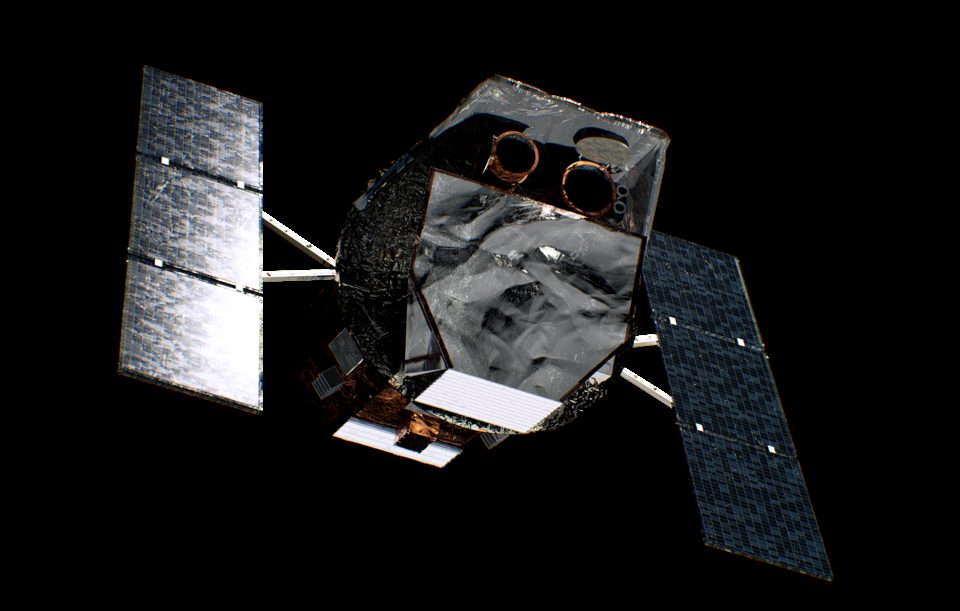
Image: NASA / Goddard Space Flight Center (public domain) — artist's rendering of the Swift observatory.