
Key Takeaways
- Webb imaged N159, a star-forming region 161,000 light-years away in the Large Magellanic Cloud.
- The infrared image traces hydrocarbons, ionised hydrogen and dense molecular hydrogen filaments around newborn stars.
- N159's low heavy-element content makes it a useful stand-in for star formation in the early Universe.
A stellar nursery, up close
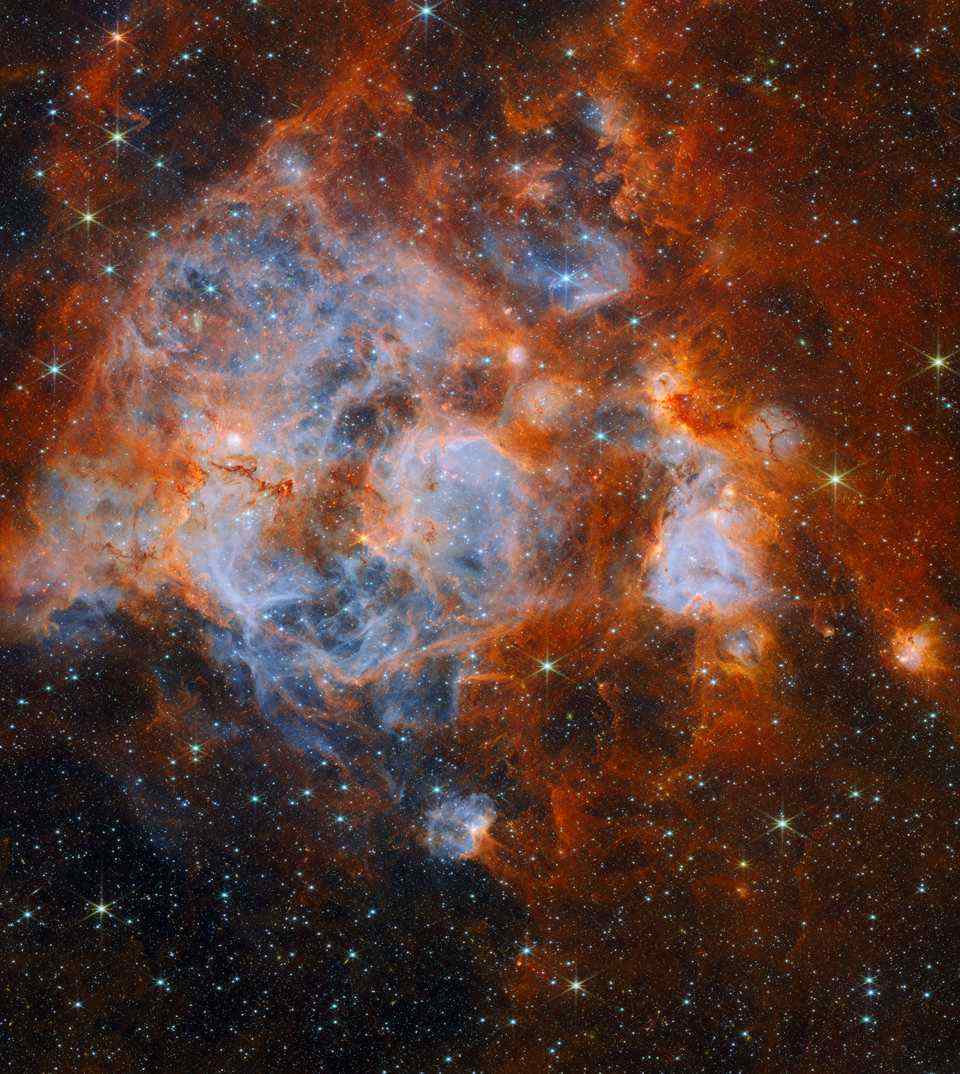
The James Webb Space Telescope has imaged a vast region of gas and dust where thousands of stars are at their earliest stages of formation.
The region, known as LHA 120-N 159 (or N159), sits 161,000 light-years away in the Large Magellanic Cloud, a satellite galaxy of the Milky Way. Webb's image spans about 230 light-years across. At less than 3 million years old, N159 is one of the youngest star-forming regions in the Large Magellanic Cloud.
How to read the colours
Webb's infrared view turns the scene into a kind of map. The orange clouds show light emitted by polycyclic aromatic hydrocarbons, carbon-based molecules. The bright blue pools are hydrogen gas ionised by ultraviolet light from massive stars.
Dark red filaments cross the centre of the image. They are made of cool molecular hydrogen and are among the nebula's densest material. The filaments shield new stars from harsh radiation and stellar winds, though they will eventually dissipate.
The bright blob at the left is the Papillon Nebula, a compact region of ionised hydrogen thought to be linked to the formation of massive stars. It was first resolved by the Hubble Space Telescope in 1999.
Why astronomers care
The Webb data allowed astronomers to detect extremely dim stars with less than a tenth of the Sun's mass and to distinguish larger, hotter, fully evolved stars from young stellar objects still wrapped in thick clouds. Young stellar objects are more concentrated in N159's western region, indicating that it is at an earlier stage of collapse to form stars.
The Large Magellanic Cloud's proportion of elements heavier than hydrogen and helium is significantly lower than the Milky Way's. That gives researchers an opportunity to study H II regions in conditions more similar to those in the early Universe.
Image credit: ESA/Webb, NASA & CSA, E. Sabbi, M. Zamani (ESA/Webb). Acknowledgement: M. H. Özsaraç.
Image: ESA/Webb, NASA & CSA, E. Sabbi, M. Zamani (ESA/Webb) (CC BY 4.0) — the star-forming region N159 in the Large Magellanic Cloud, photographed by the James Webb Space Telescope.