
Key Takeaways
- Analyst estimates provide a benchmark for judging quarterly results, but the quality and reliability of those estimates also matter.
- A company can report higher earnings while weakening its future outlook through lower margins, rising costs or slower demand.
- Investors should examine the complete earnings announcement rather than making decisions based on a single headline number.
What Is an Earnings Surprise?
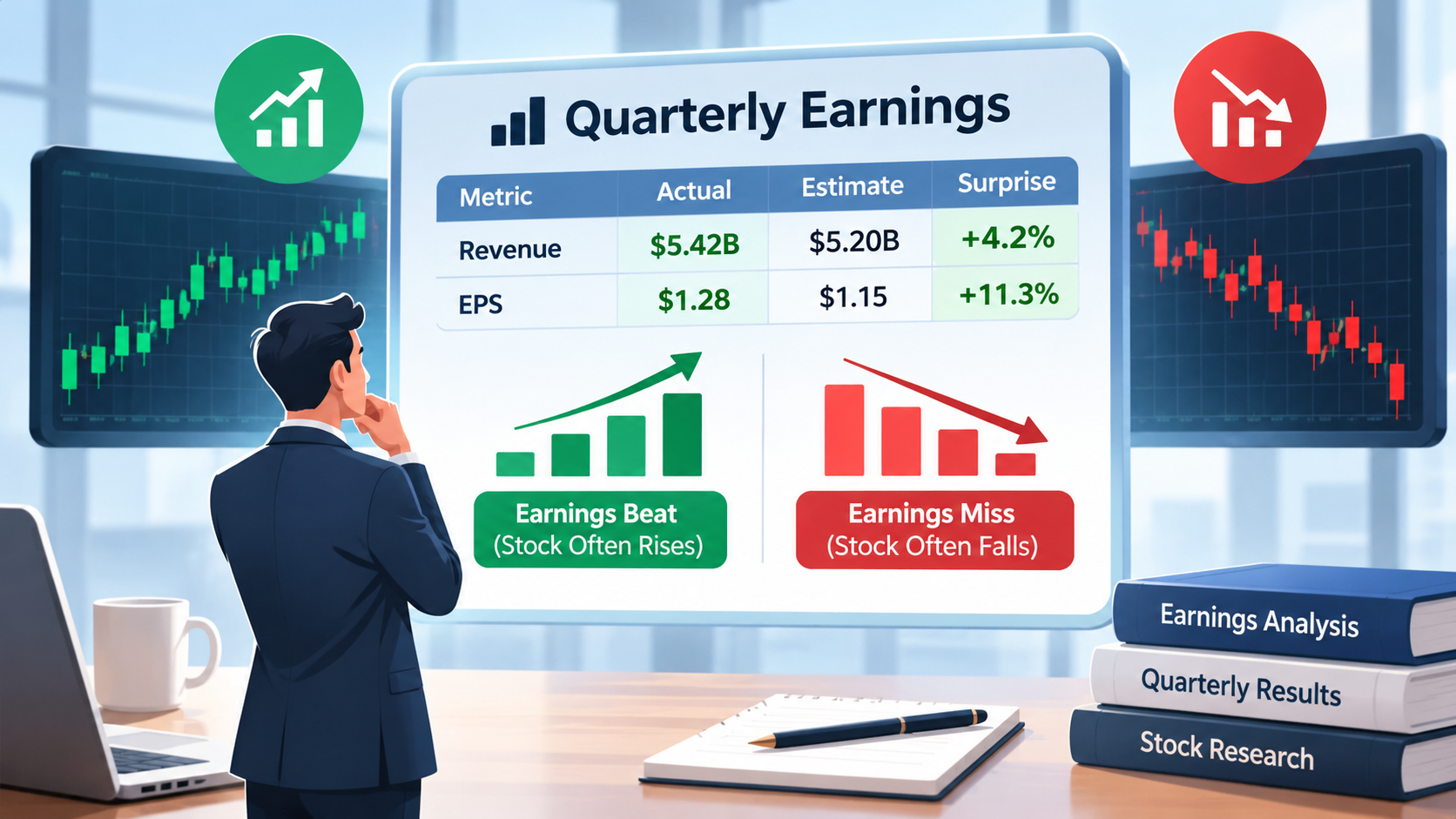
An earnings surprise occurs when a company reports earnings that differ from analysts' expectations. When reported earnings exceed the analyst consensus estimate, investors call it a positive earnings surprise or an earnings beat. When earnings fall below that estimate, it is a negative surprise or an earnings miss.
The important detail is that an earnings surprise measures performance against expectations, not simply against the previous year's results. A company can increase its profits and still disappoint investors if analysts expected a much larger improvement.
For example, imagine analysts expect a company to report earnings per share (EPS) of $1.50, but it announces $1.70. The company has delivered a positive surprise. Whether that result makes the stock attractive is a separate question.
How Do You Calculate an Earnings Surprise?
The basic calculation is straightforward:
Earnings surprise = Actual EPS − Consensus EPS
To express the difference as a percentage:
Earnings surprise (%) = (Actual EPS − Consensus EPS) ÷ |Consensus EPS| × 100
Suppose analysts expect EPS of $2.00 and the company reports $2.30.
- Actual EPS: $2.30
- Expected EPS: $2.00
- Difference: $0.30
- Earnings surprise: 15%
The company has beaten the estimate by 15%.
This is an illustrative calculation, not a prediction of how the stock will perform. Percentage comparisons can become misleading when the consensus estimate is zero or negative. In those situations, the per-share difference and the company's underlying financial performance are more useful than a simple percentage.
Investors should also check whether the company is reporting adjusted EPS or earnings calculated under its applicable accounting standards. Comparing adjusted earnings with an unadjusted estimate can create a misleading impression.
Why Can a Stock Fall After an Earnings Beat?
A positive earnings surprise does not guarantee a rising share price. Investors are assessing whether the results are better than what they had already expected and whether the improvement can continue.
Consider a company that reports EPS of $1.10 against an estimate of $1.00. At first glance, that looks encouraging. However, revenue might have missed expectations, operating margins could have contracted, and management might have lowered its forecast for the next quarter.
The market may interpret the headline beat as weaker than it first appears.
Other reasons for a negative reaction include:
- Expectations were too high: Investors may have anticipated a much larger earnings beat.
- Weak future guidance: Management may expect slower sales or higher expenses.
- One-time gains: Reported profit may have benefited from an unusual event rather than stronger operations.
- Valuation pressure: The share price may already reflect an optimistic growth outlook.
The market is not simply rewarding a company for reporting a profit. It is constantly reassessing what that profit means for future business performance.
Why Can a Stock Rise After an Earnings Miss?
A company can miss its earnings estimate and still see its shares rise. This can happen when the report contains encouraging information that matters more to investors than the shortfall itself.
For instance, a business might report EPS of $0.90 against an estimate of $1.00. Yet revenue could grow faster than expected, customer demand might improve, and management could raise its full-year forecast.
Investors may decide that the missed estimate is temporary while the business outlook is improving.
Previous market expectations also matter. If a stock has already fallen because investors feared a much larger disappointment, a less damaging result can trigger a recovery. This does not mean the earnings miss was good news; it means the announcement was better than the market's earlier concerns.
What Should Investors Check Beyond EPS?
EPS is only one part of a company's financial performance. A useful earnings review should include several other measures.
Revenue growth: Check whether sales exceeded expectations and whether growth came from higher demand, pricing or acquisitions.
Operating margins: A company can increase revenue while earning less profit from each dollar of sales. Compare current margins with previous quarters and the same period last year.
Cash flow: Accounting earnings do not always translate into cash. Review operating cash flow to understand whether the business is collecting money from customers and funding its operations.
Management guidance: Look for changes in expected revenue, margins, capital spending and demand. Guidance can reset the estimates investors use to value a business.
Balance sheet: Rising debt, weaker liquidity or higher interest expenses can make an apparently strong quarter less reassuring.
Where Can Investors Find Quarterly Earnings Results?
In the United States, public company filings are available through the SEC's EDGAR database. Investors can review Form 10-Q quarterly reports, which include financial statements and management's discussion of results. Many earnings releases are also furnished under Item 2.02 of Form 8-K.
In Canada, investors can use SEDAR+ to access reporting issuer disclosures. Interim financial statements and management's discussion and analysis provide additional context about a company's financial position and performance.
Do not rely only on a short earnings headline. Compare the announcement with earlier reports and read management's explanations. Our guide on how to read an annual report before investing can help investors examine the wider business picture.
TwikUp's Perspective: The Surprise Is Only the Starting Point
Two companies can deliver the same 10% earnings beat and deserve very different reactions. One might achieve it through stronger customer demand, better pricing and improved operating efficiency. Another might rely on a temporary tax benefit while its core business weakens.
It is also worth considering how much optimism is already reflected in the stock price. Even excellent results can disappoint when a company's valuation assumes unusually strong growth for years. A business with modest results may receive a positive response if investors had prepared for something much worse.
A practical approach is to compare reported figures with estimates, examine the reasons behind the difference, assess management's outlook and review the assumptions supporting the current valuation. Investors can then decide whether the announcement changes the long-term business case rather than reacting automatically to a green or red earnings headline.
Disclaimer
This article is for educational and informational purposes only. It is not personalized investment or financial advice. Earnings announcements can create significant share-price volatility. Investors should conduct independent research and consider their financial circumstances before making investment decisions.