
Key Takeaways
- The CEO's letter and management commentary explain the company's narrative, but investors should verify those claims against audited financial statements.
- Comparing consolidated results across several years can reveal whether growth is broad-based or dependent on a small part of the business.
- Auditor comments, accounting notes, related-party transactions and contingent liabilities can expose details that headline earnings figures do not show.
Why Should Investors Read an Annual Report?
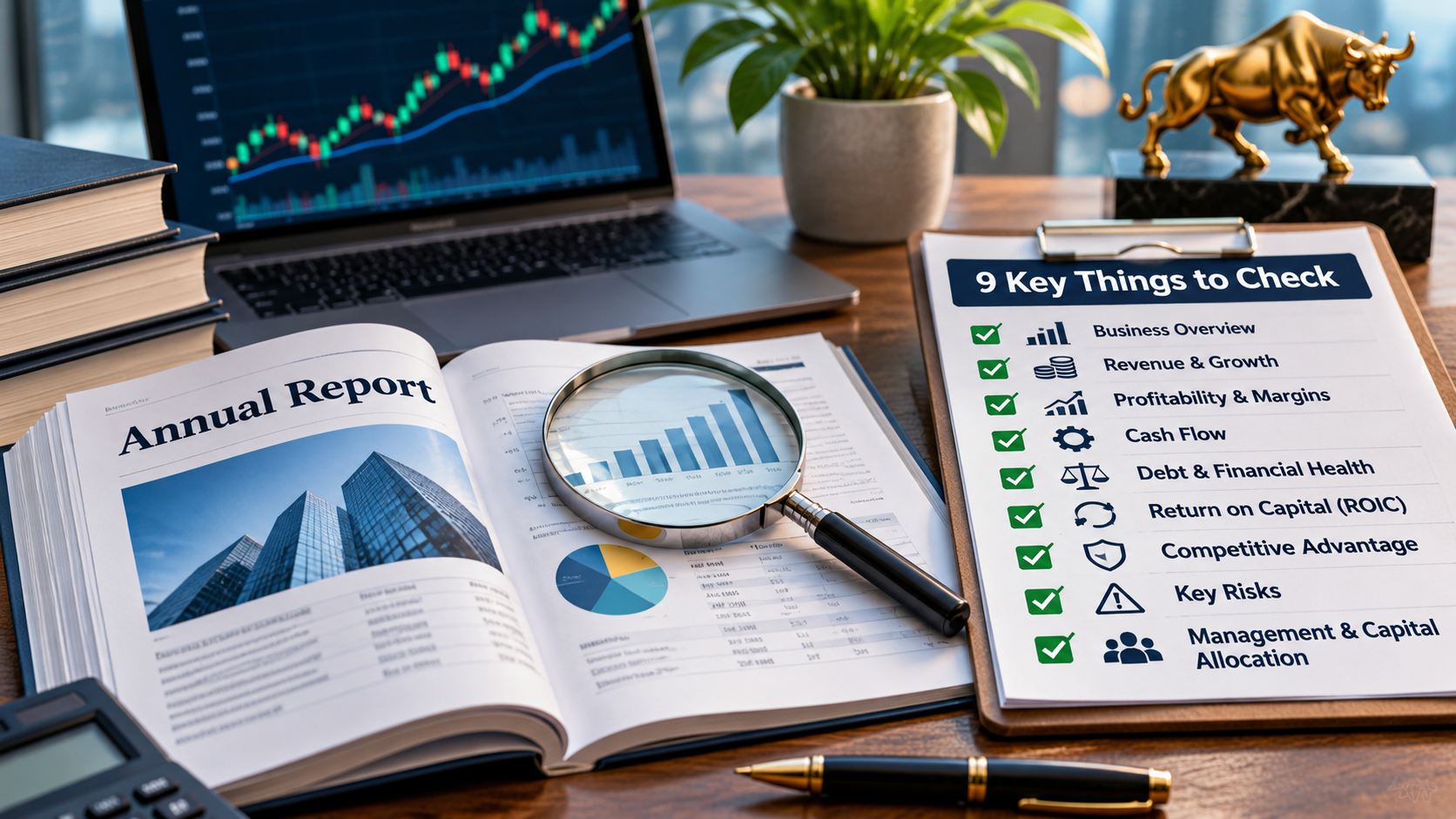
An annual report is one of the most useful documents for understanding a public company before purchasing its shares. It brings together information about the business, management decisions, financial performance, risks and obligations.
But reading every page from beginning to end is rarely the best approach. Large companies can publish lengthy reports containing financial schedules, legal disclosures and operational updates. Investors need a clear reading strategy that connects the company's story with the evidence behind it.
The objective is simple: understand how the company makes money, examine how well it performs and identify what could weaken its future prospects.
Start With the Business Overview and CEO's Letter
Begin by understanding what the company actually sells, who its customers are and which markets contribute to its revenue.
The business overview should help you identify its main products, services, operating segments, competitors and geographic exposure. A company may describe itself as a technology business, for example, but its revenue could depend heavily on one product or a small number of major customers.
Next, read the CEO's letter to shareholders. It provides management's explanation of important developments, strategic priorities and future plans.
Pay attention to what management discusses and what it avoids explaining. If the letter celebrates revenue growth but says little about falling margins or rising debt, investigate those areas in the financial sections.
Read Management's Discussion and Analysis
Management's Discussion and Analysis, commonly called MD&A, explains the financial results from management's viewpoint. This section is particularly useful because it connects reported numbers with business developments. Look for explanations of revenue changes, operating costs, margins, liquidity, capital expenditure and major business challenges.
Suppose a company reports 20% revenue growth. The MD&A may explain that an acquisition contributed significantly to the increase. That is different from achieving the same growth through stronger demand from existing customers.
For Canadian reporting issuers, MD&A is an important continuous disclosure document. In the United States, the equivalent discussion appears in the Form 10-K under Management's Discussion and Analysis of Financial Condition and Results of Operations.
Examine the Three Main Financial Statements
The financial statements test whether the company's narrative is supported by its reported performance. The income statement shows revenue, expenses and profit. Examine revenue growth, gross margins, operating income and net income across multiple years. Consistent improvement can indicate a stronger business, while rising revenue alongside declining margins deserves investigation.
The balance sheet shows assets, liabilities and shareholders' equity. Review cash, borrowings, receivables, inventory and debt obligations. A company can report attractive profits while carrying a balance sheet that leaves little room for unexpected difficulties.
The cash flow statement explains how cash enters and leaves the business. Compare operating cash flow with reported earnings and examine how much money remains after capital expenditure.
Compare Several Years Instead of Trusting One Result
One strong financial year does not establish a lasting pattern. Compare at least three years of revenue, operating profit, net income, debt and operating cash flow. Five years can provide a broader picture when the information is available and business conditions have remained reasonably comparable.
Consider this illustrative example:
A company increases revenue from $100 million to $130 million over three years, but its operating profit remains close to $10 million.
Revenue has expanded, yet operating profitability has not improved alongside it. Higher operating costs, pricing pressure or an expensive expansion programme could explain the difference. The next step is to investigate the relevant disclosures rather than assume the company is performing well simply because sales are increasing.
Read the Auditor's Report and Notes Carefully
The auditor's report provides an independent opinion on the financial statements under the applicable auditing standards. Read the opinion rather than simply looking for the auditor's name.
An unmodified opinion is not a guarantee that a company is financially healthy or that its shares are attractively priced. A qualified opinion, adverse opinion or disclaimer of opinion deserves careful examination.
Also review the notes accompanying the financial statements. They explain accounting policies, debt arrangements, lease obligations, revenue recognition, legal contingencies and related-party transactions.
For example, a company may report a manageable debt balance on its balance sheet while the notes reveal significant repayment obligations in the coming years. Pay particular attention to changes in accounting estimates and unusual transactions. Their effects can influence how investors interpret reported earnings.
Identify Risk Factors and Corporate Governance Issues
The risk section explains what could disrupt the company's operations or financial performance. Look for customer concentration, regulatory exposure, competition, supply-chain dependence, foreign exchange movements, litigation and refinancing requirements.
A company that relies on one customer for a large share of revenue faces a different risk profile from one serving thousands of independent customers. Corporate governance disclosures deserve attention too. Review board oversight, executive compensation, related-party dealings and significant changes in senior management.
These details help investors understand whether management incentives and business decisions appear aligned with shareholder interests.
TwikUp's Perspective: Build an Investment Case From Evidence
An annual report should help you form a list of questions, not push you towards an immediate buy or sell decision. A useful approach is to create three columns while researching: management's claims, financial evidence and unresolved concerns.
For example, management may describe a new product as a major growth opportunity. The financial statements may show increased research spending, while the risk disclosures mention uncertain customer demand. Together, these details create a more balanced picture than the CEO's statement alone.
You should also compare the company's business advantages with its financial performance. TwikUp's guide to ETF Overlap Explained can help connect competitive strength with long-term business quality.
Finally, remember that a financially strong company is not automatically a good investment at every share price. Use the annual report to assess business quality, then examine valuation, expected growth and the risks already reflected in the market price.
Disclaimer
This article is for educational and informational purposes only. Annual reports provide important information but cannot predict future business performance or investment returns. Investors should independently assess financial statements, valuation, business risks and personal financial circumstances before making investment decisions.