
Key Takeaways
- An economic moat is a structural advantage that helps a company defend its profitability against competitive pressure.
- Customer switching costs, network effects, intangible assets, cost advantages and efficient scale can create different forms of protection.
- Investors need evidence of durability, not just a popular brand or impressive historical returns, before assigning a company a lasting competitive advantage.
What Is an Economic Moat?
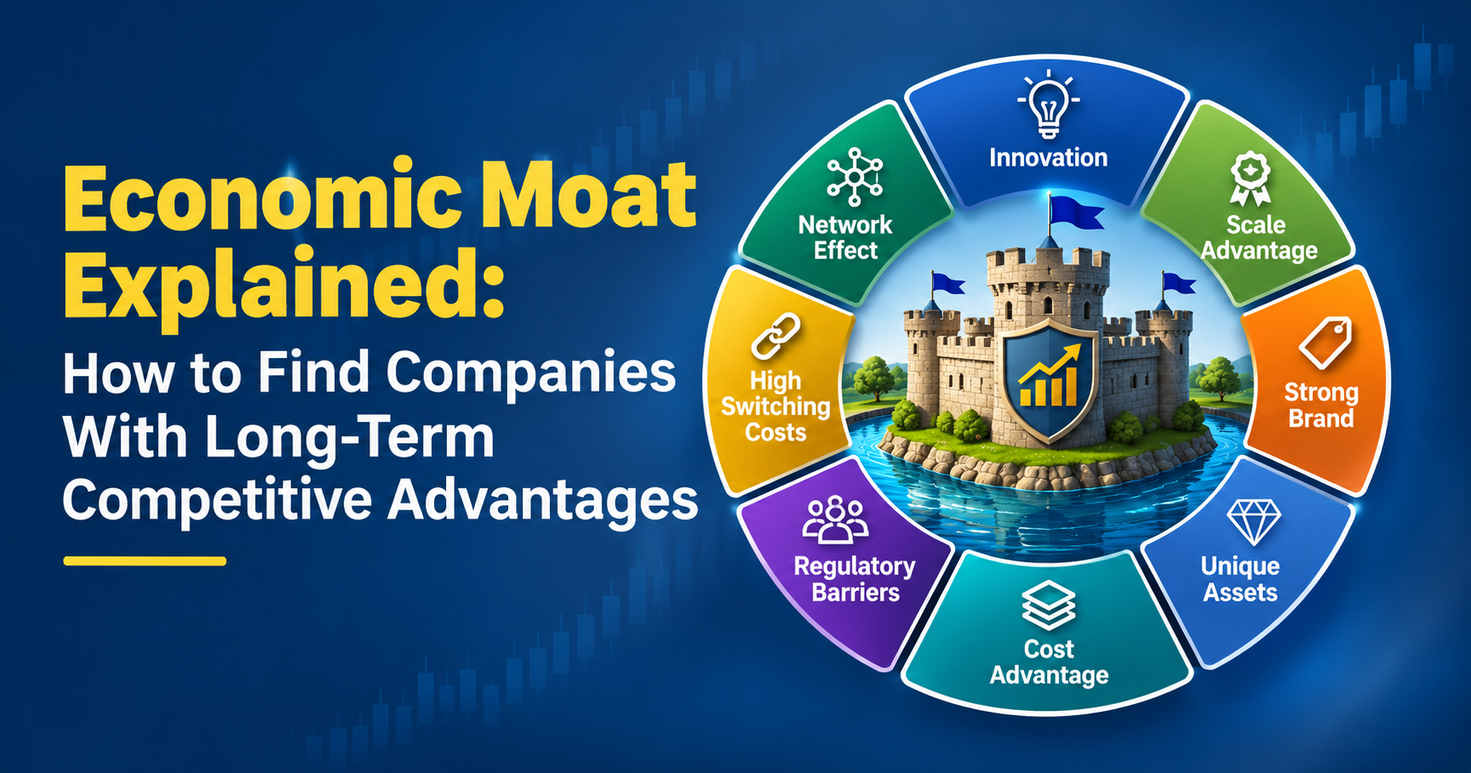
An economic moat is a durable competitive advantage that helps a company protect its market position and profitability from rivals. The idea is similar to a castle surrounded by a moat: the business is the castle, while its competitive advantages make it harder for competitors to take customers or copy its success.
For investors, the important question is not simply whether a company is profitable today. It is whether competitors can easily weaken those profits tomorrow. A business that consistently earns returns above its cost of capital may have an advantage worth investigating, particularly when there is a clear reason that rivals cannot quickly reproduce it.
What Are the Five Main Sources of an Economic Moat?
Morningstar identifies five commonly recognised sources of economic moats. A company may benefit from one or several, depending on its business model and industry.
1. Intangible assets: Patents, licences, proprietary technology and trusted brands can make it difficult for competitors to offer an equivalent product. A pharmaceutical company with protected intellectual property, for example, may have a period in which rivals cannot legally sell an identical treatment.
2. Switching costs: Customers may stay with a provider because changing systems involves expense, disruption, training or lost data. Enterprise software is one example: replacing a deeply integrated platform can require substantial time and operational effort.
3. Network effects: A service becomes more useful as more people use it. A payment network, for instance, can become more valuable when additional merchants and customers accept it.
4. Cost advantage: Some businesses can produce, purchase or distribute goods at a lower cost than competitors. They may charge lower prices while protecting margins, or maintain market prices and earn stronger profits.
5. Efficient scale: A limited market may support only a small number of providers. If a new competitor cannot enter profitably without reducing returns for everyone, established companies may benefit from a structural advantage.
These sources are not automatic guarantees of success. Their strength depends on how difficult they are to copy and whether they remain relevant as technology, customer behaviour and regulation change.
How Can Investors Identify an Economic Moat?
Start by examining the company's business model. Identify what customers value, why they choose the company, and what would make them switch. A well-known name alone is not enough. The company must show that its reputation, product, distribution or customer relationships translate into a measurable business advantage.
Next, study financial performance across several years. Look at operating margins, return on invested capital (ROIC), revenue stability and cash generation. Consistently strong returns can support the moat argument, but they do not prove it by themselves. Investors need to connect the numbers to a defensible reason competitors struggle to match the business.
Review the company's annual reports for discussion of customer retention, pricing, market competition, research spending, patents and major risks. Compare these claims with actual results rather than accepting management's descriptions at face value.
Which Financial Signals Can Support a Moat Analysis?
ROIC is a useful starting point because it measures how effectively a company generates operating returns from invested capital. If a business earns returns above its estimated cost of capital over a long period, it may be creating economic value.
However, one strong year is not convincing evidence. Check whether returns remain resilient through changing economic conditions and competitive challenges. Also examine operating margins. A company with pricing power may be able to absorb higher costs without suffering the same margin pressure as weaker rivals.
Free cash flow provides another perspective. A business may report accounting profits but still require heavy investment to maintain its position. Review capital expenditure, working-capital requirements and cash conversion.
What Can Destroy a Company's Economic Moat?
Competitive advantages are not permanent. New technology can make an established product less relevant. A patent may expire, customers may find easier alternatives, or a competitor may develop a cheaper production method.
Regulatory changes can also weaken an advantage, particularly when a business relies heavily on licences, exclusive distribution arrangements or industry rules. In other cases, management decisions can damage customer trust or allow a competitor to improve its offering.
Investors should look for warning signs such as falling customer retention, shrinking margins, rising customer acquisition costs and declining returns on capital. These developments do not automatically mean the moat has disappeared, but they deserve investigation.
Does a Strong Economic Moat Make a Stock a Good Buy?
Not necessarily. Business quality and investment price are separate questions. A company may have an excellent competitive position but trade at a valuation that already assumes years of strong growth.
Investors should estimate what the business is worth, consider realistic future expectations and compare the share price with that estimate.
TwikUp's Perspective: Look for Evidence, Not Just a Good Story
A convincing moat analysis connects a company's competitive position to measurable financial outcomes. If customers remain loyal, margins stay resilient and returns on capital remain attractive, investors have evidence worth examining. If the explanation relies mainly on brand reputation or management promises, the case is incomplete.
It is also important to compare businesses within their industries. A software company and a grocery retailer may protect their customers in completely different ways. Applying identical margin or growth expectations to both can lead to poor conclusions.
Investors can use ROIC vs ROE to explore how effectively businesses use capital, but no single ratio can establish a moat. The strongest analysis combines industry knowledge, financial history, customer behaviour and a realistic assessment of future threats.
Disclaimer
This article is for educational purposes only and does not constitute personalized investment or financial advice. Competitive advantages can weaken or disappear, and historical financial performance does not guarantee future results. Investors should evaluate company fundamentals, valuation and risk before making investment decisions.