
Key Takeaways
- Different ETF names and benchmarks do not guarantee different underlying investments.
- Comparing the percentage weight of shared securities provides a more useful picture than simply counting common holdings.
- Overlap can be intentional, but investors should understand its effect on company, sector and geographic exposure before adding another fund.
ETF Overlap Explained: Why Different Funds Can Own the Same Stocks
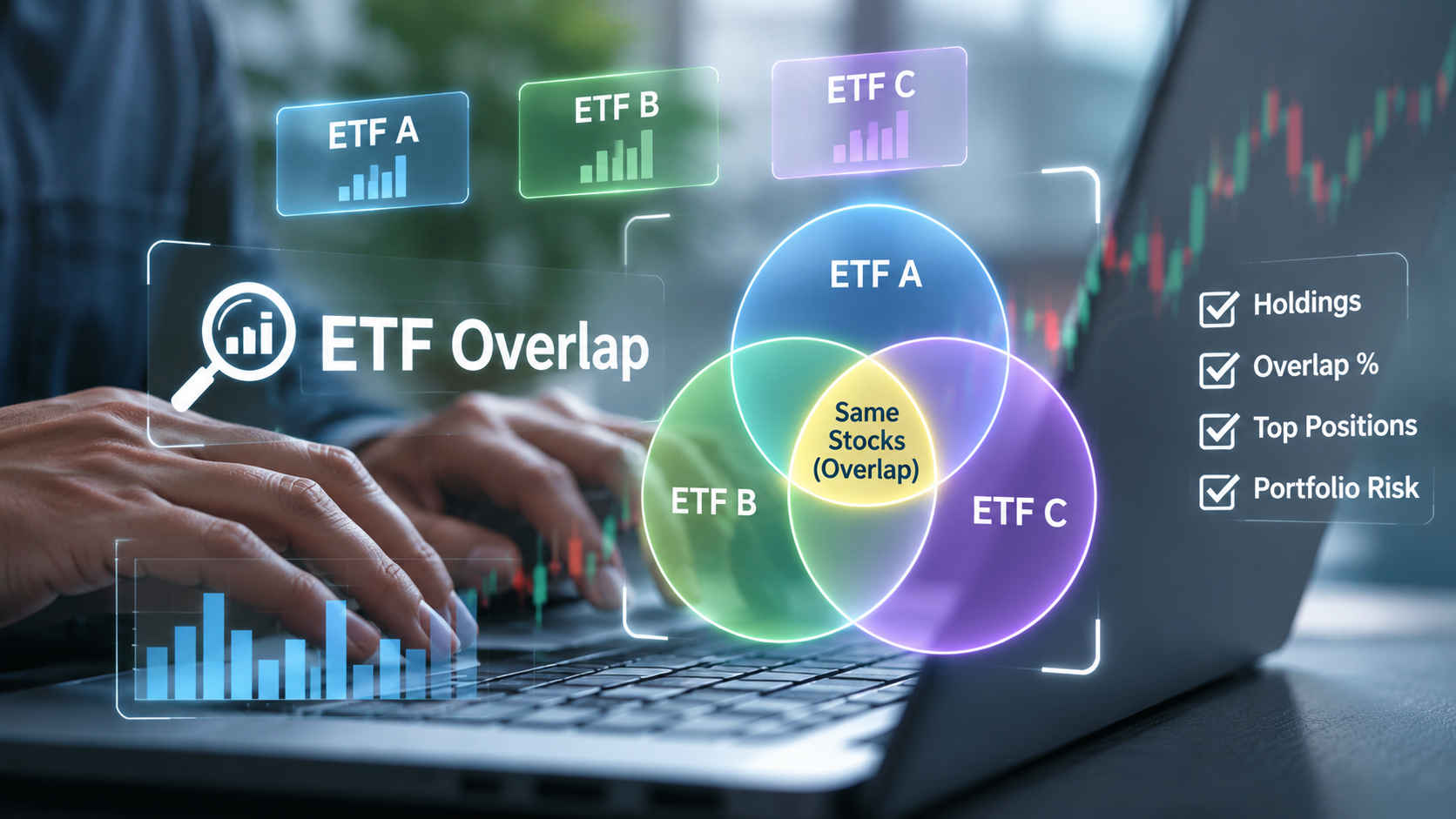
Owning several exchange-traded funds does not automatically create a diversified portfolio. Two ETFs can follow different indexes, use different investment strategies or carry different names while holding many of the same companies.
This is known as ETF overlap. It occurs when multiple funds in a portfolio invest in identical underlying securities. The result can be greater exposure to certain companies or sectors than an investor originally intended.
The problem is not that overlap exists. It is that investors may mistake several fund positions for several independent sources of diversification.
How Does ETF Overlap Work?
An ETF pools investors' money and holds a collection of securities based on its investment objective. When an investor owns two ETFs, the underlying portfolios may share companies even though the funds are separate investments.
For example, imagine holding a broad-market ETF and a technology-focused ETF. The broad-market fund may already own large technology companies. Buying the technology fund adds more exposure to some of those same businesses.
This can create concentration without making it obvious from the portfolio's list of tickers. The US Securities and Exchange Commission explains that investors should examine an ETF's holdings and investment strategy rather than assume every fund provides broad diversification.
How to Calculate ETF Overlap
A useful way to compare two ETFs is to examine the weight assigned to securities they both hold. For each shared stock, take the smaller of its percentage weight in the two funds and add those amounts together.
Formula:
Overlap = Sum of the lower weight for each shared holding
Suppose ETF A holds Company X at 6% and Company Y at 4%. ETF B holds Company X at 3% and Company Y at 5%.
The shared-weight calculation is:
Company X: 3%
Company Y: 4%
Total weighted overlap: 7%
This is a simplified pairwise measure, not the percentage of your entire personal portfolio invested in duplicated securities. It also does not measure how similarly the funds behave in every market condition.
Counting common stocks is another method, but it can be misleading. Two funds may share many small positions while allocating very different amounts of money to those companies. Weight-based comparison better reflects the financial exposure.
How to Check Whether Your ETFs Hold the Same Stocks
Start with each fund's official holdings disclosure. Look for its top investments, sector allocation, geographic exposure and underlying index. Then compare the holdings using the same reporting date whenever possible.
In Canada, investors can review the ETF Facts document. The Canadian Securities Administrators explains that it provides information about a fund's investments, top holdings, investment mix, risk rating and costs.
In the United States, investors can consult the ETF issuer's website, prospectus and shareholder reports. The SEC notes that most ETFs publish portfolio holdings on their websites daily, making it possible to inspect their underlying investments.
An ETF overlap calculator can speed up comparisons, but check its data source, holdings date and calculation method. A tool using only the largest ten positions may miss overlap among smaller holdings.
Calculate Your Actual Portfolio Exposure
Comparing two funds is useful, but investors also need to understand how much of their total portfolio is exposed to each company.
Consider a hypothetical portfolio with $6,000 in ETF A and $4,000 in ETF B. If Company X represents 6% of ETF A and 8% of ETF B, the exposure is:
ETF A: $6,000 × 6% = $360
ETF B: $4,000 × 8% = $320
Combined exposure: $680
Company X therefore represents 6.8% of the $10,000 portfolio, before considering any shares held directly or through other funds.
Repeat this calculation for major shared holdings. Include direct stock positions as well. This look-through approach gives a more realistic picture than treating each ETF as a completely separate investment.
When Is ETF Overlap a Problem?
Overlap deserves attention when it creates more concentration than an investor intended. A broad-market fund combined with a sector fund may increase exposure to a particular industry or a small group of large companies.
It can also create unnecessary complexity. Investors may pay multiple fund expenses while receiving less additional diversification than expected. However, owning overlapping ETFs does not automatically mean paying duplicate fees on the same investment directly. Each fund has its own expense structure.
High overlap may be deliberate. An investor might intentionally combine a broad-market ETF with a technology fund to overweight that sector. The important distinction is knowing that this is a concentration choice rather than an automatic diversification improvement.
What to Do After Finding Overlapping ETFs
Do not sell a fund simply because it shares holdings with another. First, identify the role each ETF plays in your investment plan. One may provide broad-market exposure, while another may target a sector, region, dividend strategy or bond allocation.
Next, compare expense ratios, investment objectives, underlying indexes, liquidity and tracking differences. Check whether the second fund adds exposure that you actually want.
If two funds serve nearly identical purposes, simplifying the portfolio may make monitoring easier. If the overlap is intentional, establish a suitable allocation and review it periodically. Rebalancing can help keep the portfolio aligned with its original risk and allocation targets.
TwikUp's Perspective: Count What You Own, Not Just What You Buy
A portfolio should be evaluated by its underlying economic exposure, not by the number of tickers in a brokerage account. Five ETFs can still leave an investor heavily dependent on the same handful of companies.
This concentration also makes company-level research important. When several funds hold the same businesses, investors should understand the quality and financial strength of those underlying companies, not just their combined portfolio weight. Our guide, ROIC vs ROE: The Metric That Can Reveal a Better Business Before the Stock Price Does, explains how investors can evaluate capital efficiency, profitability and the effect of financial leverage.
Answering that question requires looking beyond fund names and marketing descriptions. A careful holdings review can reveal whether a new ETF fills a genuine gap, deliberately increases an existing exposure or merely adds another layer to an already crowded portfolio.
Disclaimer
This article is for educational and informational purposes only. It is not personalized investment advice or a recommendation to buy or sell any ETF. Fund holdings and weights change over time, and overlap calculations depend on the data date and methodology used. Investors should review current fund disclosures and consider their own financial circumstances before making investment decisions.